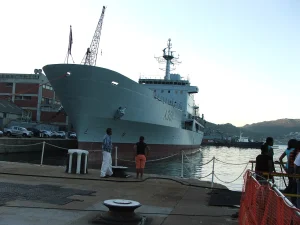
Russian Training Ship Perekop Calls at Walvis Bay as Namibian Cadets Join Four-Ocean Voyage



A Russian Navy training ship carrying naval cadets docked at Walvis Bay in late October, picking up Namibian officer trainees for the next leg of a four-ocean voyage that has already called at ports in Mozambique, Tanzania and the Seychelles. The stop was low-key and officially routine, but it fits a pattern of Russian naval outreach along Africa’s Atlantic and Indian Ocean coasts that has picked up noticeably since 2024.
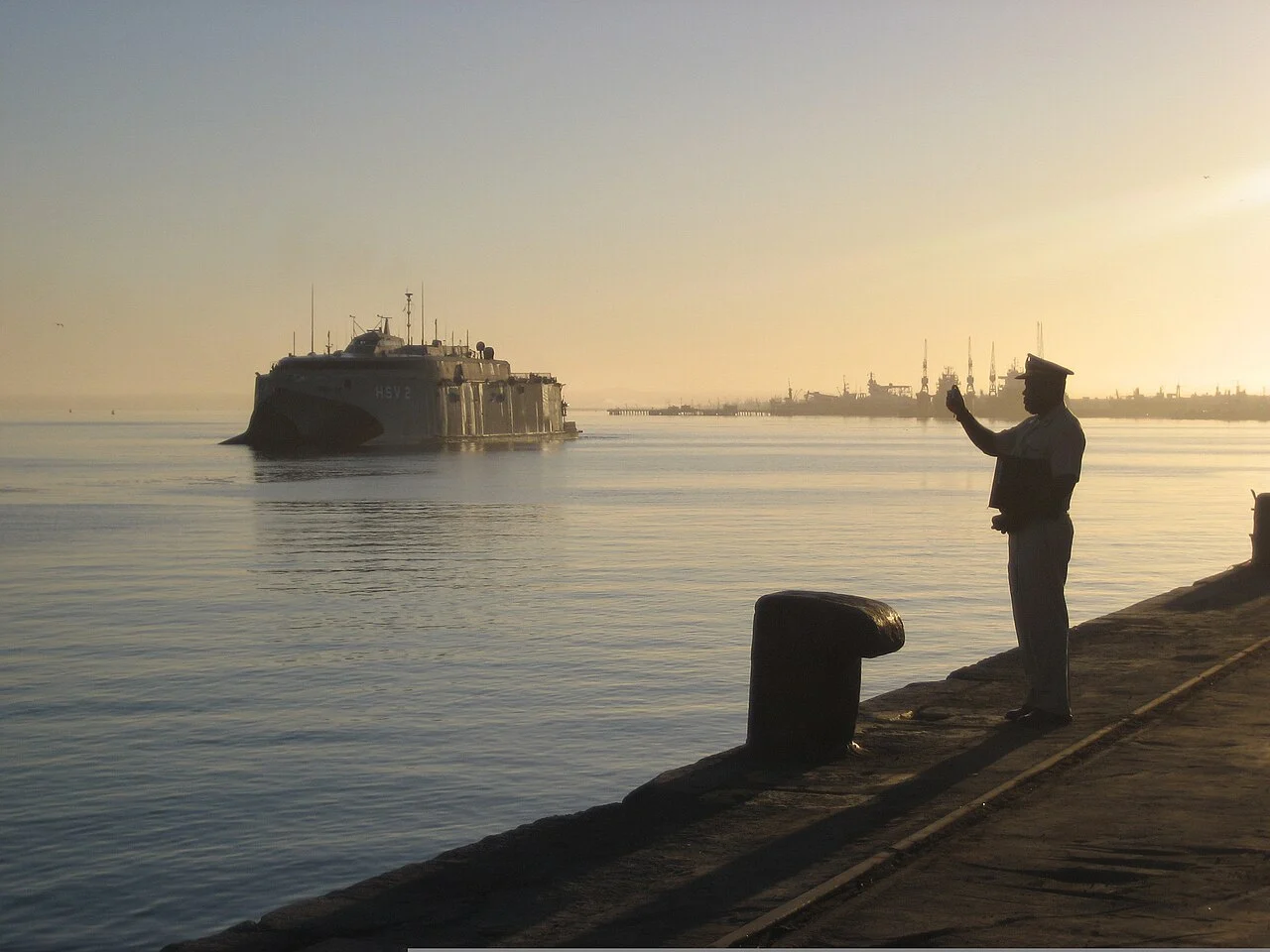
Photo: A Namibian Navy officer documents a foreign vessel’s arrival at Walvis Bay, the port that received the Russian training ship Perekop in October 2026. Credit: U.S. Navy, public domain, via Wikimedia Commons.
The Baltic Fleet training ship Perekop arrived at Walvis Bay on 20 October and stayed for several days before sailing on toward Pointe-Noire in the Republic of Congo, according to TASS and a report by Military Africa. The Russian embassy in Windhoek and Namibian Navy officers met the crew on arrival, and both sides described the call as routine rather than the product of any new defence agreement.
A Soviet-era training ship on a long African tour
Perekop is a Smolnyy-class training ship, one of two still in Baltic Fleet service, built at the Szczecin shipyard in Poland and commissioned in 1977. It displaces around 6,120 tonnes, carries two twin 76mm gun turrets and two twin 30mm anti-aircraft mounts for self-defence, and is built to carry roughly 300 cadets alongside a crew of 132 and about 30 instructors. Its role is training, not combat: cadets from the Admiral Ushakov Baltic Naval Institute use the deployment to log sea time in navigation and watchkeeping.
The current cruise left Baltiysk in July and is scheduled to run until 9 December, covering roughly 30,000 nautical miles across four oceans via the Northern Sea Route before working down Africa’s coastline. Earlier stops included Victoria in the Seychelles, Dar es Salaam in Tanzania and Maputo in Mozambique. Four Namibian cadets boarded at Walvis Bay for the Congo leg, and Military Africa reported that cadets from the Republic of Congo, Cameroon and Guinea are expected to join at later stops.
Namibia’s quiet training relationship with Moscow
Namibia has no Russian-supplied warships and no announced arms contracts with Moscow, but it does send naval personnel to Russian academies, which is why Namibian cadets were available to board Perekop on short notice. That training pipeline, rather than hardware, is the substance of the Namibia-Russia defence relationship, and it draws on goodwill dating back to Soviet support for SWAPO during Namibia’s independence struggle. Namibian social media reaction to the port call was largely positive, framing it as a continuation of an old friendship rather than a new strategic alignment.
The visit is not the first of its kind. Perekop’s sister ship Smolnyy called at Namibian, Angolan and South African ports in 2024 and returned to several African harbours in 2025. Russia has also run multinational drills off South Africa under the Mosi II framework, exercised with Egypt under Friendship Bridge, and made port calls in Tunisia and Eritrea in recent years.
Why it matters for Africa
A single cadet-training port call is a modest event, but the pattern around it is not. Russia has struggled to project combat power in Africa since the Wagner Group’s reorganisation into the Africa Corps, yet its navy keeps showing up in African ports on training and goodwill missions that cost little and carry real soft-power value. For coastal states like Namibia, hosting these visits and sending officers to Russian academies is a cheap way to diversify defence partnerships without committing to major procurement, at a time when Western navies are also increasing their own port calls and exercises along the same coastline. The European Union’s push for a more active Arctic and maritime strategy, and competing US Africa Command engagement through exercises like Obangame Express, show how contested this attention has become. None of it points to Namibia buying Russian hardware soon, but it does keep Moscow’s navy visible on a coastline where Beijing, Washington, Paris and Ankara are all competing for berths, training slots and influence.
Sources
- Military Africa: “Russian Training Ship Perekop Calls at Walvis Bay on Four-Ocean Voyage”
- TASS, Russian Ministry of Defence press service reporting on the Baltic Fleet training cruise
- Background on the Smolnyy-class training ship Perekop