Algeria’s S-300: What’s Confirmed, What Isn’t

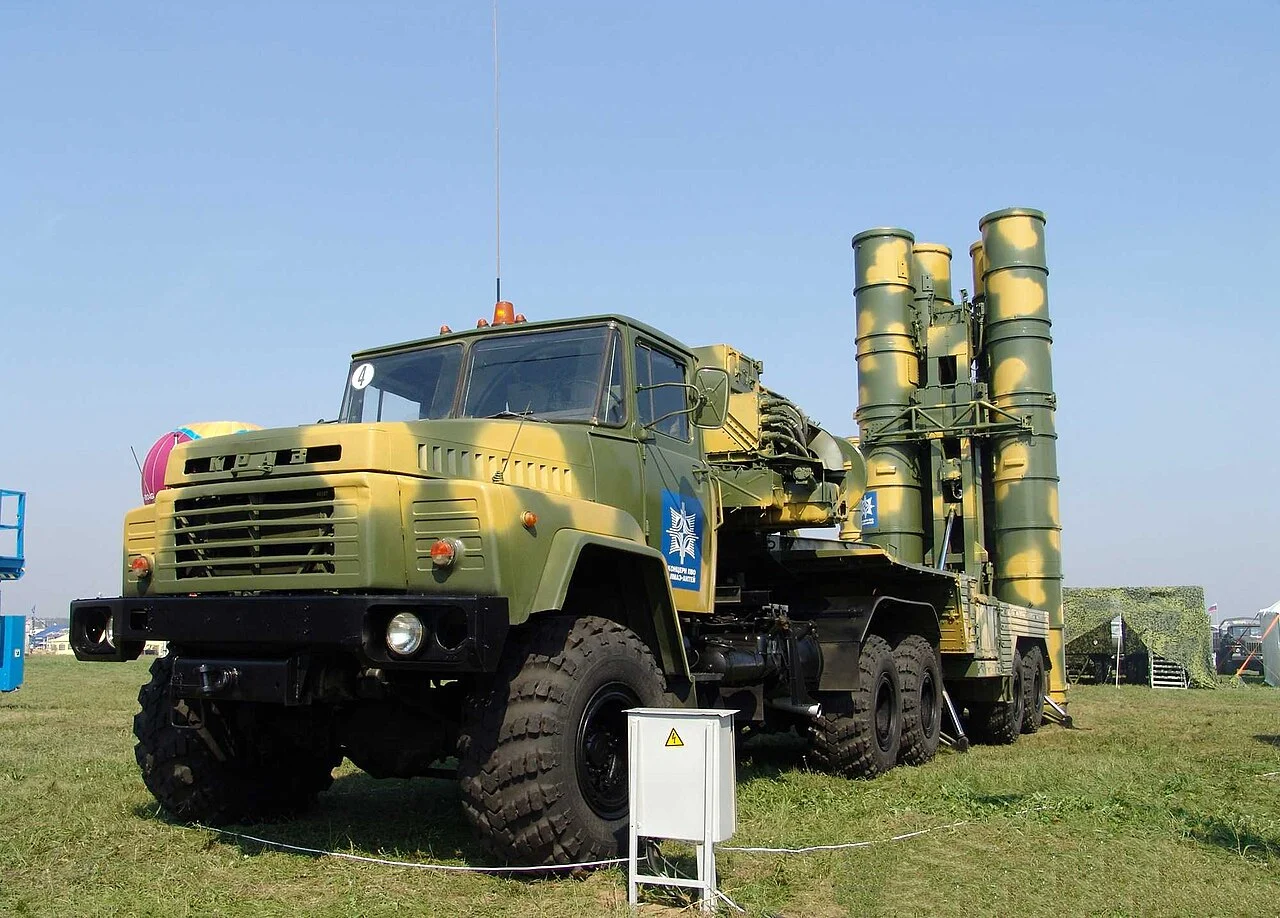


Algeria has fielded the Russian S-300PMU2 long-range air defence system since 2008, under a 2006 arms package whose exact size Algiers has never disclosed. A newer Russian system, the S-400, was reportedly shown for the first time in 2025 — but that claim remains unconfirmed by any official source. Here is what is actually verified about Algeria’s S-300.
Photo: S-300PMU2 (SA-20B Gargoyle) transporter-erector-launcher, the same variant fielded by Algeria. Credit: Vitaly V. Kuzmin, CC BY-SA 4.0, via Wikimedia Commons.
Yes, Algeria operates the S-300PMU2 Favorit (NATO reporting name SA-20B Gargoyle), and it has done so for close to two decades. The People’s National Army (ANP) received its first battalion of the system in 2008 under a Russian arms package signed in 2006, and the system has been publicly displayed at parades, photographed by commercial satellites at hardened sites, and referenced by independent trackers ever since. What Algeria has never done is confirm, officially, exactly how many battalions it fields today, what they cost as a stand-alone item, or whether a separate, newer system — the S-400 Triumf, reportedly shown at a 2025 exercise — has actually entered service. This file sets out what open sources do and do not support.
| Indicator | Detail |
|---|---|
| Country | Algeria |
| System | S-300PMU2 Favorit (NATO: SA-20B Gargoyle) |
| Manufacturer | Almaz-Antey (NPO Almaz design; MZiK production), Russia |
| Origin | Russia |
| Variant | S-300PMU2 export variant, armed primarily with the 48N6E2 missile |
| Quantity | Not officially disclosed. Contracts reportedly covered four to eight battalions (sources disagree); the number actually in service today is UNKNOWN |
| Order year | 2006 |
| Delivery | First battalion delivered 2008; further batches reportedly followed into the early 2010s, UNKNOWN in total |
| Service status | In service / operational since 2008, confirmed by repeated parade displays, satellite imagery of hardened sites and consistent independent reporting |
| Reported contract value | Not disclosed as a stand-alone figure. The S-300 order was part of a broader package reported at roughly US$7.5 billion that also covered combat aircraft, tanks and other systems |
What is the S-300PMU2, and why does it matter for Algeria?
The S-300PMU2 Favorit is the final, most capable version of the original Soviet-era S-300P family of long-range, mobile surface-to-air missile systems, developed by Almaz-Antey (then NPO Almaz) specifically for export after Russia moved on to the S-400. It combines a 64N6E2 “Big Bird” surveillance radar, 30N6E2 engagement radars and 5P85SE2/TE2 transporter-erector-launchers (TELs), each carrying four missiles, built around the 48N6E2 interceptor. Algeria was only the second export customer for the PMU2 standard, after China, and remains one of a small number of African or Middle Eastern states to field a Russian long-range strategic SAM at all — a tier otherwise dominated in the region by the US-made Patriot family.
Why did Algeria acquire the S-300?
Algeria’s S-300 purchase sits inside a much larger 2006 Russian-Algerian arms package, reported at the time at roughly US$7.5 billion, in which Moscow agreed to write off Algeria’s remaining Soviet-era debt in exchange for new orders covering combat aircraft, T-90S tanks, air defence systems and other equipment. For Algiers, the S-300PMU2 answered a specific gap: its air defence network at the time still relied heavily on the 1960s-vintage S-125 (SA-3) Pechora, which the new system was reported to partly replace at key sites. The acquisition also tracked a broader pattern — SIPRI data shows Algeria was already Russia’s third-largest arms-export customer in 2005-09 — that has continued, with Russia still supplying 39% of Algeria’s arms imports in 2021-25 even as China’s share has grown (per DefenceMENA’s own analysis of Algeria’s supplier dependence).
When did Algeria order and receive the S-300, and what happened since?
| Date | Event | Value / detail | Status | Source |
|---|---|---|---|---|
| 2006 | Contract signed as part of a broader Russia-Algeria arms package | Package reported at ~US$7.5bn across multiple systems; S-300 share not broken out | Ordered | Defense Industry Daily |
| 2008 | First S-300PMU2 battalion delivered to Algeria | Not disclosed | Delivered | Defense-Update |
| By 2012 | Induction reported, partly replacing legacy S-125 (SA-3) units at key sites | Not disclosed | In service | GlobalSecurity.org |
| 2015 | Satellite imagery shows a hardened S-300 site near completion, with further positions identified near Ouled Fayet, Reghaia and Mers El Kébir | Not applicable | In service | Bellingcat; Defense-Update |
| 5 Jul 2022 | S-300PMU2 publicly displayed at Algeria’s 60th independence anniversary military parade | Not applicable | In service | Army Recognition |
| 30 May 2025 | A separate, newer system — the S-400 Triumf — reportedly shown for the first time in a live-fire exercise (“Al-Sumoud 2025”) | Not disclosed | UNCONFIRMED by official sources; reported via a single secondary account | Army Recognition |
How many S-300 systems does Algeria actually have?
This is the point where open sources diverge most, and Algeria’s own Ministry of National Defence has never published a figure. Reporting from the mid-2000s put the original order at either four or eight battalions; a 2022 Arabic-language account cited eight systems as having been delivered by 2011. None of these figures comes from an Algerian, Russian or independent verification source that itemises deliveries battalion by battalion, and DefenceMENA’s own regional air-defence survey lists Algeria’s in-service S-300 count as UNKNOWN — “at least one battalion by 2008; further batches reported, not independently itemised” (see Which African Countries Operate Advanced Air Defence Systems). What is independently corroborated is the existence of multiple hardened sites — around Algiers (Ouled Fayet, Reghaia) and at the naval base of Mers El Kébir in the west — consistent with more than one operational unit.
How much did Algeria’s S-300 cost?
Contract value was not publicly disclosed as a stand-alone figure. The S-300 order was bundled into the broader 2006 package reported at roughly US$7.5 billion, which also covered dozens of combat and trainer aircraft, around 300 T-90S tanks and other systems; dividing that total by any assumed unit count would not produce a meaningful per-system price, since the package’s composition across systems was never itemised in public reporting. No subsequent Algerian or Russian disclosure has broken out a specific S-300 price.
Which variant does Algeria operate, and how does it differ from Egypt’s or Iran’s systems?
Algeria’s system is the S-300PMU2 Favorit, armed principally with the 48N6E2 interceptor — the version with a redesigned, heavier warhead intended to give the system some capability against short-range ballistic missiles as well as aircraft. This is the same PMU2 standard Iran received from Russia in 2016 (four battalions, delivery completed that October per TASS). It is a different design lineage from the system reportedly operated by Egypt, publicly described since 2026 as the S-300VM “Antey-2500” (NATO SA-23) — a derivative of the army-oriented S-300V family, developed by a separate design bureau, not an export version of the PMU2 Algeria fields.
| Parameter | Value | Source / note |
|---|---|---|
| Primary interceptor | 48N6E2 (backward-compatible with earlier 48N6E and 5V55R rounds) | Army Recognition, GlobalSecurity.org |
| Engagement range | Approx. 195-200 km against aerial targets | Manufacturer-derived figures reproduced by Army Recognition, GlobalSecurity.org; exact figures vary slightly by source |
| Engagement altitude | Approx. 10 m to 27-30 km | Open-source fact-sheet compilations; figures vary modestly by source |
| Missile speed | Approx. Mach 6-8.5 | Open-source compilations |
| Engagement radar | 30N6E2 | Manufacturer designation |
| Surveillance radar (typical pairing) | 64N6E2 “Big Bird” | Manufacturer designation |
| Launcher | 5P85SE2 (towed) / 5P85TE2 (self-propelled), 4 missiles per TEL | Manufacturer designation |
| Secondary role | Limited capability against short-range ballistic missiles, via the 48N6E2’s redesigned warhead | Manufacturer/open-source consensus |
How long has it been in service, and how has it performed?
Algeria’s S-300PMU2 has been in service for close to 17 years without any verified combat engagement. No independent, dated source in this research documents the system firing on a hostile target, so there is no operational record — positive or negative — to assess. What can be said is that the system has remained visible and apparently active throughout: it featured in the 2022 independence-day parade, its sites have been tracked by open-source satellite analysts since at least 2015, and Algeria has continued to invest in layering it with newer systems, most notably the Pantsir-S1 for point defence and the Buk-M2E for medium-range coverage (the latter’s presence confirmed by the Algerian army’s own El Djeich magazine in 2017, per DefenceMENA’s advanced air-defence survey). Separately, and distinctly from the S-300 itself, a single secondary report places a newer S-400 battery on display at a May 2025 exercise — a claim no official Algerian, Russian or independent primary source has confirmed as of this writing.
Is the S-300 suited to Algeria’s operating environment?
No manufacturer environmental-qualification data specific to the S-300PMU2’s performance in Algeria’s climate was identified in this research, and DefenceMENA found no Algerian official statement addressing desert-heat, dust or coastal-humidity performance directly. What is known is where the system is deployed: hardened sites near Algiers on the Mediterranean coast and at the naval base of Mers El Kébir in the west, both coastal rather than deep-desert locations, which would expose the system’s radars and electronics to salt-air corrosion risk typical of any coastal SAM deployment rather than to the sand and extreme heat challenges documented for systems fielded further south or in the Sahara. No source reviewed makes specific claims about how the system has coped with either environment in Algeria, so this remains an evidence gap rather than a documented strength or weakness.
Strengths
- Long, genuine strategic reach. At roughly 200 km, the S-300PMU2’s engagement envelope significantly exceeds medium-range systems such as the Buk-M2E that complement it in Algeria’s layered network.
- Limited anti-ballistic-missile capability. The 48N6E2’s redesigned warhead gives Algeria some protection against short-range ballistic missiles, not just aircraft and cruise missiles — a capability most regional neighbours’ air-defence inventories lack.
- Backward-compatible logistics. The system can fire earlier 48N6E and 5V55R rounds alongside the 48N6E2, which can ease munitions planning relative to a fully new missile family.
- Mature, two-decade-plus operating base. Nearly 17 years of continuous fielding gives Algerian crews and maintainers a long track record with the system, even without verified combat use.
Limitations
- No independently verified unit count. Without an official Algerian disclosure, analysts cannot assess how many battalions are actually operational today, which limits any independent assessment of real coverage depth.
- Relative age against newer Russian systems. The PMU2 standard predates the S-400 Triumf that Russia itself has since fielded and that Algeria has reportedly begun receiving separately; it is not Russia’s current-generation system.
- No verified combat record. Nearly two decades in service have produced no documented intercept or engagement, so its real-world performance against modern threats is untested in Algerian hands.
- Continued dependence on Russian technical support. As with other Algerian-Russian programmes, sustainment relies on continued access to Russian spares, training and software support, a relationship that has not always run smoothly elsewhere in Algeria’s arsenal (Moscow’s CAATSA-linked difficulties contributed to the cancellation of Algeria’s own Su-35 negotiations with other suppliers in different programmes).
What do neighbouring and regional countries operate?
| Country | System | Variant | Status | Approx. quantity | Supplier | Order year | Delivery status |
|---|---|---|---|---|---|---|---|
| Algeria | S-300PMU2 | SA-20B Gargoyle | In service / operational | Not disclosed (reportedly 4-8 battalions ordered) | Russia | 2006 | First battalion 2008; further batches not independently itemised |
| Iran | S-300PMU2 | SA-20B Gargoyle | In service / operational | 4 battalions | Russia | 2007 (original); 2015 (revised) | Completed October 2016 |
| Egypt | S-300VM “Antey-2500” (distinct design from the PMU2) | SA-23 | Rumoured since 2014; display reported 2026 | Not disclosed | Russia | 2014 (reported) | UNCONFIRMED by official sources |
| Saudi Arabia | Patriot (different system family) | PAC-2 / PAC-3 / PAC-3 MSE | In service / operational since 1991 | Multiple batteries, not fully disclosed | United States | Multiple orders since the 1990s | Ongoing; see DefenceMENA’s Saudi Arabia Patriot file |
| Morocco | No S-300-family system; Patriot (PAC-3 MSE reported) under negotiation | — | Approved for possible sale (2021); field trials reported 2025 | Not disclosed | United States | 2021 (Pentagon approval) | Not yet operational; see DefenceMENA’s PAC-3 MSE Gulf operator file |
Algeria and Iran are the clearest S-300PMU2 peers in this region, both having received the same export standard from Russia within roughly a decade of each other. Egypt’s reported long-range system is a different Russian design lineage entirely, while most of the Gulf states and Morocco have built their long-range layer around the US Patriot family instead — making Algeria one of very few regional states to combine a Russian-sourced strategic SAM with a mostly Russian-and-Chinese broader arsenal (for more on that supplier mix, see DefenceMENA’s analysis of Algeria’s defence-supplier dependence and Inside Algeria’s Russian-Built Arsenal).
What are the closest global alternatives?
- Patriot PAC-2/PAC-3 (United States, Raytheon/Lockheed Martin). The dominant long-range SAM family in the Gulf and North Africa outside Algeria; publicly documented unit and interceptor costs exist for some tranches (see DefenceMENA’s Saudi Arabia and PAC-3 MSE files), unlike the undisclosed Algerian S-300 package price.
- S-400 Triumf (Russia, Almaz-Antey). The direct successor system, offering a longer engagement envelope and reportedly already present in small numbers in Algeria per a single unconfirmed report — making it a complement to, not a replacement for, the S-300PMU2 fleet if confirmed.
- HQ-9 family (China, CPMIEC). A broadly comparable long-range SAM that Algeria has also been reported, separately and without independent confirmation, to be evaluating alongside its Chinese-sourced HQ-17 short-range systems.
Is there a Turkish alternative?
Türkiye’s domestic long-range layer, SİPER, addresses the same operational requirement as the S-300PMU2 — area air defence against aircraft, cruise missiles and some ballistic threats — but the two systems are not yet comparable on track record. SİPER-1 only completed its own battery acceptance firing and entered Türkiye’s “Steel Dome” (Çelik Kubbe) air-defence network in January 2026, with a SİPER-2 variant reportedly reaching full operational capability in June 2026 testing against a manoeuvring target (see DefenceMENA’s coverage of a SİPER Ürün-2 in-flight retargeting test). Export reporting exists — one outlet has referenced an unnamed foreign buyer, and Bangladesh’s air force has publicly expressed interest — but no contract, buyer identity or price has been officially confirmed as of this writing, and no African or Middle Eastern operator has been identified. Algeria’s S-300PMU2, by contrast, has been in continuous service since 2008. No directly comparable public unit price was identified for either system, so a cost comparison is not possible; the practical difference today is operational maturity and export track record, not a documented performance gap.
What could replace or complement Algeria’s S-300 in future?
The clearest signal of what comes next is already visible in Algeria’s own recent acquisitions rather than in any announced S-300 replacement plan: a single, unconfirmed report places a Russian S-400 battery in the country as of May 2025, and Algeria has separately been reported — again without independent confirmation — to be evaluating Chinese HQ-9B long-range systems alongside its existing HQ-17 short-range inventory. Taken together with Algeria’s confirmed move into Su-57E fifth-generation fighters (see DefenceMENA’s Algeria Su-57 fleet file), the pattern points toward the S-300PMU2 being layered with, rather than replaced by, newer systems in the near term, with its eventual retirement timeline undisclosed.
Frequently asked questions
Does Algeria have the S-300?
Yes. Algeria has operated the S-300PMU2 Favorit since its first battalion was delivered in 2008, under a contract signed in 2006.
Does Algeria have the S-400?
Unconfirmed. A single secondary report places an S-400 Triumf on display at a May 2025 live-fire exercise, but no official Algerian, Russian or independent primary source has confirmed this as of this writing.
How many S-300 systems does Algeria have?
Not officially disclosed. Reported order sizes from the 2006 contract range from four to eight battalions; the number currently operational is UNKNOWN.
What is the difference between the S-300 and the S-400?
The S-400 Triumf is Russia’s newer-generation long-range SAM, with a longer reported engagement envelope than the S-300PMU2 that Algeria has fielded since 2008; the two are related but distinct systems, and any S-400 presence in Algeria remains unconfirmed.
Why did Algeria buy the S-300?
It was acquired as part of a broader 2006 Russian arms package, in a context where Algeria’s existing air defence network relied heavily on 1960s-era S-125 systems that the S-300PMU2 partly replaced.
Is there a Turkish alternative to the S-300?
Türkiye’s SİPER addresses a comparable long-range air-defence requirement but only entered domestic service in January 2026, with no confirmed export customer in Africa or the Middle East as of this writing.
A note on the numbers
Algeria has never officially disclosed how many S-300PMU2 battalions it operates, what they cost as a stand-alone item, or the current status of a reported S-400 deployment. The figures in this file — four to eight battalions ordered in 2006, a roughly US$7.5 billion broader arms package, and a single-source S-400 sighting in 2025 — come from open, independent reporting rather than Algerian or Russian government statements, and are presented with that caveat throughout. Where a figure could not be independently corroborated, this file labels it UNKNOWN rather than estimating it.
Sources
- Defense Industry Daily – “Algerian Arms Deal Brings Russia $7.5 Billion, Gas Market Leverage”
- Defense-Update – “Satellite Imagery Uncovers New S-300 Sites in Algeria”
- GlobalSecurity.org – Algeria Air Force Modernization
- Bellingcat – “Algeria’s Hardened S-300 Site Almost Complete” (29 July 2015)
- Army Recognition – Algeria displays S-300PMU2 at military parade (5 July 2022)
- Army Recognition – Algeria reportedly deploys S-400 for the first time (30 May 2025)
- The Moscow Times – Russia delivers S-300 missiles to Iran (2016)
- Army Recognition – S-300PMU2 (SA-20B Gargoyle) technical profile
- GlobalSecurity.org – S-300PMU2 Favorit (SA-20 Gargoyle)
- SIPRI Arms Transfers Database
- DefenceMENA – Which African Countries Operate Advanced Air Defence Systems
- DefenceMENA – Can China Loosen Russia’s Grip on Algeria’s Armed Forces?
- DefenceMENA – Algeria’s Su-57 Fleet Explained
- DefenceMENA – SİPER Ürün-2 In-Flight Retargeting Test