The Angolan Navy has taken delivery of six ANAVIA HT-100 NAVAL unmanned helicopters from the UAE’s EDGE Group, giving the force its first dedicated unmanned aviation capability. The drones are earmarked for Angola’s three new BR 71 Mk II corvettes, part of a roughly €1 billion fleet-modernisation programme with France’s CMN and Abu Dhabi Ship Building.
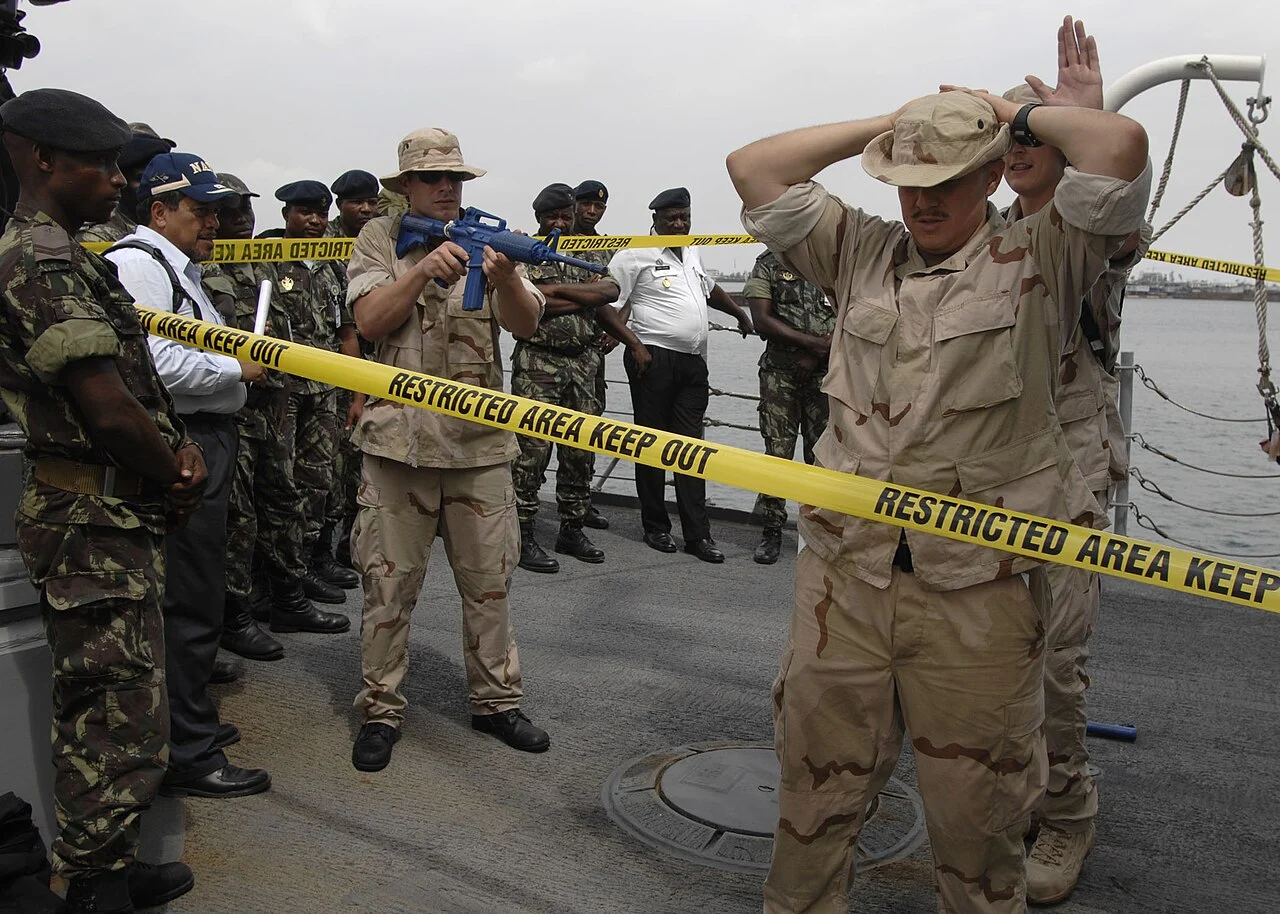
Photo: Angolan Navy personnel take part in a maritime security demonstration during Africa Partnership Station, Luanda, 2011 (file photo). Credit: U.S. Navy photo by Mass Communication Specialist 1st Class Darryl Wood, Public domain, via Wikimedia Commons
The six unmanned helicopters completed Factory Acceptance Trials at ANAVIA’s facility in Bilten, Switzerland, between 24 and 28 August, attended by a delegation from the Angolan Navy and state procurement agency Simportex, before being handed over in early September. Naval News reported that the aircraft will be split two per ship across three new corvettes now entering service, extending each vessel’s sensor reach well beyond visual range.
Six drones, three corvettes
The HT-100 NAVAL is a coaxial, intermeshing-rotor unmanned helicopter — a design known as a synchropter — built by Swiss manufacturer ANAVIA, in which EDGE Group acquired a majority 52% stake in late 2023. The naval variant has a maximum take-off weight of 120 kg, can carry payloads of up to 60 kg, and is rated for a mission range of 600 km. Endurance varies with payload: roughly one hour carrying a full 51 kg sensor load, extending to around six hours with a lighter 14 kg package. Using an encrypted mesh IP data link, the aircraft can stream high-definition video back to its host ship from up to 200 km away.
Each of Angola’s three BR 71 Mk II corvettes will operate two of the systems, giving commanders persistent overwatch of Angola’s exclusive economic zone in the Gulf of Guinea without needing to launch a manned helicopter or divert the ship itself. “The successful completion of the Factory Acceptance Trials marks an important milestone” in the programme, EDGE Group’s Khaled Al Zaabi said of the handover.
A corvette programme years in the making
The HT-100 delivery is a small but symbolically significant piece of a much larger Angolan naval build-up. The BR 71 Mk II — a further development of the Baynunah-class hull lineage — is being built jointly by Abu Dhabi Ship Building and France’s Constructions Mécaniques de Normandie under a contract worth roughly €1 billion covering three corvettes. The first of class, NRA Ekuikui II, was launched at CMN’s Cherbourg yard on 4 March 2026 and is expected to be delivered to Angola around October 2026, with sea trials for the embarked UAVs to follow shortly after. All three vessels are due in service by 2027.
The corvette programme sits alongside a broader push to build domestic naval capacity: Angola opened the Lobinave shipyard in January 2026, intended to support local assembly and maintenance work as the fleet grows. Until now, the Angolan Navy has relied largely on patrol craft and older Soviet- and Portuguese-era vessels for coastal defence; the BR 71 Mk II corvettes, backed by organic unmanned aerial reconnaissance, represent a substantial jump in blue-water and maritime-domain-awareness capability.
Why it matters for Africa
Angola’s investment reflects a wider trend among Gulf of Guinea and Southern African states toward layered maritime-surveillance packages rather than ships alone. Piracy, illegal fishing and oil-infrastructure security remain persistent concerns along Angola’s roughly 1,600 km coastline, and unmanned systems offer a way to extend patrol coverage without proportionally increasing crewed flight hours or fuel costs — an attractive proposition for African navies operating on constrained budgets.
The deal also illustrates the growing reach of Gulf defence conglomerates into African procurement. EDGE Group, formed in 2019 to consolidate dozens of Emirati defence firms, has been expanding aggressively into African markets, and the Angola contract — spanning shipbuilding, unmanned systems and local industrial participation through Lobinave — is one of its most complete African packages to date. As DefenceMENA reported from AAD 2026, Gulf, Turkish and Chinese suppliers are increasingly competing for African naval and unmanned-systems contracts once dominated by European and Russian yards — a contest in which Angola’s HT-100 order marks a clear win for Abu Dhabi.