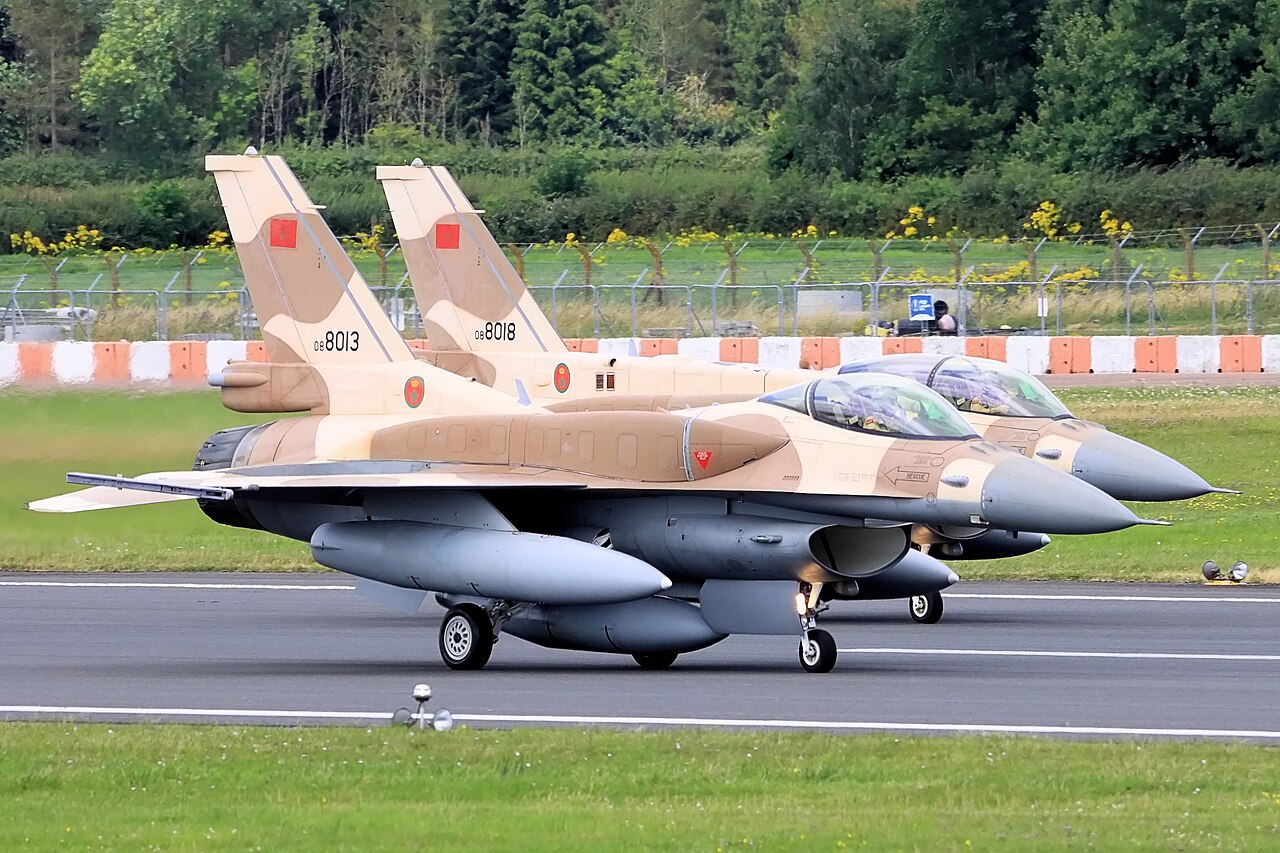
Morocco military modernisation has moved from announcements to deliveries and factory floors in the past few weeks. The Royal Moroccan Air Force has received 19 of 24 AH-64E Apache helicopters, its first new F-16 Block 72 has flown, and the Marrakech Air Show produced a guided-weapons contract with the UAE group EDGE and an Indian plant announcement. This article separates what is delivered, what is contracted and what is only planned, covering drones, air defence and local production in turn.
What Happened: Key Facts at a Glance
Four developments between early October and early November define the current picture. Two concern aircraft deliveries, one is a weapons contract, and two are industrial agreements of very different maturity.
| Item | Status | Detail |
|---|---|---|
| AH-64E Apache | Delivered: 19 of 24 | Six more received; ribbon-cutting on 26 October at 1st BAFRA, Salé |
| F-16 Block 72 | First flight made | 25 aircraft approved in March 2019; production expected to end by December |
| Guided weapons | Contracted | EDGE to supply DS-16 and THUNDER P-31 for the UCAV fleet |
| Small arms and aero engines | Memorandum only | Exploratory; no Moroccan partner named |
| Tata WhAP plant | Reported established | 20,000 m2 site; first vehicle handed over in December 2025 |
| MKU plant, Nouasser | Announced | Electro-optics and armour; investment and timeline not disclosed |
The statuses matter. A delivered helicopter and a memorandum of understanding are not the same kind of fact, and the sections below keep them apart.
Why Morocco Military Modernisation Matters for North Africa
Morocco is the only African operator of the AH-64E, and with Egypt one of only two African Apache users, according to defenceWeb. That reporting also puts the latest annual defence budget at $15.3 billion, a rise of 17.7% year on year. Rabat does not publish a line-by-line procurement list, so most totals come from supplier announcements and trade press.
Global Firepower’s latest edition ranks Morocco 56th of 145 countries and Algeria 27th, with Egypt at 19th and Libya at 80th (Global Firepower). The index is a statistical estimate, not a measure of capability, so it frames the comparison without settling it.
The common thread in the recent deals is localisation. Foreign firms are being asked to assemble, integrate or manufacture on Moroccan soil, not only to ship finished equipment.
Who Is Involved: Governments, Forces and Companies
The buyers are the Royal Moroccan Air Force and the Royal Moroccan Army, with the Administration of National Defence (ADN) as the contracting body in the EDGE agreements. The suppliers span several blocs, which is typical of how Morocco has built its inventory. For a wider view of the market, see the site’s guide to arms suppliers to Africa.
- United States: Lockheed Martin (F-16 Block 72) and Boeing (AH-64E).
- United Arab Emirates: EDGE, with guided weapons and a local-production memorandum.
- India: Tata Advanced Systems (WhAP 8×8) and MKU Limited (electro-optics and armour).
- Turkey, Israel and China: drones, as listed by defenceWeb (Bayraktar, Heron and Hermes 900, Wing Loong-2).
- France: Ground Master 400 radars and ten H225M transport helicopters ordered in November 2025.
Drones: What Is Confirmed and What Is Not
defenceWeb lists the Royal Moroccan Air Force’s drone fleet as Heron, Hermes 900, Wing Loong-2, Bayraktar TB2 and Bayraktar Akinci. Fleet sizes have not been publicly disclosed by the Moroccan authorities, and the sources reviewed give no reliable current count for any type except the older TB2 purchase.
Atalayar, citing the Moroccan outlet Hespress, reported that Morocco bought 19 TB2 in 2021 and was expected to acquire the Akinci in February 2025. It describes the Akinci as having a 20-metre wingspan and a payload of 1,500 kg. Detailed operator profiles are in the site’s guides to the Bayraktar TB2 in Africa and the Bayraktar Akinci in Africa.
The clearest new fact is the weapons side. Under the EDGE contract signed at the Marrakech Air Show, the DS-16 guided-glide weapon (23 kg, range up to 15 km) and the THUNDER P-31 precision-guided munition will be integrated across the unmanned combat aircraft fleet. The P-31 converts a Mk 81 general-purpose bomb, with a stated range of up to 10 km from drones and 20 km from high-speed, high-altitude platforms (defenceWeb).
Trade-press headlines also refer to a Baykar facility in Morocco. The sources reviewed for this article carry no site, capacity or start date for it, so it is not treated as confirmed.
Air Defence: Reported Systems and Their Limits
Air defence is the least transparent part of Morocco military modernisation. defenceWeb’s listing groups the systems by range, but it does not say, for each one, whether it is delivered, ordered or only reported. Morocco does not publish an inventory, so every line below carries the label “reported”.
| Tier | Systems listed by defenceWeb | Status |
|---|---|---|
| Long range | HQ-9B, Barak 8, Patriot PAC-3 | Reported; contract details not in sources reviewed |
| Medium range | SPYDER, MICA VL, Sky Dragon 50 | Reported |
| Short range | Stinger, Mistral | Reported |
| Radar | Ground Master 400 (France) | Reported |
The mix of Chinese, Israeli, French, European and American designs would be unusual in a single inventory. It is also why integration, not the number of launchers, is the open question. No programme for counter-drone defence is documented in the sources reviewed, which is notable given how widely small drones are now used in the region.
Local Production: Plants, Memoranda and Status
Three separate local-production stories are circulating, and they sit at three different stages.
Tata Advanced Systems. defenceWeb describes a 20,000 m2 factory for the WhAP 8×8, called the first overseas defence factory of a private Indian company. It is tied to a 2024 agreement for 150 vehicles, and the first WhAP was handed to the Royal Moroccan Army in December 2025. Tata’s stated figures are a 24-tonne amphibious vehicle, a crew of three plus nine to eleven infantry, 600 hp, a 100 km/h road speed, a 500 km range and STANAG 4569 protection from Level 1 to Level 4. Production of a lighter LAMV is described only as planned, and export of Moroccan-built vehicles is speculation, not a deal (defenceWeb).
MKU Limited. The company announced on 7 October a plant in the SGZID zone at Nouasser for electro-optics (Netro Optronics) and armour (Kavro Protection), intended as an export base for Africa. Location detail, scale, timeline and investment have not been disclosed, and MKU said they would follow “in due course” (defenceWeb).
EDGE. The second EDGE agreement is a memorandum with the ADN to identify local production opportunities for small arms and aeronautical engines through Moroccan partners. It names no partner, product or production commitment.
Combat Aircraft and Helicopters: Deliveries and Orders
The Apache programme is the most advanced. Morocco requested 24 helicopters plus 12 options in November 2019, in a potential deal worth $1.5 billion, then ordered 24 in June 2020 under a $1.3 billion contract. The first six arrived by ship in March 2025, deliveries had been due to start in 2024, and 19 have now been received.
The F-16 Block 72 order covers 25 aircraft approved by the US State Department in March 2019 at $3.7 billion. They are to carry the APG-83 AESA radar, the Joint Helmet Mounted Cueing System, AIM-120C-7 AMRAAM missiles, Paveway II bombs and GBU-39/B small-diameter bombs. Lockheed Martin announced the first flight on 6 October and expects production to conclude by December (defenceWeb).
The new jets will replace Mirage F1 and F-5E/F aircraft. The existing fleet is 23 F-16C/D Block 50/52 jets received in 2011 and 2012, one of which was lost over Yemen, with an upgrade to F-16V standard approved in 2019 at $985.2 million. A full type-by-type breakdown is in the guide to Morocco’s air force aircraft.
What to Watch Next
Several milestones will show whether the programme keeps its pace. None has a confirmed date in the sources reviewed.
- The first F-16 Block 72 delivery to Morocco, after production ends.
- Delivery of the remaining five Apaches, which would complete the order.
- Whether the EDGE memorandum names Moroccan partners and products.
- The scale, timeline and investment for the MKU plant at Nouasser.
- Any firm decision on LAMV production at the Tata site.
- An official statement on Akinci quantities and on any Baykar facility.
Frequently Asked Questions
What does Morocco military modernisation include?
It covers new F-16 Block 72 fighters, AH-64E Apache helicopters, armed drones, reported layered air defence and local manufacturing agreements with Indian and Emirati firms. Deliveries are under way for the Apaches, while the F-16s have flown but not yet been delivered. Local plants range from an established vehicle factory to announced projects.
How many Apache helicopters has Morocco received?
Morocco has received 19 of the 24 AH-64E Apaches it ordered in June 2020, after six more arrived and were marked at a ceremony on 26 October. The first six came by ship in March 2025. Five remain to be delivered, and no completion date has been published.
Which drones does Morocco operate?
defenceWeb lists the Heron, Hermes 900, Wing Loong-2, Bayraktar TB2 and Bayraktar Akinci. Morocco has not publicly disclosed fleet sizes. The only figure in the sources reviewed is the 19 TB2 reportedly bought in 2021, so current totals should be treated as unconfirmed.
Is Morocco building military equipment locally?
Yes, in part. Tata Advanced Systems has a reported 20,000 m2 factory for the WhAP 8×8 and has handed over the first vehicle. MKU announced an electro-optics and armour plant at Nouasser, and EDGE signed a memorandum to explore small arms and engines. Only the Tata plant is reported as established.
Sources
- defenceWeb: Morocco receives another six AH-64 Apaches
- defenceWeb: First Moroccan F-16 Block 72 takes to the air ahead of deliveries
- defenceWeb: EDGE signs agreements with Morocco for guided weapons and small arms
- defenceWeb: Tata Advanced Systems Limited gaining a foothold in Africa
- defenceWeb: India’s MKU to establish electro-optics and armour manufacturing facility in Morocco
- Atalayar: Morocco will acquire new Turkish Bayraktar drones
- Global Firepower: country ranking listing