Which African Countries Manufacture Their Own Weapons?



South Africa designs and builds its own artillery and attack helicopters. Nigeria has signed three multi-billion-dollar industrial pledges since mid-2025 but has yet to deliver a locally built weapon in volume. Most of the continent still imports almost everything it fires. DefenceMENA sorts eleven African states into what they actually design, license, assemble or merely promise.
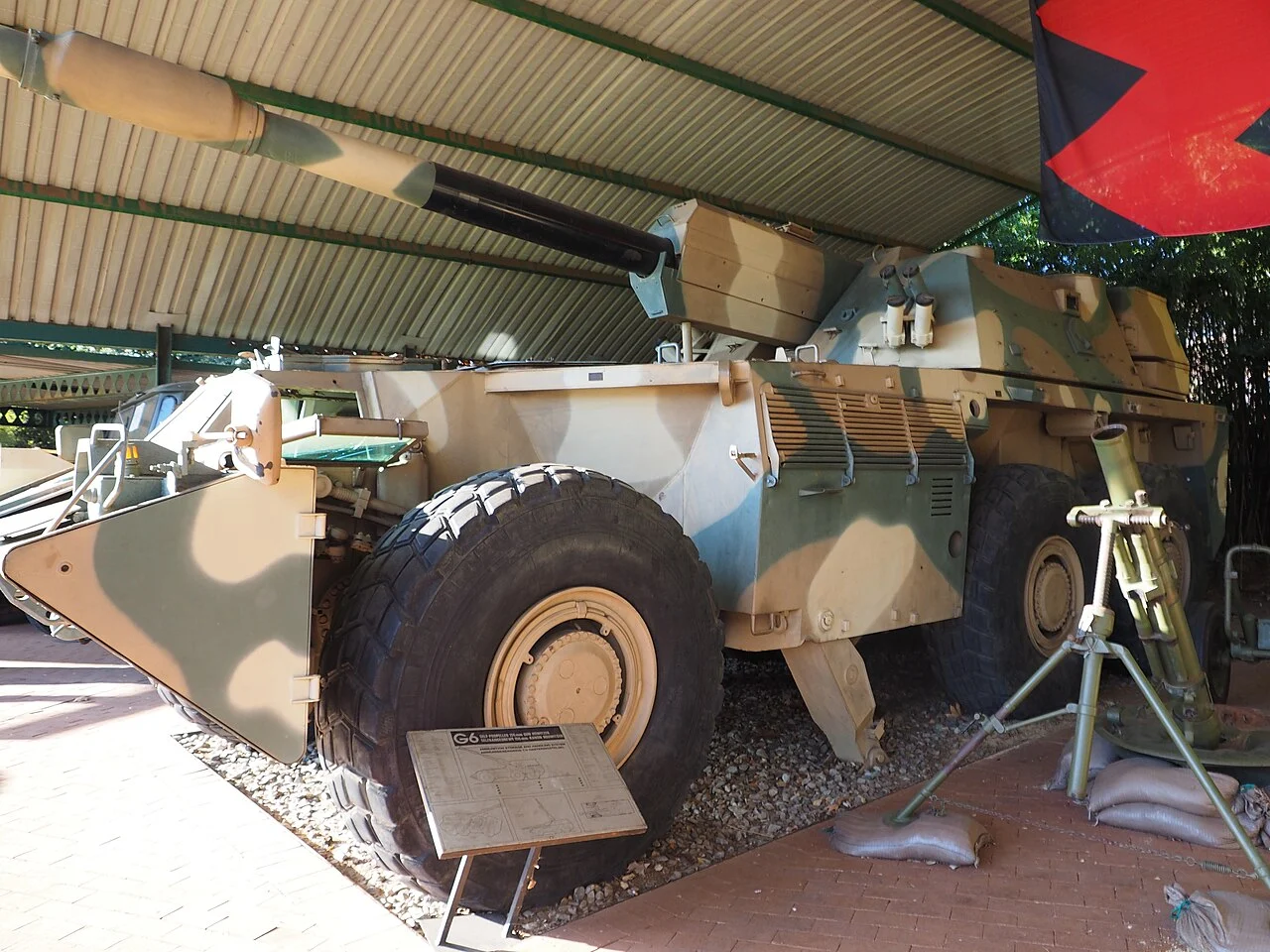
Photo: The G6 self-propelled howitzer, indigenously designed by South Africa’s state-owned Denel, on display at the South African National Museum of Military History. Credit: Nick-D, CC BY-SA 4.0, via Wikimedia Commons.
Africa Defence Exhibition (AFRIDEX) 2026 closed in Lagos on 29 October with Nigeria, Rwanda, Egypt, Morocco and the United Arab Emirates all announcing new local-production deals within days of each other. The announcements renewed a question that recurs every time an African government talks about “local defence manufacturing”: which countries actually make their own weapons, and which are only assembling, licensing or signing memoranda of understanding that have not yet produced hardware? The short answer is that fewer than a handful of African states design and build complete weapon systems from scratch. A larger group licenses or assembles foreign designs, sometimes with genuine local content and sometimes with very little. The rest of the continent, including some of its biggest defence budgets, imports almost everything it fires, flies or drives.
| Country | Flagship programme(s) | Classification | Status | Source |
|---|---|---|---|---|
| South Africa | Denel G5/G6 howitzers, AH-2 Rooivalk attack helicopter; Paramount Group Marauder/Mbombe armoured vehicles (private) | Indigenous design | OPERATIONAL (howitzers, Rooivalk in SAAF service); Paramount vehicles EXPORTED | Denel/SAAF museum holdings; Janes, defenceWeb, company statements |
| South Africa | Rheinmetall Denel Munition (RDM) 155mm ammunition | Joint venture (51% Rheinmetall / 49% Denel) | OPERATIONAL, exporting globally | Rheinmetall, defenceWeb |
| Egypt | Abrams tank hull/turret co-production at AOI’s Factory 200 | Licensed production | OPERATIONAL, long-running US FMS co-production arrangement | AOI, longstanding US defense co-production record |
| Egypt | AOI–Vinicius Group (Nigeria) MoU; AOI–China ELINC/El Shadow Wings MoUs; AOI–Pakistan GIDS deal | Licensed/technology-transfer partnerships (outbound) | CONTRACTED (MoU stage); no delivered hardware disclosed | Amwal Al Ghad, Daily News Egypt, Military Africa |
| Algeria | Fuchs 2 6×6 transport vehicle, built by Rheinmetall Algeria (Ain Smara) | Joint venture / licensed production | OPERATIONAL historically (120 units in 2018, the last year with a confirmed output figure); current rate NOT CONFIRMED | Algérie-Éco, Wikipedia-sourced company history, no 2026 output figure found |
| Nigeria | Defence Industries Corporation of Nigeria (DICON): ammunition, small arms; $2bn DICON–SP Offshore JV (Jul 2025); HAVELSAN–DICON MoU (Oct 2026); AOI–Vinicius MoU (Jun 2026) | Local assembly / licensed production, mostly at MoU or early-build stage | CONTRACTED (JVs signed); DELIVERED hardware NOT CONFIRMED as of this run | DICON statements, ThisDay, Arise News, HAVELSAN, DefenceMENA reporting |
| Nigeria | Nigerian Air Force Tsaigumi ISR drone (in-house design per NAF) | Indigenous design (NAF claim); one report alleges foreign (Portuguese) design assistance | OPERATIONAL (inducted 2018, expanded 2023); design-origin claim DISPUTED | Nigerian Air Force statements vs. The Defense Post/military.africa reporting |
| Nigeria | Arridex Group ADX-Barra 100/200 autonomous surface vessels, built with DICON | Local assembly (company claims indigenous design) | UNVEILED, no specifications or customer disclosed; EVALUATED | defenceWeb, DefenceMENA reporting |
| Morocco | EDGE Group (UAE) MoU with Administration of National Defence: CARACAL small arms, POWERTECH aero-engines | Licensed production (proposed) | PROPOSED; MoU is non-binding, names no factory or investment figure | Military Africa, Army Recognition, DefenceMENA reporting |
| Rwanda | Rwanda Engineering and Manufacturing Corporation (REMCO), Kigali Special Economic Zone | Local assembly (state-owned) | OPERATIONAL for general engineering/machining; arms-specific output (vehicles, ammunition, drones) REPORTED by one outlet, NOT independently confirmed | The New Times (Rwanda), Military Africa, Zambian Observer (single-source for weapons claim) |
| Uganda | NEC-Streit (U) Ltd: Tornado 4×4 armoured vehicles, two plants (Magere 2018, Nakasongola 2022) | Joint venture (National Enterprise Corporation / Streit Group, UAE) | OPERATIONAL, vehicles showcased and in UPDF service | Uganda Ministry of Defence, Janes, ADF Magazine, military.africa |
| Kenya | Kenya Ordnance Factories Corporation (KOFC): 9mm/7.62×51/5.56×45 ammunition; Ruiru small-arms factory (rifles) | Licensed production (legacy) / local assembly | OPERATIONAL, loss-making per Auditor-General reports; expansion at Eldoret REPORTED, undated | Kenyan Auditor-General reports, Janes, Kenyans.co.ke |
| Ethiopia | Homicho Ammunition Engineering Complex, Gafat Armament Engineering Complex (both under state-owned METEC) | Licensed/legacy-calibre ammunition production | OPERATIONAL; PM Abiy Ahmed states self-reliance for AK-47/DShK/artillery ammunition (March 2025) | Ethiopian government statements, Wikipedia-sourced complex histories |
| Sudan | Military Industry Corporation (MIC) / GIAD industrial complex: armoured vehicles, Safaroog one-way attack drone | Licensed/reverse-engineered production (manufacturer claims “indigenous”) | War-damaged since 2023; Yarmouk complex reportedly struck; current output NOT CONFIRMED for 2026 | Small Arms Survey/Armament Research Services, defenceWeb, 2025 reporting (no 2026 source found) |
| Zimbabwe | Zimbabwe Defence Industries (ZDI), Domboshawa (Elphida) ammunition plant | Licensed/legacy production | Lines reported halted since 2015; 2026 India cooperation talks REPORTED, no resumption confirmed | Nehanda Radio (2015), NewsDay (2026) |
Why this matters more than another “strongest militaries” ranking
DefenceMENA has already ranked African militaries by Global Firepower score, by defence budget and by active personnel. None of those rankings asks whether a country can make, fix or replace its own equipment if its suppliers walk away — a question that has become sharper as several Sahel states cut ties with former Western partners and African governments openly debate “sovereignty” over imported systems. This piece applies a single, consistent five-tier classification, drawn from the same taxonomy DefenceMENA uses across its database pages, rather than letting any government’s own press release define what counts as “made in Africa.”
How the tiers work
Indigenous design: the country’s own engineers originated the system’s design, even if some components (engines, sensors, software) are imported. South Africa’s G5/G6 howitzers and AH-2 Rooivalk qualify; so, with a manufacturer-level caveat, does Nigeria’s Tsaigumi ISR drone.
Licensed production: a foreign design is manufactured locally under a technology-transfer or licensing agreement, with meaningful local content. Egypt’s Abrams co-production at Factory 200 is the clearest long-running example on the continent.
Local assembly: imported components or knock-down kits are put together domestically, with limited design authority and often limited local content. Uganda’s NEC-Streit Tornado plants and most of Nigeria’s current DICON-linked announcements sit here, pending more detail.
MRO (maintenance, repair and overhaul): the country services, repairs or overhauls equipment it did not design or build. No African state outside South Africa has a clearly documented, continent-facing MRO business for complete platforms; this tier is largely aspirational elsewhere on the continent as of this run.
Joint venture: a foreign and a domestic partner co-own or co-operate a production entity. Rheinmetall Denel Munition (Germany/South Africa), Rheinmetall Algeria (Germany/Algeria), and NEC-Streit Uganda (UAE/Uganda) are the three JVs on the continent with a multi-year production record; Nigeria’s DICON–SP Offshore, HAVELSAN–DICON and AOI–Vinicius arrangements, and Morocco’s EDGE MoU, are all newer and have not yet shown delivered hardware.
South Africa: the continent’s only full-spectrum producer
South Africa is the one African state with a documented history of designing, building and exporting complete weapon systems rather than assembling or licensing someone else’s. State-owned Denel’s G5 and G6 howitzers, developed in the 1970s-80s under international sanctions, remain in South African National Defence Force service, and Rheinmetall Denel Munition — the joint venture that is 51% owned by Rheinmetall Waffe Munition GmbH and 49% by Denel — integrated a new generation of 155mm Assegai ammunition with the G5/G6 in November 2025 and says it will invest R4 billion in 2024 through 1,500 domestic suppliers, exporting to Asia, the Middle East, the Americas and other African states. Denel’s AH-2 Rooivalk attack helicopter, built around a fully South African-designed digital management system, remains in SAAF service though only twelve were ever built and the production line was mothballed in 2007; no export sale has been confirmed. Separately, the privately owned Paramount Group has become South Africa’s most internationally visible indigenous defence exporter: its Marauder MRAP, first unveiled in 2006, has gone to Nigeria’s air force and Mozambique’s armed forces, while its Mbombe infantry combat vehicle family has drawn orders reported at DSEI 2023, and the related Maatla light armoured vehicle has reportedly gone to the Democratic Republic of Congo. Paramount’s designs have also been licensed abroad — Kazakhstan builds a Marauder-derived vehicle, the Arlan, through a joint venture with Kazakhstan Engineering, and Singapore’s armed forces adapted the Marauder design for their Belrex vehicle.
Egypt: the continent’s deepest licensed-production base, with a new outbound role
Egypt’s Arab Organisation for Industrialisation (AOI) runs a licensed co-production arrangement for M1A1 Abrams tank hulls and turrets at Factory 200 under a long-standing US Foreign Military Sales co-production program, one of the longest-running licensed-manufacturing arrangements on the continent. In 2026, AOI shifted part of its focus outward: in June it signed a memorandum of understanding with Nigeria’s Vinicius Group — a private contractor licensed by DICON — to cooperate on defence manufacturing, technology transfer, local production and workforce training, with Nigeria’s defence ministry separately signalling interest in an Egyptian-assisted ammunition line. AOI’s subsidiary Arab British Dynamics also holds a supplier certification tied to Alpha Jet engine support, and AOI has pursued separate MoUs with China’s ELINC/El Shadow Wings and Pakistan’s GIDS. None of these 2026 outbound deals has produced confirmed hardware deliveries; they are MoU-stage technology-transfer agreements, not production lines.
Algeria: a real joint-venture plant, but with a stale output figure
Rheinmetall Algeria, based at Ain Smara near Constantine and formed in 2011 with Abu Dhabi-linked fund Aabar, Ferrostaal and Rheinmetall/MAN’s RMMV as partners, assembles the Fuchs 2 6×6 transport vehicle under a German government-approved arrangement originally sized at around 1,200 vehicles over ten years. The most recent production figure DefenceMENA could verify — 120 Fuchs 2 vehicles built in 2018, reported by Algérie-Éco — is eight years old; no outlet found this run gives a current output rate, so treat Algeria’s manufacturing activity as confirmed in structure but not in current volume.
Nigeria: the most announcements, the least confirmed hardware
No African country has announced more defence-industrial partnerships in the past 18 months than Nigeria, and none has delivered less confirmed hardware relative to the announcements. DICON’s $2 billion joint venture with SP Offshore, signed 16 July 2025 in Kaduna, promised assembly lines for ammunition, small arms, drones, radars and biometric systems, with local ammunition production meant to begin “within the next one year” of signing — a deadline DefenceMENA’s own tracking of the deal found largely unmet fifteen months on. At AFRIDEX 2026, DICON added a HAVELSAN memorandum that Nigerian officials have valued at “$2.5 billion,” a figure HAVELSAN itself has not confirmed or published; the MoU covers C4ISR, simulation, unmanned systems and cybersecurity cooperation, not a named production line. Nigeria’s one verified indigenous-design claim predates all of this: the Nigerian Air Force’s Tsaigumi intelligence, surveillance and reconnaissance drone, inducted in February 2018 with an in-house autopilot according to the Air Force’s own statement, though The Defense Post and military.africa have separately reported that Portugal’s UAVision assisted with the airframe — a design-origin dispute DefenceMENA could not resolve this run. The Arridex Group’s ADX-Barra autonomous surface vessels, unveiled at AFRIDEX with no published specifications, and President Tinubu’s AFRIDEX pledge of locally built tanks, armoured personnel carriers and drones “within a year,” both remain promises rather than delivered systems as of this run.
Rwanda, Uganda, Kenya: smaller, state-owned, and uneven
Rwanda’s REMCO, a state-owned firm founded in 2018 and based in the Kigali Special Economic Zone, showcased precision-engineering and metal-casting capacity to Nigeria’s Chief of Army Staff, Lt. Gen. Waidi Shaibu, during his 21 October visit — the latest in a run of continental officials touring the plant. Press reporting from the Zambian Observer says REMCO’s product range extends to military vehicles, guns, bullets and drones, but that claim comes from a single outlet DefenceMENA could not independently corroborate, and a separately reported partnership with Israel Weapon Industries is likewise unconfirmed beyond press accounts. Uganda’s case is better documented: the National Enterprise Corporation’s joint venture with the UAE’s Streit Group, NEC-Streit (U) Ltd, has run two armoured-vehicle plants since 2018 and 2022 respectively, and has shown off Tornado 4×4 vehicles in Uganda People’s Defence Force service, with President Museveni citing Uganda’s roughly $550 million annual vehicle-import bill as the rationale. Kenya’s state-owned Kenya Ordnance Factories Corporation is the continent’s most financially troubled producer of the group: it is Kenya’s only ammunition maker and the Ruiru small-arms factory reportedly builds around 12,000 rifles a year on a single shift, but the Auditor-General has repeatedly reported KOFC operating at a loss, and a reported new production line at Eldoret has no confirmed completion date in the sources checked this run.
Ethiopia, Sudan, Zimbabwe: self-sufficiency claims under real strain
Ethiopia’s state-owned METEC conglomerate runs the Homicho Ammunition Engineering Complex and the Gafat Armament Engineering Complex, and Prime Minister Abiy Ahmed said in March 2025 that Ethiopia had achieved self-reliance in AK-47, DShK and artillery ammunition — a MANUFACTURER/GOVERNMENT CLAIM, not independently audited by an outside source in the material DefenceMENA reviewed this run. Sudan presents the opposite trajectory: its Military Industry Corporation, built around the Khartoum-area Giad/Yarmouk industrial complex and historically described as Africa’s third-largest arms producer after Egypt and South Africa, has had its Yarmouk facility reported damaged amid the civil war that began in April 2023, and a Small Arms Survey-linked analysis found weapons MIC displayed at international arms fairs were based on Chinese, Iranian, Russian, South Korean and Bulgarian designs rather than wholly Sudanese engineering — an INDEPENDENT REPORT that undercuts MIC’s own “indigenous” framing of systems like its Safaroog attack drone. DefenceMENA found no 2026 reporting confirming MIC’s current production status. Zimbabwe Defence Industries’ ammunition lines at its Domboshawa (Elphida) plant were reported halted in 2015 over costs and customer non-payment; a 2026 report says Harare and New Delhi have discussed ammunition manufacturing cooperation, but no source found this run confirms production has actually resumed.
Morocco and the rest of the continent: mostly MoUs, mostly imports
Morocco has no confirmed domestic weapons-manufacturing base of its own yet, but moved furthest toward one in 2026: on 9 October, alongside a firm drone-munitions contract with Morocco’s Royal Armed Forces, the UAE’s EDGE Group signed a separate, non-binding memorandum with Morocco’s defence procurement authority to explore local production of small arms through its CARACAL subsidiary and aircraft engines through POWERTECH. The MoU names no factory, no investment figure and no timeline, which puts Morocco’s manufacturing ambitions firmly at the PROPOSED stage. Beyond the eleven countries in the table above, the great majority of Africa’s roughly 50 other states — including large arms importers such as Angola, Ghana, Senegal, Tanzania, Mozambique and the Democratic Republic of Congo — have no confirmed domestic capability to design, license-produce or meaningfully assemble complete weapon systems; Senegal’s own delegation told AFRIDEX 2026 that African defence partnerships should be judged “by results, not donations,” a reminder that pledges and partnership announcements, which dominate this year’s continental news cycle, are not themselves production.
A note on the numbers
Several figures in this piece come from a single interested party rather than an independent audit: DICON’s “$2 billion” and “$2.5 billion” deal valuations, the Zambian Observer’s claim about REMCO’s product range, and Sudan’s MIC’s own description of its drones as indigenous designs are all MANUFACTURER CLAIMS or single-outlet reports, flagged as such in the table above rather than presented as verified facts. Algeria’s Fuchs 2 production figure (120 units) is the most recent DefenceMENA could find, but it is eight years old; treat it as historical, not current. The Nigerian Air Force’s account of the Tsaigumi drone’s indigenous design and a competing report of Portuguese design assistance could not be reconciled from open sources this run. None of these gaps changes the overall picture: South Africa is the only African state with a documented, decades-long record of indigenous weapon design, and most of the rest of the continent’s “local production” news in 2026 consists of memoranda of understanding and partnership announcements that have not yet produced confirmed hardware.
Frequently asked questions
Which African country makes the most of its own weapons?
South Africa, through state-owned Denel (artillery, the Rooivalk attack helicopter) and the private Paramount Group (armoured vehicles), is the only African state with a long-documented record of indigenously designing and exporting complete weapon systems rather than licensing or assembling foreign designs.
Does Nigeria make its own weapons?
Nigeria’s Defence Industries Corporation (DICON) produces ammunition and has signed several multi-billion-dollar joint-venture and technology-transfer agreements since mid-2025 with SP Offshore, HAVELSAN and Egypt’s AOI, but DefenceMENA found no confirmed, delivered hardware from any of these deals as of this run. The Nigerian Air Force’s Tsaigumi drone is the country’s strongest indigenous-design claim, though its design origin is disputed between Air Force statements and some trade-press reporting.
What is the difference between local assembly and licensed production?
Licensed production involves a formal technology-transfer agreement and meaningful local manufacturing content for a foreign-designed system, as with Egypt’s Abrams co-production. Local assembly typically means putting together imported components or knock-down kits with limited design authority and often limited local content, which describes most current African “local production” announcements, including Nigeria’s DICON-linked projects and Rwanda’s REMCO.
Which African countries have signed defence-manufacturing deals with Turkey?
Nigeria’s DICON signed a memorandum of understanding with Turkey’s HAVELSAN at AFRIDEX 2026 covering C4ISR, simulation, unmanned systems and cybersecurity cooperation. HAVELSAN has not published a deal value or delivery timeline; DICON’s “$2.5 billion” figure is a Nigerian government estimate, not a HAVELSAN-confirmed contract value. See DefenceMENA’s continental survey of Turkish systems in African armed forces for confirmed, delivered Turkish hardware across the continent.
Is Sudan still a major weapons producer?
Sudan’s Military Industry Corporation was historically described as Africa’s third-largest arms producer, but its Yarmouk industrial complex has been reported damaged in the civil war that began in April 2023, and DefenceMENA found no 2026 reporting confirming its current production status.
Why does “Made in Africa” sometimes mean something different from what a government claims?
Several African governments describe assembly, licensing or early-stage joint ventures as full domestic manufacturing in official statements. DefenceMENA separates MANUFACTURER CLAIMS and GOVERNMENT CLAIMS from INDEPENDENTLY VERIFIED production, and labels each entry in the table above accordingly.
Last updated: 2 November 2026.
Sources
- Rheinmetall Denel Munition company profile
- defenceWeb — Rheinmetall Denel Munition company zone
- SAnews — Denel to showcase defence capabilities at AAD 2026
- BusinessDay Nigeria — DICON gunpowder production plans
- AFRIDEX — Nigeria’s defence industrial ambitions
- The New Times (Rwanda) — Rwanda showcases locally manufactured weapons
- Zambian Observer — REMCO weapons report
- Military Industry Corporation (Sudan) background
- Oryx/Small Arms Survey-linked analysis — Sudan’s weapons origins
- Uganda Ministry of Defence — armoured vehicle showroom launch
- Janes — Uganda opens armoured vehicle plant
- Amwal Al Ghad — AOI–Vinicius defence manufacturing MoU
- Kenyans.co.ke — KDF ammunition line, Eldoret
- Homicho Ammunition Engineering Complex background
- DefenceMENA — Denel: Inside South Africa’s State-Owned Defence Giant
- DefenceMENA — Nigeria’s $2 Billion Bet on Local Defence Production
- DefenceMENA — HAVELSAN–DICON MoU analysis
- DefenceMENA — Nigeria’s Army Chief Tours Rwanda’s REMCO Arms Plant
- DefenceMENA — EDGE Signs MoU to Localize Production in Morocco
- DefenceMENA — Nigeria’s Arridex Unveils ADX-Barra 200
- DefenceMENA — Nigeria Pledges Local Tanks, APCs and Drones at AFRIDEX 2026
- DefenceMENA — Senegal Tells AFRIDEX: Judge Partnerships by Results
- DefenceMENA — Africa’s Arms Spending Hit $58bn: Who Controls What the Weapons Can Actually Do?