Ghana Hosts Africa’s First Continental Maritime Security Forum



Ghana hosted Africa’s first continental maritime security forum in Accra in October, widening a Danish-backed programme that previously focused on the Gulf of Guinea into a continent-wide gathering. Naval chiefs and officials said legal and governance gaps, not equipment shortages, are now the main obstacle to securing African waters.
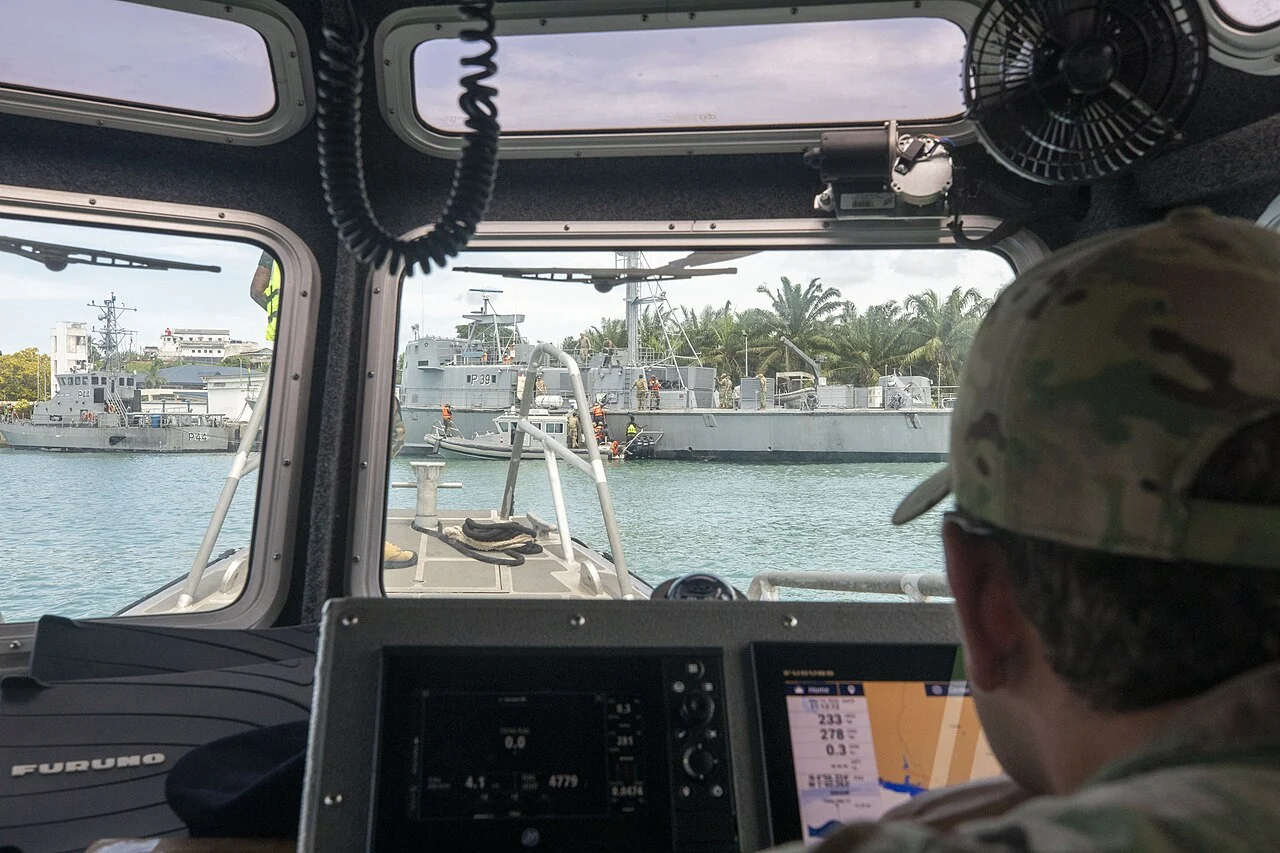
Photo: A Ghana Navy sailor operates a small boat alongside the Boundary-class patrol ship GNS Half Assini during a maritime interdiction exercise. Credit: U.S. Navy photo by Lt.j.g. Daniel Ehrlich, Public domain, via Wikimedia Commons
The Kofi Annan International Peacekeeping Training Centre (KAIPTC) convened the African Maritime Security Forum in Accra on 14-15 October, bringing together naval chiefs, policymakers and researchers from across the continent under the theme “The African Maritime Landscape in Times of Geopolitical Uncertainty in 2026 and Beyond,” Military Africa reported. The event was organised with South Africa’s Security Institute for Governance and Leadership in Africa (SIGLA) at Stellenbosch University and Denmark’s Royal Danish Defence College, funded through Denmark’s Peace and Stabilisation Fund.
From the Gulf of Guinea to the whole continent
KAIPTC Commandant Air Vice Marshal David Anetey Akrong said the Accra gathering was the first edition held outside South Africa, where four previous editions took place, and the first to widen its focus from the Gulf of Guinea to the entire African coastline. He called it a step towards a “continent-wide approach to maritime governance.” Ghana’s Minister for Defence, Kenneth Gilbert Adjei, told delegates that maritime security “needs a response that is intelligence-led and sustained by trust among nations,” adding that “maritime safety and security are not the responsibility of navies alone.”
The forum grew out of Denmark’s Maritime Security Programme for the Gulf of Guinea, which ran from 2022 to 2026. Denmark’s ambassador to Ghana, Jakob Linulf, said the partnership has trained more than 1,000 military and civilian security officers and helped build maritime crime investigation facilities in Ghana and Nigeria. He linked this year’s agenda to shipping disruption around the Middle East and the growing use of the Cape sea route as an alternative to the Suez Canal, calling for national ownership and regional coordination to protect freedom of navigation.
Governance gaps, not just equipment
Delegates ranked legal and institutional gaps above hardware shortfalls as the main barrier to maritime security. Discussion topics included revisions to the San Remo Manual on naval conduct in armed conflict, piracy trends in the Gulf of Guinea and the role of the Yaoundé Code of Conduct architecture that coordinates information-sharing among West and Central African states, and the growing use of unmanned aerial and surface vessels for surveillance — alongside the risk that armed and criminal groups adopt the same technology. Professor Ismael Theletsane, who directs the Organ on Politics, Defence and Security Affairs at the Southern African Development Community, urged African states and regional blocs to fund their own maritime operations rather than depend indefinitely on donors.
No formal agreements, signed commitments or new funding pledges came out of the two-day meeting. Its outputs were recommendations: treating the Cape route as a permanent feature of global trade requiring better maritime domain awareness, building sustainable national and regional funding instead of relying on partners such as Denmark, and strengthening information-sharing between coastal states.
Part of a wider pattern of naval cooperation
The Accra forum follows a series of multinational maritime exercises and gatherings on the continent this year, including April’s Obangame Express 2026 in Cameroon, which drew 31 participating nations, and African navies’ participation in the US Navy’s 250th-anniversary International Naval Review in New York in July. DefenceMENA has previously reported on warnings of a resurgence in Somali piracy raised at an earlier Accra forum and on the broader build-out of offshore patrol vessels in African navies.
Why it matters for Africa
Gulf of Guinea piracy has fallen sharply since its peak in the late 2010s, a decline regional navies and partners such as Denmark and the United States routinely credit to the Yaoundé Architecture’s information-sharing centres and years of joint patrols and training. But that progress is being tested by two trends discussed in Accra: ships increasingly rerouting around the Cape of Good Hope as Red Sea shipping lanes stay disrupted, pushing more commercial traffic past African coastlines with limited surveillance capacity; and the spread of cheap unmanned systems that can just as easily be used by pirates, smugglers or militants as by the navies trying to police them. A forum that explicitly moves beyond the Gulf of Guinea to cover the whole continent — and that puts governance and funding, not just patrol boats, at the centre of the conversation — reflects a recognition among African naval planners that donor-funded programmes like Denmark’s cannot be a permanent substitute for African states building and paying for their own maritime security architecture.
Sources
- Military Africa: “Ghana Hosts Africa’s First Continental Maritime Security Forum”
- DefenceMENA: Offshore Patrol Vessels and Coastal Security in African Navies
- DefenceMENA: Somali Piracy Returns in a Deadlier Form, Researcher Warns at Accra Forum