How Strong Is Ghana’s Military in 2026?




Ghana has no main battle tank, no fighter jet and no submarine in service — it runs a wheeled, counter-terrorism-shaped army, a small trainer-and-utility air force now getting its first fleet renewal in a decade, and a navy just starting to add bigger ships for Gulf of Guinea patrol.
The short answer: by Global Firepower’s 2026 index Ghana ranks 112th of 145 countries worldwide and fifth in West Africa, well behind Nigeria, Chad, Mali and Côte d’Ivoire, though GFP’s index is a weighted composite, not an inventory count. The more useful answer is about shape, not size. Ghana has never fielded a main battle tank or a combat jet, and it has avoided the big-ticket Chinese and Turkish attack drones Nigeria, Ethiopia and Côte d’Ivoire have bought. Since 2019 it has diversified its wheeled-vehicle fleet across China, Türkiye, Jordan, the UAE and the United States for counter-terrorism duty on the northern border with Burkina Faso, begun its first Air Force renewal in a decade with French helicopters and a VIP jet, and taken early steps — a new patrol ship, two more planned — toward a bigger navy for Gulf of Guinea energy security. Every figure below carries a status label: Operational, Delivered, On contract, Ordered, Under modernization, Estimated, Retired or Reported (unconfirmed); where no clean government figure exists, this profile says so rather than inventing one.
| Indicator | Figure | Year / source |
|---|---|---|
| Active personnel | 15,500 (Global Firepower 2026 active-manpower table, matched by an older Wikiwand/GlobalSecurity figure); an IndexMundi estimate from 2020 put it closer to 14,000 (Army ~10,000; Navy ~2,000; Air Force ~2,000) | Global Firepower 2026; IndexMundi 2020 (Estimated, ranges disagree) |
| Reserves | No recent official figure | — |
| Conscription | None; voluntary enlistment, ages 18–26, basic education certificate required (dated 2019 source, not reconfirmed since) | IndexMundi, 2019 |
| Military expenditure | US$507 million (2025), a SIPRI-derived database figure not independently cross-checked against a Ghanaian government document; the Finance Ministry’s November 2025 budget statement is separately reported to have raised Ministry of Defence funding by about 69% for a 2026 retooling programme, though the official GHS line item could not be confirmed from the published document | cbonds (SIPRI-derived), 2025; Citinewsroom/army-technology.com reporting on the 2026 Budget Statement |
| Foreign security assistance | EU–Ghana Security and Defence Partnership, signed 24 March 2026, the EU’s first such pact with an African state; tied to a €50 million equipment package delivered since 2023 and over €100 million in total EU peace-and-security support, with more planned for 2026 | GNA, Africanews, Ecofin Agency, March 2026 |
| Arms imports / SIPRI rank | No individual SIPRI 2021–25 import-share figure is published for Ghana; SIPRI’s own fact sheet itemises only Algeria, Morocco, Egypt, South Africa, Nigeria and the DR Congo individually among African states | SIPRI Fact Sheet, April 2026 |
| Main suppliers (by vehicle/platform count, not SIPRI share) | China, Türkiye, South Africa and Switzerland (legacy armour), the United Kingdom, the UAE, the United States/Jordan, and France (new Air Force package) | DefenceMENA research, 2026 |
| Combat aircraft | None confirmed; the Air Force’s fast-jet fleet is a small number of Hongdu K-8 jet trainers with no attack role | 2026 (Estimated) |
| Main battle tanks | None; heaviest tracked vehicles are legacy infantry fighting vehicles | — |
| Submarines / major ships | None; the largest vessel currently in commission is the 65-metre GNS Achimota | Military Africa, 2025 |
Current military overview
Ghana is one of several states covered in DefenceMENA’s West Africa armed forces desk, alongside Nigeria and Côte d’Ivoire; see also the Ghana tag page for ongoing coverage of its procurement and policy. Ghana’s armed forces are built around a single recurring mission — counter-terrorism along the northern border, where violence linked to jihadist groups has spread south from Burkina Faso and Mali — plus a growing secondary mission of Gulf of Guinea maritime security. There is no tank fleet, no fighter force and no submarine arm, and nothing in current open-source reporting suggests any of that is about to change. What has changed fast is the army’s wheeled-vehicle inventory: between 2019 and 2025 Ghana added Turkish, Chinese, Jordanian, Emirati and American armoured vehicles on top of an older South African, Swiss, British and Chinese legacy fleet, largely to mechanise infantry battalions operating in the north. In parallel, 2025–2026 brought the first big Air Force re-equipment programme in over a decade — Airbus helicopters and a Dassault Falcon jet — and the first new Navy patrol ship in several years, with two larger offshore patrol vessels approved but not yet built. A March 2026 security and defence partnership with the European Union, the bloc’s first with any African country, has added surveillance drones, counter-drone systems and communications equipment aimed at the northern border and maritime domain.
Defence budget: what the numbers do and do not show
A SIPRI-derived commercial database puts Ghana’s 2025 military expenditure at roughly US$507 million, a figure DefenceMENA treats as reported rather than independently verified against a Ghanaian government document. Trackers disagree on the trend: GlobalData’s 2024 baseline of about US$317 million forecasts an 11.3% compound annual growth rate through 2029, while MilitarySpend.org puts 2026 per-capita defence spending at only around US$8 and 0.4% of GDP, noting an IMF programme caps discretionary spending, defence included. Against that, Finance Minister Dr Cassiel Ato Forson’s 13 November 2025 Budget Statement is reported by Citinewsroom and army-technology.com to have raised Ministry of Defence funding by about 69% to fund a “retooling” programme — two offshore patrol vessels, four Air Force aircraft and 19 armoured personnel carriers. The Ministry of Finance’s 2026 Programme-Based Budget document for the Ministry of Defence is publicly available, but its budget-line figures could not be read cleanly for this profile, so the 69% increase is reported as secondary-sourced, not primary-confirmed. The 2026 national budget projects GH¢302.5 billion in total government expenditure (18.9% of GDP), with no confirmed GHS figure isolating defence spending within it.
Active personnel
Global Firepower’s 2026 tables list 15,500 active Ghana Armed Forces personnel, a figure that matches an older Wikiwand entry and a GlobalSecurity.org estimate dated to 2013, suggesting it has been carried forward across trackers rather than freshly verified. An IndexMundi estimate from 2020 is lower, at roughly 14,000 (Army ~10,000; Navy ~2,000; Air Force ~2,000). No recent official strength figure has been published, and no reserve-force number could be confirmed. Ghana has no conscription; enlistment is voluntary, with age and education requirements last confirmed in 2019 open-source data. Defence Minister Edward Omane Boamah announced in July 2025 a plan to recruit about 12,000 personnel over roughly three and a half years, and the GAF has since run its routine annual recruitment screening, with documentation and body-selection phases in Accra and Kumasi from late December 2025, per the Ghana Armed Forces and Graphic Online.
Army
The Ghana Army fields no main battle tank and no confirmed anti-tank guided missile, and open-source trackers do not list it among SIPRI’s major sub-regional arms recipients. Its heaviest armour is a legacy mix of South African Ratel IFVs and Swiss Piranha scout cars, under a fast-growing layer of wheeled vehicles bought since 2019 for counter-terrorism duty in the north.
| System | Origin | Quantity | Status | Source |
|---|---|---|---|---|
| Main battle tank | — | None confirmed | Not in service | No open-source tracker lists a Ghanaian MBT fleet |
| Ratel-90 / Ratel-20 infantry fighting vehicle | South Africa | Estimated ~39 combined | Operational | IISS Military Balance 2024 (aggregated); ghana-army-weapons research |
| Mowag Piranha I | Switzerland | Estimated 63 (4 fitted with a 25mm cannon) | Operational | IISS Military Balance 2024 (aggregated) |
| Casspir / Maverick MRAP | South Africa | Not individually quantified in available sources | Operational | ghana-army-weapons research |
| Otokar Cobra / Cobra II 4×4 | Türkiye | Estimated ~73 | Delivered 2019–2021 | Military Africa, Army Recognition |
| Norinco VN-22 6×6 APC/IFV | China | 20+ | Delivered, October 2024 | Army Recognition |
| WZ-523 APC (legacy) | China | Estimated ~82 | Operational | IISS Military Balance (aggregated) |
| STREIT Group Typhoon MRAP | United Arab Emirates | Estimated 50 | Delivered 2019–2022 | ghana-army-weapons research |
| Puma M36 Mk3 MRAP | United States | 14 | Delivered, May 2025 | Army Recognition |
| Shield SFIGHTER-2 | Jordan | Dozens | Delivered, August 2024 | Army Recognition |
| Alvis Tactica / International MXT-MV (legacy); Navistar Husky TSV (donated) | United Kingdom | Not individually quantified | Operational / Delivered 2023 | ghana-army-weapons research |
| Terrex AV-81/Sentinel II, Pandur II 8×8, Guarani 6×6 | Singapore/Israel-linked order (Elbit Systems financing) | 19 ordered, 2020 | Reported (unconfirmed) — zero delivered as of November 2025 per Ghana’s 2026 budget statement despite US$40m already paid; a renegotiated US$80m supplier-credit deal awaits parliamentary approval | Graphic Online, 2025 Budget Statement |
| KIA utility vehicles, unnamed 4×4 and 6×6 troop carriers | South Korea and undisclosed | 45 (15 KIA + 15 4×4 + 15 6×6) | Delivered, 16 October 2026 | Ghana Armed Forces, Adom Online |
DefenceMENA covered that October 2026 delivery in more detail in Ghana Armed Forces Take Delivery of 45 Utility and Troop-Carrying Vehicles. Artillery is modest and mostly towed: around six D-30 122mm howitzers, roughly 28 Finnish-made Krh/40 120mm mortars, and about three each of Chinese Type 63 and PHL-81 multiple rocket launchers. A December 2023 donation from China’s Poly Technologies was reported as “122 systems” plus 7,200 rockets, a figure DefenceMENA treats with caution since it may conflate a rocket-artillery delivery with the 122mm calibre rather than describing 122 separate launcher systems. Point air defence sits with the Army rather than a dedicated branch: ZPU-2/4 and ZU-23-2 anti-aircraft guns plus Chinese FN-6 and Soviet-era 9K32 Strela-2 man-portable missiles, all legacy equipment in small numbers. Local light-armoured-vehicle assembly exists on a small scale through the Defence Industries Holding Company’s joint venture with Kenaki Manufacturing, covered below.
Air Force
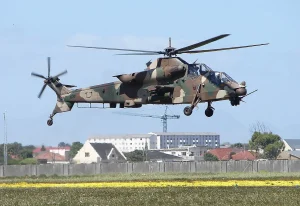
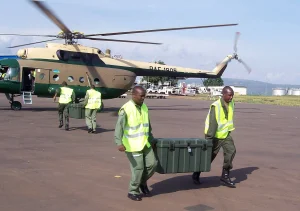
The Ghana Air Force (GAF) has flown an ageing mixed fleet built around Chinese-made Harbin Z-9EH utility helicopters, Russian-made Mi-17/171 transport helicopters, Hongdu K-8 jet trainers, a Diamond DA42 MPP Guardian surveillance aircraft and a single Dassault Falcon 900EX business jet for VIP and long-range transport. On 6 August 2025 a GAF Z-9 helicopter crashed near Obuasi in the Ashanti Region shortly after leaving Accra, killing all eight people on board, including Defence Minister Dr Edward Omane Boamah and Environment, Science and Technology Minister Dr Ibrahim Murtala Muhammed, according to the Ghana Armed Forces and reporting by Arab News and WSLS. No public finding has linked the cause of that crash to the fleet-renewal decisions that followed, but it sharpened an existing debate in Accra over the cost and condition of the Air Force’s oldest airframes.
On 3 December 2025, Parliament’s Defence and Interior Committee approved two contracts: one with Airbus Helicopters SAS of France for one H160 and three H175 helicopters, valued at €125.97 million, and one with Dassault Aviation of France for a single Falcon 6X long-range jet, valued at US$60.68 million, per Graphic Online and Rainbow Radio. The package is financed from the state budget over four years, with an initial €62.5 million instalment paid in December 2025 and further payments due in May 2026, March 2027 and December 2028. MP James Agalga told Parliament the 15-year lifecycle cost would run 30–40% below continuing to operate the ageing fleet; opposition MP Dominic Nitiwul questioned the government’s consistency after reportedly rejecting similar requests for five years, while Acting Defence and Finance Minister Dr Cassiel Ato Forson defended the acquisition. The first aircraft, an H175, was delivered to Accra on 5 March 2026 after a ferry flight from Airbus’s Marignane facility via Spain and the West African coast, per the Ghana News Agency.
A separate, older programme remains unresolved: Parliament approved a €111.4 million contract for six Aero Vodochody L-39NG light attack and trainer jets from the Czech Republic in December 2021, but Aviation Week and Military Africa reported by early 2023 that the Ministry of Defence had suspended negotiations with Aero Vodochody while evaluating a rival US bid, citing funding constraints. No public update has been found since; this profile lists it as Reported (unconfirmed) rather than Ordered, since it is unclear whether the contract is active, renegotiated or lapsed. As of 2026 the Air Force has no combat aircraft in service.
| System | Origin | Quantity | Status | Source |
|---|---|---|---|---|
| Hongdu K-8 jet trainer | China | 4 | Operational (trainer, no attack role) | Open-source aircraft directories, 2026 |
| Diamond DA42 MPP Guardian | Austria/Canada | Not confirmed this run | Operational (ISR/surveillance) | DefenceMENA, 2026 |
| Harbin Z-9EH utility helicopter | China | Fleet reduced by one after the August 2025 crash; residual number not confirmed | Operational | Ghana Armed Forces, Arab News |
| Mil Mi-17/171 transport helicopter | Russia | Not confirmed this run | Operational (legacy) | Open-source aircraft directories |
| Dassault Falcon 900EX | France | 1 | Operational, being supplemented/replaced | Graphic Online |
| Airbus H175 | France | 3 ordered, 1 delivered | Delivered (1), On contract (2) | Ghana News Agency, Rainbow Radio |
| Airbus H160 | France | 1 ordered | On contract | Rainbow Radio |
| Dassault Falcon 6X | France | 1 ordered | On contract (US$60.68m) | Rainbow Radio |
| Aero Vodochody L-39NG | Czech Republic | 6 ordered, 2021 | Reported (unconfirmed) — negotiations reported suspended by early 2023, no update since | Aviation Week, Military Africa |
Navy
The Ghana Navy’s largest current vessel is the 65-metre GNS Achimota. The broader fleet, per a July 2025 Military Africa assessment, includes four Snake-class patrol vessels, two former US Coast Guard Balsam-class ships, a second-hand Chamsuri-class craft of South Korean origin, and four Flex Fighter fast patrol boats Military Africa describes as River-class OPVs, a label other trackers do not use consistently. On 11 February 2026 the Navy commissioned GNS Pru at Sekondi Naval Base into the Western Naval Command, described by officials only as having “enhanced endurance and capability,” with no origin or specification disclosed. Deputy Defence Minister Ernest Brogya Genfi called it a strategic asset for protecting the blue economy and offshore resources; Chief of Naval Staff Rear Admiral Godwin Livinus Bessing said it improves the Navy’s ability to respond to maritime threats despite resource constraints.
The 13 November 2025 Budget Statement confirmed plans for two new 72-metre offshore patrol vessels with helipads and modern combat systems, intended to protect oil and gas installations and support Gulf of Guinea counter-piracy; the Chief of Naval Staff said construction steps were expected to begin in 2026, though no builder, cost or firm delivery date has been disclosed. Four additional fast patrol boats are reportedly planned to replace decommissioned vessels. Ghana has no submarines, frigates or corvettes. Ghana also hosted the inaugural African Maritime Security Forum in Accra in October 2026, reflecting its growing role in regional maritime-security diplomacy even as its own blue-water capacity remains limited.
| System | Origin | Quantity | Status | Source |
|---|---|---|---|---|
| GNS Achimota | Not confirmed this run | 1 | Operational (largest current vessel, 65m) | Military Africa, 2025 |
| Snake-class patrol vessel | Not confirmed this run | 4 | Operational | Military Africa, 2025 |
| Balsam-class (ex-US Coast Guard) | United States | 2 | Operational (legacy) | Military Africa, 2025 |
| Chamsuri-class patrol craft | South Korea | 1 | Operational (second-hand) | Military Africa, 2025 |
| Flex Fighter fast patrol boat | Not confirmed this run | 4 | Operational | Military Africa, 2025 |
| GNS Pru | Not disclosed | 1 | Delivered / Operational, commissioned 11 February 2026 | Ghana News Agency |
| Offshore patrol vessel (72m, new) | Not disclosed | 2 planned | Approved, construction steps expected to begin 2026 | 2026 Budget Statement, Graphic Online |
| Fast patrol boat (new) | Not disclosed | 4 planned | Requested | Military Africa, 2025 |
UAV and drone fleet
Ghana has not confirmed any Turkish Bayraktar/Akıncı or Chinese Wing Loong/CH-series combat drones in service, unlike Nigeria, Ethiopia or Côte d’Ivoire. Its closest fixed-wing ISR asset is the Diamond DA42 MPP Guardian surveillance aircraft, a manned platform also flown by Niger and Nigeria. Under the 24 March 2026 EU–Ghana Security and Defence Partnership, the EU handed over surveillance drones and counter-drone (anti-UAS) systems alongside communications equipment and motorcycles, intended for northern border surveillance and Gulf of Guinea maritime security; the manufacturer and exact quantities of the drones were not disclosed in available reporting. Separately, Ghanaian officials have been reported discussing interest in Ukrainian-made drones for border monitoring, according to 3news.com and Mezha Media, but no contract has been confirmed, so this is listed as Reported (unconfirmed).
Air defence
Ghana has no dedicated air-defence branch and no confirmed surface-to-air missile battery or air-defence radar network. What exists sits at Army level: ZPU-2/4 and ZU-23-2 towed anti-aircraft guns, and man-portable Chinese FN-6 and Soviet-era 9K32 Strela-2 missiles, all legacy systems reported in small numbers. The one new addition is the counter-UAS (anti-drone) equipment delivered under the March 2026 EU partnership, aimed at detecting and defeating small unmanned aircraft along the border and at sea rather than at providing area air defence.
Missiles and artillery
Ghana’s indirect-fire inventory is small and mostly towed: an estimated six D-30 122mm howitzers, roughly 28 Finnish-made Krh/40 120mm mortars, and about three each of Chinese Type 63 and PHL-81 multiple rocket launchers. A December 2023 donation from China’s Poly Technologies was reported as “122 systems” plus 7,200 rockets; DefenceMENA flags the “122 systems” figure as potentially a conflation with the 122mm calibre rather than a literal count of 122 launchers, since no other source corroborates that scale of delivery. No guided surface-to-surface missile system or confirmed anti-tank guided missile is in Ghanaian service.
Defence industry
Ghana’s defence-industrial base is small. The Defence Industries Holding Company (DIHOC), created in 2019 as the commercial arm of the Ghana Armed Forces, runs a joint venture called DIKMAC with Kenaki Manufacturing Company, which Army Recognition reported in 2024 had begun assembling cash-in-transit armoured vehicles with technical backing from Israel Aerospace Industries. Beyond that, the base covers vehicle maintenance and limited small-arms ammunition production. Separately, the privately owned Kantanka Automobile group has for years claimed a military product line including armoured vehicles and an “exoskeleton” suit; those claims are poorly verified against independent military sources, and Kantanka’s confirmed business remains supplying civilian-pattern vehicles to police and government fleets, not fielded Ghana Armed Forces hardware.
Main defence suppliers
No SIPRI-published import-share table exists for Ghana; the organisation’s fact sheet itemises only Algeria, Morocco, Egypt, South Africa, Nigeria and the DR Congo individually. The table below reflects supplier shares by platform and vehicle count instead, from DefenceMENA’s own Ghana Army order-of-battle research.
| Origin | Main systems | Share / era |
|---|---|---|
| China | Norinco VN-22, WZ-523 (legacy), Type 63/PHL-81 MLRS, Harbin Z-9EH helicopters, Poly Technologies rocket-artillery donation | Largest combined supplier by vehicle count once legacy and new fleets are counted together; 1980s legacy plus 2023–2024 new deliveries |
| Türkiye | Otokar Cobra/Cobra II 4×4 light tactical vehicles | Estimated ~73 units, one of the single largest wheeled-vehicle types by count; delivered 2019–2021 |
| South Africa & Switzerland | Ratel-90/20, Maverick APC, Casspir MRAP, Mowag Piranha I | Legacy armour, 1980s–2000s, still frontline |
| United Kingdom | Alvis Tactica, International MXT-MV, donated Navistar Husky TSV | 1990s legacy plus 2023 donations |
| United Arab Emirates | STREIT Group Typhoon MRAP | Estimated 50 units, delivered 2019–2022 |
| United States, Jordan & Israel-linked financing | Puma M36 Mk3 MRAP, Shield SFIGHTER-2, stalled Terrex/Pandur II/Guarani order | 2020–2025, partly undelivered |
| France | Airbus H160/H175 helicopters, Dassault Falcon 6X | Approved December 2025, deliveries through 2028 |
| European Union (collective) | Surveillance drones, counter-UAS systems, communications equipment | Delivered under the March 2026 Security and Defence Partnership |
| South Korea | KIA utility vehicles; legacy Chamsuri-class patrol craft | October 2026 delivery (vehicles); legacy (patrol craft) |
| Czech Republic | Aero Vodochody L-39NG | Ordered 2021; reported stalled since 2023 |
Recent procurement, 2025–2026
| Date | Event | Value | Status |
|---|---|---|---|
| 13 Nov 2025 | 2026 Budget Statement announces retooling plan: 2 offshore patrol vessels, 4 aircraft for the Air Force, 19 armoured personnel carriers | Not disclosed | Approved |
| 3 Dec 2025 | Parliament approves Airbus Helicopters contract (1 H160, 3 H175) | €125.97 million | On contract |
| 3 Dec 2025 | Parliament approves Dassault Falcon 6X contract | US$60.68 million | On contract |
| Dec 2025 | First instalment paid on Airbus/Dassault package | €62.5 million | Delivered (payment) |
| 11 Feb 2026 | GNS Pru commissioned at Sekondi Naval Base, Western Naval Command | Not disclosed | Delivered |
| 5 Mar 2026 | First Airbus H175 helicopter delivered to Accra | Part of €125.97m package | Delivered |
| 24 Mar 2026 | Ghana–EU Security and Defence Partnership signed; surveillance drones, counter-UAS systems and comms equipment handed over | Part of >€100 million total EU support | Delivered (partial, more planned for 2026) |
| 16 Oct 2026 | 45 utility and troop-carrying vehicles delivered (15 KIA, 15 4×4, 15 6×6) | Not disclosed | Delivered |
| Unresolved, as of Nov 2025 | 19 Elbit-linked armoured vehicles (Terrex/Pandur II/Guarani), ordered 2020, renegotiated supplier credit awaiting parliamentary approval | US$80 million credit (US$40m already paid, zero delivered) | Ordered (undelivered) |
| Unresolved since early 2023 | 6 Aero Vodochody L-39NG trainer/light-attack jets | €111.4 million | Reported (unconfirmed) |
Turkish systems in Ghana
Türkiye’s defence footprint in Ghana is narrow and consists of a single confirmed system: the Otokar Cobra and Cobra II 4×4 light tactical vehicle, delivered 2019–2021 in an estimated quantity of about 73, one of the largest wheeled-vehicle types in the Ghana Army’s fleet by count. There is no confirmed Bayraktar TB2 or Akıncı drone, no ASELSAN sensor or radar sale, no Roketsan munitions contract and no Turkish naval vessel in Ghanaian service — a sharp contrast with Nigeria, Ethiopia and Kenya, where Turkish combat drones are operational. DefenceMENA found no Ghana-specific reporting on the Cobra contract’s unit cost, delivery time or local-production terms, so no comparative cost claim is made here. Türkiye and China are Ghana’s two largest wheeled-vehicle suppliers by count, with Norinco’s VN-22 competing directly against the older Cobra/Cobra II family in the same light-armour category. For the continent-wide picture, see DefenceMENA’s Turkish Defence in Africa desk.
| Türkiye (Otokar Cobra/Cobra II) | China (Norinco VN-22) | |
|---|---|---|
| Deliveries confirmed | ~73 units, 2019–2021 | 20+ units, October 2024 |
| Local production in Ghana | None confirmed | None confirmed |
| Political exposure | Low; no public controversy found | Low; no public controversy found |
| Price / financing terms | Not disclosed in available Ghana-specific sources | Not disclosed in available Ghana-specific sources |
| Munitions / sustainment | Not confirmed this run | Not confirmed this run |
For a closer look at how the Cobra II stacks up against other light 4×4 armoured vehicles used across Africa, see DefenceMENA’s comparison of the Otokar Cobra II, Arquus Bastion and NORINCO VN4.
What is changing?
Three shifts define Ghana’s trajectory. First, the Air Force is mid-way through its first fleet renewal in over a decade — Airbus helicopters and a Dassault Falcon jet financed through 2028 — while a separate, older plan for six Czech light-attack jets remains stalled with no public update since 2023. Second, the Navy is taking incremental steps toward a bigger Gulf of Guinea presence: one new patrol ship commissioned in February 2026, two larger 72-metre offshore patrol vessels approved but not yet under construction, and four replacement fast patrol boats planned. Third, the Army’s counter-terrorism-driven diversification across Chinese, Turkish, Jordanian, Emirati and American wheeled vehicles continues, but with a cautionary example attached: an Israeli-linked order for 19 armoured vehicles has sat undelivered since 2020 despite US$40 million already paid, showing that procurement announcements do not reliably translate into fielded equipment on any fixed timeline. Underneath all three is a new EU security relationship — the bloc’s first such partnership with an African state — bringing surveillance drones, counter-drone systems and over €100 million in cumulative assistance, alongside a recruitment drive aiming to add up to 12,000 personnel by around 2028. All of this sits against a fiscal backdrop in which independent trackers put Ghana’s defence spending well under 1% of GDP, constrained by an IMF programme even as the government reports a steep nominal budget increase for 2026.
How Ghana compares in Africa
By Global Firepower’s 2026 index, Ghana ranks 112th of 145 countries worldwide and fifth among West African states, behind Nigeria (33rd), Chad (85th), Mali (104th) and Côte d’Ivoire (108th), per DefenceMENA’s own West Africa military strength comparison. Its reported 15,500 active personnel are far below Nigeria’s roughly 230,000 but above several Sahelian states by GFP’s count, including Niger and Burkina Faso, even though the index’s weighted methodology does not rank Ghana above them. On spending, DefenceMENA’s own ranking of African defence budgets places Ghana in a second tier of a few hundred million to just over a billion dollars a year, alongside Burkina Faso, Senegal and Cameroon — below Nigeria, South Africa, Angola and Kenya, and a fraction of what Algeria, Morocco or Egypt spend. Structurally, Ghana stands apart in what it lacks: unlike Nigeria, Ethiopia or Côte d’Ivoire it has no confirmed Chinese or Turkish attack drone in service, and unlike most of West Africa’s larger militaries it has never fielded a main battle tank — a genuinely light, constabulary-and-counter-terrorism-shaped force rather than a conventional heavy army.
A note on the numbers
Personnel and spending figures for Ghana diverge across sources — Global Firepower, IISS-derived trackers and SIPRI-derived commercial databases — because no recent, detailed public order of battle has been published by the Ghana Armed Forces or Ministry of Defence. The clearest gap between an announcement and a delivered capability is the stalled 2020 order for 19 Elbit-linked armoured vehicles (US$40 million paid, zero delivered as of November 2025) and the six L-39NG jets ordered in 2021 and stalled since 2023 with no confirmed update. Global Firepower’s index is used here only as an indicative, continental ranking tool, consistent with SIPRI’s own fact sheet not itemising Ghana individually; it is not an inventory source. Where a figure could not be confirmed against a dated, named source, this profile says “no recent official figure” or “not confirmed this run” rather than estimate one.
Sources
- Global Firepower, Ghana 2026
- Ghana News Agency, Government retools Ghana Navy with additional ship (February 2026)
- Graphic Online, Government to acquire 2 offshore patrol vessels, 4 helicopters and 19 armoured carriers (November 2025)
- Citinewsroom, 2026 Budget: Govt to procure 4 helicopters, 2 aircraft for GAF (November 2025)
- Ghana News Agency, Ghana, EU sign landmark Security and Defence Partnership (March 2026)
- Ecofin Agency, EU-Ghana sign security partnership as bloc delivers drones, military equipment (March 2026)
- Military Africa, Modernising the Ghanaian naval capabilities will require willpower and funding (July 2025)
- Aviation Week, Ghana’s L-39NG procurement in doubt
- Graphic Online, Parliament approves agreement for supply of fighter for GAF (L-39NG, 2021)
- MilitarySpend.org, Ghana country profile
- Army Recognition, Ghana enhances military strength with new batch of Shield APC-79 SFIGHTER-2 armoured vehicles (2024)
- DefenceMENA, Ghana Army Weapons and Equipment List (2026)
- DefenceMENA, Tracking Ghana’s Airbus Helicopter and Dassault Falcon Fleet Deal