Nigeria’s Army Chief Tours Rwanda’s REMCO Arms Plant, Urges African-Built Defence Industries



Nigeria’s Chief of Army Staff toured Rwanda’s state-owned arms manufacturer this week and called on African governments to build their own defence industries rather than rely on imports. No contract or joint venture was signed, but the visit put a spotlight on Rwanda’s small but growing arms-making sector.
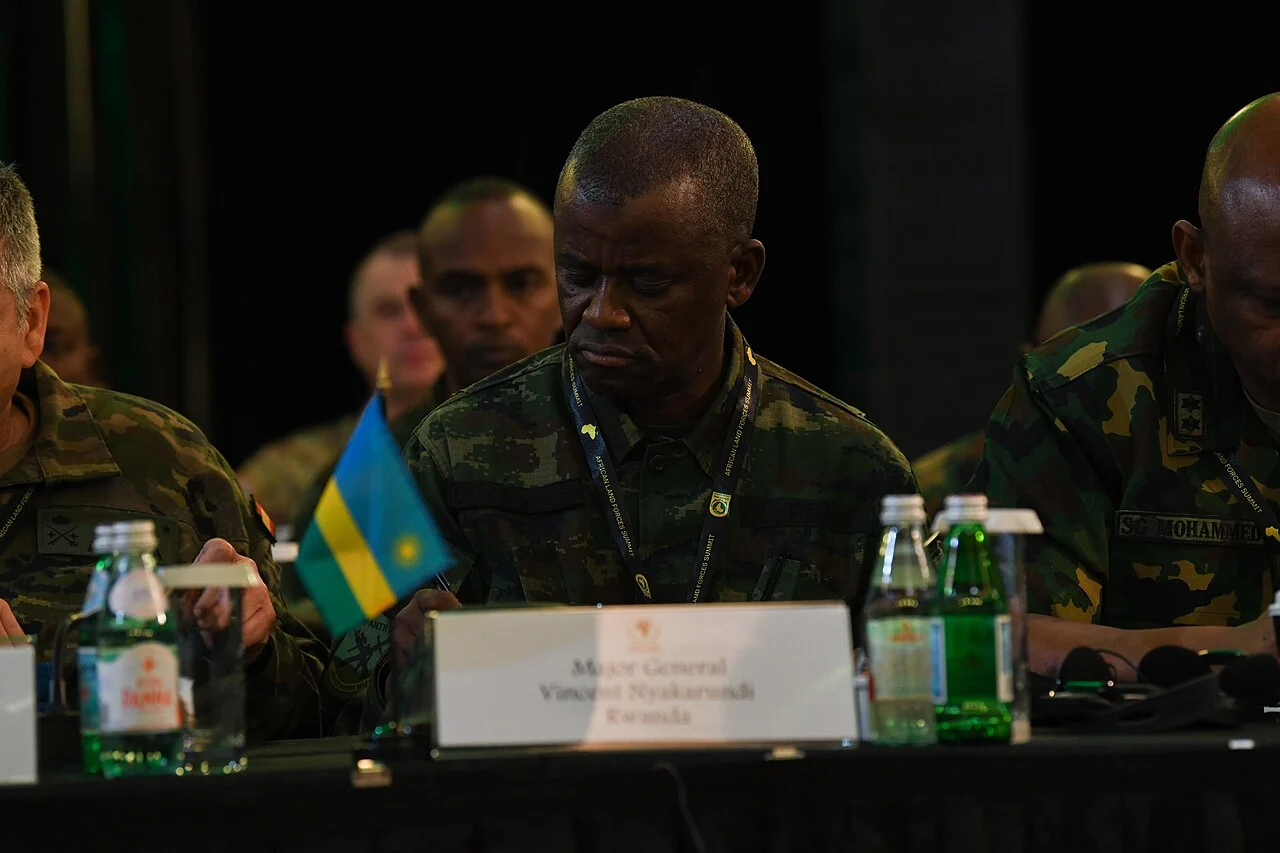
Photo: Rwandan and foreign officers at a continental land-forces summit. Credit: U.S. Army photo by Staff Sgt. Aaliyah Craven, Public domain, via Wikimedia Commons
Lieutenant General Waidi Shaibu, Nigeria’s Chief of Army Staff, visited the Rwanda Engineering and Manufacturing Corporation (REMCO) in Kigali on 21 October during an official trip to Rwanda that ran from 18 to 23 October, according to Military Africa, citing a statement from Colonel Appolonia Anele, the Nigerian Army’s acting director of public relations. REMCO’s chief executive, Emile Rugambajye, received the delegation at the company’s plant in the Kigali Special Economic Zone.
What Shaibu saw at REMCO
The Nigerian delegation was shown REMCO’s precision engineering, machining, metal casting and machinery fabrication lines. REMCO is a state-owned company founded in 2018 that makes machinery, equipment and spare parts, and that press reporting — not confirmed in the Military Africa account — links to small-arms production in partnership with Israel Weapon Industries. During the inaugural International Security Conference on Africa, held in Kigali the same week, REMCO reportedly displayed sniper rifles, assault rifles, machine guns, pistols and armoured vehicles.
Shaibu told his hosts that domestic manufacturing improves “the share of a fleet fit for use on a given day” — a reference to the readiness problems that import-dependent militaries face when spare parts or ammunition cannot be sourced quickly. He called on African states to “build their own defence industries,” urging investment in research and development, local technical skills and cross-border industrial partnerships.
A busy week in Kigali
The REMCO tour was one stop in a wider programme. Shaibu met Rwanda Defence Force Chief of Defence Staff General Mubarakh Muganga and held bilateral talks with RDF Army Chief of Staff Major General Vincent Nyakarundi. President Paul Kagame received him at Urugwiro Village on 22 October, and he also met Rwanda’s Minister of Defence. The delegation visited the Kigali Genocide Memorial and the Campaign Against Genocide Museum, and Shaibu praised Rwanda’s reconstruction since 1994, saying “discipline, leadership and national resolve remain central to countering insecurity across Africa.”
No procurement contract, technology-transfer agreement or joint venture came out of the visit. Instead, both armies reaffirmed existing memoranda of understanding covering military training and the exchange of directing staff and logistics personnel. Nigeria separately committed to specialised training, joint exercises and defence-technology cooperation — commitments of intent rather than signed programmes.
Nigeria’s own push for local production
The visit fits a pattern in Nigerian defence policy this year. The Defence Industries Corporation of Nigeria (DICON) hosted the country’s first AFRIDEX exhibition in Lagos days after Shaibu returned from Kigali, and DefenceMENA has reported in detail on DICON’s roughly $2 billion push into local production. The Nigerian Army has also pursued other external partnerships this year, including a joint service centre with China’s NORINCO in Bauchi, a training and intelligence-sharing agreement with Jordan, and an offer of training support to Bangladesh.
Nigeria remains, for now, far more reliant on imports than on domestic manufacturing. According to SIPRI data cited by Military Africa, Nigeria accounted for 16 percent of sub-Saharan Africa’s arms imports between 2021 and 2025 — the largest share in the sub-region, ahead of Senegal (8.8 percent) and Mali (8.0 percent) — even as continent-wide import volumes fell, driven largely by a 78 percent drop in Algerian imports. Recent Nigerian deals include a $346 million US arms package and a $1.38 billion contract with Italy and the United States for aircraft and helicopters, on top of Bell Textron’s ongoing production of 12 AH-1Z Viper attack helicopters for the Nigerian Air Force.
Why it matters for Africa
REMCO is small by global standards, but it is one of a handful of state-owned African manufacturers — alongside South Africa’s Denel and Paramount Group, Nigeria’s own DICON, and Ethiopia’s and Morocco’s state arms makers — that African militaries point to when arguing for local production. A visit by the army chief of Africa’s most populous country and largest arms importer to a much smaller state-owned manufacturer is itself a signal: Nigeria, which spends hundreds of millions of dollars a year on US, European and Chinese equipment, is publicly endorsing the idea that African states should build more of what they buy. Whether that translates into actual contracts, technology transfer or joint production — rather than another round of study tours and memoranda of understanding — will determine whether this visit matters beyond its symbolism. For now, it adds a data point to a broader continental debate, visible also in Rwanda’s own small-arms partnership claims and in Nigeria’s DICON expansion, about whether Africa’s growing military spending can start building local industrial capacity rather than simply funding imports.
Sources
- Military Africa: “Nigeria’s Army Chief Tours Rwandan Arms Maker, Urges Local Production”
- DefenceMENA: Nigeria’s $2 Billion Bet on Local Defence Production
- DefenceMENA: Nigeria military-strength profile