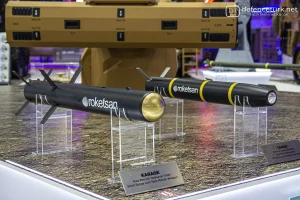
CAKIR Cruise Missile Explained: ROKETSAN’s Multi-Domain Strike Weapon

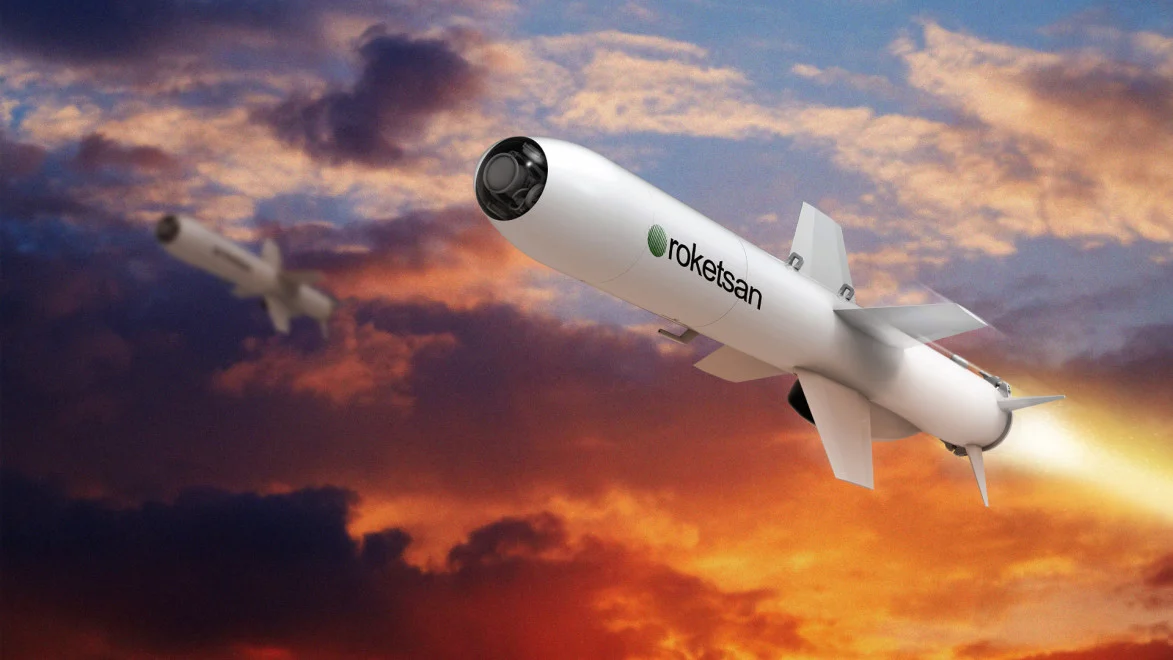


CAKIR (officially stylised CAKIR, Turkish: Cakir) is ROKETSAN’s multi-domain cruise missile, launched from aircraft, helicopters, drones, armoured vehicles and ships against land and sea targets alike. Unveiled in March 2022, it uses a domestically developed turbojet engine, imaging-infrared or RF terminal guidance and a 70 kg warhead to strike at over 150 km, with four missiles carried per launcher. ROKETSAN tested CAKIR from a Bayraktar Akinci drone in 2023 and from mobile ground launchers in 2026, extending it beyond its original air-launched role. Qatar has ordered CAKIR as the primary anti-ship weapon of two new Dearsan-built fast attack craft, and Indonesia signed a production and technology-transfer agreement for the missile in 2025 — its first two publicly confirmed customers.
Photo: ROKETSAN CAKIR cruise missile, official product image. Credit: ROKETSAN.
| Manufacturer | ROKETSAN (prime, airframe, propulsion integration and guidance); KALE Arge developed the turbojet flight engine |
| Type | Multi-domain cruise missile (air, land and sea launched) against land and surface targets |
| Range | 150+ km (ROKETSAN official specification) |
| Guidance | Mid-course: INS, anti-jam GNSS, radar and barometric altimeters, terrain-referenced navigation. Terminal: imaging infrared (IIR), RF, or hybrid IIR+RF seeker. Network-based two-way datalink |
| Warhead | 70 kg; High-Explosive, Semi-Piercing, Blast-Fragmentation or Thermobaric |
| Weight / dimensions | ≤275 kg without booster, ≤330 kg with booster; ≤3.3 m long without booster, ≤4.1 m with booster; ≤275 mm diameter |
| Propulsion | KTJ-1750 turbojet flight engine (KALE Arge) plus solid-fuel launch booster |
| Speed | High subsonic, Mach 0.75-0.85 |
| Status | Unveiled March 2022; air-launch tested 2023; ground-launch tested August 2026; not yet confirmed in Turkish Armed Forces service |
| Confirmed customers | Qatar (ordered), Indonesia (production and technology-transfer agreement) |
What is the CAKIR missile?
CAKIR is ROKETSAN’s cruise missile family, designed to be launched from fixed and rotary-wing aircraft, armed UAVs and USVs, tactical wheeled vehicles, and surface naval platforms against the same broad target set: surface ships, land and coastal targets, strategic land targets, field targets and caves (ROKETSAN, official product page, accessed 11 October 2026). ROKETSAN presented it as a force multiplier able to be fielded across domains from a single weapon design, with each launcher able to carry up to four missiles and a stated swarm capability for coordinated multi-missile attacks (ROKETSAN official product page; Naval News, 31 March 2022).
CAKIR is not a replacement for ROKETSAN’s dedicated ATMACA anti-ship missile. ATMACA is a heavier, vertically-launched, naval-only weapon purpose-built for ship-to-ship engagements; CAKIR is a lighter, multi-platform cruise missile whose anti-ship role is one of several missions alongside land-attack strike, and it is launched horizontally from a wider range of platforms, including helicopters, drones and vehicles that cannot carry ATMACA.
Development and public timeline
| 31 March 2022 | ROKETSAN unveils CAKIR at a press conference at its Ankara facilities, describing it as a new multi-domain cruise missile family (Naval News, “Turkish Roketsan Introduces New Antiship Missile Family CAKIR”) |
| August 2022 | A Turkish industry report says CAKIR is slated to enter the inventory by the end of 2022, with KALE Arge separately contracted to develop the KTJ-1750 turbojet engine (Cyprus Mail, 5 August 2022) |
| May 2023 | First publicly reported air-launch test, fired from a Bayraktar Akinci UCAV at an altitude of roughly 7,000 m (Naval News, 29 August 2026, referencing the earlier test) |
| 23 July 2025 | ROKETSAN and Indonesia’s Republikorp sign an agreement at IDEF 2025, Istanbul, covering serial production and technology transfer of CAKIR; no unit numbers or financial terms disclosed (Army Recognition; Breaking Defense) |
| 17 November 2025 | Dearsan launches the first of two FAC-50 (MAC-50) fast attack craft for Qatar’s navy, armed with CAKIR as its primary anti-ship missile (Naval News) |
| August 2025 / reported 2026 | Indonesia’s ambassador to Turkiye states that Indonesia has procured CAKIR and other Turkish missile systems, and references a planned ROKETSAN joint venture and production facility in Indonesia (reported by Naval News, 29 August 2026) |
| 14 February 2026 | Dearsan launches the second Qatari FAC-50 vessel; both are scheduled for delivery in 2027 (Defence Turkey; Naval News) |
| 28-29 August 2026 | ROKETSAN announces the first publicly disclosed ground-launch tests of CAKIR, firing two missiles from a mobile land-based launcher at a land target and a maritime target, using a next-generation imaging-infrared seeker and reporting extended range from a new fuel system (Naval News; The Defense Post, 1 September 2026) |
Who manufactures CAKIR — ROKETSAN’s role
ROKETSAN is CAKIR’s prime developer and manufacturer, responsible for the airframe, warhead, guidance integration and overall missile design. The missile’s turbojet flight engine, the domestically developed KTJ-1750, was contracted separately to KALE Arge, a Turkish aerospace-engine developer, reflecting Turkiye’s wider push to localise cruise-missile propulsion rather than rely on imported turbojets (Cyprus Mail, August 2022; ROKETSAN official product page). As with several other ROKETSAN munitions, the missile itself is a ROKETSAN design even where a specific subsystem, here the engine, is sourced from a separate Turkish supplier.
Range, guidance and warhead options
ROKETSAN’s official specification gives CAKIR a range of 150+ km, a weight of up to 275 kg without its launch booster (330 kg with it), a length of up to 3.3 m without the booster (4.1 m with it), and a diameter of up to 275 mm (ROKETSAN official product page, accessed 11 October 2026). The missile cruises at high subsonic speed, Mach 0.75-0.85, powered by the KTJ-1750 turbojet after a solid-fuel booster handles launch.
Mid-course navigation combines an inertial navigation system with anti-jam GNSS, a radar altimeter, a barometric altimeter and terrain-referenced navigation, intended to maintain accuracy if satellite navigation is degraded. In the terminal phase, CAKIR uses an imaging infrared (IIR) seeker, an RF seeker, or a hybrid IIR+RF seeker, linked back to the launch platform over a network-based, bidirectional datalink (ROKETSAN official product page). The August 2026 ground-launch tests specifically used what ROKETSAN described as a next-generation IIR seeker (Naval News, 29 August 2026).
The warhead carries 70 kg and is available in High-Explosive, Semi-Piercing, Blast-Fragmentation or Thermobaric configurations, allowing the same missile body to be fitted for hardened targets, ships, personnel and fortified or enclosed positions such as caves (ROKETSAN official product page).
Launch and compatible platforms
ROKETSAN lists CAKIR as compatible with fixed and rotary-wing aircraft, unmanned combat aerial vehicles (UCAVs), autonomous unmanned surface vehicles (AUSVs), tactical wheeled land vehicles, and surface naval platforms, with each launcher able to carry up to four missiles (ROKETSAN official product page). In practice, two launch modes have been publicly demonstrated: an air launch from a Bayraktar Akinci UCAV at roughly 7,000 m in May 2023, and a mobile ground-based launcher used in the August 2026 test campaign, which added a solid-fuel booster stage ahead of the turbojet cruise phase (Naval News, 29 August 2026). CAKIR’s naval role is confirmed through Qatar’s FAC-50 fast attack craft, where it is integrated as deck-mounted, horizontally launched armament rather than from a vertical launch system (Naval News; The Defense Post, November 2025). No fixed-wing or rotary-wing CAKIR launch has yet been confirmed on an in-service platform; the Akinci and ground-launcher firings are test events, not confirmed operational fieldings.
Which countries have ordered CAKIR?
| Country | Status | Year | Platform | Source |
|---|---|---|---|---|
| Qatar | CONTRACTED (missiles specified as primary armament; platforms under construction) | Boats launched Nov 2025 and Feb 2026; delivery scheduled 2027 | 2x Dearsan-built FAC-50 / MAC-50 fast attack craft (Qatari Navy, hulls Al Wakrah and Al Ghariyah) | Naval News, 21 Nov 2025 and 14 Feb 2026; The Defense Post, 21 Nov 2025 |
| Indonesia | CONTRACTED (serial production and technology-transfer agreement; government statement of procurement) | Agreement signed 23 Jul 2025; procurement stated Aug 2025/2026 | Naval platforms referenced in connection with Republikorp’s planned fast missile boats | Army Recognition, 29 Jul 2025; Breaking Defense, Jul 2025; Naval News, 29 Aug 2026 (citing Indonesian ambassador statement) |
Qatar’s two Dearsan-built FAC-50 fast attack craft — Al Wakrah (Q-51), launched 17 November 2025, and Al Ghariyah (Q-52), launched 14 February 2026 — carry CAKIR as their primary anti-ship weapon alongside SUNGUR surface-to-air missiles, a Leonardo 40 mm main gun and two ASELSAN STAMP remote weapon stations, with delivery of both vessels scheduled for 2027 (Naval News; The Defense Post; Defence Turkey). A single secondary outlet, Frontier India, reports a specific loadout of four CAKIR missiles per vessel; DefenceMENA treats that missile count as single-sourced rather than confirmed, while the missile type itself is independently corroborated by Naval News and The Defense Post.
Indonesia’s relationship with CAKIR centres on a 23 July 2025 agreement between ROKETSAN General Manager Murat Ikinci and Republikorp executive Norman Joesoef at IDEF 2025, covering serial production and technology transfer rather than a one-off missile sale (Army Recognition; Breaking Defense). Public reporting ties this to Republikorp’s planned stealth missile boats, shown as mock-ups at Indo Defence 2025, though no platform has yet been confirmed as carrying CAKIR in service. In comments reported in August 2025 and again referenced in 2026 coverage, Indonesia’s ambassador to Turkiye said Indonesia had already procured CAKIR and other Turkish missile systems, and pointed to a planned ROKETSAN joint venture and missile-production facility in Indonesia (Naval News, 29 August 2026). No unit numbers or contract value have been disclosed for either country.
Reported but not independently confirmed customers
ROKETSAN’s own general manager said in July 2023 that an export agreement for CAKIR had been signed prior to the missile’s entry into Turkish service, without naming the buyer (Naval News, 29 August 2026, citing the 2023 statement). No country has been officially or independently identified as that 2023 customer, and DefenceMENA does not attribute it to either Qatar or Indonesia without further confirmation. CAKIR was also displayed at DIMDEX 2026 in Doha, which several outlets describe as underlining the missile’s export ambitions in the Gulf, but exhibition presence alone is not treated as evidence of a sale (EDR Magazine, DIMDEX 2026 coverage).
Contract value and pricing
No unit price, and no total contract value, has been publicly disclosed for CAKIR by ROKETSAN, Turkiye, Qatar or Indonesia. The Qatari FAC-50 programme’s overall shipbuilding contract value has not been broken out by weapon system in public reporting, and Indonesia’s 2025 agreement with Republikorp was announced without financial terms. Where ROKETSAN or a partner government discloses a package value in the future that bundles missiles with vessels, launchers or integration work, DefenceMENA will state that package value and its scope rather than deriving a per-missile price from it.
Competing systems
CAKIR belongs to a global class of mid-range, multi-domain cruise missiles designed to be launched from more than one platform type and to hit both land and maritime targets. The comparison below applies the same criteria to each system — mission class, range, weight class, guidance and export record — using only figures published by each manufacturer or government.
| System | Origin | Weight class | Range | Guidance | Status / export record |
|---|---|---|---|---|---|
| CAKIR | Turkiye (ROKETSAN) | ≤275 kg (330 kg with booster) | 150+ km (official) | INS/GNSS mid-course; IIR, RF or hybrid IIR+RF terminal | Unveiled 2022, tested air- and ground-launched; ordered by Qatar and Indonesia, not yet confirmed in any country’s active service |
| Delilah | Israel (IMI / Elbit Systems) | ~185-187 kg | ~250 km (official); up to ~300 km per Israeli defence-source estimates | INS/GPS mid-course; electro-optical/IIR terminal; loitering capability | Operational with Israel since the 2000s; air-, ground- and ship-launched variants; limited public export record |
| Naval Strike Missile (NSM) | Norway (Kongsberg) | 350 kg without booster, 407-410 kg with booster | >200 km (baseline); >300 km per 2026 manufacturer brochure | INS/GPS mid-course; passive IIR terminal seeker; sea-skimming and terrain-masking flight | Operational with Norway, the US Navy/Marine Corps (as RGM-184), Poland, Malaysia and others; demonstrated land-attack role |
On the public figures available, CAKIR sits in a broadly comparable weight and range class to Israel’s Delilah, and both are designed for use from more than one domain. Norway’s NSM is substantially heavier and has a longer established export record across NATO and allied navies, reflecting its longer service history; CAKIR’s own export record is at an earlier stage, with Qatar and Indonesia as its first two publicly confirmed customers. None of the three governments involved has published a unit price, so cost cannot be compared on a like-for-like basis.
Related ROKETSAN systems
CAKIR is ROKETSAN’s multi-domain cruise missile, distinct from the company’s dedicated naval anti-ship weapon; for that system, see ATMACA Anti-Ship Missile Explained. For ROKETSAN’s drone-launched precision munitions, see MAM-L, MAM-C and MAM-T Explained. For its laser-guided 2.75-inch rocket, see CIRIT Laser-Guided Missile Explained. For its man-portable and vehicle anti-tank missiles, see KARAOK Anti-Tank Missile Explained and Turkish Anti-Tank Missiles Explained. For Qatar’s and the wider Gulf’s ROKETSAN relationships, see ROKETSAN in the Middle East. For a global summary of confirmed ROKETSAN operators, see Which Countries Use ROKETSAN Missiles and Munitions?. For ROKETSAN’s full product range and corporate background, see the ROKETSAN company hub. For Turkish-language technical background, see Envanter Medya’s explainer on the CAKIR cruise missile.
Frequently asked questions
What is the range of the CAKIR missile?
ROKETSAN’s official specification states a range of 150+ km. The August 2026 ground-launch tests reportedly reached extended range using a new fuel system, though ROKETSAN has not published an updated official figure.
Which countries have bought the CAKIR missile?
Qatar and Indonesia are CAKIR’s first two publicly confirmed customers. Qatar has ordered it as the primary anti-ship missile for two new Dearsan-built fast attack craft, due for delivery in 2027. Indonesia signed a production and technology-transfer agreement in July 2025, and its ambassador to Turkiye has said Indonesia has procured the missile.
Is CAKIR the same as ATMACA?
No. ATMACA is ROKETSAN’s dedicated, vertically-launched naval anti-ship missile. CAKIR is a lighter, multi-domain cruise missile that can be launched from aircraft, drones, vehicles and ships, with anti-ship capability as one of several missions rather than its sole role.
Has the Turkish military ordered CAKIR?
Not yet confirmed. CAKIR has been unveiled and test-fired from both air and ground launchers, including tests reported in 2023 and 2026, but no public source confirms a Turkish Armed Forces procurement contract or in-service status as of this article’s publication.
What platforms can launch CAKIR?
ROKETSAN lists fixed and rotary-wing aircraft, UCAVs, unmanned surface vessels, tactical wheeled vehicles and naval platforms as compatible. Confirmed public tests cover an air launch from a Bayraktar Akinci UCAV (2023) and a mobile ground launcher (2026); its naval role is confirmed through Qatar’s FAC-50 vessels.
What does CAKIR cost?
No unit price or total contract value has been publicly disclosed by ROKETSAN or by Qatar or Indonesia. Both countries’ agreements were announced without financial terms.
Sources
- ROKETSAN: CAKIR Cruise Missile, official product page (accessed 11 October 2026)
- Naval News: “Turkish Roketsan Introduces New Antiship Missile Family CAKIR” (31 March 2022)
- Cyprus Mail: “New Turkish Cruise Missile Slated for Launch End of 2022” (5 August 2022)
- Naval News: “Roketsan Tests Ground-Launched CAKIR Cruise Missile Against Land, Sea Targets” (29 August 2026)
- The Defense Post: “Roketsan Cakir Cruise Missile” (1 September 2026)
- Army Recognition: “Indonesia Signs Agreement With Turkiye to Produce CAKIR Cruise Missiles for Fast Naval Strike Program” (29 July 2025)
- Breaking Defense: “Roketsan Signs Agreement With Indonesia, Unveils Five Missile and Space Launch Vehicle Designs” (July 2025)
- Naval News: “Dearsan Launches First Fast Attack Craft for Qatar” (21 November 2025)
- The Defense Post: “Dearsan Launches First FAC 50 Vessel for Qatari Navy” (21 November 2025)
- Defence Turkey: “Dearsan Launches Second 50-Meter FAC for Qatar”
- EDR Magazine: “DIMDEX 2026 – CAKIR: Roketsan’s Compact Strike Cruise Missile Takes Centre Stage”
- Envanter Medya: “ROKETSAN CAKIR Nedir? Ne Ise Yarar? Cok Platformlu Yerli Seyir Fuzesi” (Turkish-language technical background)