South Africa ran a nine-day course on handling hazardous chemical incidents for first responders from 12 African countries this September — training it says it is uniquely positioned to deliver, as the only country on the continent certified by the global chemical weapons watchdog to do so.
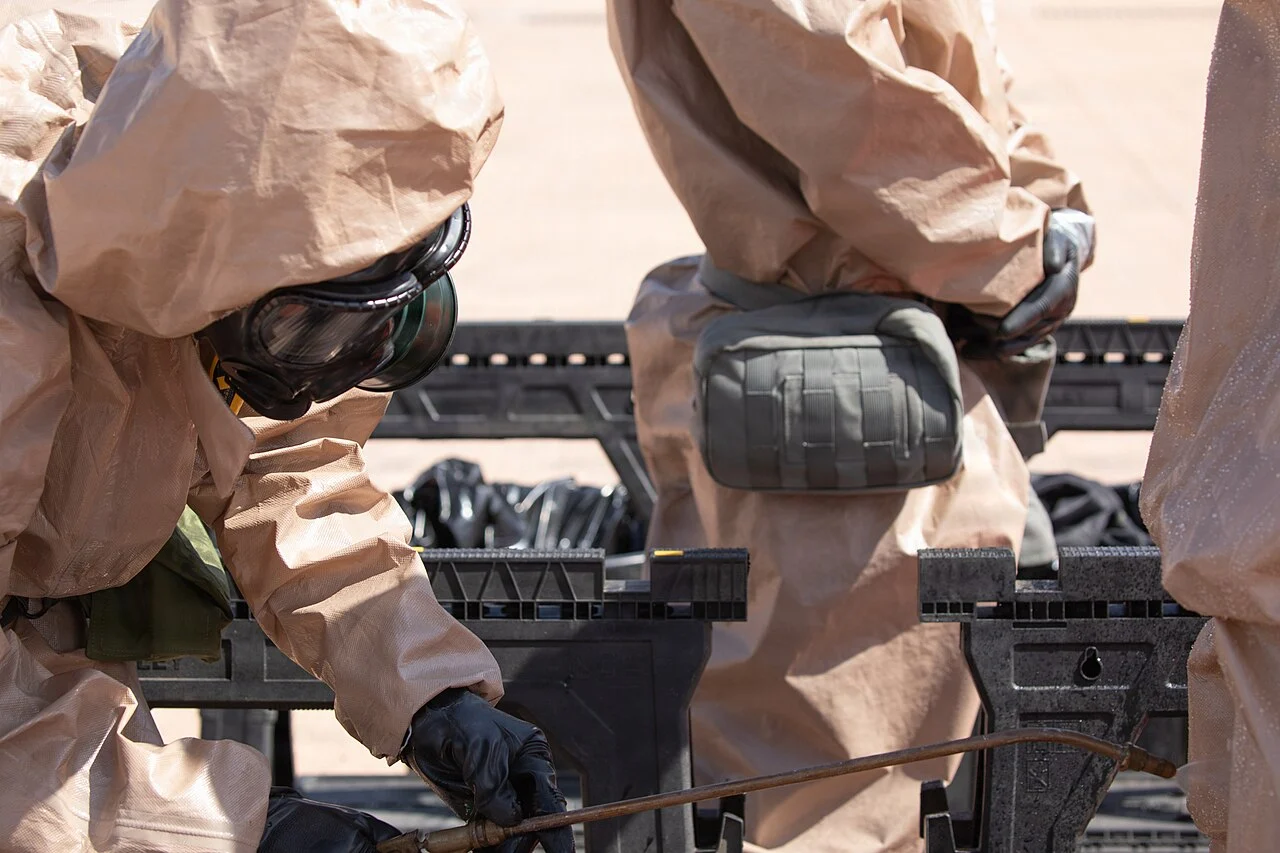
Photo: A service member decontaminates a protective suit during a simulated CBRN response drill at Exercise African Lion 26 in Agadir, Morocco (file photo, illustrative of CBRN training in Africa). Credit: U.S. Army photo by Staff Sgt. Rachel Skowyra, Public domain, via Wikimedia Commons
The “Assistance and Protection Course for African States Party to the Chemical Weapons Convention” ran from 21 to 29 September 2026 at the Ditholo military training area north of Pretoria, combining classroom instruction with hands-on practical drills, defenceWeb reported.
Twelve countries, one certified trainer
First responders from Gambia, Ghana, Kenya, Lesotho, Liberia, Malawi, Namibia, Nigeria, Seychelles, Sierra Leone, Zambia and Zimbabwe attended, according to defenceWeb. The course was led by the SA Military Health Service’s 7 Medical Battalion Group under Colonel Qaba Mafa, with Brigadier General Sehloho Thulo, general officer commanding the Mobile Military Health Formation, overseeing the programme, and SA Navy chemical-defence specialists supporting the instruction. South Africa’s Department of Trade, Industry and Competition — which administers the country’s obligations under the Chemical Weapons Convention — oversaw the course.
The detail that gives the course its weight is institutional rather than tactical: the South African National Defence Force is the only African state certified by the Organisation for the Prohibition of Chemical Weapons (OPCW) to deliver this specific assistance-and-protection training to other States Party. That certification makes South Africa the de facto regional hub for a capability most African militaries have no independent way to build.
Why this training exists
The OPCW’s Assistance and Protection programme is built around Article X of the Chemical Weapons Convention, which commits States Party to help each other respond to chemical attacks or hazardous chemical incidents — industrial accidents, transport spills, or deliberate use — regardless of whether a state has an active chemical-weapons threat. For most of the 12 participating countries, a domestic hazmat or chemical-incident response capability is thin to nonexistent; sending first responders to a SANDF-run, OPCW-recognised course is a faster route to a baseline capability than building one from scratch at home.
Why it matters for Africa
Chemical-incident response capacity is not a theoretical concern for the continent: industrial accidents involving chlorine, ammonia and other hazardous chemicals occur periodically at African ports, mines and processing plants, and the same first-responder skills apply whether the trigger is an industrial leak or a deliberate attack. Beyond the immediate training value, South Africa’s OPCW certification gives it a form of soft-power leverage in regional defence cooperation that has nothing to do with hardware sales: a recurring reason for a dozen African militaries’ chemical-defence specialists to train in South Africa, embed South African doctrine, and build personal and institutional relationships with the SANDF. That kind of low-cost, recurring defence-cooperation programme tends to generate longer-term influence than a single arms sale, and it reinforces South Africa’s position as a continental training hub even as its conventional force posture faces budget pressure elsewhere.