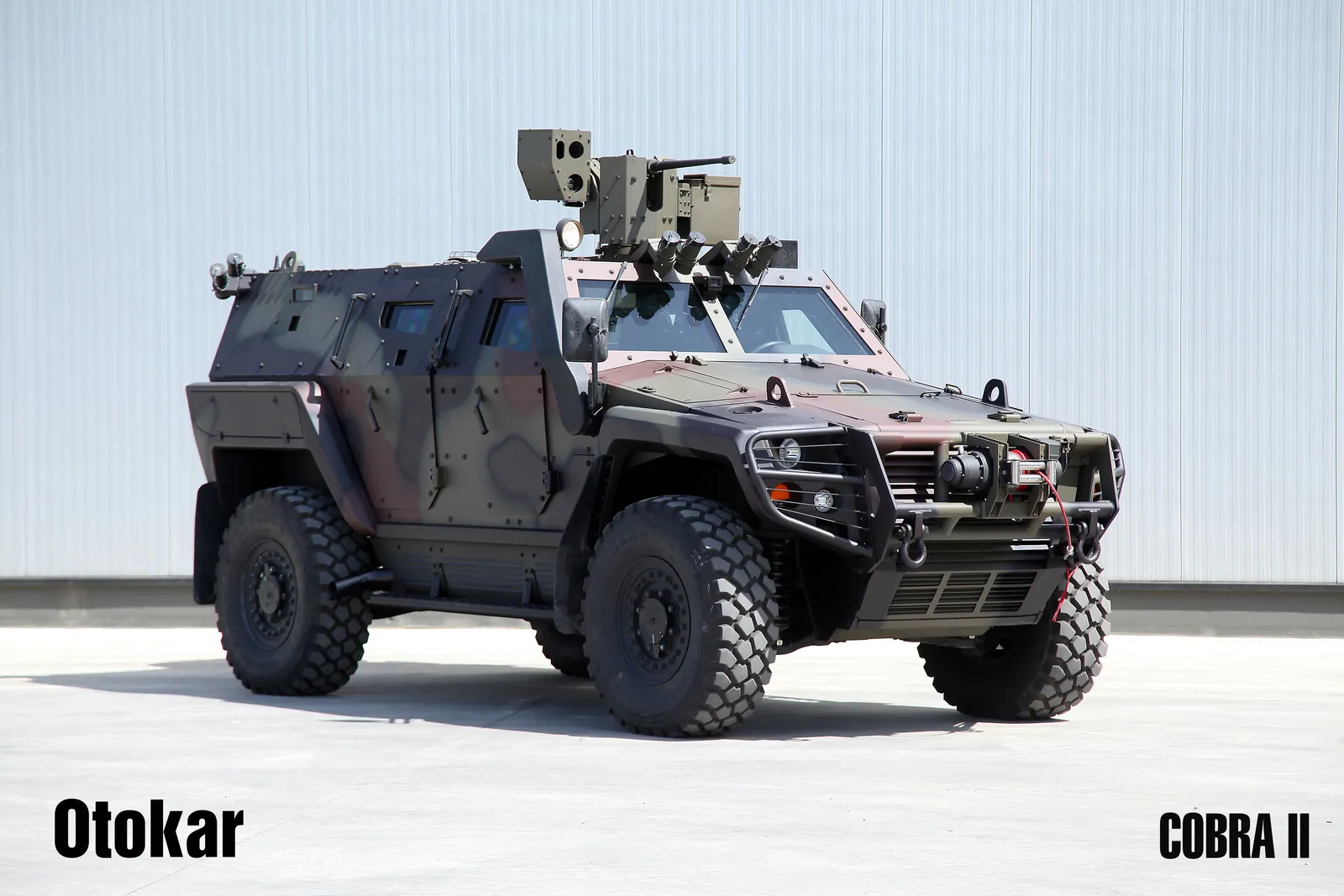
The Otokar COBRA II is a 4×4 tactical armoured vehicle that Türkiye’s police and gendarmerie use for border security, internal security and convoy work, and that Otokar has sold to more than a dozen countries since its 2013 launch. It carries up to 11 people, weighs up to 14.5 tonnes and runs on a 360 hp diesel. This file sets out what the vehicle is, how it fits into the Turkish land-vehicle programme managed by Türkiye’s Presidency of Defence Industries (SSB), who operates it, and why it is a natural candidate for African armies and gendarmeries.
Photo: Presidency of Defence Industries (SSB), Türkiye.
What is the COBRA II?
The COBRA II is the second-generation member of Otokar’s Cobra family. The original Cobra, a light 4×4 built on a Humvee-derived drivetrain, made the Sakarya-based company’s name in export markets in the 2000s, from Nigeria to Georgia. When Otokar unveiled the COBRA II at IDEF in 2013, it was a clean-sheet design rather than an update: a larger, heavier vehicle with a monocoque armoured hull, a much bigger protected volume and room for a full infantry section. Otokar, part of Koç Group, says it was developed for the needs of the Turkish Armed Forces and allied countries, and that modularity was a design goal from the start.
That modularity is what explains the vehicle’s spread. On the same hull Otokar offers an armoured personnel carrier with an open cupola or a remote weapon station, an internal security vehicle, command and control, ambulance, CBRN reconnaissance, anti-tank, air-defence, mortar fire detection radar, mobile satcom, recovery and reconnaissance and surveillance versions. A separate COBRA II MRAP, with a deeper V-hull and a gross weight of up to 19 tonnes, was added later for customers who expect heavy mine and IED threats. The result is a family that a ministry can buy once and then use across police, gendarmerie and army units without changing its training or spare-parts pipeline.
Key specifications
The figures below come from Otokar’s current COBRA II brochure (AZ77EG-25). Otokar does not publish a numeric STANAG 4569 protection level; it describes the vehicle as offering high ballistic and mine protection, and protection is tailored to each contract.
| Manufacturer | Otokar Otomotiv ve Savunma Sanayi A.Ş. (Koç Group), Arifiye, Sakarya, Türkiye |
| Type | 4×4 tactical wheeled armoured vehicle |
| First shown | IDEF 2013, Istanbul |
| Turkish users (SSB data) | General Directorate of Security (EGM, National Police) and Gendarmerie General Command (JGK) |
| Crew | Up to 11, including driver and commander |
| Gross vehicle weight | Up to 14,500 kg (COBRA II MRAP: up to 19,000 kg) |
| Dimensions | Length 6.4 m with winch and spare wheel; width 2.5 m; height over hull 2.3 m; ground clearance 400 mm |
| Engine | Turbocharged diesel, 360 hp |
| Transmission | Automatic, two-speed transfer case with differential lock |
| Suspension | Fully independent, coil spring and shock absorber |
| Speed / range | 110 km/h / 700 km |
| Mobility | 60% gradient, 30% side slope, 500 mm vertical obstacle, 1,000 mm trench and fording |
| Tyres | 395/85 R20 with run-flat system |
| Driving position | Right- or left-hand drive |
The SSB programme and Turkish service
In the SSB land vehicles portfolio, the COBRA II is listed with Otokar as prime contractor and two users: the General Directorate of Security (EGM), which is the Turkish National Police, and the Gendarmerie General Command (JGK). That pairing says a good deal about the vehicle’s role at home. It is not primarily a front-line army carrier. It is the protected workhorse of Türkiye’s internal security forces, used on the borders, on rural roads where gendarmerie patrols face mines and ambushes, and in urban public order tasks where the police need a vehicle that can take a hit and keep moving.
The domestic orders have come in tranches. In 2016 Otokar announced a €106.1 million contract to supply COBRA II vehicles, with maintenance and support systems, to Turkish security forces. Border-security versions fitted with ground surveillance radar, weapon detection equipment and electro-optical sights followed for the long eastern and south-eastern frontiers. Each batch has fed back into the design, which is one reason the COBRA II of 2026 is a heavier, better-protected vehicle than the one first shown in 2013.
SSB’s role in this has been typical of how Ankara now buys land systems. Rather than importing a foreign 4×4 for its police and gendarmerie, the presidency kept the requirement inside the domestic industry, pushed for Turkish-made subsystems such as ASELSAN remote weapon stations and locally produced armour, and used the home order book to give Otokar a stable production base. That base is what made the export campaigns possible. A vehicle that is in daily service with a country’s own security forces, and is supported by a national procurement agency, is an easier sell to a foreign ministry than a prototype.
Who operates the COBRA II?
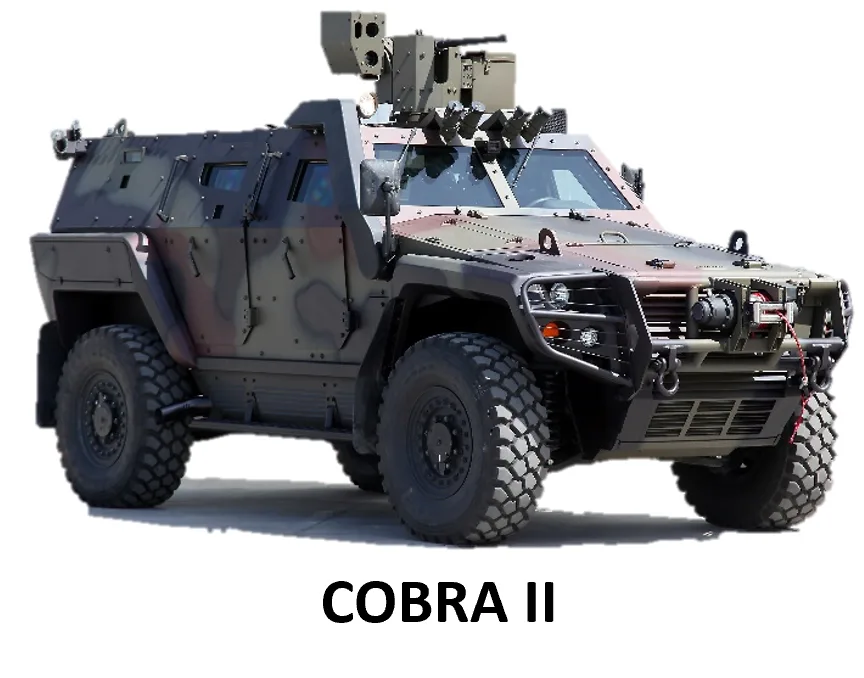
Otokar said in December 2025 that the COBRA II is used by more than 20 users in 13 countries and that around 30 variants have been developed. Army Recognition’s data page lists Azerbaijan, Bangladesh, Ecuador, Ghana, Côte d’Ivoire, Rwanda, Romania, Senegal, Tunisia, Türkiye and Ukraine among the users. The United Nations has also fielded Cobra vehicles in peacekeeping missions through troop-contributing countries.
Romania is the largest single customer. Bucharest signed a contract worth about €857 million for 1,059 COBRA II vehicles in 2024, with 278 built in Sakarya and the rest assembled by Automecanica in Mediaș. The Romanian defence ministry announced on 30 July 2026 that it had received the first 12 vehicles produced in Romania. For a NATO member to adopt a Turkish 4×4 as its standard light armoured vehicle, and to build most of the fleet at home, is a strong reference for any other buyer.
In Africa, the COBRA II is in service with Ghana, which received 40 in 2021 on top of earlier Cobras, with Côte d’Ivoire, which paraded about 20, and with Senegal’s Gendarmerie and Rwanda, whose troops have used Turkish armoured vehicles on UN missions and in Mozambique. Tunisia has taken delivery of Cobra and COBRA II vehicles. Morocco placed a US$136 million order with Otokar in December 2023, identified in the press as 200 COBRA IIs. Turkish media reported in 2025 that Saudi Arabia had also joined the buyer list. Country-by-country detail, including quantities where they are public and the difference between ordered, delivered and operational, is kept on our Otokar Cobra operator tracker for Africa.
Can the COBRA II go to Africa?
It already has, and the case for more is strong. The vehicle’s design choices line up closely with what African security forces ask for. Independent suspension and 400 mm of ground clearance matter on laterite roads that turn to mud in the rainy season. A 700 km range lets a gendarmerie patrol in the Sahel or northern Nigeria cover long distances between fuel points. Run-flat tyres and a protected hull answer the IED and ambush threat that dominates internal security operations from the Lake Chad basin to Cabo Delgado. And the option of right- or left-hand drive is a small detail that matters in East and Southern Africa, where Kenya, Tanzania, Uganda, Mozambique and South Africa all drive on the left.
The other strength is the customer mix. The COBRA II sits comfortably between army and police use, which suits countries where the gendarmerie or a paramilitary police force carries much of the counter-insurgency load. Senegal’s Gendarmerie and Côte d’Ivoire’s forces are examples, and other Francophone gendarmeries in West and Central Africa run on the same model. Otokar also brings an established African network: the original Cobra has been in Nigerian service since 2007, and the company has supported vehicles in Ghana, Rwanda and Mauritania for years.
Likely opportunities include gendarmerie and police mobile units in coastal West Africa, where Benin, Togo and Ghana are reinforcing their northern borders; Kenya and Tanzania, where left-hand-drive configurations and police use fit the vehicle well; and Lusophone markets such as Mozambique and Angola, where security forces need protected mobility for long-distance patrols. Morocco’s large order shows that North African armies see the COBRA II as a serious platform, and the Romanian model of local assembly offers a route for any African country that wants industrial participation alongside the vehicles.
How it compares
In the African light-armour market the COBRA II usually meets the Arquus Bastion and the NORINCO VN4. On the manufacturers’ own figures the COBRA II is the heaviest and most powerful of the three, with the largest crew compartment, which buys protection and payload. We have set out the full side-by-side in Cobra II vs Bastion vs VN4. Inside the Turkish range, the COBRA II sits alongside Nurol Makina’s Ejder Yalçın and BMC’s Kirpi. For more on the manufacturer, see our Otokar company profile.
Frequently asked questions
What is the Otokar COBRA II?
The COBRA II is a 4×4 tactical wheeled armoured vehicle built by Otokar of Türkiye and first shown at IDEF 2013. It carries up to 11 people, has a gross weight of up to 14,500 kg and a 360 hp turbocharged diesel, and is offered in about 30 variants from personnel carrier to air defence.
Which Turkish forces use the COBRA II?
According to Türkiye’s Presidency of Defence Industries (SSB), the Turkish users are the General Directorate of Security (EGM, the National Police) and the Gendarmerie General Command (JGK). It is used for border security, internal security and convoy protection.
Which African countries operate the COBRA II?
Documented African users include Ghana, Côte d’Ivoire, Senegal’s Gendarmerie and Rwanda, with Tunisia having received Cobra and COBRA II vehicles. Morocco ordered about 200 COBRA IIs in December 2023, worth US$136 million.
What is the range and speed of the COBRA II?
Otokar quotes a maximum speed of 110 km/h and a range of 700 km. The vehicle climbs a 60% gradient, handles a 30% side slope and fords 1 metre of water.
Is the COBRA II built outside Türkiye?
Yes. Under Romania’s 2024 contract for 1,059 vehicles, most are being assembled by Automecanica in Mediaș, and the first Romanian-built vehicles were delivered in July 2026.
Sources: Otokar COBRA II brochure AZ77EG-25 (2025); Otokar press releases (2016, 2025); Army Recognition COBRA II data page; Romanian Ministry of National Defence press release, 30 July 2026; SSB land vehicles portfolio (2026).