BAMEX 2026: Mali’s Second Defence Fair Opens as Turkey Expands Its Sahel Footprint



Mali’s second Bamako International Defence and Security Exhibition, BAMEX 2026, opens on 9 November with more than 20 Turkish companies and, for the first time, an international exhibitor list beyond Türkiye alone. Organisers are targeting up to $500 million in business, more than three times the roughly $150 million reported after the inaugural 2025 edition.
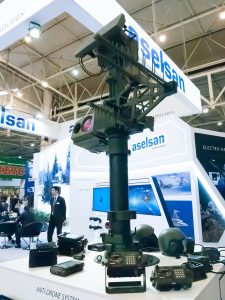
Photo: ASELSAN’s exhibit at an international defence fair. Credit: Krzysztof Popławski, CC BY 4.0, via Wikimedia Commons
The five-day fair runs from 9 to 13 November at Bamako’s exhibition grounds, under the patronage of Mali’s presidency and defence ministry. It is organised by the Turkish firm Prontaron Savunma Sanayi, trading as The Peak Defense, which also ran the 2025 debut edition. The final two days are set aside for “Demo Day” live-fire and field demonstrations in a secured military area outside the capital, where delegations can watch vehicles, drones and weapons tested under field conditions rather than on a static stand.
From a Turkish showcase to an international fair
BAMEX’s first edition, held in Bamako in November 2025, was a Turkish-only affair: around 30 companies, including Baykar, ASELSAN, ROKETSAN, MKE, STM and Otokar, exhibited under Türkiye’s Presidency of Defence Industries (SSB), with Malian Prime Minister Abdoulaye Maiga and Turkish ambassador Efe Ceylan both speaking at the opening. According to Military Africa, BAMEX chairman Harun Saraç has set a different target for 2026: “stronger international participation” and “high level official delegations,” built around what he called “the right companies and the right delegations in Bamako” rather than simply more exhibitors.
Saraç has said the measure of the fair’s success lies not in the exhibition hall but in what follows it — procurement contracts, local partnerships, training programmes, technology-transfer agreements and maintenance deals. More than 20 Turkish firms are confirmed again for 2026, among them Baykar, ASELSAN, ROKETSAN, Skydagger and Prontaron Savunma itself, alongside SSB. Organisers expect delegations from dozens of African states, built around land systems, UAV and counter-UAS platforms, weapons and ammunition, electro-optics, communications, border security and ISR, according to TurDef and Military Africa reporting.
Why Mali, and why Türkiye
Mali has become one of the clearest cases of a West African state redirecting its security partnerships toward Ankara. France withdrew its forces from the country after relations collapsed, and Mali, together with fellow Alliance of Sahel States members Burkina Faso and Niger, has since leaned on Turkish, Russian and Chinese suppliers rather than Western ones. Bayraktar TB2 drones, first delivered to Niger in 2022 before Malian forces gained access to the type, have been credited in regional reporting with supporting Malian operations, including the recapture of the northern town of Kidal from separatist and jihadist forces. Mali has since added Bayraktar Akıncı drones to its inventory, Military Africa reported in August, part of a broader shift in Mali’s military hardware toward Turkish, Russian and Chinese suppliers over the past three years.
Turkish officials have framed the relationship as reciprocal rather than purely transactional. At the 2025 opening, Ambassador Ceylan said Ankara would “keep supporting Mali’s fight against terrorism” and described Türkiye as “a reliable partner,” pointing to similar defence ties with Niger and Burkina Faso. Mali’s government, for its part, has cast the fair as a step toward what Prime Minister Maiga called a “more secure, sovereign, and resilient Africa” — a framing that fits the broader Sahelian push for security autonomy from former colonial and Western partners.
Not every assessment is uncritical. An analysis by Military Africa published in July questioned whether the Turkish model — overwhelmingly built on direct sales rather than local manufacturing or technology transfer — leaves lasting industrial capacity behind in host countries, contrasting it with deeper localisation deals Türkiye has struck in North Africa. Whether BAMEX 2026’s stated push toward “international” participation changes that balance, or simply widens the roster of foreign sellers, is likely to be one of the questions delegations raise on the sidelines of the Bamako fair.
Why it matters for Africa
BAMEX sits alongside AFRIDEX in Lagos and the Marrakech Airshow as evidence that African capitals, not just Paris, Abu Dhabi or Moscow trade shows, are now hosting the deals that shape the continent’s defence procurement. For the Sahel specifically, the fair is a barometer of how fast Mali, Burkina Faso and Niger are converting their post-French realignment into formal supply relationships — and whether competitors to Türkiye, including Russia’s Rosoboronexport and Chinese state exporters, show up in Bamako to contest a market Ankara has so far had largely to itself. A jump from $150 million to a $500 million target, even as an organiser’s aspiration rather than a confirmed outcome, would mark a rapid scaling of formal defence commerce in a landlocked, resource-dependent state still fighting a jihadist insurgency across its north and centre.
Sources
- Military Africa: “BAMEX 2026: Turning Mali Into Sahel’s Defence Hub, Says Chairman”
- Daily Sabah (Anadolu Agency): “Turkish companies showcased at inaugural defense fair in Mali”
- TurDef: “Mali’s BAMEX 2026 Targets $500M Defence Deals in Africa”
- Le Soleil: “Industrie de la défense: à travers le salon BAMEX, la Turquie veut se positionner en partenaire stratégique”
- Military Africa: “Mali Acquires Additional Akıncı Drones From Turkey”
- Military Africa: “Bought, Not Built: The Turkish Defence Model and the Capacity It Leaves Behind in Africa”