Mi-24 and Mi-35 Attack Helicopters in Africa: What Combat in Nigeria, Mali and Uganda Has Shown



The Mi-35 helicopter Nigeria flies against Boko Haram and ISWAP, and the Mi-24s Mali flies in the north, have seen more counter-insurgency combat than any other attack helicopters in West Africa. The public record of what they achieved is thin; the record of what they cost is clearer. Across Nigeria, Mali and Uganda the Hind is valued for firepower and armour, but fleets are small, ageing and hard to keep flying, and losses have come as often from accidents as from enemy fire.
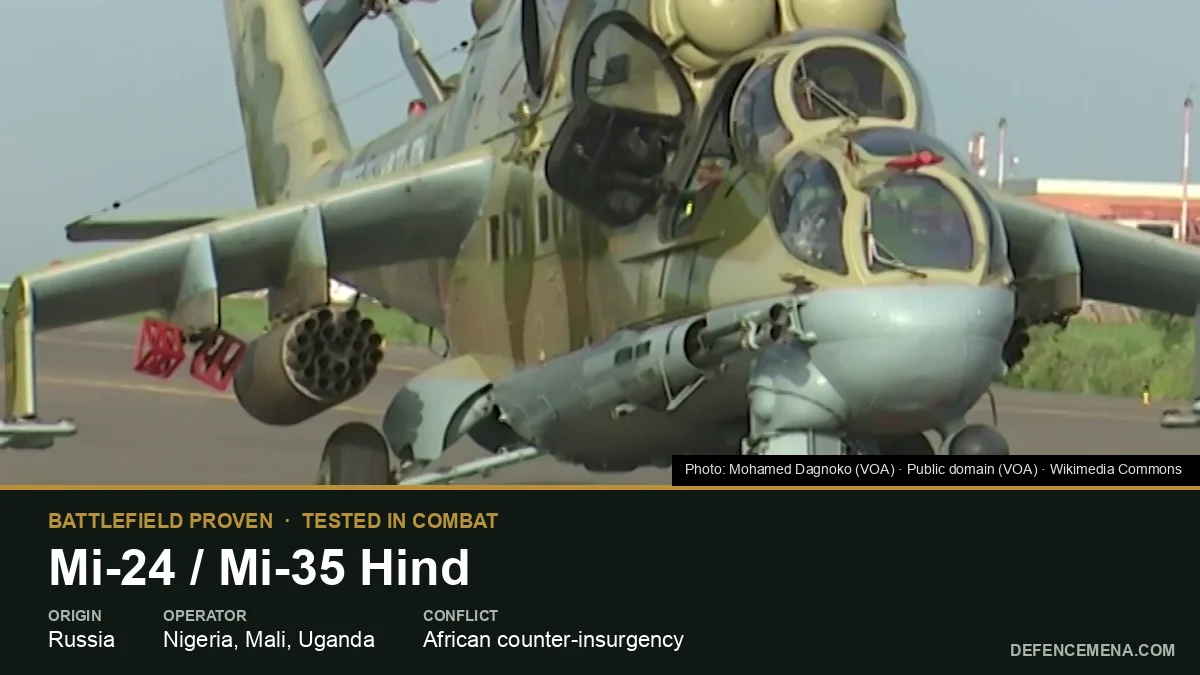
Photo: A Malian Air Force Mi-24P at Bamako, August 2022. Photo: Mohamed Dagnoko/VOA, public domain, via Wikimedia Commons. Credit: Mohamed Dagnoko (VOA), Public domain (VOA), via Wikimedia Commons.
Direct answer
Combat experience in Africa shows the Mi-24 and Mi-35 remain useful close air support platforms against lightly armed insurgents when they are serviceable, but small fleets, delivery delays, spare-parts problems and exposure to heavy machine guns limit what they deliver. Nigeria and Mali have both lost Hinds in combat zones and in accidents, and Mali has also lost them on the ground. Since 2022 both Nigeria and Uganda have hedged by adding non-Russian or newer types, while Mali has stayed with Russian supply and Russian-operated aircraft.
| System | Mil Mi-24 “Hind” family: Mi-24D/V/P, export Mi-35/Mi-35P, modernised Mi-35M |
| Manufacturer | Mil design bureau; current production and upgrades by Rostvertol (Russian Helicopters, Rostec) |
| Origin | Soviet Union / Russia |
| Operator(s) in these conflicts | Nigerian Air Force; Malian Air Force and Russian contingents (Wagner, then Africa Corps); Uganda People’s Defence Air Force |
| Period | Nigeria from 2000 (Mi-35P), Mi-35M from 2016; Mali Mi-35M from 2017, Mi-24P from 2022; Uganda in the DRC from 2021 and Somalia to 2025 |
| Evidence level summary | Operations: officially claimed, rarely type-specific. Losses: confirmed by operators in several cases; Mali 2024–2026 losses mostly claimed by armed groups or visually documented, not confirmed by Bamako or Moscow |
Where was it used?
Nigeria has the largest Hind fleet in West Africa. According to Military Africa, the Nigerian Air Force (NAF) built it in layers: second-hand Mi-35Ps from Russia in 2000, used aircraft from Ukraine and Belarus in 2008–2014, then new Mi-35Ms. A 2015 order for 12 Mi-35Ms was followed by a second 12-helicopter contract announced at the Russia-Africa summit in Sochi in October 2019. The helicopters have flown against Boko Haram and ISWAP in the North-East, against armed bandit groups in the North-West, and from 115 Special Operations Group in Port Harcourt against oil theft in the Niger Delta. Public estimates of the current fleet range from about 15 to over 20 airframes across several variants; there is no single reliable public figure. DefenceMENA’s Nigerian Air Force aircraft inventory tracks the wider fleet.
Mali has flown older Mi-24Ds for years. defenceWeb reported that a 2016 contract for four Mi-35Ms was completed in January 2021, and that two Mi-24Ps arrived by Russian transport aircraft in March 2022, shortly after Russian personnel began operating in the country. Russian contingents, first Wagner and then Africa Corps, have also been reported flying their own Hinds in Mali.
Uganda operates about a dozen Mi-24/35s, according to defenceWeb, and has used them in Operation Shujaa against the Allied Democratic Forces (ADF) in eastern DR Congo since November 2021, and with the African Union mission in Somalia.
What was the mission?
In all three countries the Hind has been used mainly for close air support of ground troops, armed reconnaissance, convoy and route escort, and strikes on camps. In Nigeria, NAF statements describe helicopter gunships supporting troops under attack, engaging insurgent vehicles and flying night missions, often alongside an ISR aircraft. In Mali, Hinds have supported ground columns and convoys in the north, around Kidal and Gao, according to Malian statements and open-source reporting. Uganda’s president credited aircraft in Operation Shujaa with fast, accurate surprise strikes on ADF camps.
What does the public evidence show?
Operators publish strike claims but seldom name the aircraft type; losses surface through crash statements, local media or armed-group videos. The table separates what operators confirmed from what others claimed.
| Claim / event | Date | Evidence level | Source |
|---|---|---|---|
| NAF Mi-35 crashes south of Bama, Borno, on a training mission; NAF cites technical fault; crew fatalities | July 2014 | Confirmed (NAF statement) | Premium Times |
| NAF attack helicopter and Alpha Jet strike bandits in Rugu Forest, Zamfara; several reported killed | Feb 2019 | Officially claimed (type not named) | NAF via PRNigeria |
| NAF Mi-35M crashes near Damasak during close air support for 145 Battalion; five crew killed | 2 Jan 2019 | Confirmed loss; cause not publicly established | NAF via defenceWeb |
| Nigeria signs for 12 more Mi-35s at Sochi summit | Oct 2019 | Confirmed (Russian official) | The Defense Post, defenceWeb |
| Russia says the 12-helicopter Nigerian contract is “partially fulfilled” | 2023 | Officially stated | Defense Express |
| NAF Mi-35P crashes after take-off from Port Harcourt for an operation; crew survive | 1 Dec 2023 | Confirmed (NAF statement) | Military Africa |
| Malian Mi-24D crashes in Bamako on return from a mission; three crew killed | 22 Apr 2023 | Confirmed (FAMa) | Military Africa |
| Malian helicopter lost at Kidal during Tinzaouaten fighting; FAMa says crash with no casualties, rebels claim shoot-down | Jul 2024 | Confirmed loss; cause disputed | Military Africa |
| Malian Mi-24P (reported as TZ-07H) abandoned and taken by FLA fighters in the north | Apr 2026 | Visually documented (OSINT) | Military Africa, UNITED24 |
| FLA says it destroyed a Russian-operated Mi-24P near Gao | 4–5 Jul 2026 | Claimed; not confirmed by Russia or Mali | UNITED24 |
| UPDF Mi-24 crashes at Mogadishu airport on an escort mission; five killed | 2 Jul 2025 | Confirmed (AU, UPDF) | African Union, Al Jazeera/Reuters |
What worked?
Three things stand out in the record. First, presence and firepower against lightly armed groups. Nigerian statements over more than a decade describe helicopter gunships breaking up attacks on bases and convoys. The casualty figures cannot be independently verified, but the consistent tasking shows commanders value the aircraft for this role.
Second, protection. The Hind’s armoured cockpit and twin engines were designed to survive small-arms fire. Crews survived the July 2024 Kidal crash, according to Malian authorities, and the 2023 Port Harcourt crash. Causes were not published, so neither case proves the armour worked.
Third, local maintenance can be built. The NAF returned two long-grounded Mi-35Ps (NAF 531 in 2018 and NAF 530 in April 2020) to service after in-house refurbishment at Port Harcourt. Uganda opened a helicopter maintenance, repair and overhaul facility at Nakasongola in January 2022, a joint venture with the Russian firm Pro-heli International, to refurbish its Mi-24s.
What problems appeared?
Availability. NAF 530 had been grounded from June 2016 until its 2020 return. Fleet counts in open sources differ widely, which usually means airframes on paper and flyable airframes are not the same.
Delivery delays. The October 2019 contract for 12 Mi-35s was described by a Russian official in 2023 only as “partially fulfilled”, and Defense Express noted no publicly reported deliveries since 2019. Nigeria’s ambassador to Moscow had already said in 2019 that sanctions on Russia did not help the process. Since 2022 Russia’s own war has competed for production and spares, and buyers of Russian defence goods face US sanctions risk under CAATSA.
Supply chains split by war. Many of Africa’s Hinds were overhauled or supplied through Ukraine, Belarus or Russia. The Russia-Ukraine war has in practice removed Ukraine as a source of parts and overhaul for Russian-origin fleets, and Mali cut diplomatic ties with Kyiv in 2024. That leaves operators dependent on Russia, Belarus, in-house work or third parties such as South African upgrade firms.
Exposure at low level. Mali’s losses since 2024 occurred in the far north and around Gao, where armed groups field heavy machine guns and anti-aircraft cannon on pickups. Analysts cited by UNITED24 suggested 23 mm fire in the July 2026 case; that assessment rests on video and is not confirmed.
Confirmed losses and limitations
Nigeria. The NAF has publicly confirmed at least three Hind-family losses: a July 2014 training crash near Bama attributed to a technical fault, the Mi-35M lost near Damasak on 2 January 2019 with all five crew, and the Mi-35P that crashed after take-off from Port Harcourt on 1 December 2023. The NAF did not attribute the Damasak crash to hostile fire and has published no final report. Older Mi-24V/Ps were retired from 2023, according to Military Africa.
Mali. A Mi-24D crashed in Bamako on 22 April 2023, killing three crew. In July 2024 the armed forces acknowledged a helicopter crash at Kidal with no casualties; rebels said they shot it down. In late April 2026, during the FLA and JNIM offensive in which Defence Minister Sadio Camara was killed, open-source analysts identified a Malian Mi-24P abandoned in the north and in rebel hands. Russian-operated helicopters were also lost (see below). Military Africa estimated Mali had about a dozen combat helicopters before these losses.
Uganda. A UPDF Mi-24 on a combat escort mission crashed at Mogadishu’s airport on 2 July 2025. The African Union Commission confirmed the crash; Reuters reported five dead and three crew injured. In October 2022 two Ugandan helicopters supporting operations against the ADF crashed; the UPDF did not publish causes.
Civilian harm. A UN human rights fact-finding report published in May 2023 found strong indications that Malian troops and foreign military personnel killed more than 500 people at Moura in March 2022, in an operation during which witnesses said a military helicopter fired on people and others landed troops. The report did not identify the helicopter type. Mali’s authorities rejected the report.
What is still disputed?
- Causes of combat-zone crashes. Damasak 2019 and Kidal 2024 are confirmed losses with contested or unpublished causes.
- The Russian helicopter lost near Gao on 25 April 2026. Reports differ over whether it was a Mi-8AMTSh transport or a Mi-35 gunship; Moscow has given no details.
- Airframe identities. Open-source reporting has linked the registration TZ-07H to both the 2024 Kidal loss and the 2026 capture. Either the 2024 aircraft was recovered and repaired, or one identification is wrong.
- Strike results. NAF and FAMa casualty claims from helicopter strikes cannot be independently verified.
- A reported Russian refusal of new gunships to the Alliance of Sahel States. A French aviation site reported in July 2026 that Moscow turned down a Mi-35M request, citing no official source; DefenceMENA treats it as unverified.
Did the manufacturer or operator change anything?
Russian Helicopters began serial production of an upgraded Mi-35P at Rostvertol in 2020, with a third-generation thermal sight and digital flight control. Nigeria’s 2021 budget, Military Africa reported, included about N3.3 billion towards upgrading three older Mi-35s to this standard; completion has not been publicly confirmed.
The bigger change was on the operator side. Nigeria ordered six Turkish T129 ATAK helicopters, the first two delivered in November 2023 according to defenceWeb with further deliveries reported in 2024, and ordered 12 Bell AH-1Z Vipers through the US Foreign Military Sales route; production began in 2026, as covered in Why Nigeria Bought the AH-1Z Viper and Bell’s production start. Armed drones and light attack aircraft took over many strike tasks; see military drones operated across Africa and light attack aircraft for counter-insurgency air forces. Uganda added Mi-28 helicopters in 2022, and Mali expanded its armed drone fleet, including the latest Akinci batch at Sévaré.
Did other countries buy it afterwards?
Hinds still change hands in Africa, in small numbers and increasingly second-hand. Algeria, which is receiving Mi-28NEs, donated two South African-upgraded Super Hind Mk IIIs to Niger in August 2026.
| Buyer | Year | What | Source |
|---|---|---|---|
| Nigeria | 2015 / 2019 | 12 Mi-35M ordered; second contract for 12 announced, “partially fulfilled” | The Defense Post, Defense Express |
| Mali | 2016–2021 | 4 Mi-35M, deliveries completed January 2021 | defenceWeb |
| Mali | 2022 | 2 Mi-24P | defenceWeb |
| Togo | 2022 | 3 Mi-35M with 2 Mi-17s | Military Africa |
| Niger | 2026 | 2 Mi-24 Super Hind Mk III donated by Algeria | defenceWeb |
The trend matters more than the list: Nigeria and Uganda, the two largest Hind users here, both bought other attack helicopters after 2021. New Russian-built Mi-35M deliveries to Africa since 2022 have been small, and the transport fleet has followed a similar path, as set out in which African countries operate the Mi-17.
What does this mean for African procurement?
Buy the support, not only the helicopter. Nigerian and Ugandan depot work shows grounded airframes can be recovered locally. Without it, availability depends on a supplier whose own war has first call on parts.
Plan for supplier risk. The Hind supply chain once ran through Russia, Ukraine and Belarus; after 2022 it runs mainly through Russia and Belarus, under sanctions pressure. Operators keeping Hinds need a ten-year view of where engines, gearboxes and rotor blades will come from.
Treat the gunship as part of a system. Sensors, night capability, self-protection, ISR cover and links to ground troops matter as much as the airframe.
Protect the bases. Mali’s 2026 losses included aircraft left behind or hit on the ground, not only in the air. Air base defence and counter-drone cover are now part of any helicopter fleet cost; DefenceMENA’s review of counter-drone systems for African armies covers the options.
Watch mixed fleets. Nigeria will soon fly Russian, Turkish and American attack helicopters, which spreads supplier risk but multiplies training, spares and weapons pipelines. The DefenceMENA military equipment database tracks these fleets by country.
Battlefield file: 7 cards
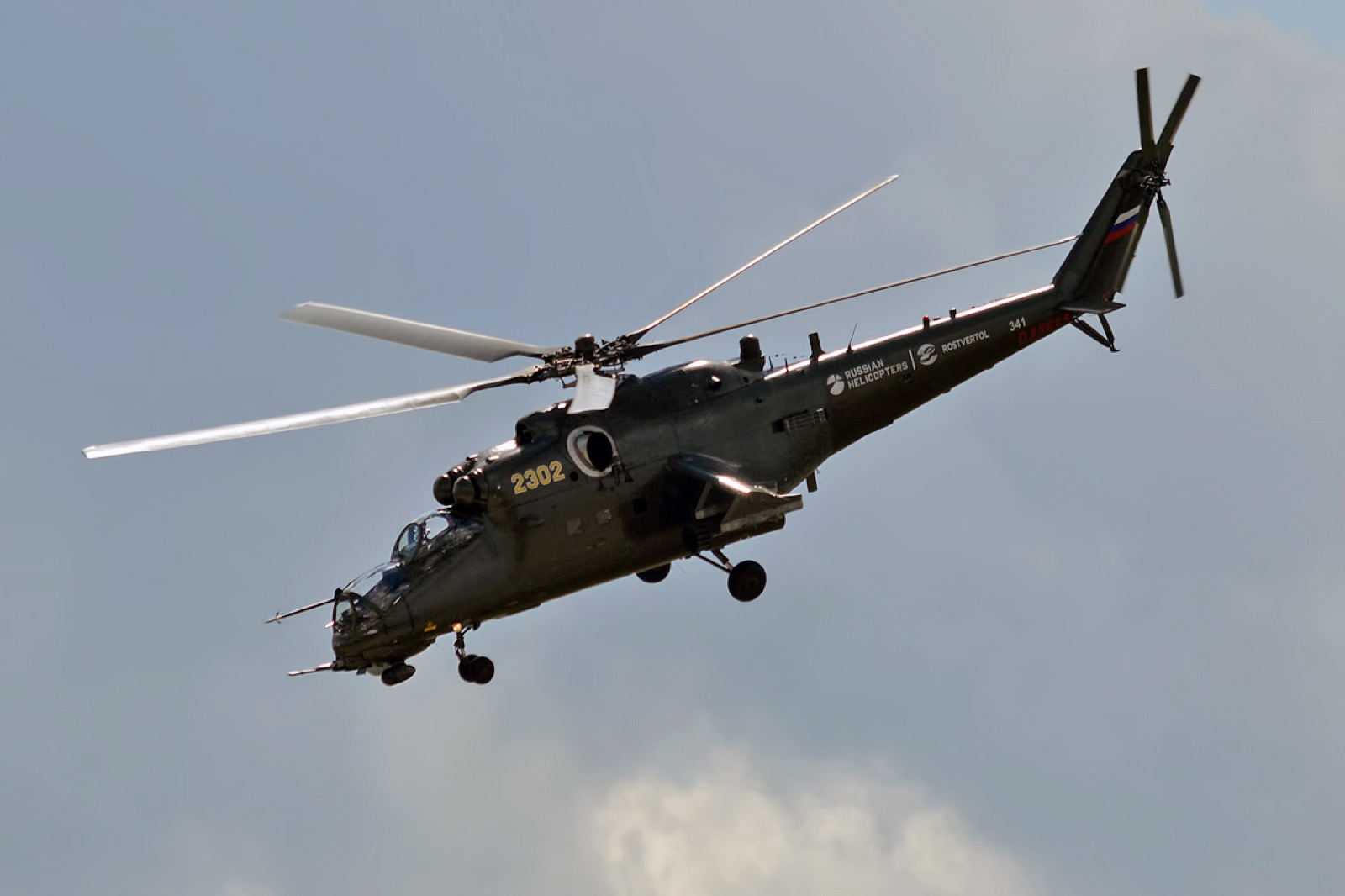
The Mi-24/Mi-35 Hind family, now built and upgraded by Rostvertol; Africa flies everything from 1980s Mi-24Ds to new Mi-35Ms.
Against Boko Haram, ISWAP and bandits in Nigeria, armed groups in northern and central Mali, and the ADF in eastern DR Congo.
Supporting troops under attack, escorting convoys and striking camps, often with an ISR aircraft overhead.
Operators publish strike claims but rarely name the aircraft; losses are better documented than results.
Confirmed crashes in Nigeria, Mali and Uganda; further Malian and Russian-operated Hinds lost in Mali’s 2026 fighting.
Nigeria added T129s and ordered AH-1Zs, Uganda bought Mi-28s, and drones took over many strike tasks.
Local depots and a secure parts pipeline matter more than the airframe when the supplier is at war and under sanctions.
FAQ
Mi-35 helicopter Nigeria: which variants are in service?
The Nigerian Air Force flies Mi-35P and Mi-35M gunships, plus a declining number of older Mi-24V/Ps, against Boko Haram, ISWAP and armed bandits. It has also added Turkish T129s and ordered US AH-1Z Vipers.
What is the difference between the Mi-24 and the Mi-35?
Mi-35 is the export name for the Mi-24 family. The Mi-35P is the export version of the cannon-armed Mi-24P, and the name was later reused for a modernisation package. The Mi-35M is a newer build with more powerful engines, a new rotor system, shorter wings, fixed landing gear and a night-capable glass cockpit.
How many Mi-35 helicopters has Nigeria lost?
The NAF has publicly confirmed at least three Hind-family crashes: near Bama in 2014, near Damasak in 2019 (five crew killed) and at Port Harcourt in 2023 (crew survived). Causes of the combat-zone losses have not been published.
Has a Mi-24 been shot down in Mali?
Armed groups claim to have downed Malian and Russian-operated Hinds in 2024 and 2026. Mali confirmed a helicopter loss at Kidal in July 2024 but described it as a crash. A Malian Mi-24P was visually documented in rebel hands in 2026. The July 2026 claim near Gao is unconfirmed.
Sources
- The Defense Post: Nigeria signs contract for 12 Mi-35 gunships (Oct 2019)
- defenceWeb: Nigeria confirms order for a dozen Mi-35 helicopters
- Defense Express: Nigerian Mi-35 contract “partially fulfilled” (2023)
- Premium Times: Nigerian Air Force helicopter crashes in Borno (2014)
- defenceWeb: NAF loses Mi-35 near Damasak (2019)
- Military Africa: Nigeria’s Mi-35P crashes at Port Harcourt (2023)
- defenceWeb: NAF returns another Mi-35 to service (2020)
- Military Africa: Nigeria turns to Rosoboronexport for Mi-35P upgrade
- PRNigeria: NAF helicopter and jet strike bandits in Zamfara (NAF statement)
- Vertical: Rostec launches serial production of upgraded Mi-35P (2020)
- defenceWeb: Mali receives Mi-24s and radars from Russia (2022)
- Military Africa: Mali Mi-24D crash in Bamako (2023)
- Military Africa: Malian helicopter losses at Kidal and Tinzaouaten (2024)
- Military Africa: Mali loses Mi-24P to rebels (2026)
- UNITED24 Media: FLA claims Russian-operated Mi-24 near Gao (Jul 2026)
- Al Jazeera: Mali’s defence minister killed in coordinated attacks (Apr 2026)
- UN News: Moura fact-finding report (May 2023)
- African Union: statement on AUSSOM helicopter crash (Jul 2025)
- Al Jazeera: AU helicopter crash at Mogadishu airport (Jul 2025)
- defenceWeb: Algeria donates Mi-24 and Mi-171 helicopters to Niger (Aug 2026)
Operators in Nigeria, Mali and Uganda rarely name the aircraft type in strike statements, and several combat-zone losses have no published investigation. Claims by armed groups and open-source identifications are reported as claims. Fleet sizes are estimates from secondary sources. This article will be updated at the same URL if significant new evidence appears.
More from Battlefield Proven
- Bayraktar TB2 in Libya: What Did Its Combat Use Actually Show?
- Sudan War Drones: What the Evidence Shows on SAF and RSF Since 2023
- Pantsir-S1 in Libya: What the Battlefield Record Revealed
- Drones in the Ethiopia War: What Is Confirmed and What Remains Unverified
- Wing Loong II in Libya: How Did China's Armed Drone Perform in Combat?
- Bayraktar TB2 and Akinci in Mali and Burkina Faso: What Combat Use Has Shown
- Nigeria Super Tucano: What Five Years of Combat Use Have Shown
- BMC Kirpi in Africa: What Is Publicly Known About Its Mine and IED Protection Record