The UAE Ordered 80 Rafales From France. French Jets Defended It First



France sold the UAE its first Mirage jets in the 1980s, then Leclerc tanks, Baynunah corvettes and, in December 2021, a record order for 80 Rafale fighters. Three months before the Emirati Air Force has taken delivery of a single operational Rafale, it was French Air Force Rafales, flying out of Al Dhafra, that intercepted Iranian drones over the UAE. This is how the relationship was built, what Paris has actually delivered, and what is still only a contract.
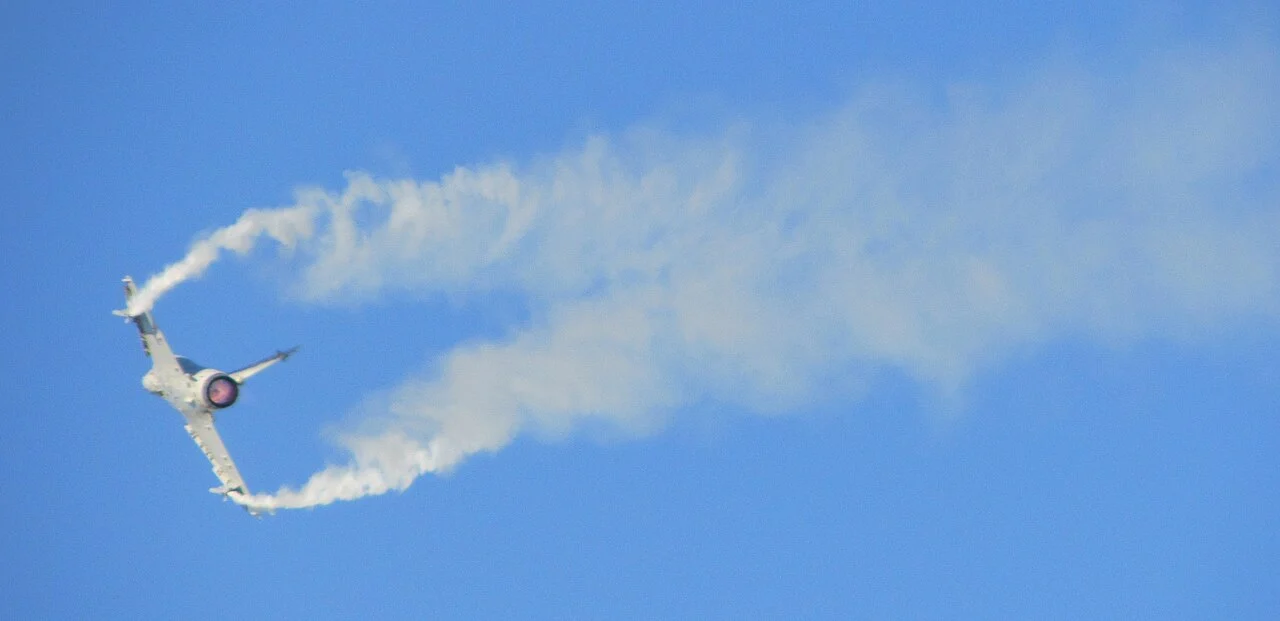
Photo: UAE Air Force Dassault Mirage 2000-9, Dubai, 2011. Credit: Kurush Pawar, CC BY-SA 2.0, via Wikimedia Commons
SIPRI’s March 2026 arms-transfer figures rank France second among the UAE’s suppliers for 2021–25, behind the United States (42% of the total) and ahead of South Korea, China and Russia; the French percentage itself was not published in the sources reviewed for this piece. What the French share does not capture is how old and how layered the relationship is. The UAE’s Mirage 2000 fleet dates to the 1980s, the Leclerc tank order to 1993, and the Baynunah-class corvette programme to the early 2000s, well before the 80-aircraft Rafale contract of December 2021 made headlines as France’s largest-ever export order. The full inventory, including the American, Korean, Russian and local systems that sit alongside the French line, is in the UAE military profile; this piece follows only the French and French-linked programmes, in the order they were signed, and labels each with DefenceMENA’s standard status vocabulary. An order is not a delivery, and a delivery is not an operational squadron.
How the relationship formed
France and the newly federated UAE built a defence relationship early. The UAE’s first Mirage 2000s were ordered in 1983, 36 aircraft in total, with deliveries beginning later in the decade; they gave the young Emirati Air Force its first genuinely modern fighter. Paris and Abu Dhabi formalised the wider relationship on 18 January 1995, when French Defence Minister François Léotard and UAE Foreign Minister Sheikh Hamdan bin Zayed Al Nahyan signed a political and military cooperation agreement in Abu Dhabi, the document that still underpins the relationship today.
The 1990s added weight to the paper partnership. In 1993 Abu Dhabi signed with Giat Industries (now Nexter Systems) for 436 tracked vehicles built around the Leclerc main battle tank, a contract reported at roughly US$3.4 billion, at the time the largest Gulf order for a French land system. In 1997 the UAE ordered about 600 Black Shaheen cruise missiles, the export version of the MBDA/Storm Shadow family, built specifically to arm the Mirage fleet. A second Mirage order followed in 1998: 32 new-build aircraft plus the retrofit of 30 of the UAE’s existing jets to a common standard, together called the Mirage 2000-9, which made the UAE the type’s largest export customer.
The partnership became a physical presence in 2008, when France and the UAE agreed to station French forces in the country on a permanent footing, an extension of the 1995 accord. Air Base 104 at Al Dhafra, hosting a rotation of French Air Force fighters since 1 October 2008, became the most visible symbol; a French naval facility and Zayed Military City followed. France now keeps an estimated 750 to 900 military personnel in the UAE, its largest permanent military footprint in the Middle East, and the two countries renewed the underlying defence agreement in Toulouse in May 2026. It was on that basing arrangement, not on any UAE-owned Rafale, that French jets drew on in March 2026, when Emmanuel Macron’s government sent Rafales over Emirati airspace after a drone struck a French base hangar amid the regional war that followed the US and Israeli strikes on Iran; French Foreign Minister Jean-Noël Barrot said the jets, armed with Meteor and MICA missiles, intercepted Iranian drones, and the UAE Ministry of Defence separately confirmed interceptions of Shahed-type drones and Al-Qiam missiles over its territory.
Against that backdrop, the Rafale sale itself, signed on the sidelines of Dubai’s Expo 2020 on 3 December 2021, read as a continuation of an existing relationship rather than a new one. The headline event was aircraft; the contract bundled in missiles and helicopters, and, by 2023, one of those secondary items had already fallen through.
Anatomy table: French programmes in the UAE
| System | Manufacturer | Contract / announcement | Quantity | Delivery | Current status | Source |
|---|---|---|---|---|---|---|
| Mirage 2000EAD/RAD, first order | Dassault Aviation | 1983 order | 36 aircraft | From the late 1980s | Retired or upgraded; airframes feed the 2000-9 fleet | Defense News; The National; aviation directories via DM research |
| Leclerc main battle tank family | Giat Industries / Nexter Systems | 1993 contract, reported about US$3.4 billion | 436 vehicles ordered (about 388–390 MBTs plus recovery and training variants, sources differ) | 1994–2003, with a delivery dispute in 2001 | In service; about 300 estimated remaining after 80 were donated to Jordan in 2020 | GlobalSecurity.org; Army Recognition; UPI archive |
| Black Shaheen cruise missile (MBDA/Storm Shadow family) | MBDA / Matra (at the time) | 1997 order | About 600, reported | From about 2003; operational by about 2007–08 | In service on the Mirage 2000-9 fleet | CSIS Missile Threat; Arabian Aerospace |
| Mirage 2000-9 (new-build and retrofit) | Dassault Aviation | 1998 contract | 32 new-build plus 30 retrofitted from the earlier fleet (62 total; one source gives a 30/33 split) | New aircraft from about 2003 | In service; largest Mirage 2000-9 fleet of any export customer | Defense News; The National; Dassault Aviation statements |
| Baynunah-class corvette | CMN (design, lead ship) / Abu Dhabi Ship Building (prime, five ships) | Contract reported at about US$820 million | 6 | 2000s into the early 2010s | In service | Naval Technology; Arab News |
| Mirage 2000-9 avionics upgrade | Dassault Aviation | Intention announced Dubai Airshow, 14 November 2017 (reported about US$350 million); contract actually signed at the November 2019 Dubai Airshow, reported at about US$490 million | Fleet-wide (Dassault cited 62 aircraft) | Not confirmed complete in sources reviewed | Contracted; completion status unclear | Dassault Aviation statement; Janes; AIN Online; FlightGlobal |
| Gowind 2500 corvette (Bani Yas class) | Naval Group | 2019 contract | 2 (Bani Yas, Al Emarat) | Bani Yas handed over 9 Nov 2023; Al Emarat handed over 27 June 2024, both at Lorient | In service; three-year in-service support contract signed with Naval Group and Tawazun | Naval Group; Naval Technology; The Defense Post |
| Rafale F4, MBDA missile package and 12 H225M Caracal helicopters | Dassault Aviation; MBDA; Airbus Helicopters | Signed 3 December 2021; French government figure about €17 billion (about US$19 billion) for the full package; Dassault’s own fighter contract cited at about €16 billion | 80 Rafale F4; 12 Caracal; missile quantities not disclosed | First airframe rolled out and accepted January 2025 for flight test; operational deliveries expected to begin late 2026 | Rafale: Contracted / Under delivery (first airframe only). Caracal: reported terminated by the UAE in 2023, citing lifecycle cost and local-content shortfalls — outside DefenceMENA’s standard status labels, treated here as cancelled. | Dassault Aviation; Breaking Defense; Arab News; Al Jazeera; The National |
| AD Naval joint venture (EDGE Group / CMN Naval) | EDGE Group, CMN Naval | Announced March 2025 | Shipbuilding joint venture, not a platform order; absorbs existing non-NATO CMN order book | Not applicable | Contracted (joint venture established); no UAE Navy order under it reported yet | Breaking Defense; The Defense Post; Naval Today |
Air: from the Mirage to the Rafale
For nearly four decades the Mirage was the backbone of France’s relationship with the Emirati Air Force. The first 36 Mirage 2000s, ordered in 1983, were followed in 1998 by a programme that both bought new aircraft and upgraded the existing fleet to a single, UAE-specific standard: the Mirage 2000-9, combining the RDY-2 radar, the Mica and Black Shaheen missile integration, and a defensive-aids suite the UAE had asked Dassault to tailor. Directories put the fleet at about 62 aircraft, and Dassault has called it the largest Mirage 2000-9 operator among export customers. In November 2017, at the Dubai Airshow, the two sides announced the intention to sign a further avionics upgrade for the fleet, reported then at about US$350 million; the contract itself was actually signed two years later, at the November 2019 Dubai Airshow, reported at a higher figure of about US$490 million. Public sources do not confirm whether the work is complete.
The Rafale F4 contract, signed on 3 December 2021 on the margins of Dubai’s Expo 2020, is the largest order Dassault has ever won: 80 aircraft, plus MBDA weapons and, originally, 12 Airbus H225M Caracal helicopters. French government figures put the combined value at about €17 billion (roughly US$19 billion); Dassault’s own account of the fighter-only portion runs closer to €16 billion. The aircraft are the F4 standard, still in development for the French Air Force itself at the time of signing, which is one reason the delivery schedule has repeatedly slipped: initial reporting in 2021 pointed to first deliveries in 2027 and a programme running to 2031, while Dassault’s more recent guidance has first deliveries beginning in late 2026. The single airframe rolled out and formally accepted by the UAE in January 2025 was, by multiple accounts, a symbolic first step rather than an operational delivery: it stayed at Dassault’s Mérignac flight-test centre for trials, and the aircraft now used to train Emirati pilots and ground crews are not yet the operational jets that will eventually replace the Mirage 2000-9.
That gap between contract and squadron is why French Air Force Rafales, not Emirati ones, were the jets that responded when the UAE came under attack in March 2026. With regional tensions high after the US and Israeli strikes on Iran, a drone struck a hangar at a French base in the UAE; Paris responded by flying Rafales from Al Dhafra over Emirati territory, and French and Emirati officials separately confirmed the interception of Iranian drones and, in one account, an Al-Qiam missile. It is a reminder that the basing relationship built since 2008, not the Rafale sale, is what currently backs up Emirati air defence against the deepest threats, and that the new jets will only change that once deliveries actually begin.
Land: the Leclerc, a one-off order left unrepeated
The Leclerc contract, signed in 1993 with Giat Industries (renamed Nexter Systems), covered 436 tracked vehicles built around the tank: reporting on the exact mix varies, with most accounts giving roughly 388 to 390 main battle tanks plus engineering and recovery variants and two driver-training vehicles, at a price reported around US$3.4 billion. Deliveries ran from 1994 to 2003, but the programme was not smooth: in January 2001 France suspended further deliveries in a dispute over the contract’s continual-upgrade clause, and the two governments needed a formal agreement to resolve it before shipments resumed. No second Leclerc order has followed in the more than three decades since, and the UAE has instead diversified its armoured fleet with Russian, South African and Jordanian-linked systems over time. In 2020 the UAE donated 80 of its Leclercs to Jordan, which has since deployed them publicly; open-source estimates now put the UAE’s own Leclerc fleet at around 300.
Naval: two generations of French-designed corvettes
France’s naval relationship with the UAE runs through two separate corvette programmes a generation apart. The Baynunah class, a derivative of CMN’s BR70 design built jointly with the French yard, has six ships: the lead vessel was built at CMN’s Cherbourg yard, and the remaining five by Abu Dhabi Ship Building (ADSB) under a technology-transfer arrangement, at a contract reported around US$820 million. All six are in service and remain a core part of the UAE Navy’s surface fleet.
A second, separate programme followed in 2019, when the UAE ordered two Gowind 2500 corvettes directly from Naval Group, this time built in France rather than locally. Bani Yas, laid down in 2020 and launched in December 2021, was handed over at Lorient on 9 November 2023; its sister ship Al Emarat followed on 27 June 2024. Naval Group, the UAE Navy and the Tawazun Council signed a three-year in-service support agreement covering both vessels. Naval industrial cooperation has since widened beyond ship sales: in March 2025, Emirati conglomerate EDGE Group and CMN Naval announced AD Naval, an Abu Dhabi-based joint venture for small and mid-size vessel construction that also absorbs CMN’s existing non-NATO order book, and EDGE separately signed a memorandum of understanding with Naval Group to explore cooperation on naval combat systems. Neither arrangement has yet produced a reported UAE Navy order of its own.
Missiles and the Rafale’s weapons
MBDA is the French name most embedded in the UAE’s arsenal outside the aircraft themselves. The Black Shaheen, the export version of the Storm Shadow/SCALP-EG cruise missile family, was ordered in 1997 specifically to arm the Mirage 2000-9 and, by most accounts, became operational around 2007–08; about 600 were reported ordered, though the figure comes from secondary sources rather than an MBDA or UAE government statement. The Rafale package signed in 2021 is reported to include MBDA weapons, and the Meteor and MICA missiles were specifically named by French and German reporting as armament on the French Air Force Rafales that flew over the UAE in March 2026; whether or in what mix those missiles will equip the UAE’s own Rafale fleet once delivered has not been confirmed in the sources reviewed here.
Sustainment, basing, local production and financing
The French presence in the UAE is as much about basing and industrial access as about hardware sales. Air Base 104 at Al Dhafra, hosting rotating French Air Force fighters since 2008, and Zayed Military City and a naval facility, together host an estimated 750 to 900 French military personnel, by far France’s largest permanent footprint in the Middle East; the two countries renewed the underlying defence agreement in Toulouse in May 2026. On the industrial side, EDGE Group, the UAE’s state-owned defence conglomerate, opened a Paris headquarters and signed a cooperation framework with France in June 2026, on top of the CMN Naval shipbuilding joint venture and a separate Thales partnership covering electro-optics (including maintenance of Thales’s Sophie thermal-imager range) and software-defined radio development. Financing terms for the UAE’s own Rafale and Leclerc contracts have not been itemised in the sources reviewed; unlike the French export-credit arrangements reported for Egypt’s 2021 Rafale purchase, no comparable state-guaranteed loan structure for the UAE deal was found.
How France competes with the UAE’s other suppliers
| Supplier | What it provides | SIPRI share, 2021–25 | Verified deals | Local production / transfer | Notes |
|---|---|---|---|---|---|
| United States | F-16E/F Block 60, THAAD, Patriot, Apache, Chinook, HIMARS | 42% (largest supplier) | Long-running FMS cases; new approvals reported 2025–26 | Limited reported local work | Backbone of the UAE’s air-defence and strike inventory |
| France | Mirage 2000-9, Rafale F4 (contracted), Leclerc, Baynunah and Gowind corvettes, Black Shaheen | 2nd by SIPRI ranking; percentage not published in sources reviewed | 1983/1998 Mirage orders; 1993 Leclerc; Baynunah; 2019 Gowind; 2021 Rafale | Baynunah hull-building at ADSB; AD Naval JV (EDGE/CMN) | Oldest continuous Western supplier relationship after the 1995 pact |
| South Korea | Cheongung-II air defence, K239 Chunmoo | Not broken out in sources reviewed | Reported contracts, under delivery | Not confirmed | Growing air-defence and rocket-artillery role |
| China | Wing Loong-series drones, various munitions | Not broken out in sources reviewed | Reported purchases | Not confirmed | Mostly unmanned systems |
| Russia | Legacy systems from earlier decades | Sharply lower than in 2016–20 (SIPRI trend) | Limited recent activity reported | Not confirmed | Declining share |
The picture is not a French monopoly on any domain: Washington supplies the UAE’s principal fighter (the F-16E/F Block 60) and its top-tier air defence, while France’s strength lies in a parallel, older fighter line, the land and some of the naval inventory, and, since 2008, a permanent basing relationship that the arms figures alone do not capture. For how the same supplier appears in two neighbouring markets, see DefenceMENA’s France’s arms deals with Egypt and France’s arms deals with Morocco; for how a smaller Gulf state manages a similarly mixed supplier base, see Is Qatar’s three-fighter air force a strength or a liability? On the UAE’s own attempt to reduce reliance on any single outside supplier, see How independent is the UAE’s defence industry?
What is pending or reported
- Rafale deliveries: 80 aircraft contracted; one airframe accepted for flight test in January 2025; operational deliveries reported to begin late 2026 (Under delivery for that single airframe; the remaining 79 remain Contracted).
- Caracal helicopters: 12 H225M ordered in the 2021 package, reported terminated by the UAE in 2023 over lifecycle cost and local-content shortfalls. Airbus has not detailed its own account publicly.
- Mirage 2000-9 avionics upgrade: intention announced 2017, contract actually signed November 2019 (about US$490 million, reported), completion status not confirmed in public sources (Status unclear).
- AD Naval and the EDGE–Naval Group MoU: industrial frameworks exist; no UAE Navy platform order has been reported under either as of this writing (Reported, unconfirmed as a procurement outcome).
How many Rafales will the UAE have, and when?
Contracted: 80 Rafale F4, signed 3 December 2021. Delivered for operational service: none confirmed as of this writing. Accepted for flight test: one airframe, January 2025, which stayed at Dassault’s Mérignac site rather than entering Emirati squadron service. Expected start of operational deliveries: late 2026, per Dassault’s most recent public guidance, with earlier reporting from 2021 having pointed to 2027–2031 for the full programme. Treat both delivery windows as reported rather than confirmed, since the F4 standard itself was still completing development for the French Air Force when the UAE contract was signed.
Why the French line matters for the UAE
Three things stand out. First, the Rafale will eventually retire a Mirage 2000-9 fleet that has served since the early 2000s, but the transition is years from complete, and in the meantime the Mirage, not the Rafale, remains the UAE’s French-built fighter in service. Second, the Caracal cancellation shows that even a headline nine-figure package signed in a single ceremony can unravel piece by piece once the paperwork gives way to lifecycle-cost and local-content negotiations. Third, the 2008 basing arrangement, not any single arms contract, is what put French combat aircraft over Emirati skies during the most serious regional crisis of 2026, a reminder that the defence relationship runs on infrastructure and treaties as much as on the inventory list. Follow the country desks for UAE and France and the wider Middle East coverage. An Arabic-language profile on DefenceArabia covers the UAE’s armed forces in more depth for Arabic-speaking readers.
A note on the numbers
Contract values for the 1993 Leclerc order, the Baynunah programme and the 2021 Rafale package are press-reported or derived from French government statements; neither the UAE nor the manufacturers concerned have published full line-item figures. SIPRI’s supplier-share data are trend-indicator values based on production cost, not sale prices, and are recorded when equipment is delivered rather than when it is ordered, which is one reason a contracted but undelivered programme the size of the Rafale deal does not yet show up in the French share of UAE imports. Global Firepower is not used here as an inventory count.
Sources
- Al Jazeera, UAE buys record 80 French fighter jets in $19bn arms deal (December 2021)
- The Aviationist, UAE signs historic deal with France for 80 Rafale fighter jets (December 2021)
- Defaiya, UAE inaugurates first Dassault Rafale fighter jet (January 2025)
- AIN Online, UAE fighter deal leads Rafale’s global resurgence (October 2025)
- Breaking Defense, UAE cancels €800m military helicopter deal with Airbus (May 2023)
- Defense News, Dassault to modernise UAE’s Mirage fleet (November 2017)
- AIN Online, UAE signs $490 million Mirage 2000-9 upgrade contract with Dassault (November 2019)
- CSIS Missile Threat, SCALP EG / Storm Shadow / Black Shaheen
- Army Recognition, UAE to donate 80 Leclerc MBTs to Jordan (2020)
- Naval Technology, Baynunah-class corvette programme
- Naval Technology, UAE Navy receives second Gowind corvette from France (2024)
- The Defense Post, Naval Group delivers first Gowind corvette to the UAE (November 2023)
- Breaking Defense, EDGE Group joins forces with French firm CMN Naval (March 2025)
- The Defense Post, EDGE opens Paris HQ, signs cooperation framework with France (June 2026)
- Al-Monitor, France deploys jets over UAE to protect its military bases (March 2026)
- Dawn, French fighter jets neutralise Iranian drones over UAE: FM Barrot (March 2026)
- Al-Monitor, UAE, France renew defence pact after Rafale jets controversy (May 2026)
- UPI archive, UAE-France sign defense pact (18 January 1995)
- SIPRI, Trends in International Arms Transfers, 2025 (March 2026)