SAMIDRC in the DRC: What Combat Against M23 Showed About South African Equipment



South Africa sent its largest armoured contingent in a generation into the eastern Democratic Republic of Congo under the SADC Mission (SAMIDRC). Fourteen months later, the force had lost 14 soldiers, surrendered or abandoned vehicles at Sake and Goma, and been formally terminated by SADC — exposing not the weakness of any single piece of equipment, but the cost of sending ageing, under-supported hardware into a war the political mandate never matched.
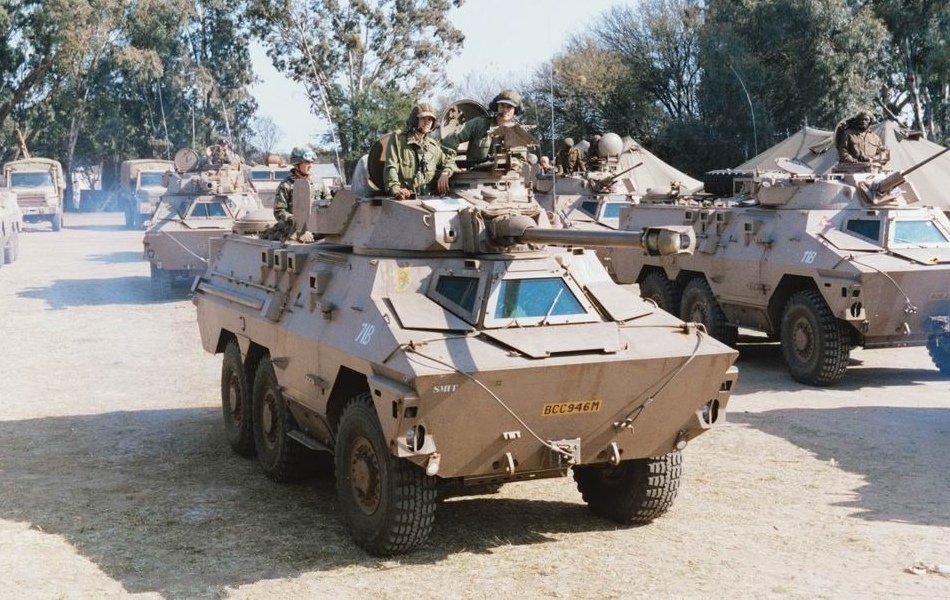
Photo: A South African National Defence Force Ratel-90 infantry fighting vehicle, the mainstay of the SA Army’s mechanised infantry, pictured during a training exercise at the Lohatla combat training range — not in the DRC. Credit: BoonDock / Cape Town Highlanders Regiment collection, CC BY-SA 3.0, via Wikimedia Commons.
Direct answer
South African National Defence Force (SANDF) armour deployed with SAMIDRC — mainly Ratel-90 infantry fighting vehicles, Casspir and Mamba armoured personnel carriers, and a Mfezi armoured ambulance — survived repeated contact with AFC/M23 around Sake and Goma in 2024–2025, but the mission lost soldiers, had vehicles damaged, abandoned or captured, and was wound down after SADC terminated its mandate in March 2025. The record points less to a single system failing than to chronic under-resourcing: stalled vehicle refurbishment, missing air defence components, and an admitted failure to track South Africa’s own military assets.
| Operator | South African National Defence Force (SANDF), lead nation in SAMIDRC |
| Mission | SADC Mission in the DRC (SAMIDRC), under the SADC Mutual Defence Pact |
| Deployed | 15 December 2023 – mandate terminated 13 March 2025; phased withdrawal from April 2025 |
| Core equipment | Ratel-90 IFV, Casspir APC, Mamba APC, Mfezi armoured ambulance; Rooikat and Olifant held in reserve by the parent brigade |
| Troop strength | South Africa approx. 2,900; Tanzania and Malawi a combined approx. 2,100 |
| Confirmed SANDF fatalities | 14 since deployment (5 in June 2024, 9 in January 2025), per South African press and parliamentary statements |
| Adversary | AFC/M23, with Rwanda Defence Force support documented by the UN Group of Experts |
Where was it used?
SAMIDRC deployed into North Kivu province in eastern DRC, concentrated around Goma and the town of Sake roughly 25km to the city’s northwest. The force replaced the East African Community Regional Force, whose mandate had expired, after Congolese President Félix Tshisekedi invoked the SADC Mutual Defence Pact. South Africa contributed the largest contingent, reinforced by Tanzanian and Malawian troops, and operated alongside the Armed Forces of the DRC (FARDC) and the UN’s MONUSCO mission, which is a separate, longer-running deployment.
What was the mission?
SAMIDRC’s mandate was to support FARDC in halting the AFC/M23 advance and to help restore state authority in North Kivu and South Kivu. It was explicitly a combat-support mission rather than a traditional UN-style peacekeeping deployment, which meant SANDF mechanised infantry — built around Ratel-90s, Casspirs and Mambas — was expected to hold ground and contest territory against a better-resourced adversary, rather than simply monitor a ceasefire.
What does the public evidence show?
| Claim / event | Date | Evidence level | Source |
|---|---|---|---|
| SANDF base near Sake attacked; 2 soldiers killed, around 20 injured, toll later rose to 5 | June 2024 | CONFIRMED | SANDF statement, South African press |
| SANDF confirms a clash at Sake damaged two armoured personnel carriers | May 2024 | CONFIRMED | SANDF statement |
| M23 claims capture of two SANDF vehicles | June 2024 | OFFICIALLY CLAIMED | M23 statement, reported by ADF Magazine |
| Major battle at Sake; SANDF confirms contact, cites 13–14 wounded; South African press later reports 9 SANDF soldiers killed | 23–24 January 2025 | CONFIRMED (fatalities); figures vary by outlet | SANDF statement, DefenceWeb, Daily Maverick |
| M23 claims 4–5 SAMIDRC vehicles destroyed and 1–2 APCs plus a truck captured at Sake | January 2025 | OFFICIALLY CLAIMED, not independently verified | M23 statements, DefenceWeb |
| Mfezi ambulance damaged; Casspir and Mamba vehicles damaged or abandoned; Tanzanian IVECO ammunition truck captured | January 2025 | INDEPENDENTLY REPORTED | DefenceWeb field reporting |
| SADC terminates the SAMIDRC mandate | 13 March 2025 | CONFIRMED | SADC statement, regional press |
| SADC and M23 sign Goma agreement: SAMIDRC equipment may withdraw with troops, FARDC equipment must stay | 28 March 2025 | CONFIRMED | Signed agreement, DefenceWeb |
| Abandoned SAMIDRC vehicles and equipment still litter Goma airport runway; control tower inoperable | April 2025 | VISUALLY DOCUMENTED / INDEPENDENTLY REPORTED | ADF Magazine |
| Skyshield air defence components and recce equipment reported incomplete at Sake; pistols allegedly withheld from some troops | January 2026 (account of events in 2024–2025) | UNVERIFIED — single first-hand soldier account | Afridesk |
| Parliament told soldiers bought their own boots, bedding and tents; bulletproof vests arrived after deployment | December 2025 | OFFICIALLY CLAIMED (parliamentary testimony) | EWN, Parliament of South Africa defence committees |
| Auditor-General finds SANDF asset registers unreliable and incomplete | March 2026 | CONFIRMED | Auditor-General of South Africa, Daily Maverick |
What worked?
The core vehicle fleet — decades-old by African procurement standards — kept functioning under fire. SANDF’s own statements describe sustained contact at Sake without the mission collapsing: Ratel-mounted mechanised infantry, Casspir-borne motorised infantry and Mamba-equipped light infantry held their positions for two days of fighting in January 2025 before M23 pressure forced a withdrawal from forward positions. Ahead of later troop rotations under the separate Operation Mistral framework, South Africa reportedly refurbished at least 100 Ratel-90s and dozens of Casspirs, indicating the platforms remained serviceable enough to be worth maintaining rather than retiring outright. No independent source documents a Ratel, Casspir or Mamba catastrophically failing its crew in combat; losses reported are consistent with vehicles being outmatched, abandoned under logistical pressure, or left behind in a negotiated withdrawal rather than destroyed outright in large numbers.
What problems appeared?
The problems documented are logistical and institutional rather than purely mechanical. A Sunday Times account citing a senior SANDF officer attributed January 2025 losses partly to the Sake staging base being sited at the foot of high ground M23 controlled — a planning failure, not an equipment one. Parliament’s defence committees were told in December 2025 that soldiers deployed without adequate personal equipment, with bulletproof vests arriving only after troops reached the DRC. A single, unverified soldier account published by Afridesk in January 2026 describes a Skyshield air-defence system sent to Sake with key components left behind in Goma, and under-equipped reconnaissance platoons — claims that have not been independently confirmed and should be read as one soldier’s perspective rather than an official finding. What is independently confirmed, by South Africa’s own Auditor-General in March 2026, is that the Department of Defence cannot reliably track its military assets, with incomplete and unverifiable registers — a structural gap that predates and outlasts the DRC deployment.
Confirmed losses and limitations
SANDF has officially confirmed two armoured personnel carriers damaged in a May 2024 clash at Sake, and additional vehicle damage during the January 2025 battle, without ever publishing a consolidated tally of total equipment losses across the deployment. M23 has claimed higher figures — destroying four to five SAMIDRC vehicles and capturing one to two APCs plus a truck in January 2025 alone — but these are the rebel group’s own claims and have not been independently verified; destroyed-vehicle claims from an active belligerent should not be read as a confirmed fact. DefenceWeb’s field reporting, drawing on sources closer to the contingent than M23’s statements, describes a Mfezi ambulance damaged and Casspir and Mamba vehicles damaged or abandoned in the same fighting, alongside a captured Tanzanian ammunition truck. Separately, ADF Magazine’s April 2025 visual reporting documented abandoned SAMIDRC vehicles and equipment still present on the tarmac at Goma airport months after the January fighting, a consequence of the airport’s prolonged closure rather than of combat destruction. No credible source has published a full, audited inventory of vehicles lost, damaged or abandoned across the full SAMIDRC deployment, and the table above should be read with that gap in mind.
What is still disputed?
The exact fatality and equipment-loss figures are disputed between sources: South African press most consistently cites nine SANDF deaths in the January 2025 Sake battle on top of five in June 2024, for a cumulative total of 14 cited in parliamentary debate, but individual outlets have reported varying injury counts (13 to at least 18) and the SANDF has faced criticism from its own soldiers’ union for not publishing a full official breakdown. Whether the January 2025 setback stemmed primarily from poor planning, under-resourcing, or the adversary’s own capability is also contested: a Sunday Times source blamed terrain and planning, a Mail & Guardian analysis stressed the absence of South African air cover, and opposition politicians pointed to a decade of budget cuts. The UN Group of Experts has documented that M23 and the Rwanda Defence Force fielded advanced military technology that altered the conflict’s dynamics and contributed to grounding FARDC’s own air assets — a strategic factor cited by analysts, though the Group of Experts’ reporting concerns the adversary’s capability rather than any confirmed deficiency in a specific SANDF vehicle type.
Did the manufacturer or operator change anything?
There is no public evidence that Ratel, Casspir or Mamba manufacturers made design changes in response to the DRC deployment; these are decades-old, in-service South African designs rather than systems under active development. The operator response has been institutional rather than technical. SADC terminated the SAMIDRC mandate on 13 March 2025, and a 28 March 2025 agreement with M23, signed by Major General Ibrahim Mhona and Major General Sultani Makenga, provided for SAMIDRC troops to withdraw with their own weapons and equipment while any captured FARDC equipment stayed behind; implementation was repeatedly delayed, with DRC’s government at one point linking SAMIDRC’s exit to a parallel M23/Rwanda Defence Force withdrawal from Goma. Separately, South Africa’s longer-running UN peacekeeping presence in the DRC, under Operation Mistral, began a phased MONUSCO-mandated downsizing from 4 October 2025, with remaining equipment scheduled for repatriation to South Africa. Parliament’s defence committees have since pressed for increased SANDF funding and a new defence review, and South Africa’s Auditor-General flagged the department’s unreliable asset registers in March 2026 — an institutional, not a platform-level, response.
Did other countries buy it afterwards?
SAMIDRC was a multinational operation, not a single exportable weapon system, so this question does not translate directly. What the record does show is that South African armoured-vehicle manufacturers kept securing African and other orders through and after the deployment, without any publicly reported buyer citing the DRC experience as a reason to walk away. Demand signals for South African-designed mine-protected vehicles in Africa have persisted independently of SAMIDRC’s record.
| Buyer | Vehicle | Year | Source |
|---|---|---|---|
| Unnamed SADC and Latin American defence forces | Paramount Mbombe 6 (6×6) | 2023 | Janes |
| Mozambique Defence Armed Forces (FADM) | Paramount Marauder | Ongoing, confirmed operator | DefenceWeb, company reporting |
| DRC national police (Police Nationale Congolaise) | Paramount Maatla | 2025 | DefenceWeb, company reporting |
Specific unit numbers and full contract terms for these orders are not publicly disclosed, and no source directly links any of them to lessons learned from SAMIDRC.
What does this mean for African procurement?
The SAMIDRC experience is a caution against treating vehicle acquisition as separable from sustainment. South Africa’s own armoured fleet — Ratel, Casspir and Mamba designs proven in earlier African conflicts — was not the documented point of failure; the Auditor-General’s finding that the SANDF cannot reliably track its own military assets, and parliamentary testimony that deployed soldiers bought their own boots and bedding, point instead to budget and logistics failures that any African force could replicate regardless of which vehicles it buys. For African defence planners, the lesson is that a combat-support mandate into contested territory requires funded sustainment, air cover and personal equipment pipelines as a precondition, not an afterthought, and that peace-support deployments under regional mutual-defence frameworks carry risks closer to conventional combat than to traditional peacekeeping.
Ratel-90 IFVs, Casspir and Mamba APCs, and a Mfezi armoured ambulance, backed by a brigade structure that also holds Rooikat AFVs and Olifant tanks.
Concentrated around Goma and Sake, roughly 25km to the city’s northwest, from December 2023.
SAMIDRC was mandated to help FARDC hold ground against AFC/M23, a more combat-oriented role than a traditional UN monitoring mission.
Confirmed SANDF fatalities and vehicle damage in May 2024, June 2024 and January 2025 clashes; M23’s higher loss claims remain unverified.
No full official tally of equipment losses has been published; abandoned equipment remained visible at Goma airport months after the fighting.
SADC ended the SAMIDRC mandate in March 2025; South Africa’s Auditor-General later found the SANDF cannot reliably track its military assets.
The record shows ageing but serviceable vehicles undermined more by funding and logistics gaps than by design, a warning for any force planning a combat-support deployment.
FAQ
What happened to South African soldiers in the DRC?
SANDF troops deployed with SAMIDRC fought AFC/M23 around Sake and Goma between 2024 and 2025, losing 14 soldiers in total — five in a June 2024 attack and nine in a major battle on 23–24 January 2025 — before SADC terminated the mission’s mandate in March 2025.
How many SANDF soldiers died in the DRC?
South African press and parliamentary statements put the cumulative SANDF death toll at 14 since the SAMIDRC deployment began, though individual reports on the January 2025 battle alone have cited figures as low as one in the SANDF’s initial statement and as high as nine in later consolidated reporting.
What vehicles did South Africa send to the DRC?
SANDF’s armoured contribution to SAMIDRC centred on Ratel-90 infantry fighting vehicles, Casspir and Mamba armoured personnel carriers, and a Mfezi armoured ambulance, drawn from a mechanised brigade that also holds Rooikat armoured fighting vehicles and Olifant tanks.
Is SAMIDRC still active in the DRC?
No. SADC terminated the SAMIDRC mandate on 13 March 2025, and troops began a phased withdrawal from April 2025, separate from South Africa’s longer-running MONUSCO contribution under Operation Mistral, which began its own UN-mandated downsizing from 4 October 2025.
Why did South Africa’s DRC mission struggle?
Public reporting points to a combination of factors: a combat-support mandate against a well-armed adversary, a staging base at Sake sited on low ground overlooked by M23, limited air cover, and parliamentary testimony that deployed soldiers lacked basic personal equipment — rather than any single confirmed failure of South African armoured vehicles themselves.
Sources
- DefenceWeb: MONUSCO peacekeepers step in to help FARDC and SAMIDRC against M23 advance on Goma
- DefenceWeb: SANDF casualties in latest battle against M23 rebels in the DRC
- DefenceWeb: M23 rebels claim to have damaged another SANDF vehicle in the DRC
- DefenceWeb: SAMIDRC and M23 reach agreement on withdrawal of SADC troops and equipment
- Sunday Times: Poor decision-making and equipment failures doomed the SANDF troops in Sake, DRC
- Daily Maverick: SANDF to send reinforcements to DRC after nine SA soldiers die in battle
- Daily Maverick: Goma ‘fiasco’ — deal to bring SA and SADC troops home hits a snag
- Daily Maverick: Fears grow for trapped SAMIDRC troops after M23 rebels renege on agreement
- Daily Maverick: South African and other SADC troops finally begin withdrawal from war-torn DRC
- Daily Maverick: AG finds SANDF can’t keep track of military assets as R823m troop deployment begins
- Africa Defense Forum: Experts scrutinize SADC’s failures in DRC
- Africa Defense Forum: M23’s tech might outgun SADC force peacekeepers in DRC
- EWN: SANDF soldiers in DRC forced to buy own equipment, generals slammed by parliament
- EWN: Withdrawal of troops from DRC not a sign of weakness, says SANDF
- Mail & Guardian: SANDF, a force stretched to its limits
- Financial Mail: The SANDF, a Ratel stuck in a ditch
- Afridesk: An SANDF soldier’s experience with SAMIDRC (single first-hand account, unverified)
- Parliamentary Monitoring Group: Question NW5233 to the Minister of Defence and Military Veterans
- UN Security Council: Final report of the Group of Experts on the DRC, S/2024/118
- UN Security Council: Final report of the Group of Experts on the DRC, S/2025/446
More from Battlefield Proven
- Bayraktar TB2 in Libya: What Did Its Combat Use Actually Show?
- Sudan War Drones: What the Evidence Shows on SAF and RSF Since 2023
- Pantsir-S1 in Libya: What the Battlefield Record Revealed
- Drones in the Ethiopia War: What Is Confirmed and What Remains Unverified
- Wing Loong II in Libya: How Did China’s Armed Drone Perform in Combat?
- Bayraktar TB2 and Akinci in Mali and Burkina Faso: What Combat Use Has Shown
- Nigeria Super Tucano: What Five Years of Combat Use Have Shown
- BMC Kirpi in Africa: What Is Publicly Known About Its Mine and IED Protection Record
- Mi-24 and Mi-35 Attack Helicopters in Africa: What Combat in Nigeria, Mali and Uganda Has Shown
- Casspir and Mamba: What South Africa’s Mine-Protected Vehicles Proved in African Combat
- Rooivalk in the DRC: What Combat Use Actually Showed
Related background: South Africa Ends 27 Years of DRC Peacekeeping as Operation Mistral Closes, Kabila Heads New Congo Rebel Front With M23, South Africa’s Military Has Advanced Hardware It Can Barely Keep Running, South Africa Shifts R560m to Cover SANDF Veterans’ Medical Fund Shortfall, Denel Rooivalk vs Mi-24/Mi-35: Africa’s Attack Helicopters Compared and the DefenceMENA Military Equipment Database.
Casualty and equipment-loss figures in this piece vary by source and have not been consolidated into a single official SANDF tally; M23’s own loss claims are reported as claims, not independently verified facts. This article will be updated at the same URL if significant new evidence appears.