Why Did Burkina Faso Buy Chinese Armoured Vehicles?



Burkina Faso bought Chinese armoured vehicles because its army was losing soldiers to mines and ambushes faster than Western and donor-funded fleets could replace them, and because the junta that took power in September 2022 wanted a supplier that would deliver in volume, quickly and without political conditions. The Norinco VP11 and CS/VP14 mine-protected 4x4s, the VN22 6×6 fighting vehicle and the CS/VN9 carrier arrived in at least four batches between June 2024 and October 2025, handed over personally by Captain Ibrahim Traoré under a “strategic equipment plan” he announced on 31 December 2023. The official rationale is the war against jihadist groups; the contract value, the financing and the supplier contract itself have never been published.
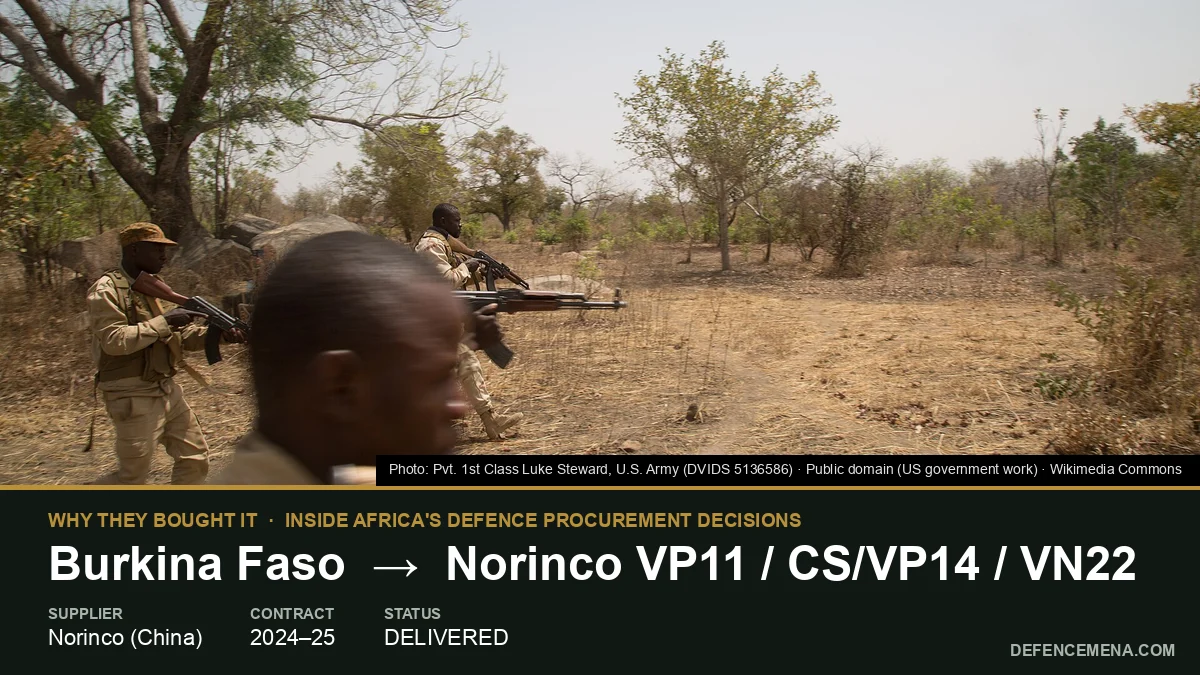
Photo: Burkinabè soldiers respond to a simulated ambush during Exercise Flintlock 2019 near Po, 26 February 2019. Ambushes and IEDs on road-bound units are the threat the 2024–25 MRAP purchases were meant to answer. Photo: Pvt. 1st Class Luke Steward / U.S. Army (public domain). Credit: Pvt. 1st Class Luke Steward, U.S. Army (DVIDS 5136586), Public domain (US government work), via Wikimedia Commons.
- Country
- Burkina Faso (Armée de terre; rapid-intervention battalions)
- System
- Norinco VP11 and CS/VP14 MRAPs, VN22 6×6 AFV, CS/VN9 6×6 APC
- Supplier
- Norinco (China)
- Quantity
- Press counts from handover videos: about 40 VP11, about 100 CS/VP14, 45–50 VN22 plus 6 VN22B, about 10 CS/VN9
- Contract year
- Not disclosed (plan announced Dec 2023; first deliveries Jan 2024)
- Status
- DELIVERED
- Main requirement
- Mine- and ambush-protected mobility for counter-insurgency units (officially stated)
- Training
- Not publicly disclosed
- Localisation
- None documented; “Made in Burkina” claims disputed
- Known alternatives
- No tender documented; Egyptian Temsah/Buffalo E10 and Turkish Cobra II bought in parallel
What capability did Burkina Faso need?
The requirement was blunt: survivable vehicles, in large numbers, for an army fighting a mobile insurgency across most of its territory. Jama’at Nusrat al-Islam wal-Muslimin (JNIM) and Islamic State Sahel Province have besieged towns such as Djibo for years, and their preferred weapons against road-bound army units are improvised explosive devices and ambushes on convoys. Military Africa, reporting the October 2024 VN22 delivery, put the share of national territory under jihadist control at roughly 40 per cent; The Soufan Center’s June 2025 assessment put it at roughly 60 per cent. The two figures measure different things and different dates, but both describe an army that cannot move without protected mobility.
The official framing is consistent across every handover since January 2024. When Traoré presented the first consignment on 12 January 2024, the Presidency described the equipment as part of the “strategic equipment plan for the national armed forces” announced in his New Year address and intended “to support the fight against terrorism”. At the June 2024 ceremony where the VP11 and CS/VP14 fleets were received, defenceWeb quoted the president telling his defence minister: “Remember that we are in a world of predation and to have peace, we must wage war. So, wage war.” That is as close to a published requirement as Burkina Faso has produced. There is no white paper, no parliamentary debate and no tender notice.
The cost behind the demand is documented: defenceWeb cited more than 10,000 casualties and about two million displaced since 2016, and terrorism deaths rising 68 per cent between 2022 and 2023, from 1,135 to 1,907.
What did it already operate?
Before the Chinese batches, the Burkinabè army’s protected fleet was a patchwork of small donor-funded or opportunistic purchases. defenceWeb’s January 2019 profile listed ten French ACMAT Bastion armoured personnel carriers, 31 South African Puma M26 carriers and a first batch of Turkish Otokar Cobra 4x4s delivered from September 2018 to the Commando Infantry Regiments. One of those Cobras was destroyed by an IED on 22 December 2018, killing three soldiers, an early illustration of why mine protection became the decisive criterion.
The European Union added four Bastions in November 2019 under its African Peace Facility programme for the G5 Sahel force, with two more promised (The Defense Post). Military Africa recorded 24 Storm 4x4s from Qatar in May 2019, three Ukrainian Shrek-M mine-clearing vehicles and, in March 2021, a contract through OTT Technologies and the US contractor PAE for 25 more Puma M26s. From 2023 the junta widened the net: Nurol Makina Ejder vehicles from Türkiye, Isotrex Phantom MRAPs from the United Arab Emirates and Egyptian Buffalo E10 (Temsah-2) MRAPs in January 2024, all reported by Military Africa. It had flown Bayraktar TB2s since 2022 and received at least two Akıncı in April 2024 (see the TB2 and Akıncı combat record in Mali and Burkina Faso).
China was already in the picture before the MRAPs. The very first consignment of the strategic plan, received on 12 January 2024, consisted of six Norinco WMA301 105 mm fire-support vehicles, a WZ551 command vehicle, eight CS/SM1 81 mm self-propelled mortars on Dongfeng EQ2050 chassis and WW90 60 mm mortars, according to defenceWeb. What the fleet lacked was one protected carrier type in battalion numbers. The June 2024 batch changed that.
What system was selected?
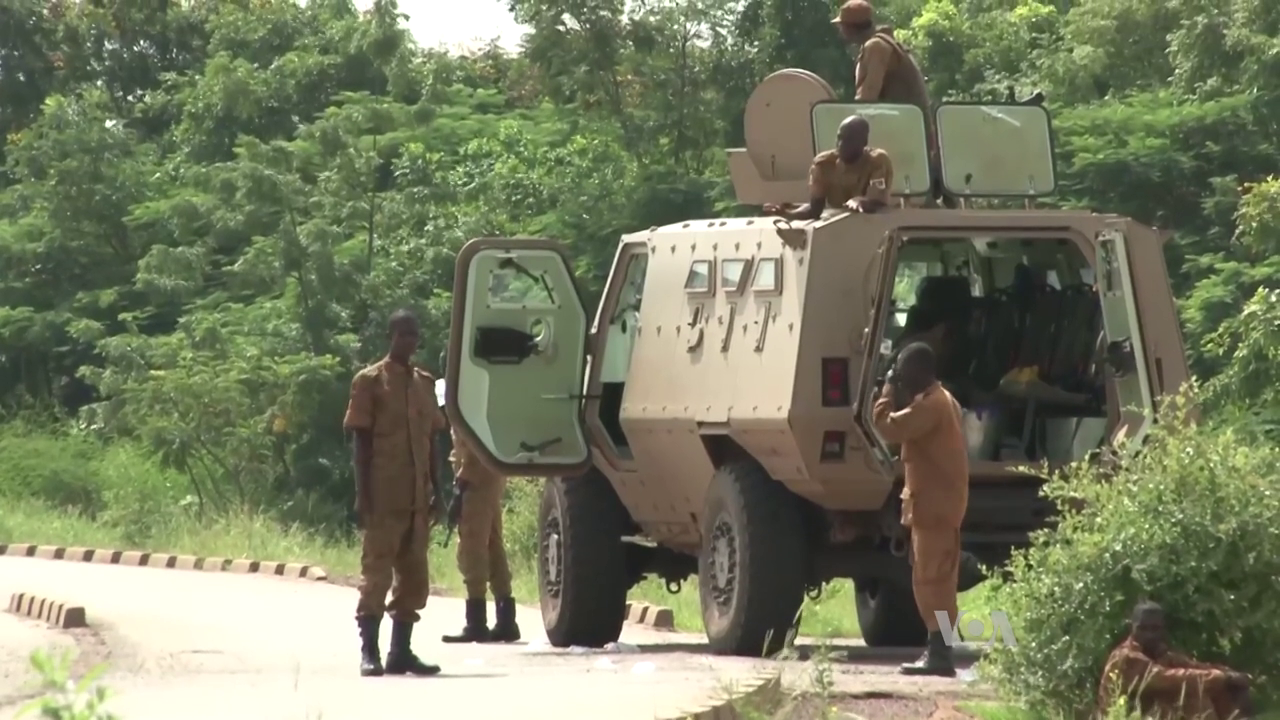
Four Norinco wheeled vehicles make up the core of the purchase. The VP11 is a 4×4 mine-resistant ambush-protected vehicle with a gross weight of about 10 tonnes according to defenceWeb’s reading of Norinco material (Army Recognition quotes 12 tonnes and a 12-person capacity, so the figure should be treated as a range). Before Burkina Faso it was already in service in Côte d’Ivoire, Gabon and Mali. The CS/VP14 is a newer 4×4 MRAP of about 9 tonnes, carrying ten soldiers and two crew, certified to STANAG 4569 level 3b against blast, which Military Africa interprets as 8 kg of TNT under the hull and 16 kg under a wheel, with protection against 7.62 mm armour-piercing rounds. The Kenya Army had been its only known operator.
The VN22 is a heavier 6×6 fighting vehicle first shown at the Zhuhai airshow in 2021, with a V-shaped hull and protection against 14.5 mm armour-piercing fire (STANAG level 4), delivered to Burkina Faso with a 30 mm cannon turret. A fire-support version, the VN22B with a 105 mm gun, followed in 2025. The CS/VN9 is a 6×6 armoured personnel carrier in the same family, delivered in a batch of about ten. Military Africa reported in August 2025 that the Presidency said the armoured vehicles “are equipped with laser-guided missile devices” and that the new material was assigned to a Rapid Intervention Field Artillery Battalion (BACIR) and a Rapid Intervention Armoured Battalion (BBIR).
Burkina Faso thus bought a layered family from one supplier: light MRAPs, a cannon-armed 6×6, a 6×6 carrier and the fire-support vehicles that go with them. DefenceMENA’s ranking of Africa’s most widely exported armoured vehicles places the VP11 among the most common Chinese types on the continent.
Which alternatives were considered?
No competition is documented. Burkina Faso has published no tender or evaluation for any post-2022 armoured purchase, and no manufacturer claims to have bid against Norinco. The record shows parallel buying instead: Egyptian, Turkish, Emirati and later South African vehicles arrived in the same period. The table lists same-class vehicles, not vehicles the ministry is known to have evaluated.
| Alternative | Class | Status of consideration | Source |
|---|---|---|---|
| Egyptian Temsah / Buffalo E10 (EIFDS) | 6×6 MRAP / APC | REPORTED ALTERNATIVE (bought in parallel, Jan and Apr 2024) | defenceWeb, Military Africa |
| Otokar Cobra / Cobra II (Türkiye) | 4×4 protected vehicle | REPORTED ALTERNATIVE (in service since 2018) | defenceWeb |
| Nurol Makina Ejder Yalçın (Türkiye) | 4×4 MRAP | REPORTED ALTERNATIVE (delivered 2023) | Military Africa |
| Paramount Mbombe 4 (South Africa) | 4×4 MRAP / IFV | REPORTED ALTERNATIVE (seen in service Oct 2025) | defenceWeb |
| BMC Kirpi (Türkiye) | 4×4 MRAP | SAME-CLASS MARKET ALTERNATIVE (no Burkinabè evaluation documented) | DefenceMENA |
The Kirpi’s own African record is covered in DefenceMENA’s BMC Kirpi combat record, and the wider Sahel fleet in which MRAPs are used in the Sahel.
Why were the Norinco vehicles selected?
Officially stated: the war effort. Every public statement ties the purchase to the “fight against terrorism” and to Traoré’s 31 December 2023 strategic equipment plan. Defence Minister Brigadier General Kassoum Coulibaly said at the 12 January 2024 handover that this was “the first of five consignments that are expected to arrive over the coming months” (defenceWeb). At the 6 June 2024 ceremony he said, per Military Africa: “This batch only represents the first delivery out of four batches, and we are basically at around 18–20% of the materiel, the rest is yet to come.” The shift from “five consignments” to “four batches” within five months is in the sources and is reproduced here as stated; it may reflect counting from different starting points.
Officially stated: paid for by Burkinabè citizens. Coulibaly told the January 2024 audience to use the equipment wisely, “knowing that these are contributions made from the sweat of the whole Burkinabè people”, a reference to the Fonds de soutien patriotique created in January 2023. LeFaso.net reported that the fund raised 99 billion CFA francs in 2023 against an 80 billion target, with a 100 billion target for 2024; its stated purpose is paying, training, equipping and fuelling the Volunteers for the Defence of the Homeland (VDP) militia, with a share for “strategic materials” for the armed forces. Whether the fund paid for the Norinco contract is not stated anywhere; the minister’s words link the two rhetorically, not in the accounts.
Reported by Military Africa and defenceWeb: a supplier pivot after France. The French Sabre special-forces task force lowered its flag at Kamboincin on 18 February 2023 after the junta gave Paris four weeks to leave, as The Defense Post reported. Russia’s Africa Corps landed a first contingent of 100 personnel in Ouagadougou on 24 January 2024, with 200 more planned, according to Africa Defense Forum. Military Africa frames the Chinese purchases as part of a diversification “away from France” toward China and Russia. No Burkinabè official has said that the vehicles were bought because of the French departure; that remains an inference by the reporting outlets.
Analysts assess: volume and speed. Between January 2024 and October 2025 Norinco shipped, by press counts, more than 200 armoured vehicles plus trucks, mortars, rocket launchers and howitzers. No other supplier delivered on that scale. That is the most plausible operational reason for the choice, but it is an assessment, not a statement from Ouagadougou.
Possible but unconfirmed: financing terms. Military Africa wrote in August 2025 that the deals were likely financed through “concessional loans, barter exchanges, or deferred payments” and noted that the Ministry of Defence “has not revealed specifics”. Burkina Faso’s sanctions exposure after the 2022 coups, its suspension from ECOWAS decision-making and its formal exit from the bloc on 29 January 2025 are documented facts; their role in the choice of supplier is not. We do not state that China was chosen because it was cheaper or because Western suppliers refused: no source supports either claim.
What was included in the contract?
The supplier contract has never been published and its scope has to be reconstructed from what was unloaded. Beyond the four armoured types, the Chinese consignments included 17 Caterpillar excavators (June 2024), about 90 Shacman H3000 trucks and tankers and 45 tractor units (December 2024 to January 2025, Military Africa), weapons and ammunition described but not counted, and in 2025 a fire-support and artillery package: six VN22B 105 mm vehicles, four SR5 multiple rocket launchers with two resupply vehicles, six SM6/WMA09 120 mm self-propelled mortars, two WZ551-based command vehicles, six Dongfeng EQ2050 vehicles, about 14 SH1 122 mm self-propelled howitzers and at least 16 towed howitzers, per Military Africa and Zona Militar. Whether this is one contract or several is not known.
How much did it cost?
Not publicly disclosed. No contract value, unit price or package value has been released by the Burkinabè government, Norinco or the Chinese state. Press reports do not quote even an estimate, and this article does not attempt one. The only financial statement on record from the ministry concerns the Egyptian vehicles of April 2024, which Coulibaly said were “funded entirely by Burkina Faso with the support of Egypt” (defenceWeb). Nothing equivalent exists for the Chinese material.
How many were ordered?
The order quantity is unknown; the delivered quantity is a press reconstruction from state television footage. defenceWeb counted at least 40 VP11 and 50 CS/VP14 in June 2024. Military Africa counted at least 20 VN22 at the port of Tema in Ghana on 26 October 2024, then about 50 more CS/VP14, 30 VN22 and 10 CS/VN9 in the batch received around the turn of 2025; defenceWeb’s summary of the same batch gives 25 VN22. Zona Militar and defenceWeb then counted six VN22B at the 10 October 2025 handover. Adding the press counts gives roughly 40 VP11, 100 CS/VP14, 45 to 50 VN22, 6 VN22B and 10 CS/VN9, with the caveat that handover parades may show only part of a shipment, or the same vehicles twice.
Training, maintenance and support
Not publicly disclosed. No Chinese training mission, in-country technical team or spares contract has been reported, and the Burkinabè ministry has not described how the fleet will be sustained. General Célestin Simporé, formerly chief of the general staff, replaced Coulibaly as defence minister on 8 December 2024 (LeFaso.net) without publishing a sustainment plan for a fleet that now mixes Chinese, Turkish, Egyptian, Emirati, South African, French and American types.
Local production or technology transfer
None is documented, and the claims that exist are contested. LSI Africa reported on 21 September 2026 that Traoré had told an audience Burkina Faso had produced about 300 armoured vehicles since November 2025 through a company called Faso Armored; a senior military source told the outlet the work consisted of recovering components from immobilised South African Casspirs to reinforce pickup trucks. The same report notes that Chinese-built Norinco vehicles had been promoted as domestic products in late 2024. For this series’ purposes, localisation of the Norinco fleet is recorded as “none documented”.
Delivery and operational status
Status: DELIVERED. All four armoured types have been handed over in public ceremonies and assigned to units; operational use is reported but not independently verified.
- 18 Feb 2023French Sabre task force lowers its flag at Kamboincin after the junta’s four-week ultimatum.
- 31 Dec 2023Traoré announces a “strategic equipment plan” for the armed forces in his New Year address.
- 12 Jan 2024First consignment: six WMA301, WZ551 command vehicle, eight CS/SM1 mortars; Coulibaly calls it “the first of five consignments”.
- 24 Jan 2024Russia’s Africa Corps lands 100 personnel in Ouagadougou.
- 6 Jun 2024Traoré receives about 40 VP11 and 50 CS/VP14 plus 17 excavators; “around 18–20% of the materiel”.
- 26 Oct 2024At least 20 VN22 with 30 mm turrets transit Tema, Ghana, for Ouagadougou.
- Dec 2024 – Jan 2025About 50 CS/VP14, 25–30 VN22, 10 CS/VN9 and 135 Shacman trucks and tractors handed over.
- 29 Jan 2025Burkina Faso, Mali and Niger formally leave ECOWAS.
- 11 May 2025JNIM overruns Djibo’s military base and briefly holds the town.
- 10 Oct 2025Handover of VN22B, SR5, SM6, SH1 and command vehicles to BACIR and BBIR.
Has it been used operationally?
Yes, at the public level. The vehicles were issued to rapid-intervention battalions and the Presidency’s own videos show them deployed. The most serious test came on 11 May 2025, when JNIM attacked Djibo in the Sahel region: Human Rights Watch documented that the group “overran a military base, seized weapons, and killed dozens of soldiers” and killed at least 26 civilians, while The Soufan Center relayed JNIM’s own claim of 200 military dead, a figure no independent body has confirmed. No source identifies which vehicle types were present at Djibo or lost there.
What has operational use shown?
Two things can be said with sources. First, protected mobility has not changed the character of the war: JNIM kept besieging Djibo and attacking convoys and VDP positions through 2025, as Human Rights Watch recorded at Gorom Gorom in July and Youba in August. Second, the published protection levels of the Norinco fleet match the IED and small-arms threat the army faces; how the vehicles perform against the vehicle-borne bombs JNIM now uses is not documented in any public source and is not assessed here.
Did Burkina Faso order more?
Yes, within the same plan. The batches of October 2024, the turn of 2025 and October 2025 were all presented as continuations of the December 2023 programme rather than new contracts, and the Presidency’s 1 September 2026 video of a Sky Dragon 30 surface-to-air missile test showed VN22B, SR5 and SM6 vehicles alongside it, confirming that the Norinco relationship has extended from armour to artillery and air defence. DefenceMENA covered that system separately in why Burkina Faso is testing the Sky Dragon 30. Whether a fifth consignment under the original plan remains outstanding, or whether a second plan has been agreed, has not been stated.
What does this tell us about African procurement?
The first lesson is about scale. For a decade Burkina Faso’s armoured fleet grew by handfuls: ten Bastions, four EU-funded ones, 25 Pumas under a US contract, a few dozen Cobras. Those programmes came with training and, often, donor money, but never a battalion of one type. The Norinco batches did, in eighteen months. A buyer at war measured suppliers by what they could put on the dock at Tema, and on that measure the Chinese group had no rival. That is a deal-specific observation, not a claim about Chinese pricing or Western reluctance, neither of which any source documents.
The second lesson is about opacity. The purchases are known only because the Presidency films its handovers; nobody outside the ministry knows the value, the financing, the spares or the training. For a country whose war is partly crowd-funded through the Fonds de soutien patriotique, that gap between public sacrifice and private contracting is a political risk as much as a logistical one. It also makes the “Made in Burkina” controversy predictable: when the state alone holds the facts, local-manufacture claims cannot be checked.
The third lesson concerns diversification. The junta did not replace France with China; it replaced France with everyone. Türkiye supplies drones and Ejders, Egypt Temsahs, the Emirates Phantoms, South Africa Mbombes, Russia the Africa Corps, and China the bulk of the armour and now the artillery and air defence. DefenceMENA’s survey of who supplies Africa’s weapons shows this is the regional norm, and its review of Chinese military systems in African service shows the Norinco pattern repeating elsewhere. The result is a fleet that is politically resilient and logistically fragile.
Finally, the case shows how far Sahel procurement has moved since the G5 era. The 2019 EU Bastion programme served a joint force under regional and European oversight. Six years later the same army receives Chinese fighting vehicles at ceremonies attended by Russian trainers, outside ECOWAS, funded by a mechanism the public pays into but cannot audit. That trajectory is documented; what it means for readiness in 2030 is not.
Procurement record
| Field | Value |
|---|---|
| Country | Burkina Faso |
| Service | Armée de terre (Burkinabè Army); BBIR and BACIR rapid-intervention battalions |
| System | Norinco VP11 4×4 MRAP, CS/VP14 4×4 MRAP, VN22 / VN22B 6×6 AFV, CS/VN9 6×6 APC |
| Manufacturer | China North Industries Corporation (Norinco) |
| Origin | China |
| Category | MRAP / armoured fighting vehicles |
| Requirement | Mine- and ambush-protected mobility and fire support for counter-insurgency (officially stated as “fight against terrorism”) |
| Order date | Not disclosed; strategic equipment plan announced 31 Dec 2023 |
| Contract date | Not disclosed |
| Quantity | Press counts: ~40 VP11, ~100 CS/VP14, 45–50 VN22, 6 VN22B, ~10 CS/VN9 |
| Contract value | Not disclosed; no estimate published |
| Delivery | Batches Jan 2024 (fire support), Jun 2024 (VP11/VP14), Oct 2024 (VN22), Dec 2024–Jan 2025 (VP14/VN22/VN9), Oct 2025 (VN22B and artillery) |
| Operational status | DELIVERED; operational use reported, not independently verified |
| Training | Not publicly disclosed |
| Support | Not publicly disclosed |
| Localisation | None documented; “Made in Burkina” claims disputed (LSI Africa) |
| Tech transfer | None documented |
| Confirmed competitors | None (no tender documented) |
| Follow-on order | Continuing batches under the same plan through Oct 2025; Sky Dragon 30 air defence shown Sep 2026 |
| Primary source | Presidency handover ceremonies as reported by defenceWeb (27 Jun 2024) and Military Africa (Jun 2024, Oct 2024, Jan 2025, Aug 2025) |
| Last verified | 5 October 2026 |
FAQ
Why did Burkina Faso buy Chinese armoured vehicles?
The government says the vehicles implement the strategic equipment plan announced by President Traoré on 31 December 2023 to support the fight against terrorism. Reporting outlets add a supplier pivot after the French departure in 2023 and the volume Norinco could deliver; no official has given a reason beyond the war effort.
How many armoured vehicles did Burkina Faso get from China?
Press counts from handover footage give about 40 VP11, roughly 100 CS/VP14, 45 to 50 VN22, six VN22B fire-support vehicles and about ten CS/VN9 between June 2024 and October 2025, plus fire-support, mortar, rocket and howitzer vehicles. The ordered total has not been disclosed.
What is the Norinco VP11?
A 4×4 mine-resistant ambush-protected vehicle of roughly 10 to 12 tonnes, used in Africa by Côte d’Ivoire, Gabon, Mali and now Burkina Faso. The CS/VP14 is a lighter 4×4 MRAP of about 9 tonnes carrying ten soldiers and two crew.
How much did Burkina Faso pay for the Norinco vehicles?
Not publicly disclosed. Neither the Burkinabè government nor Norinco has published a contract value, and no credible estimate exists. Financing terms are also unknown.
Are the Chinese vehicles used against JNIM?
They are assigned to rapid-intervention battalions fighting JNIM and Islamic State Sahel, and official videos show them deployed. No public source documents which types were engaged in specific battles such as Djibo in May 2025.
Does Burkina Faso build armoured vehicles locally?
No local production of the Norinco types is documented. A 2026 claim of 300 “Made in Burkina” armoured vehicles was reported by LSI Africa to involve reinforcing pickups with parts from old Casspirs; earlier claims had presented Chinese vehicles as domestic.
More from Why They Bought It
- Why Did Morocco Buy the AH-64E Apache?
- Why Did Nigeria Buy the VT-4 Tank?
- Why Did Côte d'Ivoire Buy the Wing Loong II?
- Why Did Kenya Buy 118 Katmerciler HIZIR Armoured Vehicles?
- Why Did Nigeria Buy the M-346FA?
- Why Did Egypt Buy (and Build) the K9 Howitzer?
- Why Did Niger Buy the Bayraktar TB2?
- Why Did Senegal Buy the OPV 58 S?
- Why Did Kenya Buy the MD 530F Cayuse Warrior?
- Why Did Uganda Buy the Su-30MK2?
Sources
- ECOWAS Commission – Burkina Faso, Mali and Niger’s withdrawal from ECOWAS is now a reality (30 January 2025)
- LeFaso.net – Le général de brigade Célestin Simporé nommé ministre de la Défense (8 December 2024)
- LeFaso.net – Fonds de soutien patriotique : 100 milliards de FCFA à mobiliser pour 2024 (26 March 2024)
- KOACI – Un important lot de matériel militaire remis au ministère de la Défense (12 January 2024)
- defenceWeb – Burkina Faso operating Chinese self-propelled guns and mortars (January 2024)
- defenceWeb – Burkina Faso acquires more military vehicles and UAVs (April 2024)
- defenceWeb – Burkina Faso receives huge batch of Chinese military equipment (27 June 2024)
- Military Africa – Burkina Faso receives additional Chinese armoured vehicles (June 2024)
- Military Africa – Burkina Faso acquires VN-22 armoured vehicles from China (October 2024)
- Military Africa – Burkina Faso receives more Chinese armoured vehicles (3 January 2025)
- Military Africa – Burkina Faso receives more Chinese combat vehicles and artillery (10 August 2025)
- defenceWeb – Burkina Faso acquires more armoured vehicles, artillery from China (11 August 2025)
- Zona Militar – China completed the delivery of new Norinco 6×6 VN22B armored fighting vehicles to Burkina Faso (16 October 2025)
- defenceWeb – Burkina Faso reveals new Sky Dragon air defence system (17 September 2026)
- Military Africa – Burkina Faso tests new Chinese air defence system, but which one? (September 2026)
- defenceWeb – Burkina Faso operating Cobra armoured vehicles (8 January 2019)
- The Defense Post – EU hands 13 Arquus Bastion armored vehicles to Mali for G5 Sahel operations (21 January 2020)
- Military Africa – OTT Technologies and PAE to supply Puma armoured vehicles to Burkina Faso (19 March 2021)
- Military Africa – Burkina Faso boosts its defence with Egyptian-made Buffalo E10 MRAP vehicles (29 January 2024)
- The Defense Post – Burkina announces French army operation officially over (20 February 2023)
- Africa Defense Forum – Burkina Faso opens door for Russia’s Africa Corps (20 February 2024)
- Human Rights Watch – Burkina Faso: Islamist armed groups massacre civilians (15 September 2025)
- The Soufan Center – JNIM expanding geographic reach and staging coordinated attacks in the Sahel (5 June 2025)
- LSI Africa – 300 blindés « Made in Burkina » : une nouvelle « histoire fabriquée » ? (21 September 2026)
- Army Recognition – Burkina Faso receives new 4×4 CS/VP14 and VP11 MRAP vehicles from China (June 2024)
Last updated: 5 October 2026. This article is updated in place when the procurement status changes.