Morocco’s Attack Helicopters Explained: From Gazelle to Apache



Morocco is replacing a Cold War-era attack and transport helicopter fleet in real time. This explainer identifies every major rotary-wing attack or armed-support type the Royal Moroccan Air Force and Royal Moroccan Army currently fly, have on order, or are phasing out, grouped by status, with sourced figures as of November 2026.
DEFENCE AFRICA | One country, one category | Data as of November 2026
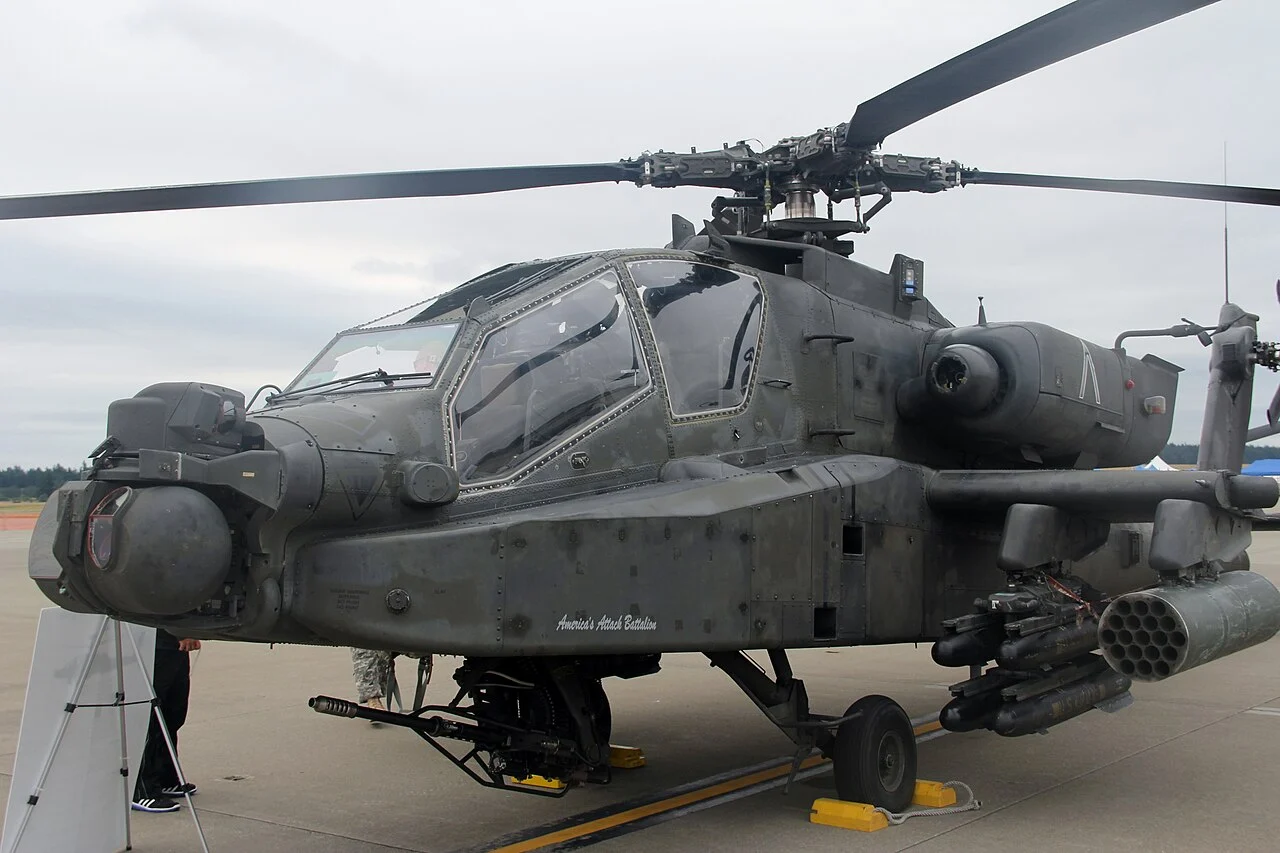
For five decades Morocco’s helicopter attack capability rested almost entirely on one airframe: the Aérospatiale SA342 Gazelle, armed with French HOT anti-tank missiles and flown against Polisario Front forces in Western Sahara since the early 1980s. That changed in March 2025, when the Royal Moroccan Air Force (Forces Royales Air, FRA) took delivery of its first batch of Boeing AH-64E Apache Guardian attack helicopters under a Foreign Military Sale case first notified by the US Defense Security Cooperation Agency (DSCA) in November 2019.
The transition is still under way. As of late October 2026 Morocco had received 19 of the 24 AH-64Es it ordered, while its ageing Gazelle and Puma fleets remain in service pending full Apache fielding and the arrival of a separate special-operations helicopter, the Airbus H225M Caracal. This piece sets out what is confirmed about each type, what is not, and why the mix matters for a military still fighting a low-intensity war along the Western Sahara berm and increasingly training alongside the US military in exercises such as African Lion.
Key facts
- 19 of 24 ordered Boeing AH-64E Apache Guardians delivered as of 26 October 2026 (US Army Southern European Task Force Africa, SETAF-AF)
- US DSCA notified a possible sale of up to 36 AH-64Es (24 firm, 12 optional) in November 2019 at an estimated $4.25 billion ceiling (Federal Register, Transmittal 19-63)
- The FMS case actually contracted is valued at approximately $1.3 billion, per SETAF-AF’s October 2026 release
- Morocco received its first HOT-2 anti-tank missiles for Gazelle helicopters in 1991 (Wikipedia, citing open-source missile proliferation data)
- 10 Airbus H225M Caracal special-operations helicopters ordered, contract confirmed by Airbus at the Dubai Airshow on 18 November 2025
- Morocco is one of only two African air forces operating the Apache, and the only one flying the E-model; Egypt flies the older AH-64D
ACTIVE
1. Boeing AH-64E Apache Guardian — operational, fleet still growing
Manufacturer: Boeing (United States). Origin: United States. Quantity: 19 delivered of 24 firm-ordered, as of 26 October 2026 (SETAF-AF). Variant: AH-64E v6 Guardian. Service status: operational, fleet still being delivered.
In November 2019 the DSCA notified Congress of a possible sale to Morocco of up to 36 AH-64Es — 24 firm plus a 12-aircraft option — along with 79 T700-GE-701D engines, AGM-114R Hellfire and M36E9 training missiles, AIM-92H Stinger air-to-air missiles and APKWS laser-guided rocket kits, at an estimated program ceiling of $4.25 billion (Federal Register, Transmittal 19-63, December 2019). Rabat signed for the 24 firm aircraft in 2020; the 12-unit option has not been publicly exercised. SETAF-AF’s October 2026 release puts the actual FMS case value at approximately $1.3 billion, a lower figure than the DSCA ceiling, which bundled optional items and munitions Morocco has not necessarily all bought.
Deliveries have come in three tranches: six helicopters in March 2025, a further seven on 8 May 2026 at Cap Draa (Tan-Tan) during Exercise African Lion 2026, and six more on 26 October 2026 at the First Royal Air Force Base in Salé. Five aircraft remain to be delivered. Neither the Royal Armed Forces nor SETAF-AF has stated how many of the 19 delivered airframes are combat-ready or how many crews are fully trained. Key specifications: twin General Electric T700-GE-701D turboshaft engines; AGM-114R Hellfire anti-armour missiles and FIM-92/AIM-92H Stinger air-to-air missiles in the 2019 package; Manned-Unmanned Teaming (MUM-T) datalink allowing the crew to receive video from, and in some configurations direct, unmanned aircraft; composite main rotor blades and an uprated transmission over the earlier AH-64D. It gives Morocco a dedicated day/night attack and armed-reconnaissance capability it has never had at this scale, and makes Morocco the only African operator of the E-model Apache — Egypt’s AH-64D fleet is an older generation (see Egypt’s biggest defence deals, linked below).
ORDERED
2. Airbus H225M Caracal — contracted, deliveries not yet reported
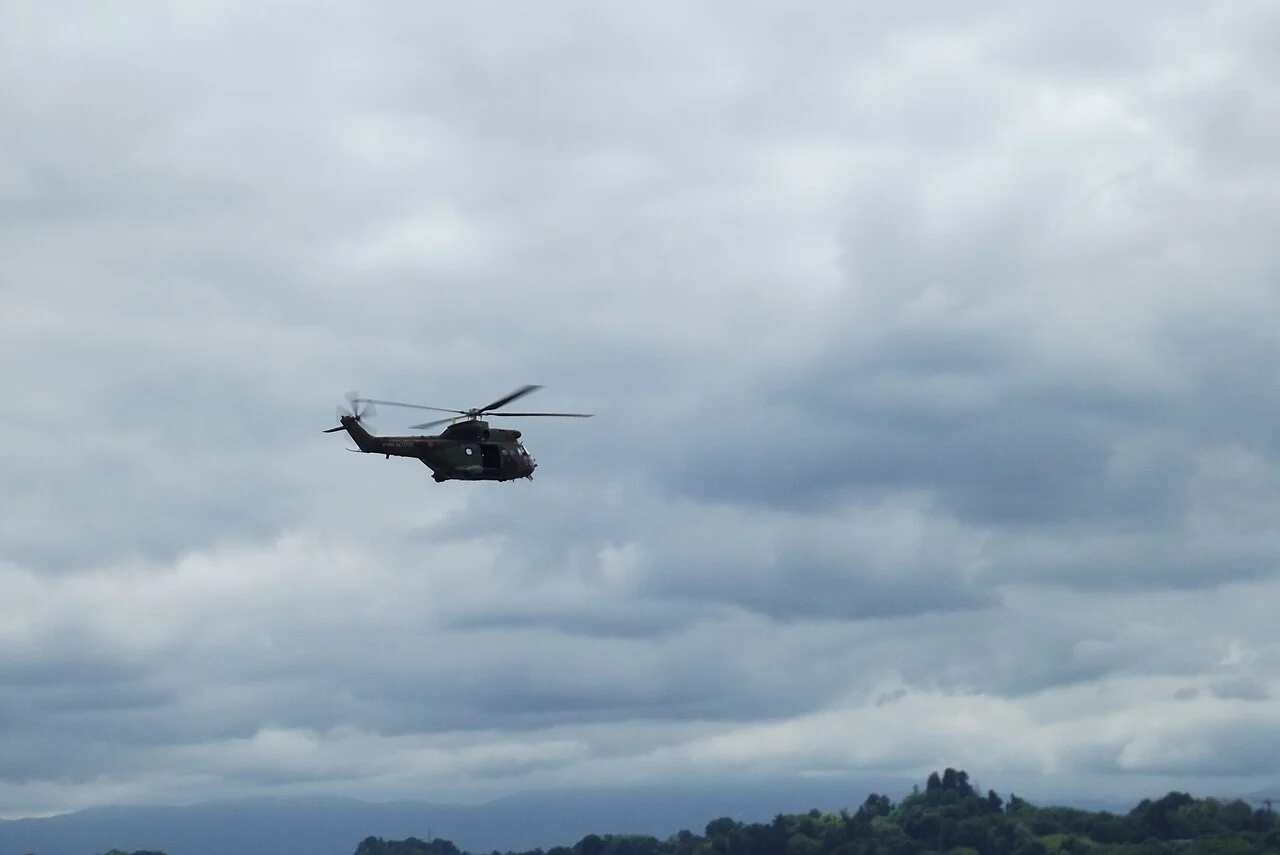
Manufacturer: Airbus Helicopters (France). Origin: France. Quantity: 10 ordered; none confirmed delivered as of November 2026. Variant: H225M (militarised Super Puma family). Service status: ordered.
Morocco placed the order in 2025 — Moroccan outlets reported the deal on 1 September 2025, and Airbus confirmed it publicly at the Dubai Airshow on 18 November 2025. France’s Armed Forces Ministry has reported cumulative Moroccan contracts with French industry above €1.3 billion over a ten-year span, including more than €532 million in the most recent year, but Airbus has not disclosed a standalone contract value for the ten helicopters (Breaking Defense, November 2025). The aircraft is intended mainly for special-operations infiltration and exfiltration, combat search and rescue and tactical transport, replacing Morocco’s SA330 Puma fleet. Moroccan reporting describes the aircraft as fitted with optical and radar systems and unspecified weaponry for self-protection, but no manufacturer or government source has published a detailed weapons fit, so that claim is treated here as reported, not confirmed. Key specifications of the standard H225M: twin Safran Makila 2A1 turboshaft engines; typical troop-carrying capacity around 28 personnel in the transport configuration; a nose-mounted FLIR/electro-optical turret is standard on the militarised variant; defensive countermeasures suite as standard equipment on the “M” (militarised) version. This is a special-operations support type rather than a dedicated gunship, but it directly replaces Morocco’s armed Puma fleet in that role.
BEING REPLACED
3. Aérospatiale SA342 Gazelle (HOT) — still operational, fleet being phased out
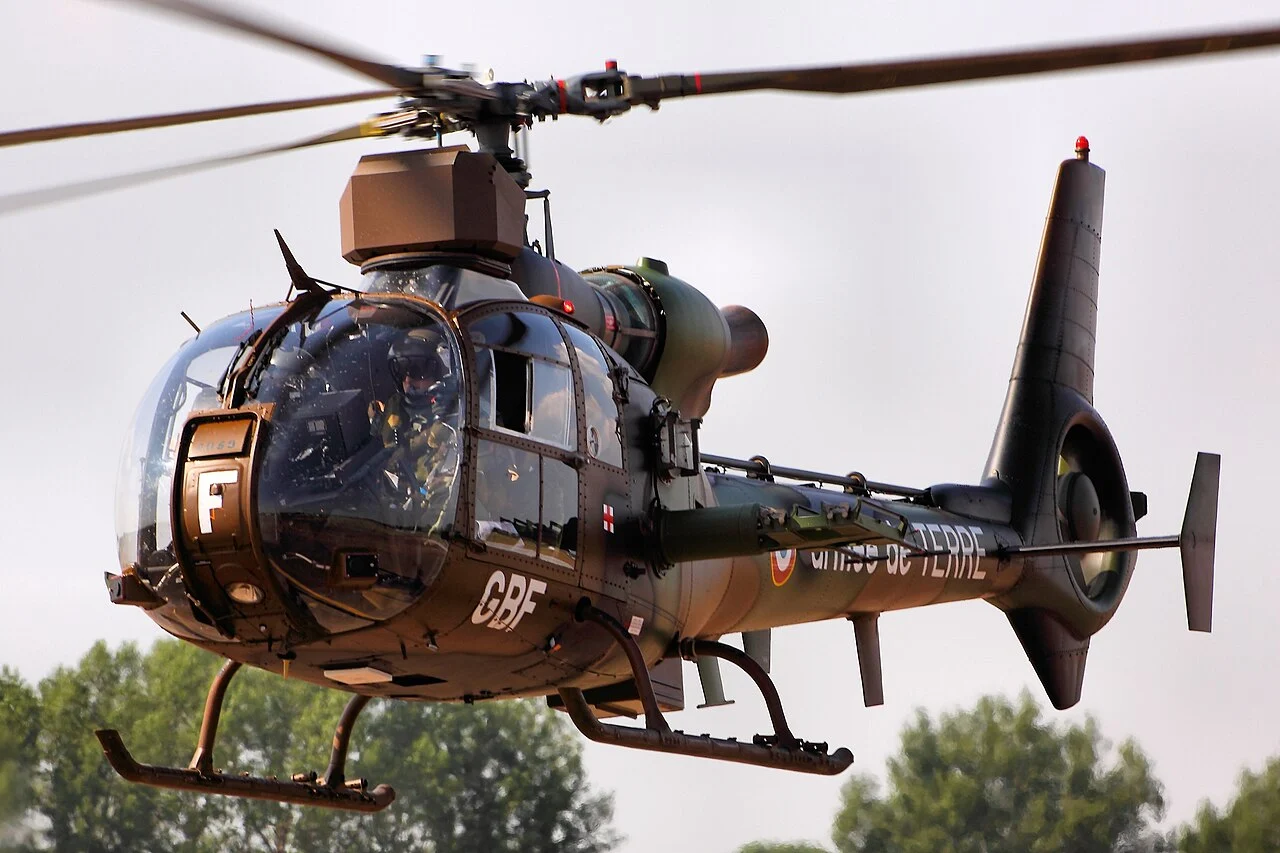
Manufacturer: Aérospatiale, now Airbus Helicopters (France). Origin: France. Quantity: not verified precisely; open-source estimates (Wikipedia, citing Royal Moroccan Air Force order-of-battle data) put roughly 19 in service, down from a larger Cold War-era fleet. Variant: SA342M/L, armed with HOT anti-tank missiles. Service status: operational, being phased out.
The Gazelle has been Morocco’s primary anti-armour helicopter since the start of the Western Sahara conflict. Morocco acquired HOT and HOT-2 missiles for helicopter and vehicle use in 1983 and 1991 respectively. The missile is tube-launched with semi-automatic command-to-line-of-sight (SACLOS) guidance, a gunner tracks the target through a sight while the missile’s wire link relays steering commands, with a quoted range of 75-4,000 metres for the HOT and HOT-2 versions and up to 4,300 metres for the later HOT-3 (manufacturer-published figures as compiled by Wikipedia’s HOT missile entry). Each SA342M typically carries four HOT rounds in two twin launchers. Moroccan defence media describe the arrival of the AH-64E as marking “the gradual abandonment of the older SA342 Gazelle helicopters” (Hespress, 2026), though no retirement date has been announced and the type remains in the active inventory. It matters for Africa because the Gazelle/HOT combination is one of the continent’s longest-serving anti-armour helicopter pairings, and its retirement timeline will show how fast a legacy African air arm can transition to a modern attack helicopter without a capability gap.
4. Aérospatiale SA330 Puma — still operational, fleet being replaced
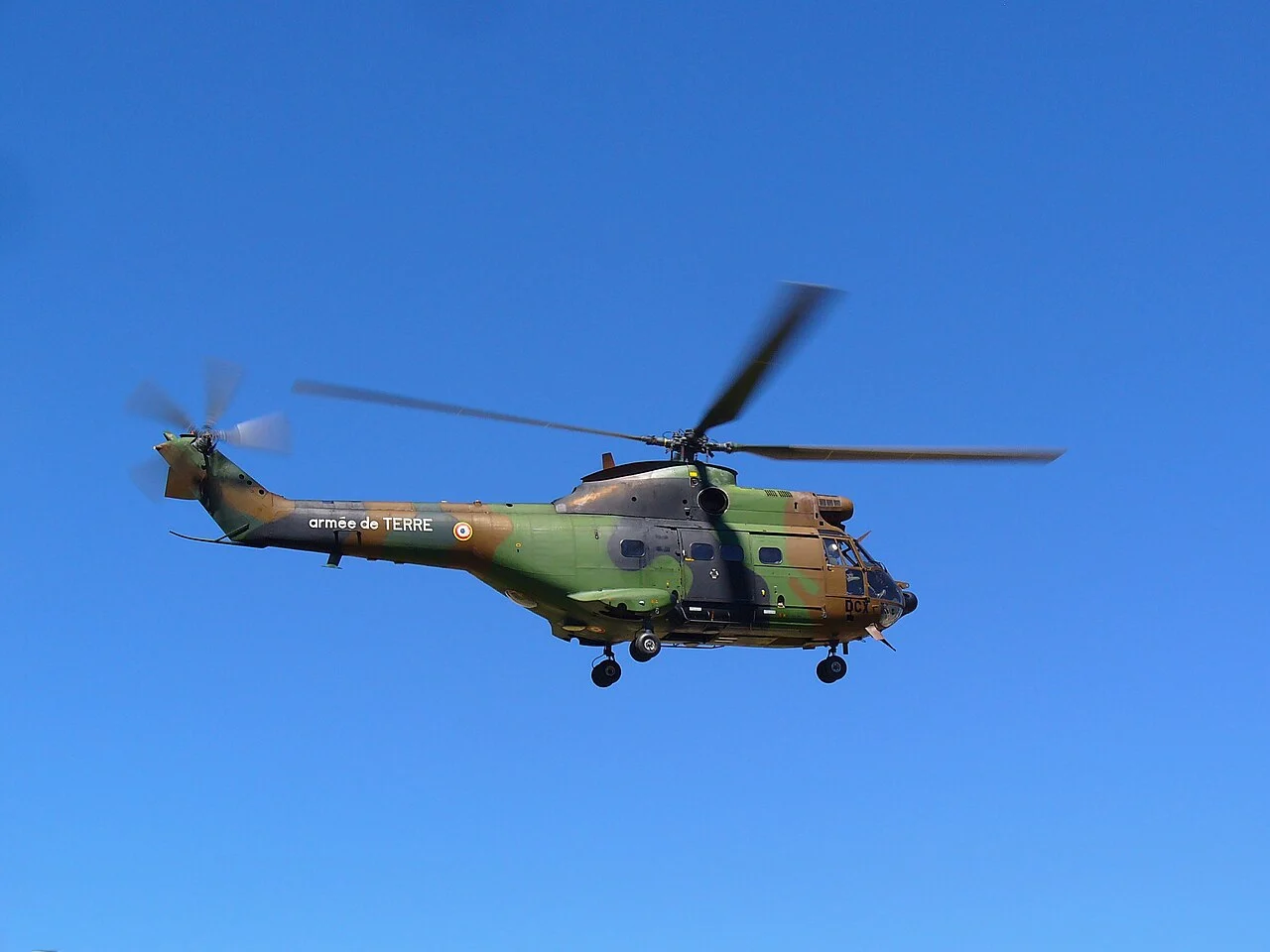
Manufacturer: Aérospatiale, now Airbus Helicopters (France). Origin: France. Quantity: Morocco originally acquired 38 Pumas from 1975; a current in-service figure is not verified in available open sources. Variant: SA330, including armed/gunship configurations. Service status: operational, being replaced.
The Puma entered Moroccan service in 1975 and, according to Moroccan defence reporting, played a central transport and fire-support role against Polisario forces through the 1970s and 1980s. The 20mm M621 cannon is documented as a weapon fitted to Moroccan Puma and Gazelle airframes for close-support roles (list of equipment of the Royal Moroccan Army, citing manufacturer weapon data), though public sourcing does not specify how many Pumas currently carry it or confirm an exact in-service count. Along the Western Sahara defensive line, Moroccan forces have also used Super Puma, AB205 and CH-47 Chinook helicopters for troop movement; those types sit outside this attack-helicopter category. In September-November 2025 Morocco ordered 10 Airbus H225M Caracal helicopters explicitly described in regional reporting as a Puma replacement (Breaking Defense; Telquel), which is why the Puma appears here as being phased out rather than retired. It matters because Morocco’s ability to retire a fifty-year-old airframe without a sustainment gap in the special-operations and fire-support role depends on how quickly the Caracal order is delivered.
No major Moroccan attack-helicopter type is confirmed as fully retired, and none is listed as awaiting delivery outside the Apache’s remaining five airframes and the Caracal order above; both groups are omitted here rather than populated with unverifiable entries.
| System | Manufacturer | Status | Quantity | Source / year |
|---|---|---|---|---|
| AH-64E Apache Guardian | Boeing (US) | Operational, fleet growing | 19 of 24 delivered | SETAF-AF, Oct 2026 |
| H225M Caracal | Airbus Helicopters (FR) | Ordered | 10 ordered | Airbus/Breaking Defense, Nov 2025 |
| SA342 Gazelle (HOT) | Aérospatiale/Airbus (FR) | Operational, being replaced | ~19 (not precisely verified) | Wikipedia RMAF order of battle, 2026 |
| SA330 Puma | Aérospatiale/Airbus (FR) | Operational, being replaced | 38 acquired from 1975; current total not verified | Moroccan defence media, 2026 |
Why it matters for Africa
Morocco’s helicopter transition is a useful test case for how an African air force modernises attack aviation without a US-style defence budget. The FMS ceiling the DSCA notified in 2019 ran to $4.25 billion for a maximalist package; the deal Morocco actually signed, and the one now being delivered, is reported at roughly a third of that figure, underlining how much daylight separates a DSCA notification from a signed contract across the continent, not just in Morocco’s case. The parallel purchase of French Caracals for special operations, alongside the US-sourced Apache for the attack role, also shows Morocco keeping two separate supplier relationships rather than consolidating around one partner — a hedge that matters for sustainment, spares and training pipelines over the life of both fleets. For other African operators of legacy Gazelle, Puma or Mi-24/35 fleets (see Denel Rooivalk vs Mi-24/Mi-35, linked below), the open questions Morocco has not yet answered — how many Apaches are combat-ready, how fast Gazelle and Puma airframes will actually stand down, what the Caracal will actually carry — are the same questions that will determine whether any transition of this kind closes a capability gap or opens one.
Sources
- US Federal Register, Transmittal No. 19-63, DSCA notification on Morocco AH-64E sale, 27 December 2019
- DefenceMENA: Morocco Receives Third Batch of AH-64E Apaches, Taking Its Fleet to 19 of 24
- Wikipedia: HOT (missile) — range, guidance and operator list including Morocco
- Wikipedia: Royal Moroccan Air Force — helicopter order of battle
- Breaking Defense: Morocco to buy 10 Airbus multi-purpose H225M helos, November 2025
- Wikipedia: List of equipment of the Royal Moroccan Army — Puma/Gazelle armament
Related on DefenceMENA: Morocco’s full military profile, the latest Apache delivery, Airbus’s new helicopter MRO hub in Morocco, and Denel Rooivalk vs Mi-24/Mi-35: Africa’s attack helicopters compared.