Why Egypt’s Long-Delayed Somalia Deployment Is About the Red Sea, Not Just Peacekeeping



Egypt is preparing to send roughly 1,091 troops to Somalia under the African Union Support and Stabilization Mission, a deployment that has slipped for more than a year and now carries weight far beyond peacekeeping. Cairo frames the mission as strategic depth along the Red Sea; Ethiopia, locked in its own dispute with Egypt over the Nile, is watching uneasily.
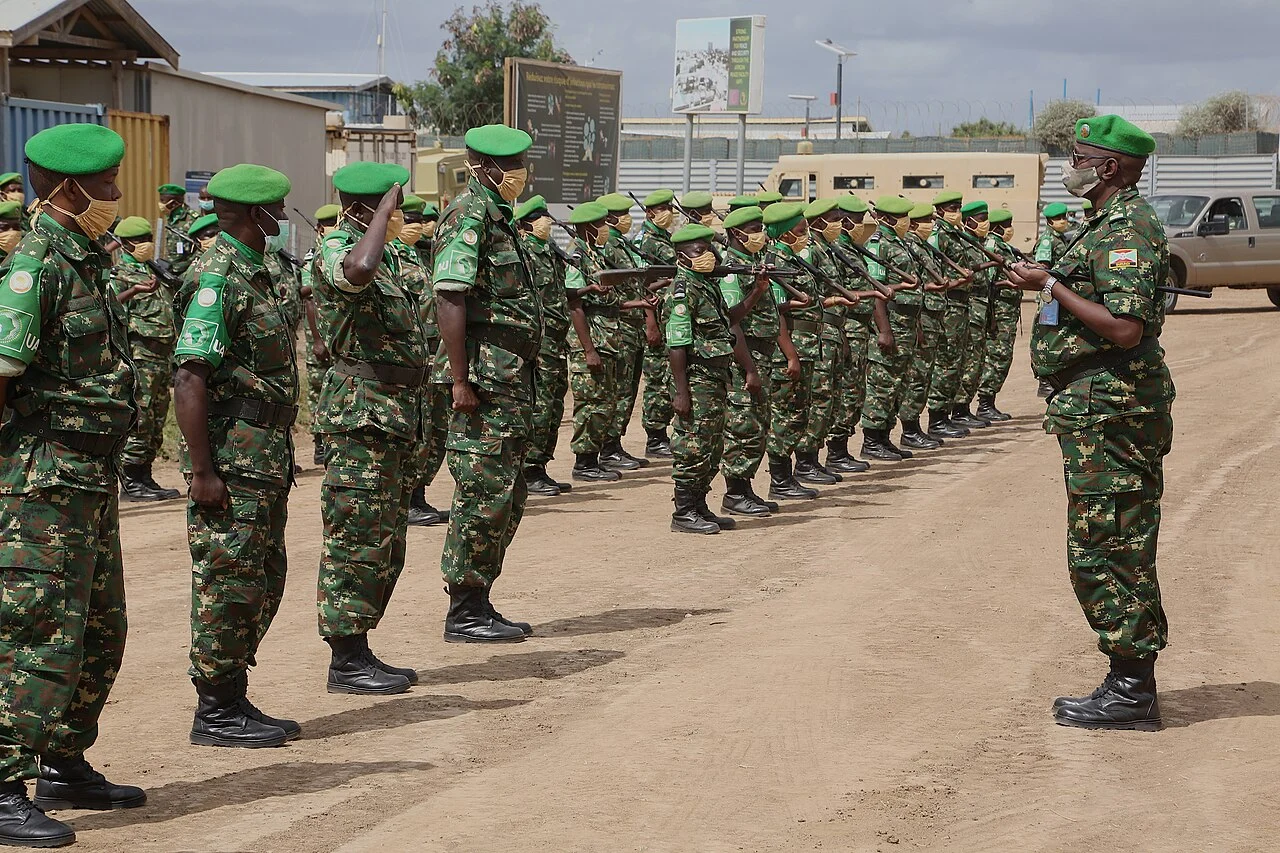
Photo: African Union peacekeeping troops on parade in Somalia. Credit: AMISOM Public Information, CC0, via Wikimedia Commons
According to UN planning documents cited by Somali media, Egypt is allocated 1,091 personnel within the African Union Support and Stabilization Mission in Somalia (AUSSOM), which began operating on 1 January 2025 under UN Security Council Resolution 2767, replacing the earlier ATMIS mission. The Egyptian contingent is meant to take over from Burundian troops, who will remain in place until relief arrives. Other AUSSOM troop contributors include Uganda (4,500), Ethiopia (2,500), Djibouti (1,520) and Kenya (1,410) — meaning Egypt and Ethiopia, two countries at odds over the Nile, will both have soldiers inside the same AU force.
A Deployment Running More Than a Year Late
Egypt and Somalia signed a military cooperation protocol in August 2024, under which Cairo pledged arms deliveries and help rebuilding the Somali Air Force. Within weeks, an Egyptian warship delivered a large arms shipment reported to include anti-aircraft guns and artillery. By December 2024 Egypt had formally committed to joining AUSSOM, and a 16-member Egyptian delegation led by Maj. Gen. Islam Radwan surveyed sites in Mogadishu the following September. AU sources at the time expected full deployment by the end of 2025. It did not happen.
Somalia’s State Minister for Foreign Affairs, Ali Mohamed Omar — known as Ali Balcad — has blamed the delay on AU and UN procedural hurdles, troop rotation schedules, logistics and funding gaps, not on any reluctance from Cairo. Somali President Hassan Sheikh Mohamud has said Egyptian forces will be based in the Middle Shabelle region, and site preparation is reportedly under way at Ceelcade, near the former Cisiley airfield just north of Mogadishu’s administrative boundary — about 400 km from the nearest point on the Ethiopian border. In February 2026, Hassan Sheikh and Egyptian Gen. Abdel-Magid Saqr reviewed a lineup of Egyptian AUSSOM units, and talks between Egyptian and Somali officers on training continued into September, including a meeting with Somali Defence Minister Ahmed Moallim Fiqi on 20 September. No arrival date has been announced.
Egypt’s Strategic Calculus
For Cairo, the Somalia deployment is not really about peacekeeping doctrine. Lt. Gen. Khaled Okasha, an Egyptian security analyst, has described Somalia as Egypt’s “strategic depth,” tying the mission directly to the security of the Bab al-Mandeb strait and the Suez Canal — both central to Egypt’s economy and to Red Sea shipping more broadly. That framing only makes sense against the backdrop of Egypt’s long-running dispute with Ethiopia over the Grand Ethiopian Renaissance Dam (GERD) on the Blue Nile, and Addis Ababa’s separate push for direct access to the Red Sea, which has unsettled several of its neighbours. The two countries’ militaries are themselves closely watched rivals — a comparison of their armed forces shows Egypt holding a wide edge in heavy equipment and air power, even as Ethiopia fields Africa’s largest standing army by troop numbers. Analysts have warned that Egyptian and Ethiopian troops serving simultaneously inside the same AU mission risks turning Somalia into a venue for a proxy contest between the two rivals, even if neither government frames it that way publicly.
Ethiopia’s Unease
Ethiopia has not opposed Egypt’s deployment outright, but its discomfort is on record. Suleiman Dedefo, Ethiopia’s ambassador to Somalia, said Addis Ababa is “neither threatened nor comfortable” with Egyptian troops arriving in the country — a carefully hedged line that still signals concern. Ethiopia’s own 2,500 troops already serving under AUSSOM give it a stake in how the mission’s internal balance shifts once Cairo’s contingent is in place, particularly given Addis Ababa’s historical wariness of Egyptian influence anywhere along the Horn of Africa’s coastline.
The Somaliland Complication
A separate dispute has added friction to an already tense picture. Israel recognised Somaliland’s independence in December 2025, a move President Hassan Sheikh Mohamud called a serious violation of Somali sovereignty. The recognition does not involve Egypt or Ethiopia directly, but it sharpens Mogadishu’s sensitivity to any external actor seen as encroaching on Somali territorial integrity — and reinforces Cairo’s argument that a reliable partner, rather than a rival claimant, should anchor the AU mission’s most strategically exposed sectors.
Al-Shabaab Still the Immediate Threat
Whatever the geopolitics, AUSSOM’s stated mandate — protecting civilians, enabling humanitarian access and supporting Somali-led offensive operations — exists because al-Shabaab, the al-Qaeda-linked insurgency, still controls significant territory and continues to threaten government forces and civilians. Somali analyst Hassan Muhammad has described al-Shabaab as the country’s major security challenge, and fixed Egyptian bases, once established, would become potential targets in their own right. Egypt’s equipment contribution to the mission — press accounts mention MRAP vehicles, armoured personnel carriers, helicopters and surveillance aircraft, though neither government has itemised the list — will matter less for prestige than for how it holds up against an insurgency that has outlasted two previous AU missions.
Why It Matters for Africa
AUSSOM was designed as an African-led, UN-backed answer to a security problem the continent has struggled to resolve through more than fifteen years of AU peacekeeping in Somalia. Egypt’s entry adds a well-resourced, externally funded contingent, but it also imports a rivalry — over the Nile, and increasingly over the Red Sea — that has nothing to do with Somalia’s own conflict. For the AU Peace and Security Council, which has extended AUSSOM’s mandate to December 2026, the test is whether a mission built on troop-contributing countries with diverging regional interests can still function as a single force. For Somalia, the immediate question is simpler: whether a partner that has waited more than a year to deploy can still make a difference against al-Shabaab once it finally arrives. For the wider Horn of Africa, Egypt’s presence is one more sign that competition over the Red Sea’s southern approaches — already drawing in Ethiopia, the UAE, Turkey and now Israel’s Somaliland recognition — is reshaping security alignments well beyond the countries directly on its coastline.
Sources