Can China Loosen Russia’s Grip on Algeria’s Armed Forces?

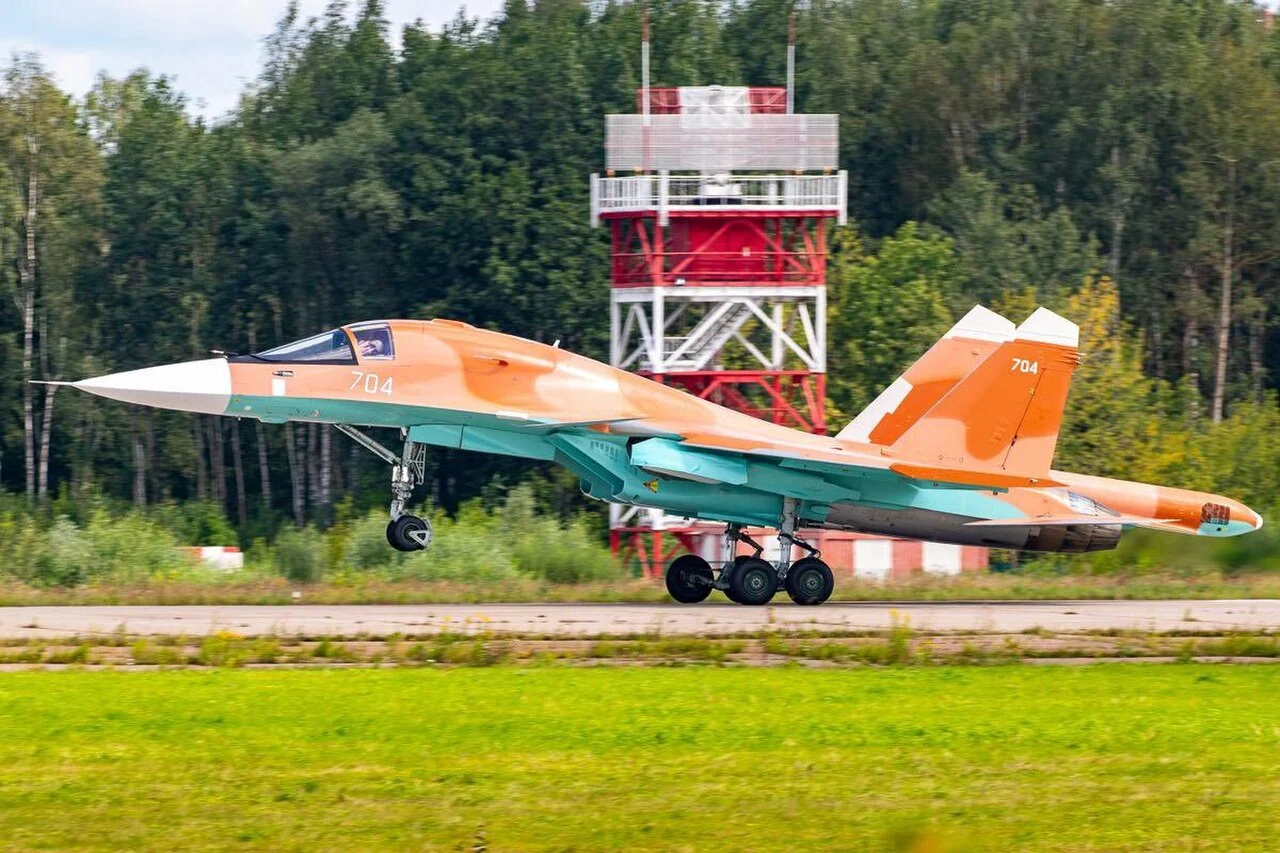


Algeria has spent six decades buying almost all of its combat aircraft, tanks and air-defence missiles from a single supplier. New SIPRI figures and a reported Chinese fighter deal suggest that pattern is finally loosening, though not in the direction Western governments might prefer.
Photo: An Algerian Air Force Su-34 fighter-bomber. Credit: Baracho Didi, CC0, via Wikimedia Commons
- Russia supplied 39% of Algeria’s arms imports in 2021-25, down sharply from 69% in 2016-20, as China’s share rose to 27% and Germany’s to 18%, according to SIPRI’s March 2026 data.
- Algeria is reportedly the first foreign operator of Russia’s Su-57E stealth fighter, a deal the US State Department has called “problematic” under CAATSA, while deliveries of Su-34 strike aircraft continue in parallel.
- Algeria is reportedly negotiating a package of 30-40 Chinese J-10CE fighters and up to five KJ-500 airborne early-warning aircraft, which would end Russia’s six-decade near-monopoly on Algerian combat aviation.
- Local industry remains narrow: German-licensed assembly of Fuchs 2 and Boxer armoured vehicles, and since 2025 local assembly of Chinese Type 056 corvettes, are the only serious technology-transfer programmes; engines, radars and guided munitions are still imported.
- A reported post-2022 shortage of Russian spare parts for Algeria’s roughly 500 T-90SA tanks is said to have pushed Algiers to evaluate China’s VT-4 as a hedge, a sign that even Algeria’s primary supplier relationship is not immune to Moscow’s own wartime strain.
Who Actually Supplies Algeria’s Military
For most of its history, Algeria has been treated in Western commentary as a straightforward case: a Russian client state, full stop. The inventory supports that view at first glance. The backbone of the Algerian Air Force is somewhere between 60 and 72 Su-30MKA multirole fighters, supplemented by newly delivered Su-34 strike aircraft and, since 2025, a reported handful of Su-57E fifth-generation fighters that would make Algeria the type’s first foreign operator. The army’s roughly 500 T-90SA main battle tanks, bought under Rosoboronexport contracts signed in 2006, 2011 and 2014, are the largest T-90 fleet outside Russia and India. The navy’s two Kilo-class submarines and Tiger-class corvettes came from the same supplier.
But the supplier picture has been shifting for years, and the shift shows up clearly in SIPRI’s Trends in International Arms Transfers data. For 2016-20, Russia accounted for 69% of Algeria’s arms imports, with Germany at 12% and China at under 10%. By the 2021-25 period, Russia’s share had fallen to 39%, China’s had risen to 27%, and Germany’s to 18% — a genuine reshuffling of Algeria’s supply base, even as SIPRI itself cautions that Algeria is unusually secretive about its arms purchases and that unverified reports of further Russian contracts during 2021-25 suggest the real Russian share may be higher than the published figure. Algeria’s total import volume also fell by roughly 78% between the two periods, pushing it down to 33rd among global arms importers from a position as the continent’s dominant buyer — a decline Algerian officials have not explained, but one that coincides with falling hydrocarbon-driven budget flexibility earlier in the period and a pivot toward fewer, larger-ticket deals since.
Germany’s growing share is not really a diversification of combat power — it reflects licensed local assembly of Fuchs 2 and Boxer wheeled armoured vehicles rather than frontline strike systems, discussed below. The more consequential shift is the opening China has been given in combat aviation, a domain Russia has held almost without interruption since Algerian independence.
| Capability | Main supplier | Dependency level | Main risk | Alternative |
|---|---|---|---|---|
| Fighter aircraft | Russia (Su-30MKA, Su-34, reportedly Su-57E) | High | Sole-source combat fleet; CAATSA exposure on Su-57; Russian wartime production and spares strain | China (J-10CE/KJ-500 reportedly under negotiation) |
| Air defence | Russia (S-300PMU2, Buk-M2E, Pantsir-S1) | High | Single-sourced SAM architecture; missile resupply tied to a sanctioned Russian industrial base | None confirmed; Chinese systems unverified |
| Tanks / armour | Russia (T-90SA, main battle tanks); Germany (Fuchs 2/Boxer APCs, local assembly) | High (MBT) / Medium (APC) | Reported post-2022 spares shortage for T-90S fleet; APC engines still German-sourced | China’s VT-4 reportedly evaluated for tanks |
| Helicopters | Russia (Mi-28, Mi-171, Mi-26) | High | Same single-OEM exposure as fixed-wing fleet | Limited; no confirmed alternative programme |
| Naval systems | Russia (submarines, corvettes); Germany (frigates); China (corvettes, local assembly); Italy (landing ship) | Medium | Four separate OEM maintenance ecosystems to sustain at once | Already diversified; Chinese corvette assembly growing |
| UAVs | China (CH-3/CH-4/CH-5, Wing Loong); Türkiye (Anka, Aksungur) | Medium | Two non-Western suppliers, limited Western options sought | Already split across two suppliers |
| Missiles / munitions | Russia (Kh-29, Kh-31, R-77, Iskander-E); China (YJ-12B); domestic (ONEX, ERIS, SCAFSE for conventional ammunition) | Medium-High | Guided-weapons ecosystem almost entirely imported; local output limited to small/medium-calibre ammunition | Incremental, foreign-JV-dependent domestic programme |
Dependency levels are DefenceMENA’s editorial assessment based on the sources listed below, not an official rating.
Six Capabilities, Six Different Dependencies
Treating Algeria as uniformly “Russian-dependent” obscures more than it reveals. The fighter fleet is the clearest case of platform, engine, weapons and software dependence rolled into one: the Su-30MKA, Su-34 and reported Su-57E are Russian airframes with Russian engines, Russian radars and mission software, and a weapons loadout (Kh-29, Kh-31, R-77) that is entirely Russian in origin. There is no meaningful domestic or third-country alternative for sustaining that fleet today.
Air defence is similarly concentrated but politically distinct. The S-300PMU2, Buk-M2E and Pantsir-S1 batteries are a layered, Russian-built system whose interceptor stocks depend on continued Russian production — production that is itself under strain from the war in Ukraine and from Western sanctions on Russia’s defence-industrial supply chains. Algeria is not sanctioned, but it is a downstream customer of a sanctioned producer, which is a different and less-discussed kind of exposure than the CAATSA question usually associated with Russian arms deals.
Land systems split more cleanly. The T-90SA fleet, discussed alongside other regional tank fleets in DefenceMENA’s survey of main battle tanks in Arab armies, is a straightforward Russian platform-engine-munitions package. The Fuchs 2 and Boxer wheeled vehicles are a genuine, if partial, industrial exception: Rheinmetall’s Algerian joint venture, agreed in 2014 with Ferrostaal and Algerian state partners, assembles the vehicles domestically under licence, with components including the engines still supplied from Germany (reportedly built by MTU at a facility in Constantine) and Algeria contractually barred from re-exporting the finished vehicles. That is local assembly with foreign critical components and a political restriction attached — not full industrial independence.
Naval systems are Algeria’s most genuinely diversified category, almost by accident of history rather than deliberate strategy: Russian submarines and corvettes, German-built MEKO A-200AN frigates, an Italian-built landing ship (the Kalaat Beni-Abbes, delivered by Fincantieri/Orizzonte Sistemi Navali, with a second reportedly under discussion following a 2025 Algeria-Italy shipbuilding agreement), and, since a 2025 agreement, locally assembled Chinese Type 056 corvettes. Sustaining four separate class lineages from four different industrial bases is logistically heavier than a single-supplier fleet, but it also means no one OEM can single-handedly ground the navy.
UAVs show a similar pattern on a smaller scale: Chinese CH-series and Wing Loong drones alongside Turkish Anka and Aksungur types ordered from 2023, giving Algeria two non-Western supply lines rather than one. For a closer look at the full inventory behind the Russian platforms discussed here, DefenceMENA’s earlier profile of Algeria’s Russian-built arsenal traces the fleet in detail. Munitions, meanwhile, are the starkest illustration of the platform-versus-ecosystem gap that runs through this series: owning Su-30s and T-90s is not the same as owning the precision-guided weapons that make them useful in a modern fight, and Algeria’s domestic output — explosives, ammunition and some guided systems under a 2019 presidential decree establishing ONEX, ERIS and SCAFSE as designated producers — remains tied to foreign technology partners (Norinco for ONEX, Serbia’s Zastava for ERIS, and Cassidian/Carl Zeiss for SCAFSE’s optics and sensors) rather than being indigenous in any full sense.
The Su-57 and the CAATSA Question
Algeria does not face the same CAATSA calculus as a US treaty ally or FMS customer, because it buys almost nothing from the United States to begin with — there is no American aid, FMS pipeline or ITAR-licensed platform for Washington to threaten. That changes the shape of the risk rather than removing it. The specific trigger is the Su-57E. Algeria confirmed in February 2025 that it would become the type’s first foreign customer, with pilots training in Russia; leaked Rostec documents reportedly describe a phased delivery schedule of two aircraft in 2025, six in 2026 and four in 2028, for a total order reported at 12-14 airframes, though neither government has published official figures. Russia confirmed in November 2025 that two aircraft of the type had already reached an unnamed foreign customer, which Defense News and other outlets identified as Algeria, and footage of a Su-57 flying near Oum El Bouaghi air base surfaced again in February 2026.
A State Department official has described the deal as “problematic” and said it could trigger sanctions under Section 231 of CAATSA, the same provision used against Turkey over its S-400 purchase and against China over Su-35 and S-400 transactions. Twenty-seven US lawmakers called for sanctions against Algeria over earlier Russian arms purchases back in 2022; Algeria responded by cancelling a planned joint military exercise with Russia, and no sanctions followed. That precedent — a documented warning, a symbolic Algerian concession, no actual measure — is the pattern to watch rather than a settled outcome; CAATSA sanctions depend on executive-branch determination, not automatic triggering, and Washington’s interest in Algeria’s gas exports and counter-terrorism cooperation in the Sahel gives it reasons to calibrate any response carefully.
The reported Chinese fighter package introduces a second, less legally defined form of political exposure: dependence on Beijing’s own willingness to continue supplying an advanced, export-sensitive platform (J-10CE) and an airborne early-warning aircraft (KJ-500) that China has historically been selective about exporting. Algeria would be trading one single-supplier relationship with real but calibrated sanctions risk for a second single-supplier relationship with different, largely untested risk — not for an absence of political dependence.
What Algeria’s Own Industry Can Actually Take Over
Algeria’s domestic defence-industrial base is real but narrow, concentrated in three areas. First, licensed assembly: the Rheinmetall joint venture for Fuchs 2 and Boxer vehicles, reportedly targeting output in the hundreds of units over a decade, and — far more recently — local assembly of Chinese Type 056 corvettes under a 2025 agreement, Algeria’s first foray into assembling a modern surface combatant class domestically rather than simply buying it afloat. Second, ammunition and ordnance: the 2019 decree establishing ONEX (explosives), ERIS (ammunition) and SCAFSE (radar, electronic and optical systems) as the designated vehicles for an expanded indigenous weapons programme, each paired with a foreign technology partner rather than developing capability from scratch. Third, light manufacturing of small arms, patrol boats and trainer aircraft that predates the current programme and remains modest in scale.
What is conspicuously absent is any domestic capacity in the categories that actually determine combat-fleet readiness: jet and tank engines, active radar and electronic-warfare systems, precision-guided munitions, and mission software. Every one of those remains an import, whether from Russia, Germany or China. Algeria’s industrial progress over the past decade has been real — assembling a corvette hull domestically is a meaningfully larger undertaking than bolting together an armoured personnel carrier — but it has not yet touched the layer of the supply chain that would reduce Algeria’s exposure if any single supplier relationship were disrupted.
Alternatives
For the fighter fleet, the most consequential alternative in play is China’s J-10CE and KJ-500 package, reportedly under negotiation with potential initial deliveries from 2027, which Algerian and Chinese sources have not officially confirmed as of mid-2026. Technically, the J-10CE is a capable, combat-proven fourth-plus-generation fighter already exported to Pakistan; politically, it offers Algeria a second supplier without Western export-control strings, at the cost of trading Russian for Chinese single-source dependence rather than eliminating dependence altogether. A pivot to Western fighters (Rafale, Eurofighter, or an F-16 variant) is not under serious discussion in available reporting and would face steep political and infrastructure barriers given Algeria’s historical alignment and total absence of Western-standard maintenance, munitions or training infrastructure.
For armour, the reported interest in China’s VT-4 as a hedge against T-90S spares shortages is the clearest alternative signal, though it rests on limited and not fully independently verified reporting; a confirmed VT-4 order would mark China’s first entry into Algeria’s main battle tank fleet. For air defence, no credible alternative to the existing Russian S-300/Buk/Pantsir architecture has been reported; a shift would require an entirely new missile-defence doctrine and infrastructure, making it the single most locked-in category in the inventory. For UAVs and munitions, Algeria has already demonstrated that diversification across non-Western suppliers (China and Türkiye) is achievable without political friction, and that template is the most realistic model for any further diversification in other categories.
Switching Cost
Algeria’s fighter pilots, ground crews and maintenance depots have been trained exclusively on Russian aircraft, engines and avionics for six decades; introducing a Chinese fighter type means building a parallel training, simulator, spares-logistics and munitions-storage infrastructure rather than replacing the existing one, at least during a multi-year transition — exactly the “diversification multiplies logistics” dynamic visible elsewhere in this series. The same applies to air defence, where switching missile families would mean retraining radar operators, replacing fire-control software, and re-certifying command-and-control links built around Russian systems, with no guarantee of equivalent coverage during the transition window.
Naval diversification has already cost Algeria this kind of complexity: Russian submarine propulsion, German frigate combat systems, Italian amphibious-ship systems and now Chinese corvette hulls mean four separate spares pipelines and maintenance cultures rather than one, a cost accepted in exchange for not being beholden to a single navy supplier. Extending that model to fighters or air defence would multiply the same complexity across far more expensive, operationally central platforms — why Algerian planners appear to be moving incrementally rather than announcing a wholesale pivot.
From Moscow’s Near-Monopoly to a Calibrated Three-Supplier Balance
Algeria’s diversification, where it exists, has reduced one kind of risk while leaving another largely untouched. The drop in Russia’s import share from 69% to 39% over two SIPRI reporting periods, and the reported opening to Chinese fighters, genuinely reduces Algeria’s exposure to any single disruption of Russian supply — whether from sanctions, wartime production bottlenecks, or a future shift in Moscow’s own strategic priorities. It does not reduce Algeria’s exposure to non-Western supplier risk in general, since China and Russia both sit outside the Western export-control architecture that is the main subject of sanctions scrutiny in this series’ other country profiles; Algeria has swapped a single point of political dependence for a slightly larger but similarly non-aligned set of points.
Where diversification has clearly helped is logistics resilience in the navy, where four suppliers mean no single disruption grounds the fleet, and in the emergence of actual industrial capacity — local corvette assembly, local armoured-vehicle assembly — that did not exist a decade ago. Where it has clearly added cost is exactly where this series’ framework predicts: more maintenance ecosystems, more spares pipelines, more foreign technical-advisor relationships to manage, for a defence budget of roughly $24-25bn that, while large by regional standards, is not unlimited. Algeria’s case is less a story of successful diversification than one of a dominant single-supplier relationship beginning, cautiously and only partially, to loosen.
| Criterion | Weight | Score | Justification |
|---|---|---|---|
| Domestic manufacturing | 20 | 6 | Licensed assembly of German APCs and, since 2025, Chinese corvettes; no indigenous engines, radars or guided munitions |
| Local maintenance | 15 | 4 | Fleet sustainment remains OEM-dependent across Russian, German and Chinese suppliers; no evidence of depot-level overhaul independence for major platforms |
| Local ammunition | 15 | 7 | Credible domestic output of conventional/small-calibre ammunition via ONEX/ERIS/SCAFSE; guided munitions entirely imported |
| Supplier diversification | 15 | 10 | Russia’s import share fell from 69% to 39% over two SIPRI periods as China and Germany grew; genuine multi-supplier spread, strongest score in this category of any country reviewed so far |
| Critical components | 15 | 3 | Engines, radars and mission software for every major platform are foreign-sourced, including German engines in locally assembled APCs |
| Technology transfer | 10 | 5 | Real but narrow transfer via the Rheinmetall APC joint venture and the 2025 Chinese corvette-assembly agreement; no transfer in aviation or air defence |
| Export-control exposure | 10 | 5 | Documented, active CAATSA risk flagged by the US State Department over the Su-57E, with precedent of warnings but no sanctions imposed to date |
| Total | 100 | 40 |
DefenceMENA editorial analytical index, not an official ranking.
Why It Matters for the MENA Region
Algeria is the clearest regional test of whether diversification away from a dominant supplier is possible without Western re-alignment. Every other country in this series that has reduced single-supplier dependence — Egypt, Morocco, Saudi Arabia, the UAE — has done so by adding Western or Western-adjacent suppliers alongside existing relationships, and Algeria’s rival compares strikingly differently on exactly this point. Algeria’s path, if the reported Chinese fighter deal materialises, would be the first case of a MENA military diversifying by adding a second non-Western supplier to an existing non-Western one, with no Western platform anywhere in its combat core. That matters for how the rest of the region reads supplier risk: it suggests sanctions exposure and political dependence can be managed, to a degree, without ever entering the US or European export-control system at all — a different diversification model than the rest of this series has documented, and one worth watching as China’s defence-export ambitions in North Africa grow.
Sources
- SIPRI data via Morocco World News, March 2026 — Algeria’s 2021-25 and 2016-20 supplier shares (Russia, China, Germany)
- Defence Security Asia, August 2026 — reported J-10CE/KJ-500 negotiation, quantities and timeline
- Defense News, February 2026 — Su-57 sighting and delivery context
- Air Data News — Algeria’s acknowledgement of the Su-57E deal
- North Africa Post — US official statements on CAATSA exposure over Russian arms purchases
- Army Recognition, 2019 — ONEX/ERIS/SCAFSE decree and foreign technology partners
- Military Africa, January 2025 — local assembly agreement for Chinese Type 056 corvettes
- Defense News, 2016 — German MEKO A-200AN frigate delivery
- Offshore Energy — Fincantieri/Orizzonte Sistemi Navali landing ship contract for the Algerian Navy
- Military Africa, 2023 — Turkish Anka-S and Aksungur UAV orders
- Defense industry of Algeria, Wikipedia — overview of ONEX, ERIS, ECMK and related state producers