


Why Did Senegal Buy the OPV 58 S?

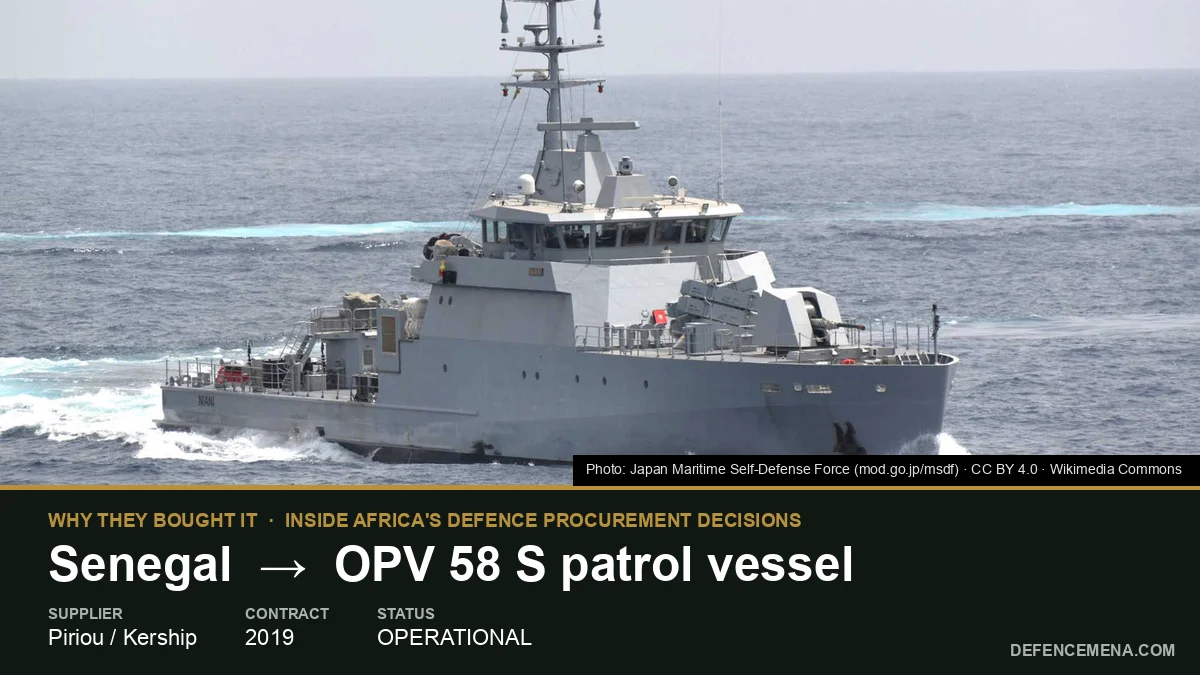


Senegal bought three Piriou OPV 58 S offshore patrol vessels because it was about to become an oil and gas producer and had no ship able to stand guard over the fields. The Ministry of the Armed Forces signed with the Concarneau yard on 17 November 2019, in front of President Macky Sall and the visiting French prime minister, and the ministry later described the first ship, Walo, as arriving “in a context of oil and gas exploitation”. All three, Walo, Niani and Cayor, were delivered between June 2023 and April 2024. They are the first Senegalese warships armed with anti-ship missiles, and one of them fired a Marte Mk2/N for the first time in November 2025.
Photo: The Senegalese Navy's OPV 58 S Niani at sea off Dakar during the Japan Maritime Self-Defense Force training squadron's visit, July 2024. The 76 mm gun and the twin Marte Mk2/N anti-ship missile launchers are visible forward of the bridge. Photo: Japan Maritime Self-Defense Force (CC BY 4.0). Credit: Japan Maritime Self-Defense Force (mod.go.jp/msdf), CC BY 4.0, via Wikimedia Commons.
- Country
- Senegal (Marine nationale sénégalaise)
- System
- OPV 58 S offshore patrol vessel, 62 m, missile-armed
- Supplier
- Piriou with Kership and Naval Group (France)
- Quantity
- 3 (Walo, Niani, Cayor)
- Contract year
- 2019 (in force 30 Sep 2020)
- Status
- OPERATIONAL all three in Dakar since June 2024
- Main requirement
- Protection of offshore oil and gas fields, fisheries and the EEZ; state action at sea
- Training
- Crews trained by the builder for operation and maintenance; seven years of support in Senegal
- Localisation
- None; in-service support through Piriou Ngom Senegal in Dakar
- Known alternatives
- None documented; previous suppliers OCEA and Israel Shipyards
What capability did Senegal need?
In 2019 Senegal was counting down to first oil. Woodside’s Sangomar field, about 100 km off the Petite Côte, and the bp-operated Greater Tortue Ahmeyim (GTA) gas field on the maritime border with Mauritania were both under development, and the government expected production to begin within two or three years. Zone Militaire (Opex360), reporting the Piriou contract the day after it was signed, put the stakes in numbers: reserves estimated at three billion barrels of oil and around 450 billion cubic metres of gas, with exploitation scheduled for 2021-2022. Sangomar actually produced first oil on 11 June 2024, and GTA loaded its first LNG cargo on 17 April 2025. The ships arrived in the same window.
The official framing is unusually clear for an African naval purchase. When Walo was formally received on 3 August 2023, the Ministry of the Armed Forces wrote that the navy was showing its strength “dans un contexte d’exploitation du pétrole et du gaz” (in a context of oil and gas exploitation). When Cayor reached Dakar in June 2024, the state broadcaster RTS said the ship would serve “la défense militaire, la protection des ressources halieutiques et la sécurisation des installations pétrolières et gazières en mer”: military defence, protection of fisheries and the security of offshore oil and gas installations. That is the requirement, officially stated, in the government’s own words.
Underneath the hydrocarbons story sits an older problem. Senegal’s exclusive economic zone covers roughly 200,000 square kilometres of rich fishing water on the cocaine route from South America to Europe, and Janes listed illegal fishing, irregular migration and drug trafficking as the pressures behind the purchase. The existing patrol ships could board a trawler; none could escort a floating production unit against an armed threat. The OPV 58 S is a patrol vessel in name and a light corvette in armament because the ministry wanted both.
What did it already operate?
The Senegalese Navy that signed the Piriou contract was a coastal force of around 900 sailors and some thirty hulls, almost all based in Dakar, according to a 2016 Mer et Marine survey. Its largest modern unit was Fouladou, a 58 m aluminium OPV 190 Mk II built by OCEA at Les Sables-d’Olonne and delivered in October 2016, armed with little more than a water cannon on trials. Below it came Kédougou, a 45.8 m patrol vessel built at Lorient and in service since 2015, and Ferlo, a 33 m RPB 33 from Ufast in Quimper, commissioned in October 2013. The 1981-vintage Njambuur, 58 m with two 76 mm turrets, was the only ship with a naval gun worth the name; Poponguine and Podor dated from the mid-1970s.
The fast-boat layer was newer. Israel Shipyards delivered two Shaldag Mk II fast patrol boats, Anambé and Soungrougrou, in 2019, and a third Mk II, Cachouane, plus a Mk V, Lac Retba, in November 2020, defenceWeb reported. Two more RPB 33s were contracted in 2018. It was a fleet built for inshore law enforcement, not for sea control 100 km out. DefenceMENA’s survey of patrol vessels in Gulf of Guinea navies shows how typical that profile was for the region.
What system was selected?
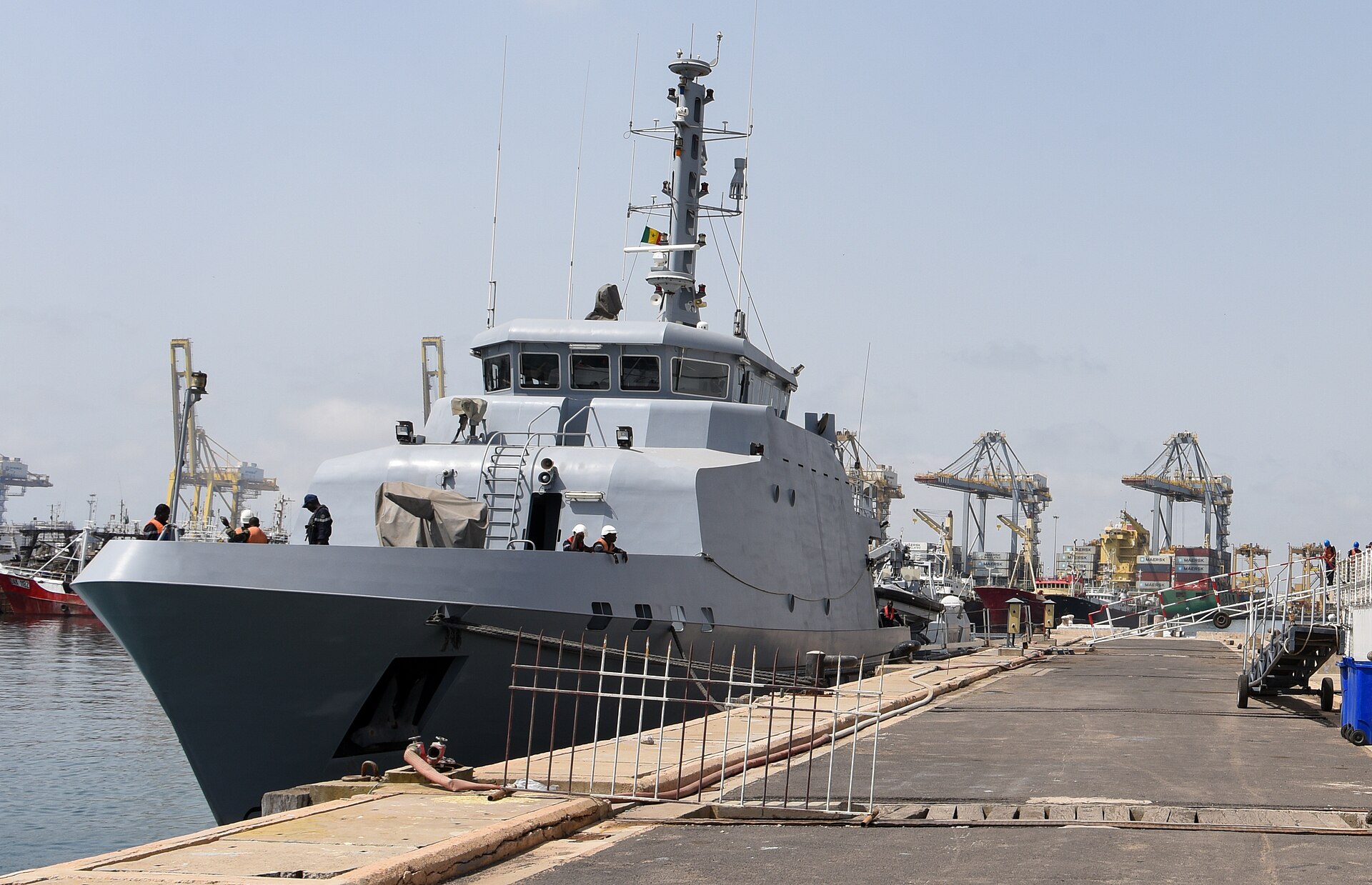
The OPV 58 S is a 62.2 m steel-hulled patrol vessel with an aluminium superstructure, designed by Piriou and built with its Kership joint venture with Naval Group. Walo was built entirely at Concarneau; the hulls of Niani and Cayor were produced at Kership’s Lanester yard near Lorient and towed to Concarneau for outfitting, Mer et Marine reported. Piriou gives a beam of 9.5 m, a draught of 2.9 m, 21 knots, 4,500 nautical miles at 12 knots and an endurance of 25 days; defenceWeb quotes 600 tonnes, while RTS gave 62.82 m and 735 tonnes at full load for Cayor. The crew is 24 with berths for 24 more, typically a boarding team, commandos or divers (EDR Magazine’s 36 plus 12 is the one outlier).
The weapons fit is what makes the class unusual. Forward of the bridge sits a Leonardo 76 mm gun, with two twin launchers for four MBDA Marte Mk2/N anti-ship missiles immediately behind it. A SIMBAD-RC remote-controlled mount with two Mistral 3 missiles gives point air defence, and two Nexter Narwhal 20 mm remote weapon stations and two 12.7 mm machine guns cover the close-in task. Naval Group’s POLARIS combat management system ties it together, with a Terma Scanter surveillance radar and Safran Paseo XLR and Vigy Observer optronics. MBDA describes the Marte Mk2/N as a 310 kg fire-and-forget sea-skimming missile with a range of more than 30 km, sized for littoral work between a gun and a full Exocet. Two RHIBs launch from stern ramps.
Which alternatives were considered?
No tender was published and no competition is documented. The contract was announced during a French prime-ministerial visit to Dakar, which points to a government-to-government choice rather than an open bid. What can be said is that Senegal had two incumbent patrol-boat suppliers, OCEA and Israel Shipyards, and chose neither for its first missile ships. The table lists the market alternatives of the time; none of them is known to have been formally evaluated.
| Alternative | Class | Status of consideration | Source |
|---|---|---|---|
| OCEA OPV 190 Mk II (France) | 58 m aluminium OPV, incumbent (Fouladou) | SAME-CLASS MARKET ALTERNATIVE; no competition documented | Mer et Marine 2016 |
| Israel Shipyards OPV 62 (Israel) | 62 m OPV, incumbent supplier (Shaldag) | SAME-CLASS MARKET ALTERNATIVE; no competition documented | defenceWeb 2020 |
| Damen OPV / Stan Patrol (Netherlands) | 50-80 m OPV family | SAME-CLASS MARKET ALTERNATIVE; no competition documented | DefenceMENA market survey |
| Dearsan OPV 76 (Türkiye) | 76 m OPV, later sold to Nigeria | SAME-CLASS MARKET ALTERNATIVE; no competition documented | DefenceMENA market survey |
| CSOC P18N (China) | 95 m OPV, Nigerian Navy | SAME-CLASS MARKET ALTERNATIVE; no competition documented | DefenceMENA market survey |
Why was the OPV 58 S selected?
Offshore energy security (officially stated). The ministry’s own release on Walo, the RTS report on Cayor and the 2019 Opex360 account all put the oil and gas fields first. Sangomar’s floating production unit sits roughly 100 km offshore; GTA’s floating LNG facility is on the Mauritanian border. A 25-day, 4,500-mile patrol ship with a gun and missiles is the smallest hull that can maintain a presence there and answer an armed intrusion, and the timing of the contract against the production schedule is the strongest evidence of motive in the public record.
State action at sea (documented in procurement material). Piriou, Kership and Naval Group describe the ships as dedicated to Senegal’s “Maritime Defence and State Action at Sea”: surveillance, identification, intervention, boarding, commando projection, rescue, anti-trafficking and pollution control. That phrase, “action de l’État en mer”, is the French legal concept of the state’s police powers at sea, and the ships were specified to carry a 24-strong intervention team on top of the crew. The navy’s drug-interdiction record since 2023, described below, is the practical reading of that clause.
Deterrence and prestige (reported by Military Africa; analysts assess). Military Africa framed the 2019 order as a shift in the “naval balance of power” in West Africa, and Naval News called the missile fit “a first” for the navy. No Senegalese official has named an adversary, and this article does not infer one. What the navy did say, after the first live Marte firing in November 2025, was that the shot “symbolises the operational maturity of our Navy and its constant commitment to serving national sovereignty”. The missile fit is best read as a sovereignty statement to match the arrival of oil revenue, not as a response to a specific threat.
The French relationship (documented; motive possible but unconfirmed). The contract was signed during Prime Minister Édouard Philippe’s visit, with President Sall present; the financing is not public. Senegal had bought from French yards for a decade (OCEA, Ufast, STX Lorient), and a French Navy Falcon 50 based in Dakar supported the navy’s 2023 drug operations, according to MAOC-N. That made a French builder the path of least resistance; it does not prove that price or financing decided it, and no source says so.
Through-life support in Dakar (documented in procurement material). defenceWeb reported that the contract includes seven years of follow-on support in Senegal through the builder’s local subsidiary, Piriou Ngom Senegal. Piriou’s president, Vincent Faujour, told the Walo handover that the yard was “fully aware of the imperative need to guarantee the highest level of quality and availability of your ships”. For a navy whose previous flagship had come from a different yard with no such arrangement, a builder already established in Dakar was a measurable advantage.
What was included in the contract?
Three OPV 58 S hulls with their full weapons and sensor fit, delivered under the Senegalese flag from Concarneau. The missile element was contracted separately with MBDA, Opex360 reported, which is normal for a French naval export. defenceWeb’s account of the Walo handover is the only source to detail the support package: seven years of in-country support through Piriou Ngom Senegal. RTS reported that the crews “received training for the operation, maintenance and upkeep of the ships”, and that a Senegalese officer, Capitaine de vaisseau Ousmane Ndiéguène Niang, supervised construction of all three. Munitions quantities, spares and any infrastructure at the Amiral Faye Gassama naval base are not public.
How much did it cost?
The contract value has never been released by either government or by Piriou. Two press figures exist, and they do not come from the same place. Zone Militaire (Opex360) wrote on 18 November 2019 that the deal was worth “at least 205 million euros”, without naming a source. The Dakar daily Jotaay wrote that each ship cost 44 billion CFA francs and the three together 132 billion CFA francs, roughly 200 million euros, again without a source. The two numbers are consistent with each other but neither is official, and neither says whether missiles, training and the seven-year support package are included. For scale, the Ministry of the Armed Forces’ 2026 budget is about 438 billion CFA francs in commitment authorisations, Seneweb reported. Financing terms are not public.
How many were ordered?
Three, and three were built. There was no option clause in any public statement.
Training, maintenance and support
RTS reported that the crews were trained for “la mise en œuvre, la maintenance et l’entretien” of the ships. Each ship sailed from France to Dakar under its own crew, Niani via Brest, Lorient and Casablanca in December 2023, Mer et Marine reported. In-service support is the builder’s responsibility for seven years under the contract, delivered through Piriou Ngom Senegal, the group’s Dakar subsidiary, and Piriou said after the Cayor handover that its teams in Dakar “remain mobilised to guarantee maximum operational availability”. The content of that support, whether it includes dry-docking, missile maintenance or spares pools, has not been published.
Local production or technology transfer
None. All three ships were built in Brittany; the Senegalese contribution was the supervision team and the crews. Piriou Ngom Senegal exists for repair and support, not construction, and no offset or industrial participation clause has been announced. Three hulls do not justify a transfer of shipbuilding capacity.
Delivery and operational status
Piriou delivered to the revised plan. The 2019 announcement had promised deliveries “by mid-2023”; the contract only came into force on 30 September 2020, pushing the 44-month programme to spring 2024, when Cayor was handed over. Faujour said the work “represented more than 600,000 hours of work”. One date conflict: Piriou and defenceWeb say Walo “reached Dakar in August 2023”, while the Senegalese Navy and ministry websites record her arrival on 7 July 2023, with the presidential ceremony on 3 August. The official Senegalese dates are used here.
- 17 Nov 2019Contract for three OPV 58 S signed in Dakar between the Ministry of the Armed Forces and Piriou, during the French prime minister’s visit
- 30 Sep 2020Contract enters into force; first steel cut in October 2020
- 11 Apr 2022Walo launched at Concarneau; Niani launched in September 2022
- 2 Jun 2023Walo handed over at Concarneau to Armed Forces Minister Sidiki Kaba and Rear Admiral Abdou Sène
- 7 Jul 2023Walo arrives at the Amiral Faye Gassama naval base, Dakar; received by President Macky Sall on 3 August
- 14 Nov 2023Niani delivered; sails for Dakar in December and arrives in January 2024
- 16 Apr 2024Cayor handed over at Concarneau; programme complete
- 5 Jun 2024Cayor received in Dakar by Rear Admiral Abdou Sène
- 21 Nov 2025First live Marte Mk2/N firing by an OPV 58 S against a target hulk (navy statement via Military Africa)
- Jul 2026Niani crosses the Atlantic for FLEETEX 250 and the International Naval Review in the United States
Has it been used operationally?
Yes, from the first months. The navy seized about three tonnes of cocaine at sea in late November 2023 and a similar quantity in mid-December, Africa Defense Forum reported; Mer et Marine credited Walo with a three-tonne seizure, and defenceWeb wrote that the ship “already has intercepted dozens of vessels trafficking narcotics”. On 22 December 2023 a Senegalese Navy ship, unnamed by MAOC-N, took 690 kg from a go-fast boat 120 nautical miles offshore; MAOC-N counted four such operations with Senegal in 2023 totalling 7,470 kg.
What has operational use shown?
Piriou’s president said at the Cayor handover that Walo and Niani had already carried out “rescue operations, the fight against illicit trafficking and the fight against pollution at sea”. On 21 November 2025 one of the ships fired a Marte Mk2/N at a decommissioned landing craft rigged with containers; the navy said the missile hit and set the target alight, Military Africa reported, calling it the first live anti-ship missile firing by the Senegalese Navy. In mid-2026 Niani crossed the Atlantic for FLEETEX 250 off Norfolk and the International Naval Review in New York, a statement of confidence in the ships’ endurance two years after delivery. None of this is combat.
Did Senegal order more?
No follow-on order has been announced as of October 2026. Faujour’s remark at the Cayor ceremony that “the story is not over yet” has not been matched by a contract. Military Africa reported in 2025 that the navy is working to a “Naval Strategy 2050” roadmap; its content is not public. Senegal’s other recent maritime purchases have gone elsewhere: it has paired the ships with Turkish-built maritime surveillance aircraft for the wide-area search task.
What does this tell us about African procurement?
First, resource timing drives naval procurement more reliably than threat. Senegal did not buy missile ships after an incident; it bought them three years before first oil, so that the fleet would exist when the revenue did. Nigeria made the same calculation with its P18N and Dearsan OPVs, and Angola with its corvettes. The pattern is visible across Africa’s frigate and corvette fleets: where there is an offshore field, there is a surface-combatant programme within five years.
Second, the “patrol vessel” label hides a spectrum. The OPV 58 S is 600 tonnes and carries four anti-ship missiles, a 76 mm gun and a point-defence system, which is more than some corvettes twice its size carry in African service. Ministries like the label because it fits a law-enforcement narrative; navies like the hull because it can be armed up. Senegal is the clearest case so far of an African navy buying a corvette’s teeth on a patrol vessel’s paperwork.
Third, the incumbent-supplier logic is strong but not absolute. Senegal had been a reliable OCEA and Israel Shipyards customer and moved to Piriou for its first missile ships without any public competition. That says less about the incumbents than about what the ministry wanted: a yard with a combat-systems partner, an in-country subsidiary and a government relationship able to carry a contract of this size. DefenceMENA’s analysis of who supplies Africa’s weapons shows how much of France’s remaining African defence business is naval and Francophone.
Fourth, the price opacity is total. Neither party has given a figure and the two press estimates are unsourced. For a country whose 2026 defence budget is around 438 billion CFA francs, a programme reported at 132 billion is a parliamentary question that has never been answered in public; Africa’s defence budgets ranked puts that budget in context.
Procurement record
| Field | Value |
|---|---|
| Country | Senegal |
| Service | Marine nationale sénégalaise (Senegalese Navy) |
| System | OPV 58 S offshore patrol vessel (Walo, Niani, Cayor), 62.2 m, missile-armed |
| Manufacturer | Piriou (Concarneau) with Kership (Lanester hulls) and Naval Group (POLARIS CMS); MBDA missiles |
| Origin | France |
| Category | Naval; offshore patrol vessel |
| Requirement | Security of offshore oil and gas installations, fisheries protection, counter-trafficking, state action at sea (officially stated) |
| Order date | 17 November 2019 (contract signature, Dakar) |
| Contract date | 17 November 2019; in force 30 September 2020 |
| Quantity | 3 |
| Contract value | Not disclosed. Press figures: “at least EUR 205 million” (Opex360, 2019); 132 billion CFA francs for three (Jotaay); scope unknown |
| Delivery | Walo 2 Jun 2023 (Dakar 7 Jul 2023); Niani 14 Nov 2023 (Dakar Jan 2024); Cayor 16 Apr 2024 (Dakar 5 Jun 2024) |
| Operational status | OPERATIONAL |
| Training | Crew training by the builder for operation and maintenance; details not public |
| Support | Seven years of in-country support through Piriou Ngom Senegal (defenceWeb) |
| Localisation | None |
| Tech transfer | None announced |
| Confirmed competitors | None documented |
| Follow-on order | None as of Oct 2026 |
| Primary source | Ministry of the Armed Forces of Senegal; Piriou press releases |
| Last verified | 5 October 2026 |
FAQ
What is the OPV 58 S Senegal bought?
A 62.2 m, 600-tonne offshore patrol vessel designed and built by Piriou at Concarneau, armed with a 76 mm gun, four Marte Mk2/N anti-ship missiles, a SIMBAD-RC Mistral launcher and 20 mm and 12.7 mm guns. Senegal bought three: Walo, Niani and Cayor.
Why did Senegal buy the OPV 58 S?
The officially stated reason is the protection of offshore oil and gas installations at Sangomar and GTA, together with fisheries protection and the fight against trafficking. The contract was signed in 2019, three years before first oil.
How much did the OPV 58 S Senegal contract cost?
The value has not been disclosed. Opex360 reported “at least 205 million euros” in 2019 and the Senegalese daily Jotaay reported 132 billion CFA francs for the three ships; neither figure is official.
When were Walo, Niani and Cayor delivered?
Walo was handed over on 2 June 2023 and reached Dakar on 7 July 2023; Niani was delivered on 14 November 2023 and arrived in January 2024; Cayor was handed over on 16 April 2024 and arrived in Dakar on 5 June 2024.
Does the Senegalese Navy have anti-ship missiles?
Yes. The three OPV 58 S carry four MBDA Marte Mk2/N missiles each, and the navy conducted its first live firing against a target hulk on 21 November 2025.
What did the Senegalese Navy operate before the OPV 58 S?
Its largest ships were the OCEA-built OPV 190 Fouladou (2016), the 45 m Kédougou (2015), the RPB 33 Ferlo (2013), Israeli Shaldag fast patrol boats delivered in 2019 and 2020, and the 1981 patrol ship Njambuur.
Has Senegal ordered more patrol vessels from Piriou?
No follow-on order has been announced as of October 2026.
More from Why They Bought It
- Why Did Morocco Buy the AH-64E Apache?
- Why Did Nigeria Buy the VT-4 Tank?
- Why Did Côte d'Ivoire Buy the Wing Loong II?
- Why Did Kenya Buy 118 Katmerciler HIZIR Armoured Vehicles?
- Why Did Nigeria Buy the M-346FA?
- Why Did Egypt Buy (and Build) the K9 Howitzer?
- Why Did Niger Buy the Bayraktar TB2?
Sources
- Ministère des Forces armées du Sénégal – Réception d’un patrouilleur lance-missiles : le Walo (3 Aug 2023)
- Ministère des Forces armées du Sénégal – Le Walo bien arrivé en eaux sénégalaises (7 Jul 2023)
- Marine nationale sénégalaise – Arrivée à Dakar du PHM Walo (7 Jul 2023)
- RTS – Le Cayor, troisième patrouilleur lance-missiles de la Marine nationale, réceptionné (Jun 2024)
- Piriou – Senegal signs with Piriou a contract to purchase 3 OPV (Nov 2019)
- Piriou – Piriou delivers the second OPV Niani to the Senegalese Armed Forces (Nov 2023)
- MBDA – Marte Mk2/N product page
- Naval News – Senegal orders 3 offshore patrol vessels from French shipyard Piriou (17 Nov 2019)
- Zone Militaire (Opex360) – Le Sénégal commande trois patrouilleurs hauturiers OPV 58S auprès du chantier naval français Piriou (18 Nov 2019)
- Jotaay – Le Sénégal sur le point d’acquérir l’un des trois navires armés de missile OPV 58 S : 132 milliards pour renforcer la sécurité maritime
- Naval News – Piriou launches first of three new OPV for Senegal (Apr 2022)
- Mer et Marine – Piriou : la construction des patrouilleurs de la marine sénégalaise progresse (22 Nov 2022)
- Mer et Marine – Piriou : le patrouilleur sénégalais Walo a débuté ses essais (Jan 2023)
- defenceWeb – Piriou hands over first OPV 58S patrol vessel to Senegal (Jun 2023)
- Naval News – Piriou delivers second OPV to the Senegalese Navy (Nov 2023)
- Mer et Marine – Le patrouilleur Niani va rejoindre Dakar, le Cayor a débuté ses essais (Dec 2023)
- defenceWeb – Third and final OPV 58S offshore patrol vessel delivered to Senegal (Apr 2024)
- Janes – Update: Piriou completes OPV 58 S programme for Senegal (Apr 2024)
- EDR Magazine – Piriou delivers the Cayor and finalizes the OPV 58 S program for the Senegalese Navy (Apr 2024)
- Marine & Océans – Piriou livre à la marine sénégalaise le 3ème et dernier bateau du programme OPV 58 S (Apr 2024)
- The Defense Post – Senegal receives third Piriou offshore patrol vessel (18 Apr 2024)
- Military Africa – Piriou delivers third missile-armed OPV 58 S to Senegalese Navy (Apr 2024)
- Military Africa – Naval balance of power shifts as Senegal introduces ship-killing warship (Dec 2019)
- Military Africa – Senegal Navy executes historic anti-ship missile test (Nov 2025)
- Africa Defense Forum – Senegal sends message to traffickers with major cocaine seizures (Jul 2024)
- MAOC-N – MAOC-N supports another successful Senegalese operation in the Atlantic: 690 kg of cocaine seized (Dec 2023)
- The Gambia Journal – Gambian naval officer joins Senegal OPV Niani in historic U.S. fleet exercises (Jun 2026)
- Mer et Marine – La marine sénégalaise (Jul 2016)
- Mer et Marine – Ocea : le patrouilleur sénégalais Fouladou achève ses essais (Oct 2016)
- defenceWeb – Israel Shipyards delivers last two Shaldag fast patrol boats to Senegal (Dec 2020)
- Oilfield Technology – Woodside achieves first oil at Sangomar in Senegal (11 Jun 2024)
- LNG Industry – bp completes loading of first cargo from Greater Tortue Ahmeyim LNG project (17 Apr 2025)
- Seneweb – Budget 2026 du ministère des Forces armées : près de 438 milliards FCFA (Dec 2025)
Last updated: 5 October 2026. This article is updated in place when the procurement status changes.


