Why Did Niger Buy the Bayraktar TB2?

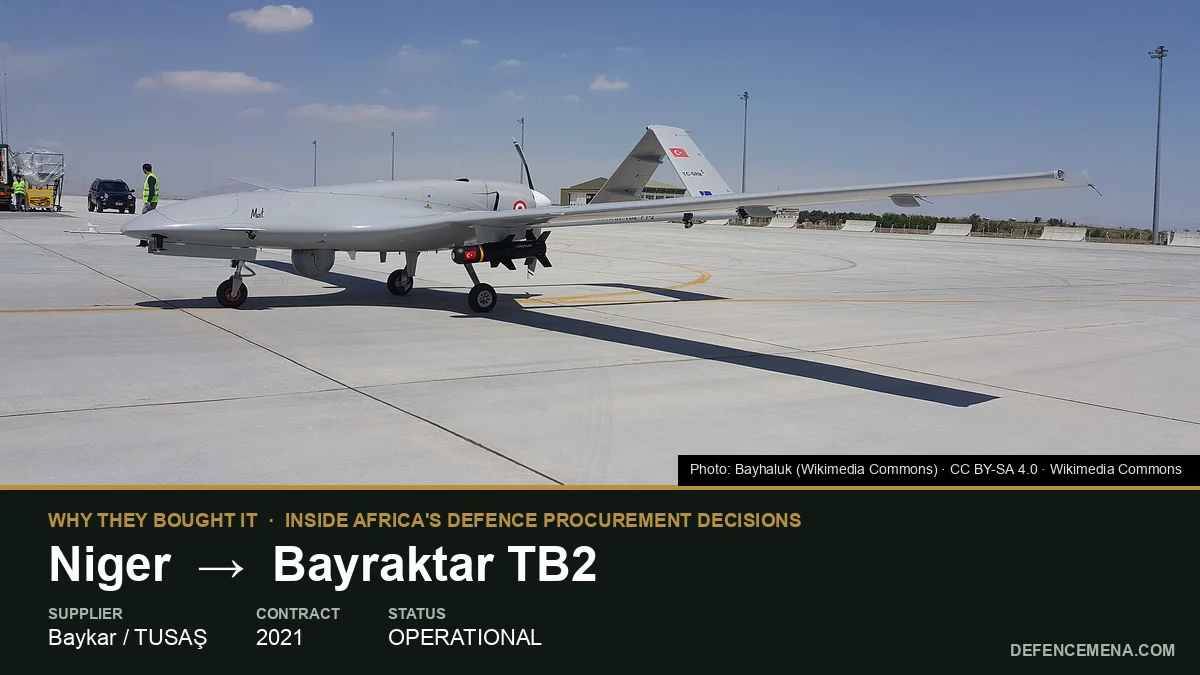


Niger bought the Bayraktar TB2 because, by 2021, it was fighting Islamic State and al-Qaeda affiliates on three fronts with two Su-25s, a handful of helicopters and no armed drone of its own, while the only Reapers flying over its territory belonged to France and the United States. President Mohamed Bazoum’s government agreed a package with Türkiye in November 2021 that bundled six TB2s with Hürkuş-C light attack aircraft, Nurol Makina armoured vehicles and Roketsan munitions. The six drones landed at Niamey in May 2022. The July 2023 coup removed the buyer, but not the aircraft: the junta kept flying them, built a drone base at Tahoua, and went back to Turkish suppliers for Karayel-SU and Aksungur drones.
Photo: A Bayraktar TB2 with a Roketsan MAM-L munition under the wing, the configuration delivered to Niger in May 2022 (Turkish aircraft shown). Photo: Bayhaluk, Wikimedia Commons, CC BY-SA 4.0. Credit: Bayhaluk (Wikimedia Commons), CC BY-SA 4.0, via Wikimedia Commons.
- Country
- Niger (Armée de l’Air du Niger)
- System
- Bayraktar TB2 armed UAV; Hürkuş-C light attack/trainer
- Supplier
- Baykar / TUSAŞ (Türkiye)
- Quantity
- 6 TB2 delivered; 2 Hürkuş-C delivered (12 reported ordered)
- Contract year
- 2021
- Status
- OPERATIONAL TB2 in combat use since 2022
- Main requirement
- Armed ISR over the tri-border area and Lake Chad; “secure our borders” (Presidency)
- Training
- Pilots trained in Türkiye; on-site Turkish training protocol 2026
- Localisation
- None
- Known alternatives
- No documented competition; US/French-operated Reapers were the only comparable assets
What capability did Niger need?
In the second half of 2021 Niger was under pressure from three directions at once: the Tillabéri “tri-border” zone with Mali and Burkina Faso in the west, the Diffa front on Lake Chad in the south-east, and the open Libyan border to the north. Military Africa, reporting the Turkish deal in November 2021, described an insurgency on the south-eastern border and around Lake Chad that had cost thousands of lives since the late 2000s; Journal du Niger, covering the May 2022 delivery, said the drones were meant for the Islamic State and al-Qaeda-affiliated groups operating around the triple border with Mali and Burkina Faso.
The gap was not surveillance in general, which Western partners had been providing for a decade. It was Nigerien-owned, Nigerien-tasked aircraft that could watch a motorcycle column for hours and strike it without waiting for a partner’s approval. The Presidency put the requirement in its own words when the first drones arrived: the TB2s were ordered “to strengthen its air fleet as part of the strategy to fight terrorism and secure our borders”, so that people in insecure areas could “live their daily lives with more serenity” (Military Africa, March 2022, quoting the Nigerien Presidency).
Timing mattered too. France was dismantling Operation Barkhane in Mali and the European Takuba task force was winding down. Bazoum told Foreign Policy in mid-2022 that “after the departure of Barkhane and Takuba, this area will be even more infested”. The Turkish package was signed in the same months that those withdrawals were being announced.
What did it already operate?
Niger’s combat aviation before the TB2 was small and ageing. Military Africa’s November 2021 inventory lists two Su-25 ground-attack jets, two Mi-35P and two Mi-171Sh helicopters, and three SA342M Gazelles, alongside a mixed bag of transport and training aircraft from Russia, Ukraine, the United States and France. The ISR fleet consisted of US-donated Cessna 208 Caravans, two of them configured for surveillance, and a Diamond DA42 MPP. None of these could loiter for a day over the tri-border area, and none could put a guided munition on a target found by its own sensor.
The armed drones that did operate from Nigerien soil were foreign. The United States had opened Air Base 201 at Agadez in 2019, a facility costing around $100 million built for drone surveillance across the Sahel, and kept close to 1,000 personnel in the country between Agadez and Air Base 101 in Niamey (defenceWeb). France based its only overseas Reaper detachment at Niamey as part of a 1,500-strong presence. Both missions fed intelligence to Nigerien forces, but the aircraft, the crews and the targeting decisions were not Niger’s. For the wider picture of who flies what on the continent, see DefenceMENA’s guide to military drones used in Africa.
What system was selected?
The Bayraktar TB2 is Baykar’s medium-altitude, long-endurance armed UAV: a 630 kg maximum take-off weight aircraft with a 12 m wingspan, a 100 hp Rotax piston engine, an electro-optical/infrared turret and underwing stations for Roketsan MAM-L guided munitions and UMTAS missiles. Army Recognition’s delivery report gives a line-of-sight range beyond 150 km and a top speed of around 130 km/h; Journal du Niger, citing a French security source, put endurance at up to 27 hours. It is the same configuration that the other African TB2 operators have bought.
Niger’s deal was a package rather than a single platform. The Turkish Presidency’s Directorate of Communications named three items after the 18 November 2021 Erdoğan–Bazoum call: “TB2 SİHA, HÜRKUŞ ve zırhlı araçlar”, that is TB2 armed drones, Hürkuş aircraft and armoured vehicles. defenceWeb’s May 2022 report fills in the rest: Ejder Yalçın 4×4 armoured vehicles from Nurol Makina fitted with Aselsan Serdar weapon stations, and Roketsan munitions including MAM-L and UMTAS. Niger was the first export customer for the Hürkuş, and the version delivered was the Hürkuş-C, the armed variant with an Aselsan FLIR and CATS targeting pod and a 1,500 kg weapons payload for Cirit rockets and UMTAS missiles (Defense News, October 2022).
Which alternatives were considered?
No competition is documented. The deal was negotiated government-to-government, announced by the Turkish Presidency before any Nigerien communiqué, and followed by Bazoum’s own tour of Baykar, TUSAŞ, Havelsan, Aselsan, Roketsan and Nurol Makina in Ankara in March 2022. Nothing in the public record shows Niger requesting Chinese, US or European armed drones in 2021. The table therefore separates what was actually on offer from what was merely on the market.
| Alternative | Class | Status of consideration | Source |
|---|---|---|---|
| US MQ-9 Reaper (Agadez/Niamey) and French Reaper (Niamey) | MALE UAV, foreign-operated | REPORTED ALTERNATIVE: the capability existed on Nigerien soil but was never for sale to Niger; it was the status quo the TB2 replaced | defenceWeb, Aug 2024; Al Jazeera, Dec 2023 |
| AVIC Wing Loong I/II | MALE UCAV | SAME-CLASS MARKET ALTERNATIVE: no Nigerien request documented | DefenceMENA comparison |
| CASC CH-4 | MALE UCAV | SAME-CLASS MARKET ALTERNATIVE: no Nigerien request documented | DefenceMENA comparison |
| TUSAŞ Anka-S | MALE UCAV | SAME-CLASS MARKET ALTERNATIVE: Chad, not Niger, chose Anka; Niger later bought the larger Aksungur | Army Recognition, Sep 2025 |
How the TB2 stacks up against the Chinese types that Nigeria, Egypt and Côte d’Ivoire chose is covered in TB2 vs Wing Loong II vs CH-4 in Africa.
Why was the TB2 selected?
Officially stated (Niger): border security and counter-terrorism. The Presidency’s March 2022 statement is the only Nigerien rationale on record: strengthen the air fleet, fight terrorism, secure the borders, give people in insecure areas a normal life. It did not name a threat group or a region.
Officially stated (Türkiye): capability building. The Directorate of Communications said the Turkish equipment would increase the capabilities of Niger’s military and security forces, and Erdoğan paired the announcement with condolences for soldiers killed in an attack that week and a pledge of support against terrorism.
Reported by Foreign Policy: the Barkhane and Takuba drawdown. Bazoum’s own words about the tri-border zone becoming “even more infested” after the French and European departures are the closest thing to a motive from the buyer’s side. Niamey wanted a strike capability that did not depend on partners who were packing up next door in Mali.
Documented in procurement material: a package, not a product. Bazoum’s Ankara tour took in six companies, and the deal delivered drones, munitions, light attack aircraft and armoured vehicles under one political umbrella.
Analysts assess: diversification and the Turkish-African agenda. Michaël Tanchum, writing for the Turkey Analyst in August 2023, traces the deal to a January 2020 mining agreement and a July 2020 economic and defence cooperation accord that included military training, and argues that Ankara saw Niger as the connective tissue between Algeria and Nigeria on the Trans-Saharan corridor. From the Nigerien side he reads the deal as part of a broader Francophone drift away from Paris. That is analysis, not a Nigerien statement.
Possible but unconfirmed: price and speed. For Niger no source documents the claim, often made about the TB2 in Africa, that it was cheaper or faster to deliver than the alternatives; the contract value has never been published and no other offer is on record. Envanter Media keeps an English-language analysis of why Turkish armed drones sell worldwide, but it should be read as general context rather than evidence about this deal.
What was included in the contract?
From fetched sources the November 2021 package comprised: six Bayraktar TB2 air vehicles with ground control equipment (RFI via Army Recognition; defenceWeb); Roketsan MAM-L and other MAM munitions and UMTAS anti-tank missiles (defenceWeb); Hürkuş-C light attack aircraft, of which two were delivered (Shephard, Defense News); and Ejder Yalçın 4×4 armoured vehicles with Serdar remote weapon stations (Military Africa, defenceWeb). Pilot and technician training in Türkiye was part of the deal (Shephard Media reported Nigerien pilots already in training in October 2022). A UAV base in the centre of the country was reported under construction in 2022 (defenceWeb), later identified as the drone base at Tahoua airport (Africanews, March 2026). Whether the base was financed inside the Turkish contract or separately is not publicly disclosed.
How much did it cost?
Not publicly disclosed. Neither the Turkish Presidency, Baykar, TUSAŞ nor the Nigerien government has released a contract value for the 2021 package. Defense News reported in October 2022 that TUSAŞ declined to give a value for the Hürkuş-C deals with Niger and Chad “citing commercial secrecy”, and relayed an industry estimate of roughly $40–50 million per aircraft; that is an estimate of a unit price, not a contract figure, and it does not cover the TB2s. The only hard number in the Nigerien drone story is the follow-on: Africa Intelligence, cited by Army Recognition and Military Africa, put the October 2024 Karayel-SU deal at about €80 million (around $87.5 million) for five aircraft with ground stations and munitions. No figure should be inferred for the TB2 contract from that package.
How many were ordered?
Six TB2s were delivered in May 2022 and described by RFI as “the first part” of the November 2021 contract, which implies more aircraft were envisaged. No second TB2 batch has ever been reported, and Military Africa reported in October 2024 that the post-coup CNSP had looked at additional TB2s before turning to the Karayel-SU; that claim rests on a single outlet. The Hürkuş figures conflict: TUSAŞ’s Atilla Doğan said in October 2022 that Niger had ordered 12 Hürkuş in 2021 (Defense News, Military Africa), while every delivery report, and the Turkish Presidency’s own 2021 communication, speaks of two aircraft. The honest reading is two delivered against a larger announced ambition that has not been confirmed since the coup.
Training, maintenance and support
Nigerien TB2 crews were trained in Türkiye before delivery, and TUSAŞ said in October 2022 that Nigerien Hürkuş pilots were already in training ahead of the aircraft (Defense News, Shephard Media). The French security source quoted by Journal du Niger in June 2022 made the obvious point that the drones “complement Niger’s surveillance capacities” but that the whole system still had to be built: pilots, image analysts, maintenance, spares and a supply chain. Niger and Türkiye have since tried to close that gap in-country. On 7 April 2026 Turkish Defence Minister Yaşar Güler and his Nigerien counterpart General Salifou Mody signed a Protocol on the Provision of On-Site Training Support, which Military Africa describes as placing Turkish instructors and technical teams at Nigerien air bases to support drone logistics and maintenance. Twelve Nigerien personnel were trained in Türkiye on the Aksungur before its September 2025 unveiling (Army Recognition).
Local production or technology transfer
None. No assembly, maintenance depot or industrial offset in Niger has been announced by either government or by Baykar or TUSAŞ. The 2026 training protocol is a support arrangement, not a transfer of technology. The Turkish industrial footprint on the continent is mapped in Turkish defence companies active in Africa.
Delivery and operational status
The TB2 fleet has been in service for more than four years and has outlived the government that bought it. Its status is OPERATIONAL. The two Hürkuş-C are DELIVERED; their operational status is unclear, and one is reported lost in the January 2026 attack on Air Base 101 (see below). The Karayel-SU is ORDERED with no delivery confirmed in public; the Aksungur is DELIVERED and was unveiled in September 2025.
- Jul 2020Türkiye and Niger sign an economic and defence cooperation accord including military training (Turkey Analyst).
- 18 Nov 2021Erdoğan–Bazoum call; Turkish Presidency announces TB2, Hürkuş and armoured vehicles for Niger.
- Mar 2022Bazoum tours Baykar, TUSAŞ, Havelsan, Aselsan, Roketsan and Nurol Makina in Ankara; Presidency states the purpose of the drone purchase.
- 20–21 May 2022Six TB2s arrive at Niamey on two Il-76 flights (defenceWeb; RFI 25 May).
- End 2022Two Hürkuş-C due for delivery by year-end per TUSAŞ; later reports treat them as delivered.
- 26 Jul 2023Coup removes Bazoum; the CNSP under General Abdourahamane Tiani takes over the fleet.
- 22 Dec 2023Last French troops and their Reapers leave Niamey.
- 5 Aug 2024US withdrawal from Air Base 201 complete; Niamey vacated 8 July.
- Oct 2024CNSP orders five Karayel-SU from Lentatek, about €80m (Africa Intelligence via Army Recognition).
- 29 Sep 2025Aksungur unveiled at Air Base 101 by General Salifou Mody.
- Jun 2026Tiani in Ankara on his first trip outside Africa; defence and training agreements signed.
Has it been used operationally?
Yes. Niger’s TB2s have flown armed missions in the tri-border area since 2022, first under Bazoum and then under the junta, which has made drone strikes a central tool against JNIM and the Islamic State’s Sahel Province in Tillabéri. The record is partly visible through the civilian-harm reporting that has followed. Human Rights Watch’s 2025 World Report notes that military drone strikes near Tyawa on 6 January 2024, launched after an attack on an army post, killed civilians, and that the junta acknowledged civilian casualties the next day without giving a toll. In February 2026 HRW documented a strike on a market at Kokoloko in Tillabéri on 6 January 2026 that killed at least 17 civilians and three Islamic State fighters; HRW could not identify the aircraft or munition and the government did not respond. HRW’s report lists Niger’s drone fleet as Turkish-made TB2, Karayel-SU and Aksungur.
The fleet has also been a target. In the early hours of 29 January 2026 Islamic State fighters attacked Air Base 101 at Niamey; defenceWeb, working from the group’s own video, counted one DA42, two Cessna Caravan ISR aircraft, one Mi-171 and one Hürkuş destroyed on the ground, while the government acknowledged only four soldiers wounded and no confirmed TB2 damage. On 9 March 2026 gunmen on motorcycles attacked the drone base at Tahoua airport, built in 2022; the army said the assault was repelled. Niger’s experience sits alongside that of its Alliance of Sahel States partners, examined in the TB2 and Akıncı combat record in Mali and Burkina Faso.
What has operational use shown?
Three things, at public level. First, that six TB2s gave a small air force a persistent strike capability it never had with two Su-25s, and that a junta cut off from Western partners could keep it running for years with Turkish support. Second, that the departure of US and French ISR in 2023–24 left the Nigerien drones as the country’s only eyes over Tillabéri, raising both their workload and, as HRW’s documentation shows, the cost of errors in target identification. Third, that the drones and their bases are now on the insurgents’ target list.
Did Niger order more?
Not more TB2s, but a great deal more from Türkiye. In October 2024 the CNSP signed for five Lentatek Karayel-SU tactical drones at about €80 million; Military Africa’s account that the junta rejected a further TB2 purchase on price is unconfirmed by any other source. In April 2025 Niger disclosed an Aksungur purchase from TUSAŞ, and the aircraft was unveiled at Niamey on 29 September 2025. The April 2026 training protocol and Tiani’s June 2026 visit to Ankara, where Erdoğan said meetings with Turkish defence companies were expected to “yield positive results”, suggest more to come, but nothing new has been contracted in public as of 5 October 2026. Reports that Niger has received the Bayraktar Akıncı are not supported by any delivery evidence and are not counted here. The full Turkish order book on the continent is tracked in Turkish systems in African service.
What does this tell us about African procurement?
The Niger case is the clearest example in this series of a purchase that was made by one government and inherited by another with the opposite foreign policy. Bazoum bought Turkish drones as a complement to French and American partners; Tiani flies them as a substitute. The equipment did not care. What made that continuity possible was that Türkiye, unlike Paris and Washington, attached no political conditions to continued support, signed a training protocol with the junta and received its leader in Ankara. For buyers across the Sahel, that is now part of the product.
It also shows the limits of a platform-only reading. Niger did not buy “a drone”; it bought an armed ISR capability wrapped in a package of munitions, light attack aircraft, armoured vehicles, training and, later, in-country maintenance. The single-supplier approach simplified logistics for a small air force, but it also concentrated dependence. When the Hürkuş was destroyed on the ground in Niamey, the replacement path ran back to Ankara, and when helicopters were needed the junta turned to Algeria. The Russian Africa Corps presence that defended Air Base 101 adds a third dependency rather than removing one.
Finally, Niger’s trajectory from TB2 to Karayel-SU to Aksungur, all through Turkish industry, and the attack drawn by the Tahoua base, show that the first drone contract in a country sets both its supply chain and its basing problem for a decade. That is why the competition for the first sale in Africa has been so intense, and why this series tracks who won it where. The combat history that underpins the TB2’s reputation on the continent began in Libya, in the Bayraktar TB2’s Libya combat record.
Procurement record
| Field | Value |
|---|---|
| Country | Niger |
| Service | Armée de l’Air du Niger (Nigerien Air Force) |
| System | Bayraktar TB2 armed UAV; package with Hürkuş-C light attack/trainer, Ejder Yalçın 4×4, Roketsan MAM-L/UMTAS |
| Manufacturer | Baykar (TB2); TUSAŞ (Hürkuş-C); Nurol Makina; Roketsan |
| Origin | Türkiye |
| Category | UCAV / armed ISR |
| Requirement | Armed ISR and strike over the tri-border area and Lake Chad; “fight terrorism and secure our borders” (Presidency, Mar 2022) |
| Order date | Announced 18 Nov 2021 (Turkish Presidency); contract described by RFI as signed Nov 2021 |
| Contract date | November 2021 (exact date not publicly disclosed) |
| Quantity | 6 TB2 delivered (“first part”); 2 Hürkuş-C delivered, 12 reported ordered (unconfirmed) |
| Contract value | Not publicly disclosed (industry estimate $40–50m per Hürkuş-C, Defense News; Karayel-SU follow-on ~€80m) |
| Delivery | TB2: 20–21 May 2022, Niamey, two Il-76 flights; Hürkuş-C: reported end-2022/early 2023 |
| Operational status | OPERATIONAL (TB2); DELIVERED (Hürkuş-C, one reported destroyed 29 Jan 2026) |
| Training | Crews and pilots trained in Türkiye; on-site Turkish training protocol signed 7 Apr 2026 |
| Support | Turkish technical teams at Nigerien air bases under the 2026 protocol; drone base at Tahoua built 2022 |
| Localisation | None |
| Tech transfer | None announced |
| Confirmed competitors | None documented |
| Follow-on order | 5 Karayel-SU (Oct 2024, ~€80m, ORDERED); Aksungur (announced Apr 2025, unveiled 29 Sep 2025, DELIVERED) |
| Primary source | Turkish Presidency Directorate of Communications, 18 Nov 2021; Nigerien Presidency statement via Military Africa, Mar 2022 |
| Last verified | 5 October 2026 |
FAQ
Does Niger have Bayraktar TB2 drones?
Yes. Niger received six Bayraktar TB2 armed drones at Niamey on 20–21 May 2022 under a contract announced by the Turkish Presidency in November 2021. They remain in service with the Nigerien Air Force under the military government that took power in July 2023.
Why did Niger buy the Bayraktar TB2?
The Nigerien Presidency said the drones were bought “to strengthen its air fleet as part of the strategy to fight terrorism and secure our borders”. Before 2022 Niger had no armed drone of its own; the Reapers flying from Agadez and Niamey belonged to the United States and France.
How many TB2 drones does Niger have?
Six were delivered in May 2022, described by RFI as the first part of the contract. No further TB2 deliveries have been reported. Niger has since ordered five Karayel-SU drones and taken delivery of the larger Aksungur.
How much did Niger pay for the TB2?
The contract value has not been made public by Türkiye, Baykar or Niger. The only published figure in Niger’s drone programme is the October 2024 Karayel-SU deal, reported at about €80 million for five aircraft.
What happened to Niger’s drones after the 2023 coup?
The junta kept the fleet and continued to use it, mainly in the Tillabéri region. Türkiye maintained the relationship, signing an on-site training protocol in April 2026 and hosting General Tiani in Ankara in June 2026.
Did Niger also buy the Hürkuş aircraft?
Yes. Two Hürkuş-C light attack aircraft were delivered around the end of 2022, the first export of the type. TUSAŞ said in 2022 that Niger had ordered 12, but only two have been confirmed delivered.
Where are Niger’s drones based?
At Air Base 101 in Niamey and at a drone base built in 2022 at Tahoua airport in central Niger, which was attacked and defended in March 2026.
More from Why They Bought It
- Why Did Morocco Buy the AH-64E Apache?
- Why Did Nigeria Buy the VT-4 Tank?
- Why Did Côte d'Ivoire Buy the Wing Loong II?
- Why Did Kenya Buy 118 Katmerciler HIZIR Armoured Vehicles?
- Why Did Nigeria Buy the M-346FA?
- Why Did Egypt Buy (and Build) the K9 Howitzer?
Sources
- Türkiye Directorate of Communications – Statement on the Erdoğan–Bazoum call: TB2, HÜRKUŞ and armoured vehicles for Niger (18 Nov 2021)
- Military Africa – Turkey announces Bayraktar TB2 drone order from Niger (Nov 2021)
- Military Africa – Niger orders Ejder Yalçın armoured vehicles from Nurol Makina; Bazoum tours Turkish industry (Mar 2022)
- defenceWeb – Nigerien Bayraktar TB2 deliveries begin (May 2022)
- Army Recognition – Turkey delivers six Bayraktar TB2 drones to Niger, citing RFI (May 2022)
- Journal du Niger – Le Niger a réceptionné six drones Bayraktar TB2 (2 Jun 2022)
- Foreign Policy – Niger Is Turkey’s Newest African Ally (8 Jun 2022)
- Shephard Media – TAI confirms Hürkuş-C deliveries to Niger and Chad (Oct 2022)
- Defense News – TAI to deliver Hurkus-C combat aircraft to Niger, Chad (28 Oct 2022)
- Turkey Analyst (M. Tanchum) – The Niger coup and Turkey’s military-industrial complex in Africa (23 Aug 2023)
- Al Jazeera – Au revoir, Sahel: did 2023 crush France’s influence in Africa? (31 Dec 2023)
- defenceWeb – US military completes withdrawal from Air Base 201 in Niger (Aug 2024)
- Army Recognition – Niger orders several drones from Türkiye amid tensions in region (17 Oct 2024)
- Military Africa – Niger to acquire Turkish Karayel combat drones (15 Oct 2024)
- Army Recognition – Niger rolls out Turkish Aksungur drone (Sep 2025)
- Human Rights Watch – Niger: Military drone strike kills 17 civilians (9 Feb 2026)
- defenceWeb – Multiple aircraft destroyed by Islamic State during attack on Nigerien air base (4 Feb 2026)
- Africanews – Niger: Army repels attack on Tahoua drone base (9 Mar 2026)
- Military Africa – Turkey and Niger formalize on-site military training and logistics (May 2026)
- Anadolu Agency – Türkiye, Niger seek deeper cooperation in defense, security, investment (4 Jun 2026)
Last updated: 5 October 2026. This article is updated in place when the procurement status changes.