A mutiny by “hundreds of disaffected soldiers” at Niamey’s Air Base 101 on 29 August 2026 was put down not by loyalist Nigerien units alone, but with the direct intervention of Russia’s Africa Corps — the clearest sign yet that the mercenary force protecting Niger’s junta prioritises regime survival over the counter-insurgency fight it was originally brought in to support.
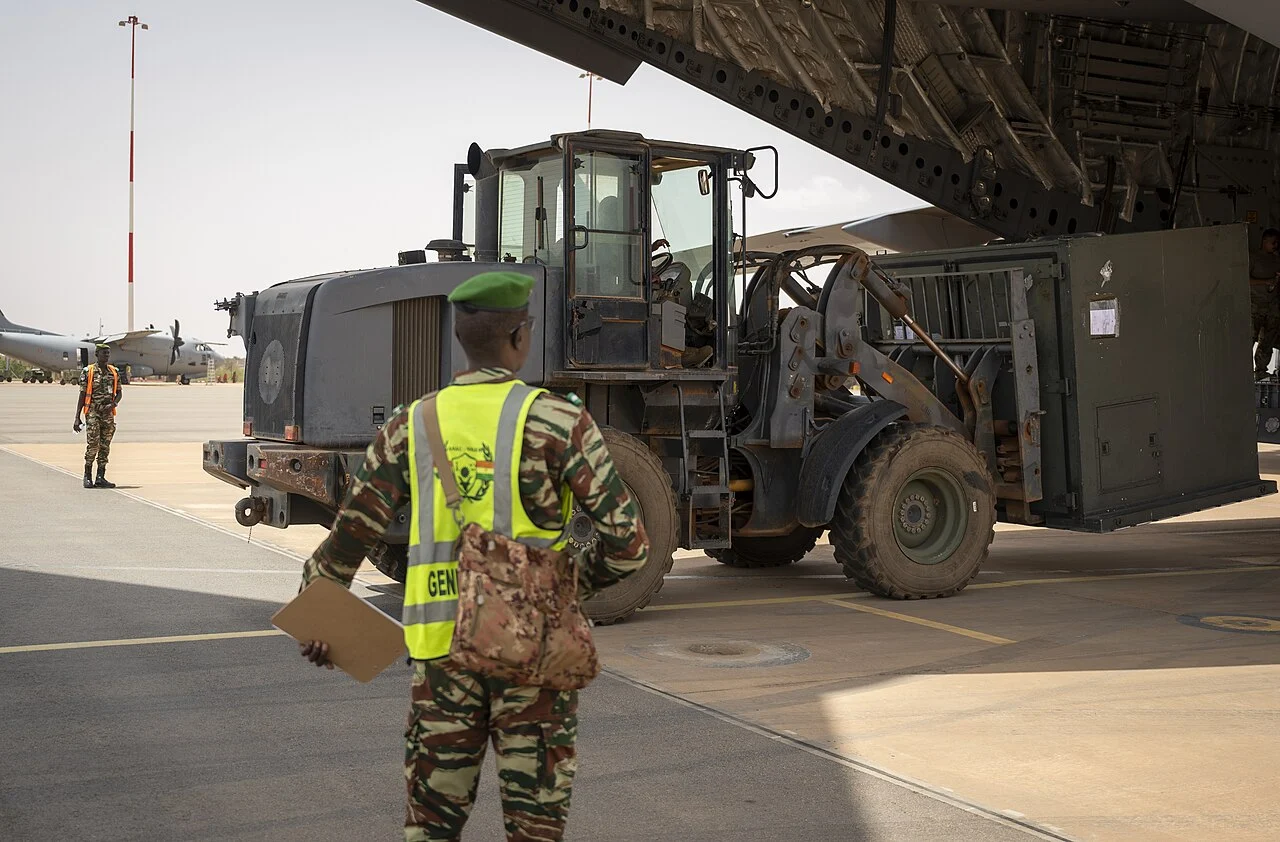
Photo: Air Base 101 in Niamey, the site of the August 2026 mutiny. Credit: U.S. Army photo by Tech. Sgt. Christopher Dyer, Public domain, via Wikimedia Commons
Gunfire and explosions broke out around 1 a.m. at Air Base 101, next to Niamey’s Diori Hamani International Airport, in what Niger’s Defence Minister later characterised as soldiers venting a “fit of temper” over violations of military regulations, according to Africa Defense Forum. The official framing understated what analysts say actually happened: a mutiny serious enough that Niger’s own forces could not — or did not — contain it without Russian help.
Russia steps outside its usual role
Sahel researcher Héni Nsaibia told ADF that “the regime ultimately relied on support from Russia’s Africa Corps to put down the mutiny,” marking what he described as the first time Russian personnel in Niger have intervened directly in an internal military crisis rather than joint counter-terrorism operations against jihadist groups. Wassim Nasr of the Soufan Center drew the wider lesson bluntly: “Fighting jihadis comes as a second priority… but the first priority is to sustain regimes.” Neither analyst put a figure on how many Africa Corps personnel are currently based in Niger; the article contains no official troop count.
The mutineers were reportedly drawn heavily from frontline units in southwestern Niger that have taken a battering from jihadist attacks in recent months — including roughly 18 soldiers killed in an attack in the Dosso region barely a week before the mutiny. That detail matters: this was not a coup attempt by officers seeking power, but rank-and-file frustration from troops absorbing heavy casualties in a counter-insurgency campaign that, on this account, Russian forces are not primarily there to help them win.
The junta’s sovereignty narrative under strain
President Abdourahamane Tiani seized power in the July 2023 coup partly on a promise of sovereignty and independence from foreign security guarantees — first French, then, implicitly, anyone else’s. Having to call on Russian mercenaries to put down unrest among his own soldiers cuts directly against that narrative, and echoes a pattern now visible elsewhere in the Sahel, where Russian-linked forces have taken on internal-security and regime-protection functions well beyond the anti-jihadist mandate originally advertised. DefenceMENA’s tracking of flight data on Russia’s air bridge into the Sahel has shown a similar pattern of opaque, hard-to-verify Russian military logistics feeding several juntas in the region simultaneously.
Why it matters for Africa
Niger is one of three Sahelian states — alongside Mali and Burkina Faso — that have leaned on Russian security support after severing or downgrading ties with former Western partners, and all three continue to lose ground to jihadist groups despite that support. If Africa Corps’ core function is proving to be regime protection rather than counter-terrorism, that has a direct bearing on how effective the wider Alliance of Sahel States’ security strategy actually is against al-Qaeda- and Islamic State-linked insurgencies operating across the tri-border area. It also raises the stakes for the soldiers doing the fighting: a force whose foreign backers step in to suppress mutinies, but whose battlefield losses against jihadists keep mounting, has every reason to question who its Russian partners are actually there to protect.
Sources
- Africa Defense Forum: Niger Mutiny Highlights Russia’s Regime Protection Role
- Critical Threats: Africa File, September 3, 2026