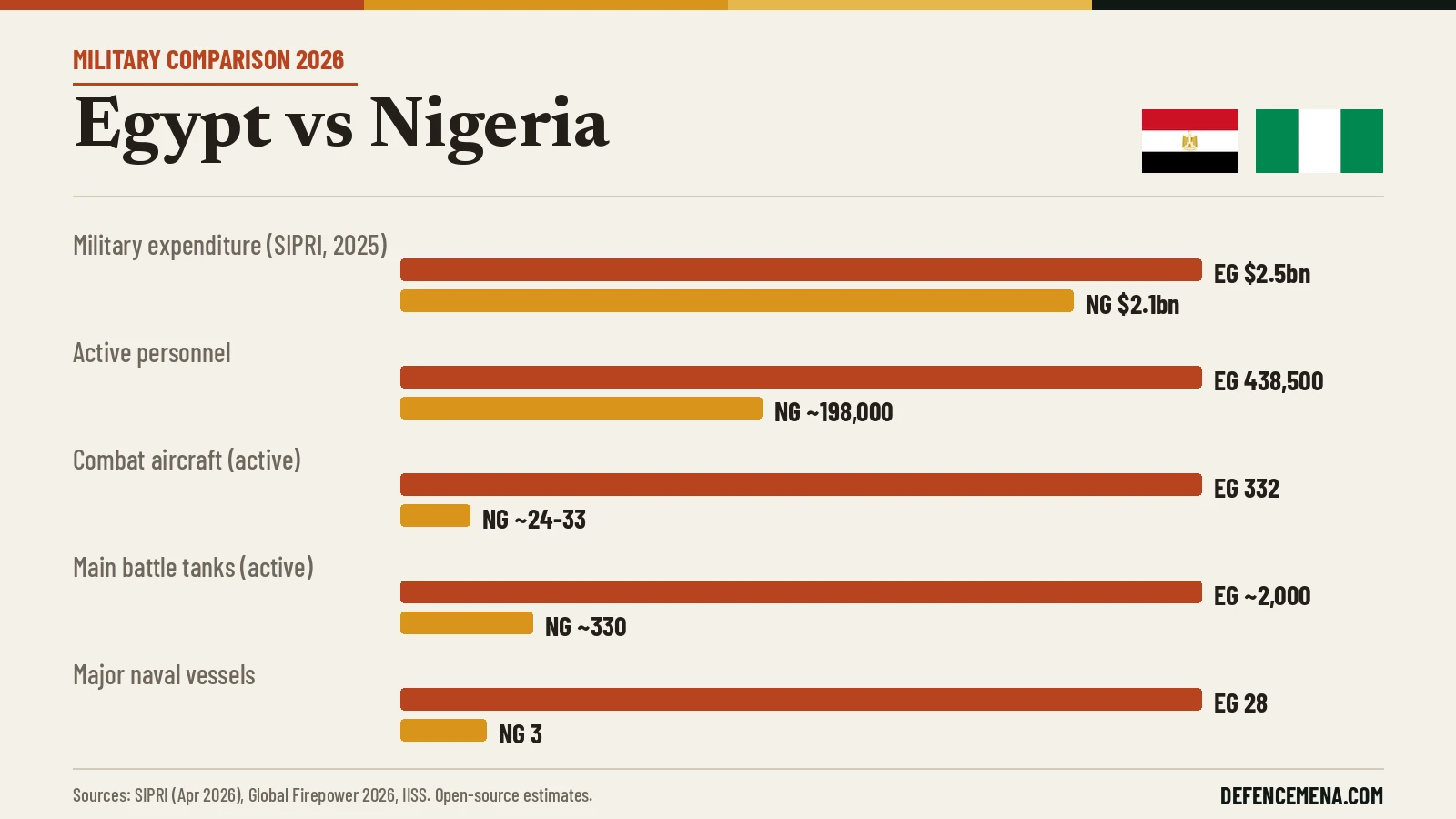
Egypt fields the largest, best-equipped armed forces on the African continent; Nigeria fields the one doing the most actual fighting. This comparison sets budgets, personnel, air, land, naval and air-defence capability, drones, industry and suppliers side by side, drawing on SIPRI’s 2025 data, official budget documents and FlightGlobal’s 2026 World Air Forces directory wherever the two can be matched on the same basis.
DefenceMENA tracks both forces on dedicated Egypt and Nigeria desks, within our North Africa and West Africa coverage. Full country-strength profiles are published for both: how strong is Egypt’s military in 2026 and Nigeria’s military strength in 2026. Earlier entries in this series cover Egypt vs Algeria, Morocco vs Algeria and Nigeria vs South Africa.
Egypt vs Nigeria at a glance
| Metric | Egypt | Nigeria | Source / year |
|---|---|---|---|
| Military expenditure (SIPRI) | $2.5bn (+4.3% real, 2025) | $2.1bn (+55% real, 2025) | SIPRI, Apr 2026 |
| Official defence budget | No unclassified defence line published; FY2026/27 state budget EGP 8.176tn | ₦3.16 trillion (2026) | Egyptian House of Representatives / Nigerian National Assembly |
| Active personnel | 438,500 (Army ~310,000; Navy 18,500; Air Force 30,000; Air Defence Forces ~80,000) | ~143,000–230,000 (estimated; commonly cited ~198,000) | IISS-derived, 2025 |
| Reserve / paramilitary | 479,000 reserve; 300,000 paramilitary | ~80,000 trained reserve; NSCDC ~63,000 | Global Firepower 2026 / estimated |
| Main battle tanks | ~2,000 active (M1A1, M60A3, T-62, T-54/55); 3,620 incl. stored | ~330 (Vickers Mk3, T-72, T-55, VT-4) | IISS 2025 / Global Firepower 2026 |
| Combat aircraft (active) | 332 (Rafale, F-16, MiG-29M/M2, Mirage 2000) | ~24–33 (JF-17, F-7Ni, Alpha Jet, A-29) | Global Firepower 2026 / FlightGlobal 2026 |
| Attack helicopters | 100 (AH-64D, Ka-52) | ~15 Mi-35; 4–6 of 6 T129 ATAK delivered | Global Firepower 2026 / estimated |
| UAV/UCAV capability | Armed MALE (Akinci, TB2, Wing Loong, CH-4B); domestic Hamza-1 in development | Armed MALE (TB2, Wing Loong II, CH-3/4); domestic programmes at prototype stage | Open-source, 2026 |
| Major naval vessels | 13 frigates, 7 corvettes, 8 submarines, 2 LHDs | 1 frigate, 2 corvettes, 2 large OPVs | Open-source, 2026 |
| Submarines | 8 (4 Type 209/1400mod; 4 Romeo, doubtful status) | None | Open-source, 2026 |
| Air defence | Layered: long (S-300VM, HQ-9B), medium (IRIS-T SLM, Buk-M2), short (Tor-M1/M2, Pantsir-S1) | Fragmented, point-defence only, no long-range layer | Open-source, 2026 |
| Defence industry | Ministry of Military Production, AOI, Alexandria Shipyard, K9A1EGY line with Hanwha | DICON, nascent local assembly with D7G/Gray Insignia | Open-source, 2026 |
| GFP rank (auxiliary) | 19th globally, 1st in Africa | 33rd globally, 3rd in Africa | Global Firepower, 2026 |
Defence budgets
SIPRI’s Military Expenditure Database puts Egypt’s 2025 spending at $2.5 billion, up 4.3% in real terms — a figure SIPRI itself flags as an understatement. A 2020 SIPRI background paper found Egypt’s reported budget excludes significant paramilitary, off-budget and US Foreign Military Financing items, the last worth roughly $1.3 billion a year on its own. Egypt does not publish a separate, unclassified defence budget line; the closest public figure is the overall FY2026/27 state budget of EGP 8.176 trillion, which bundles defence spending with everything else government funds. Global Firepower’s 2026 index estimates Egypt’s defence budget at $5.19 billion, roughly double the SIPRI figure — a gap this article flags rather than resolves.
Nigeria’s SIPRI-reported $2.1 billion marks the steepest rise in sub-Saharan Africa for 2025, up 55% in real terms against worsening insurgent and bandit violence. Nigeria’s National Assembly approved a ₦3.16 trillion defence and special-operations vote for 2026, converting to roughly $2.1–2.3 billion depending on which exchange rate is applied. Personnel costs consume 76% of that vote, leaving little margin for equipment and maintenance. Egypt’s budget is larger even on the lower SIPRI measure, but Nigeria’s is rising far faster.
Personnel
Egypt’s 438,500 active personnel make it Africa’s largest standing force by a wide margin, split roughly between a 310,000-strong army, an 80,000-strong Air Defence Forces branch kept organisationally separate from the air force, an 18,500-strong navy and a 30,000-strong air force. Global Firepower also credits Egypt with 479,000 reservists and 300,000 paramilitary personnel — figures DefenceMENA treats as estimates given the difficulty of independently verifying reserve mobilisation bases anywhere in the region.
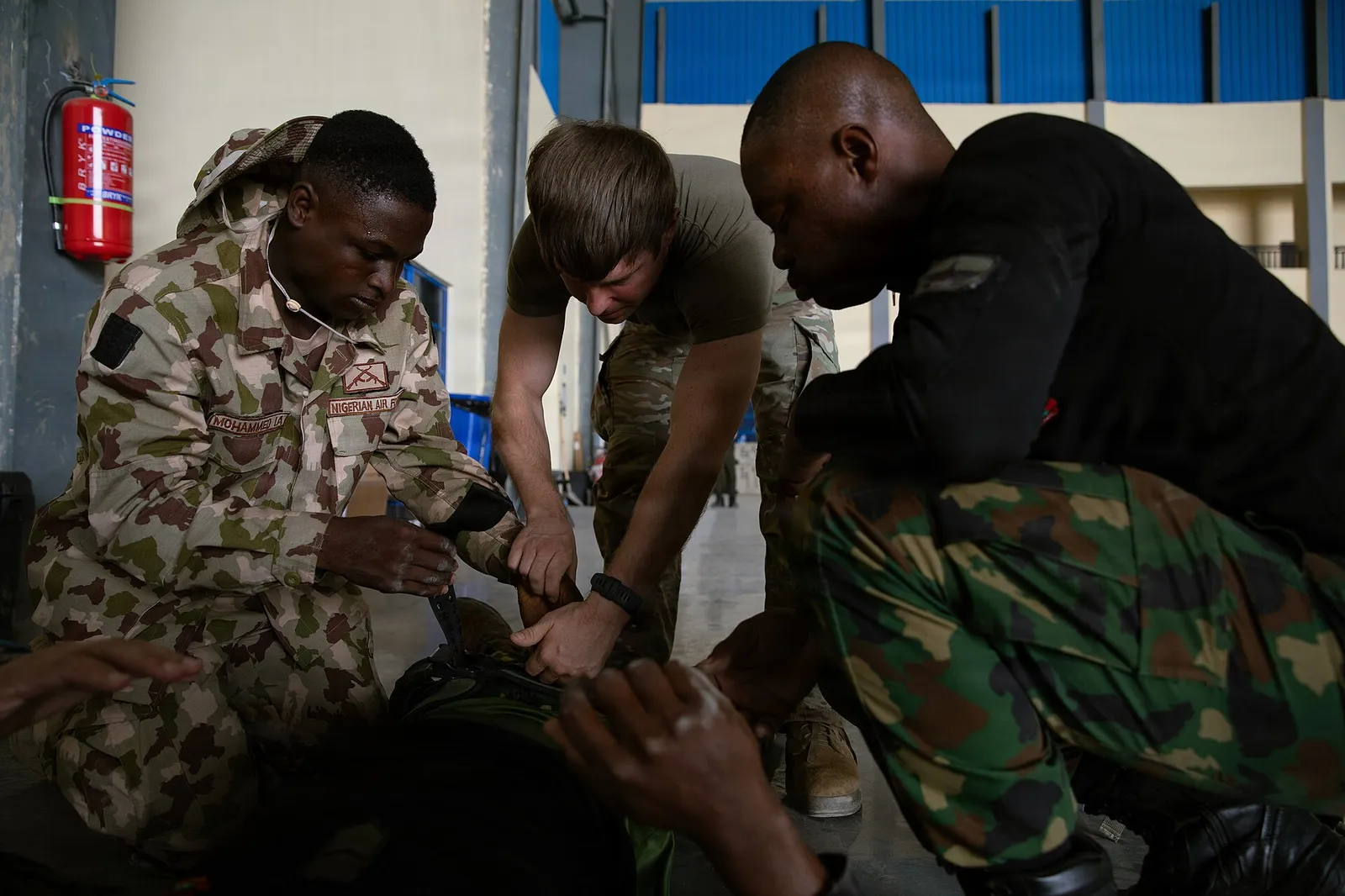
Nigeria’s figures are genuinely contested, ranging from roughly 143,000 to 230,000 depending on source, with an IISS-derived sum of about 198,000 (army ~160,000, air force ~18,000, navy ~20,000) the most commonly cited estimate. Reserve figures vary even more sharply — around 80,000 trained reservists against a theoretical mobilisation base an order of magnitude larger — and the paramilitary Nigeria Security and Civil Defence Corps self-reports over 63,000 personnel, unverified independently. Even at the high end of Nigeria’s range, Egypt’s active force is close to double, and its reserve and paramilitary tiers are better documented.
Air power
Egypt’s combat fleet is the most diverse in Africa and one of the more diverse anywhere: around 46–50 Dassault Rafale DM/EM in service from a 54-aircraft contract base (a further 24 were reportedly requested in September 2026, not yet a signed contract), roughly 200 F-16s across the Block 30/40/52 generations, 45 MiG-29M/M2s and 18 Mirage 2000s, backed by 7 E-2C Hawkeye AEW&C aircraft but no tanker fleet. FlightGlobal and Global Firepower converge on a combat total around 332 fighters and attack aircraft, though open-source fleet estimates differ. Egypt’s attack-helicopter fleet of 100 splits between 45 AH-64Ds (10 more AH-64Es on order) and 46 Russian Ka-52s, an unusual mixed Western-Russian pairing.
Nigeria’s combat fleet is far smaller and older: 3 JF-17 Thunder and roughly 5–6 F-7Ni fighters from China, about 13 Alpha Jets flown in a light-attack role, 12 A-29 Super Tucanos, and the first of 24 M-346FA light combat aircraft on order from Italy. FlightGlobal rounds this to 24 “combat aircraft,” against a type-by-type tally closer to 33 depending on whether dual-role trainers count. Nigeria has no AEW&C or tanker capability either. Its attack-helicopter fleet mixes roughly 15 ageing Mi-35s with 4–6 of 6 Turkish T129 ATAKs delivered, and 12 Bell AH-1Z Vipers under a $997 million US foreign military sale that only entered production in September 2026, with deliveries expected from late 2026 into 2029.
Land forces
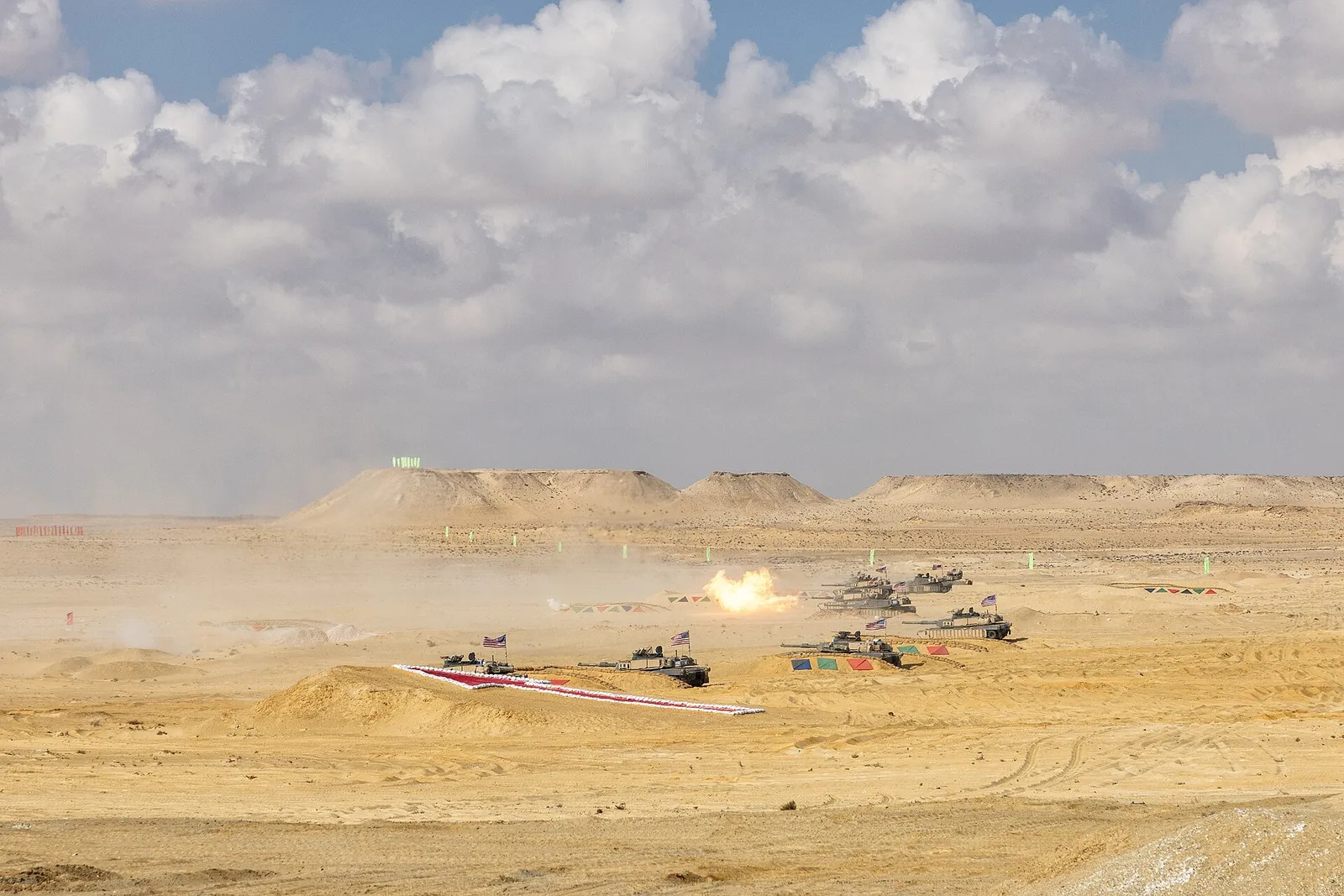
Egypt’s tank park centres on roughly 2,000 active main battle tanks by IISS’s count (3,620 including stored equipment per Global Firepower), led by 1,300 M1A1 Abrams assembled domestically at Factory 200, with 555 slated for upgrade to the M1A1SA standard. Older M60A3s, T-62s and T-54/55s make up the balance, mostly in reserve or stored roles. Egypt’s self-propelled artillery includes a growing fleet of South Korean K9A1EGY howitzers under a roughly $1.6 billion 2022 contract with Hanwha that includes more than 60% planned local production, with first deliveries shown publicly in December 2025. Supporting armour spans M113, Fahd, Walid and BMR-600 families, and ground-based air defence sits with the separate Air Defence Forces rather than the army.
Nigeria’s roughly 330 tanks mix an estimated 172 British-origin Vickers Mk3 “Eagle” tanks — reported by Army Recognition as more reliable in the field than the newer imports — with up to 41 T-72 variants, around 100 ageing T-55s, and 17 Chinese VT-4s, its most modern type. Supporting armour includes Chinese Type-89 armoured personnel carriers and ST-1 tank destroyers delivered from 2021, a wide mix of Streit Group, Dongfeng Mengshi and Nigerian-built Ezugwu mine-protected vehicles, and army-level air defence that is effectively limited to unconfirmed MANPADS, since ground-based air defence assets sit mainly with the air force rather than the army.
Naval power
Both countries have coastlines and active navies of very different scale. Egypt’s fleet is the largest in Africa: two Mistral-class LHDs, three FREMM frigates, four MEKO A-200EN frigates built partly at Alexandria Shipyard, two ex-US Perry-class frigates, four Gowind 2500 corvettes (three built locally), and eight submarines — four German-designed Type 209/1400mod boats plus four older Romeo-class submarines of doubtful operational status. Egypt operates from Alexandria, Safaga and the newer Red Sea base at Berenice, opened in 2020.
Nigeria’s navy is smaller and oriented toward Gulf of Guinea anti-piracy and constabulary work rather than blue-water operations: a single frigate, NNS Aradu, currently under a Turkish Dearsan refit; two China-built Centenary-class offshore patrol vessels; and two Turkish-built Dearsan OPV-76 patrol vessels delivered in 2025. Smaller patrol and missile craft — Thunder-class ex-US Coast Guard cutters, Chinese-built Sea Eagle and Chamsuri-type boats, indigenous Seaward Defence Boats — round out a fleet Global Firepower puts at 153 hulls overall, but hull count is not a strength metric: Nigeria has no submarines, corvettes beyond the Centenary class, destroyers or carriers, where Egypt fields all of the above except destroyers.
Air defence
Egypt runs one of the more layered air-defence networks in Africa, organised under its own separate Air Defence Forces branch of roughly 80,000 personnel. The long-range tier includes four S-300VM Antey-2500 battalions delivered by 2017 and a Chinese HQ-9B system confirmed publicly by a retired Egyptian general in July 2025, reportedly with four batteries; a medium tier of IRIS-T SLM and Buk-M2 batteries plus older I-Hawk launchers; and a short-range tier of Tor-M1/M2, Pantsir-S1, Crotale and legacy Skyguard/Amoun and Chaparral systems. A US package reportedly offering four NASAMS batteries alongside F-16 upgrades remains an offer, not a signed contract.
Nigeria’s air defence is fragmented by comparison: ageing French Roland missiles, Soviet-legacy Strela-2 and Blowpipe MANPADS, ZSU-23-4 guns and a 36D6 surveillance radar, with no integrated national system. Nigerian Air Force leadership held talks with Turkey’s ASELSAN in September 2025 on radar and counter-drone upgrades, but this remains at the discussion stage. Neither country’s ground-based air defence sits under army command — Egypt’s under its dedicated Air Defence Forces, Nigeria’s limited layer mostly with the air force.
Drones and loitering munitions
Both countries have moved into Turkish and Chinese armed drones, though at different scales and stages. Egypt operates at least two Bayraktar Akinci heavy-strike drones observed at East Oweinat air base near the Sudanese border since August 2025, alongside Wing Loong I/II and CH-4B types from China; a 2024 agreement for Bayraktar TB2s has not produced confirmed deliveries. Domestically, Egypt is developing the EJune-30/Nut MALE drone and has signed a September 2026 sales and local-production agreement with Turkey’s Havelsan for the Hamza-1 system, alongside the indigenous Hamza-3 loitering munition unveiled in February 2026.
Nigeria has procured around 43 Turkish Bayraktar TB2s under “Project Guardian,” with an initial batch delivered from 2023, alongside smaller numbers of Chinese Wing Loong II and CH-3/CH-4 armed drones. Domestic programmes — the Gulma, its Tsaigumi successor, and the DICON/AFRDC UNIKAM loitering-munition series — remain at prototype or low-rate stage, so Nigeria’s operational drone fleet, like Egypt’s, is overwhelmingly imported rather than domestically built.
Turkish systems in the two inventories
Turkish equipment features in both air forces, though it plays a different role in each. Egypt is folding Turkish platforms into a far larger, more diversified inventory and pairing them with domestic production; Nigeria has made Baykar’s TB2 the backbone of its entire armed-drone capability.
| System | Manufacturer | Quantity | Status | Role |
|---|---|---|---|---|
| Bayraktar Akinci (Egypt) | Baykar | 2 or more observed | Operating from East Oweinat since Aug 2025 | Heavy MALE strike/ISR |
| Bayraktar TB2 (Egypt) | Baykar | Undisclosed | Agreed 2024, deliveries unconfirmed | Armed MALE UAV |
| Hamza-1 (Egypt) | Havelsan + AOI | Not disclosed | Sales agreement Sep 2026, local production planned | Armed drone, local assembly |
| Bayraktar TB2 (Nigeria) | Baykar | 43 ordered | In delivery since 2023 | Armed MALE UAV, ISR/strike |
| T129 ATAK (Nigeria) | Turkish Aerospace | 6 ordered | 4–6 delivered since 2023 | Attack helicopter |
| OPV-76 patrol vessel (Nigeria) | DEARSAN | 2 | Delivered 2025 | Offshore patrol vessel |
The appeal of Turkish systems differs by case rather than following a single pattern. For Nigeria, the TB2 offered a faster delivery timeline and a lower price point than comparable Western armed drones at a moment the country needed armed ISR quickly against Boko Haram and banditry; Turkish Aerospace’s T129 and DEARSAN’s patrol vessels followed the same relationship. For Egypt, Turkish systems arrive alongside — not instead of — a far larger Western and Russian-sourced air force, and the Havelsan deal specifically buys local production and technology transfer through AOI rather than simply importing hardware. Neither country’s Turkish inventory outperforms its Chinese alternative on paper — Egypt’s Wing Loong II and CH-4B, Nigeria’s Wing Loong II and CH-3/4, fill a broadly similar MALE role — and the real differentiators are financing terms, delivery speed, munitions compatibility and, for Egypt, the depth of local production on offer. Turkish outlet Envanter Medya maintains an inventory tracker for the Nigerian armed forces with further equipment detail.
Defence industry
Egypt’s defence-industrial base is the most developed in Africa. The Ministry of Military Production runs around 20 factories including the Factory 200 tank plant and Helwan and Abu Zaabal sites; the Arab Organisation for Industrialization (AOI) builds the Fahd, Temsah and ST-100 armoured vehicle families, Sakr rockets and aircraft and engine components, and holds a manufacturing and support agreement with Dassault for the Rafale programme. Alexandria Shipyard has delivered three Gowind 2500 corvettes and the locally built MEKO A-200EN frigate Al-Jabbar, and the K9A1EGY line with Hanwha is intended to localise more than 60% of production. AOI has also begun exporting, including a vehicle-manufacturing deal in Nigeria announced around the February 2026 World Defense Show.
Nigeria’s Defence Industries Corporation (DICON), based in Kaduna, is still rebuilding basic capacity rather than competing at Egypt’s level: it resumed ammunition production in 2025, delivering 4 million rounds of 7.62mm to the army, and entered a joint venture with D7G/Gray Insignia for local assembly of armoured vehicles including BR6 and MRAP-Buffalo variants, with a BMP-2 line planned. This is a genuine restart of domestic capacity, not an established manufacturing base, and the AOI-Nigeria vehicle deal noted above is itself a sign of how much further Egypt’s industry has progressed.
Main suppliers
SIPRI’s arms-transfers data shows strikingly different supplier profiles. Egypt ranked 12th among the world’s largest arms importers for 2021–25 with a 2.6% share, down 51% in volume against the previous five-year period as Cairo diversified and trimmed imports under IMF-linked budget pressure; France (39%), Germany (30%) and Italy (18%) supplied the bulk of that total, reflecting the FREMM, MEKO and submarine programmes.
| Egypt’s arms imports, 2021–25 (SIPRI) | Share |
|---|---|
| Global import rank | 12th (2.6% of world total, −51% vs 2016–20) |
| France | 39% |
| Germany | 30% |
| Italy | 18% |
Nigeria does not appear among the 40 largest global arms recipients for 2021–25, but within sub-Saharan Africa it was the largest single recipient, taking 16% of subregional imports. China was the subregion’s leading supplier with a 22% share across 23 recipient states, followed by Russia (12%) and Turkey (11%); Nigeria’s own supplier base spans China, Turkey, Pakistan, Italy and the United States — a wider spread of partners than Egypt’s, even though the absolute volumes involved are far smaller.
Modernisation and orders not yet in service
Egypt’s pipeline includes a reported request for 24 more Rafales beyond the existing 54-aircraft contract base (not yet a signed deal), 10 AH-64E Apaches, 11 CH-47F Chinooks, two C-130J transports, the remaining K9A1EGY/K10/K11 artillery systems with expanding local production, further IRIS-T SLX/SLS air-defence batteries, the unconfirmed 2024 TB2 agreement, local Hamza-1 production, and a US offer of F-16 upgrades bundled with NASAMS that has not been contracted. A submarine-replacement study was reported in 2024.
Nigeria’s pipeline centres on 12 AH-1Z Viper attack helicopters under the $997 million FMS case, with deliveries expected from late 2026 into 2029; 23 more M-346FA light combat aircraft beyond the single airframe delivered; and the remaining balance of its 43-aircraft TB2 order. A widely speculated JF-17 Block III order could not be corroborated from open sources.
Geography and doctrine
Egypt’s 2,612km of land border and 2,450km of coastline span some of the most strategically sensitive terrain in Africa: the Suez Canal, the Sinai Peninsula, a 1,115km Libyan border, a southern frontier with Sudan where Egypt has based strike drones at East Oweinat, the Gaza-Israel frontier, and a Red Sea coastline anchored by the newer Berenice naval base near the Bab el-Mandeb approaches. Upstream, the Grand Ethiopian Renaissance Dam on the Nile remains a live strategic concern. Egypt’s doctrine blends conventional deterrence across several fronts with counter-terrorism in Sinai.
Nigeria borders Benin, Niger, Chad and Cameroon and has an 853km Gulf of Guinea coastline encompassing the Niger Delta. Its force posture is shaped by live internal conflict rather than external deterrence: Boko Haram and ISWAP in the northeast, banditry and the newly proscribed Lakurawa group in the northwest and north-central states, Niger Delta militancy, and Gulf of Guinea piracy driving the navy’s patrol focus. Human Rights Watch recorded more than 6,000 conflict-linked deaths in Nigeria in 2025 — a scale of internal violence Egypt’s security forces, focused mainly on Sinai, do not face at comparable intensity.
What the numbers show
Egypt’s force is larger and more capable across almost every conventional category — personnel, combat aircraft, tanks, major warships and layered air defence — reflecting both a bigger budget base once US financing and Gulf-linked support are counted and three decades of diversified procurement across French, American, Russian, German and now Turkish and Chinese suppliers. Nigeria’s much smaller force is built around the conflicts it is actually fighting: Boko Haram, banditry and Gulf of Guinea piracy, which is why its recent procurement skews toward light-attack aircraft, armed drones and patrol vessels rather than heavy armour or blue-water warships. Both countries have adopted Turkish drones and both run air-defence and ground-force layers that sit outside their armies, but Egypt pairs imported Turkish and Chinese systems with a genuine domestic production base, while Nigeria’s DICON is still rebuilding from a much lower starting point. SIPRI’s expenditure trend lines also diverge sharply — Nigeria’s spending rose 55% in a single year against Egypt’s steadier 4.3% — even though Egypt’s absolute budget, especially once understated items are factored in, remains substantially larger.
Methodology and data notes
- Figures are drawn from Egyptian and Nigerian official budget documents, SIPRI’s Military Expenditure and Arms Transfers fact sheets (April and March 2026), FlightGlobal’s World Air Forces directory, IISS Military Balance analysis, and defence-trade reporting including Army Recognition, Military Africa, The Defense Post and defenceWeb.
- SIPRI military expenditure and each government’s own official defence budget measure different things and are reported separately rather than merged; Egypt’s SIPRI figure is known to understate real spending, per SIPRI’s own 2020 background paper on the subject.
- Active, reserve and paramilitary personnel are kept separate throughout. Where sources disagree by a wide margin, a range is given rather than a single figure.
- Equipment on order, requested or announced but not yet delivered is listed under modernisation, not counted in active-inventory figures.
- Trainer aircraft are excluded from combat-aircraft totals even where a type also performs a light-attack role in practice.
- Global Firepower’s 2026 index is used only as an auxiliary, secondary data point and never as the primary or sole source for any figure in this article.
- “Major naval vessels” refers to frigates, corvettes, submarines and LHDs/large amphibious ships; smaller patrol and missile boats are counted separately and are not treated as a stand-alone measure of naval strength.
Sources
- SIPRI, “Trends in World Military Expenditure, 2025” (April 2026)
- SIPRI, “Trends in International Arms Transfers, 2025” (March 2026)
- Military Africa, “Nigeria’s defence budget hits record high but inflation eats the gains”
- Vanguard, “Defence, Special Operations get N3.15trn in 2026 budget”
- Nairametrics, “Nigeria’s military spending jumps 55% to $2.1 billion amid worsening insecurity”
- Wikipedia, “List of equipment of the Nigerian Air Force”
- Wikipedia, “List of equipment of the Nigerian Army”
- Army Recognition, “Nigeria AH-1Z Viper attack helicopter production begins at Bell”
- FlightGlobal, “Nigeria set to receive first three M-346FAs”
- Defence Turkey, “DEARSAN begins construction of $76m offshore patrol vessels for the Nigerian Navy”
- defenceWeb, “Nigeria’s DICON resumes ammunition production as it continues expansion”
- Human Rights Watch, World Report 2026: Nigeria
- Army Recognition, “Egypt asks Dassault for 24 more Rafales, taking its fleet to 78” (September 2026)
- Militarnyi, “Egypt to purchase Chinese HQ-9B air defense system”
- Janes, “EDEX 2025: Egypt receives first batch of K9 howitzers”
- BusinessDay, “Vinicius International moves to build local security production facility in Nigeria”
- Envanter Medya, Nigerian armed forces inventory tracker
- Envanter Media, “Africa’s Strongest Militaries 2026” (further reading)