Casspir and Mamba: What South Africa’s Mine-Protected Vehicles Proved in African Combat



The Casspir vehicle and the Mamba MRAP were born in southern Africa’s mine wars and have spent four decades carrying African soldiers and peacekeepers from Namibia to Somalia, Mali, Mozambique and eastern Congo. The public record shows two designs that repeatedly kept crews alive under blast, and two fleets whose weakest point was usually spare parts, not steel.
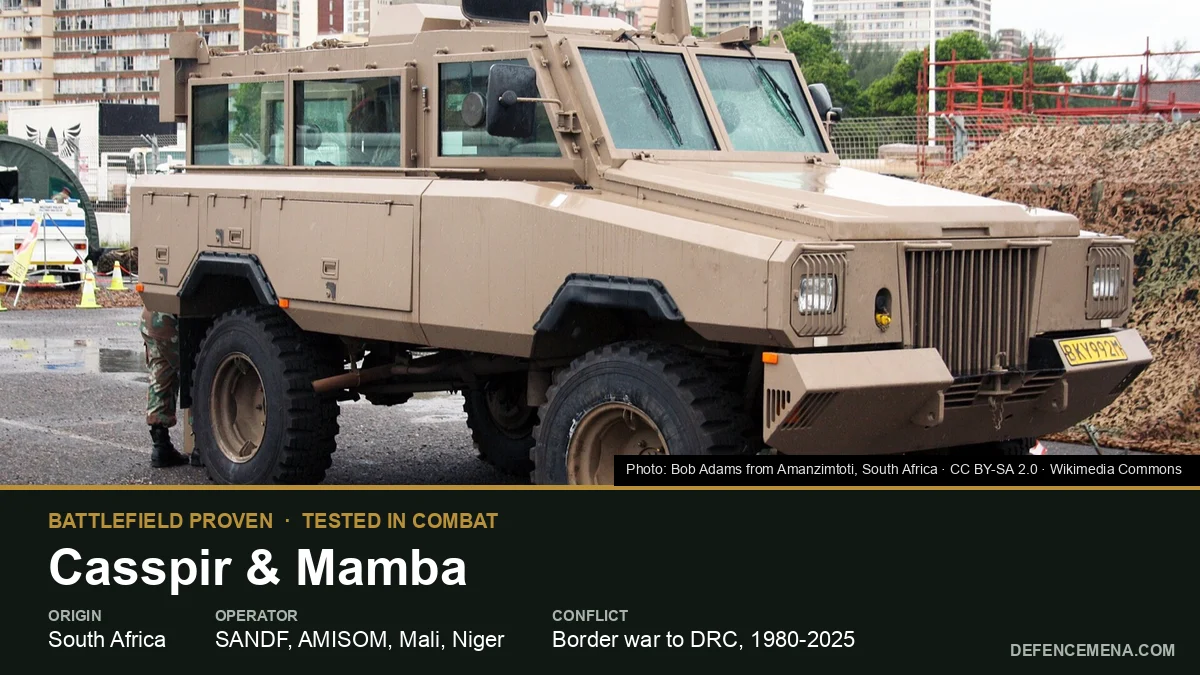
Photo: A South African Army Mamba Mk III at SANDF Armed Forces Day 2017. Photo: Bob Adams, CC BY-SA 2.0, via Wikimedia Commons. Credit: Bob Adams from Amanzimtoti, South Africa, CC BY-SA 2.0, via Wikimedia Commons.
Direct answer
South African MRAP vehicles proved that a V-shaped, high-riding steel hull on a simple truck drivetrain can protect crews against mine blast at low cost, and that idea later shaped the American MRAP family. In African service the Casspir and Mamba have survived documented IED and ambush incidents, but they have also been damaged, abandoned or grounded when fleets were old, thinly supported or outgunned. The lesson for buyers is less about the hull than about workshops, spares and the mission the vehicle is given.
| System | Casspir (Mk I–III, NG2000 series) and Mamba (Mk2, Mk3, Mk5, Mk7) mine-protected 4×4 vehicles |
| Manufacturer | Casspir: CSIR design, built by TFM, later Denel Mechem. Mamba: South African design, built by TFM/OMC lineage (later Alvis, BAE Systems); Mk7 by Osprea Logistics since 2016 |
| Origin | South Africa |
| Operator(s) in this conflict | SADF and SA Police (1980s); SANDF; Uganda, Burundi and Kenya in AMISOM; Mali; Angola; Niger and Togo (Mamba Mk7); UN contingents |
| Period | 1979 to 2025 |
| Evidence level summary | Service and deliveries CONFIRMED; survivability records mostly OFFICIALLY CLAIMED by manufacturers; 2024 SANDF damage in Mozambique and DRC CONFIRMED by SANDF and defenceWeb, with rebel loss claims DISPUTED |
Where was it used?
The Casspir was designed by the Council for Scientific and Industrial Research (CSIR) to a South African Police requirement; the name is an anagram of CSIR and SAP. According to defenceWeb’s fact file, the first prototype left the TFM plant in April 1979. It went to war in South West Africa (now Namibia) and on the Angolan border with the police counter-insurgency unit Koevoet, the SADF’s 101 Battalion and special forces units. The same vehicles were also used inside South Africa: Engineering News described how Casspirs were deployed in townships resisting National Party rule and became closely associated with repression under apartheid. That history still shapes how many South Africans see the vehicle.
The Mamba came later, as a lower, enclosed successor to the Buffel for internal security and infantry work, entering South African service in the early 1990s. After 1994 both families moved into peacekeeping. Casspirs went to AMISOM contingents in Somalia, to Mali (29 donated by Germany in July 2019, handed over at Kati) and to Angola, which ordered 45 Casspir NG2000B vehicles in 2013. Mamba Mk7s built by Osprea Logistics went to Kenya and Uganda for Somalia, and to Niger and Togo. The SANDF took Casspirs to Mozambique under the SADC mission (SAMIM), and Casspirs and Mambas to eastern DRC under SAMIDRC. For the wider South African inventory, see our South African Army weapons and equipment list.
What was the mission?
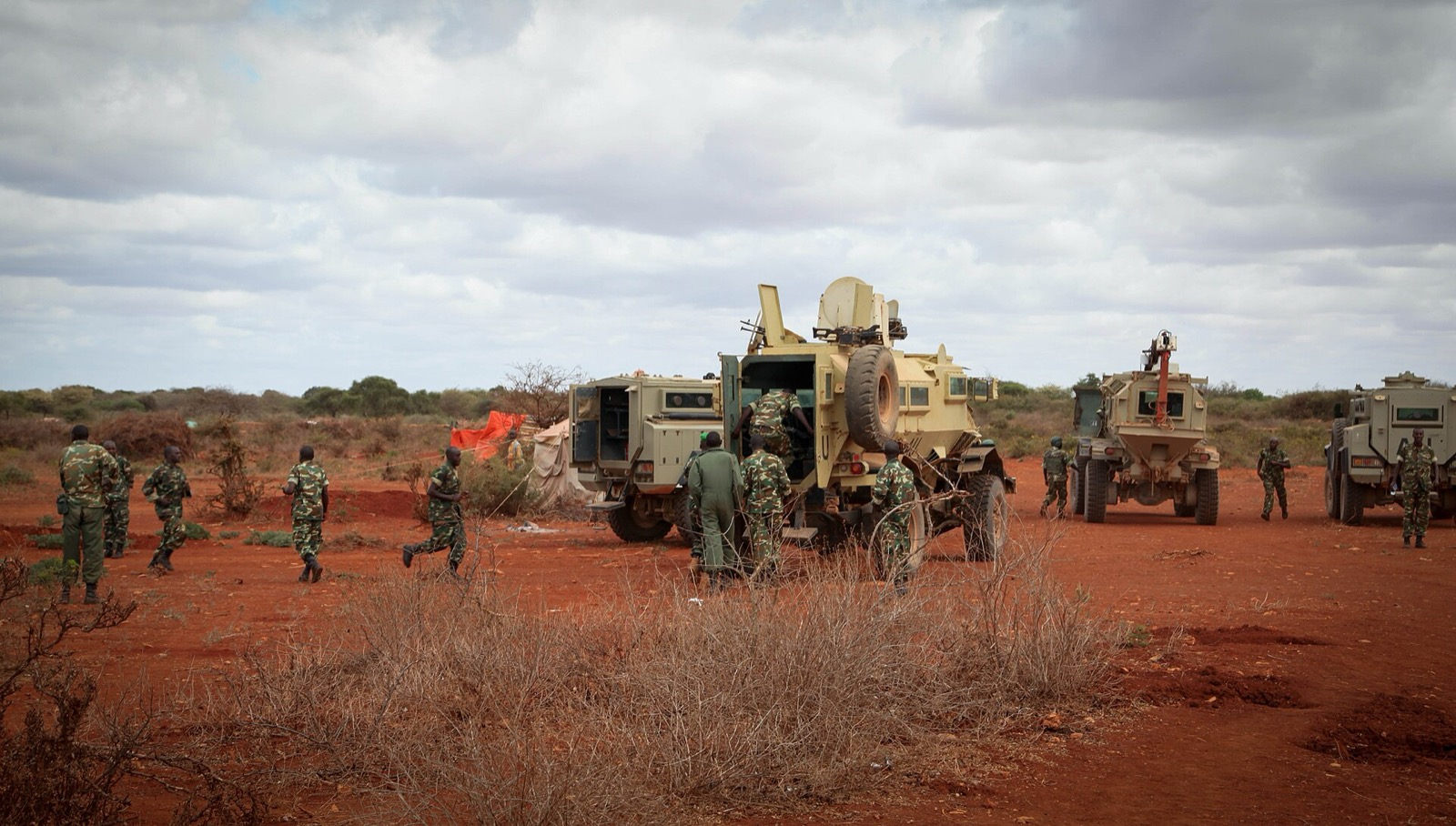
Neither vehicle was built to fight tanks. The original requirement was a mine-protected counter-insurgency vehicle that could run long patrols on dirt roads, stop rifle fire and be repaired quickly in the field. In AMISOM, Mali and Mozambique the mission shifted to convoy escort, route security and moving infantry between bases in areas where roadside bombs were a daily risk. In the DRC in 2024, SANDF vehicles were drawn into a far more conventional fight against a well-armed rebel force.
What does the public evidence show?
Most survivability claims come from manufacturers; loss evidence rests mainly on SANDF statements and 2024 reporting.
| Claim / event | Date | Evidence level | Source |
|---|---|---|---|
| Casspir prototype built to SAP requirement; police orders follow | 1979–1980 | CONFIRMED | defenceWeb fact file; Engineering News |
| Casspirs used by Koevoet and SADF units in the Namibia/Angola border war | 1980s | CONFIRMED (historical record) | defenceWeb fact file; Engineering News |
| No AMISOM personnel inside an Osprea armoured vehicle cabin seriously injured or killed by “dozens” of IED strikes | 2007–2023 | OFFICIALLY CLAIMED (manufacturer) | Osprea case study |
| Mambas survived IED strikes of 50 kg, 80 kg and more with no fatalities in Somalia, Mali and Niger | Stated 2023 | OFFICIALLY CLAIMED (manufacturer) | defenceWeb, citing Osprea |
| US to replace 20 Casspirs used by Ugandan and Burundian AMISOM troops with 20 ex-Afghanistan MRAPs | January 2015 | CONFIRMED (US military) | US Africa Command |
| 13 of 33 US-supplied Casspirs in AMISOM grounded for maintenance reasons | 2015 | INDEPENDENTLY REPORTED | The EastAfrican |
| Two of five serviceable SANDF Casspirs damaged in 45-minute ambush at Macomia; no SANDF casualties reported | 10 May 2024 | INDEPENDENTLY REPORTED | defenceWeb |
| SANDF says two APCs damaged, one soldier killed and 13 injured at Sake; images show a damaged Mamba and an apparently abandoned Casspir | 30 May 2024 | CONFIRMED (SANDF) / VISUALLY DOCUMENTED | defenceWeb |
| M23 claims four APCs destroyed and two captured | May–June 2024 | DISPUTED | defenceWeb, citing M23 statements |
What worked?
Blast protection for the crew. The core idea, a V-shaped monocoque hull set high above the ground, did what it was meant to do in the incidents that are publicly described. Osprea’s statement that no AMISOM occupants of its armoured vehicles were seriously injured or killed by IED strikes is a manufacturer claim that has not been independently audited, and none of the public reports reviewed for this article contradicts it. At Macomia in May 2024, the SANDF’s Casspirs came through a prolonged ambush that included at least one IED, and defenceWeb reported no SANDF casualties.
Simplicity and cost. Both vehicles use commercial truck components. That kept them within reach of donor programmes and small armies, as Germany’s Casspir gift to Mali and the AMISOM and UN fleets show. A 2016 Engineering News report put total Casspir production at about 3,000, and defenceWeb reported in 2017 that more than 200 had been sold to African clients and the UN since production restarted in 2010.
A design that travelled. The South African approach became the template for later mine-protected vehicles. Military.com’s 2007 guide to the US MRAP programme described Force Protection’s Buffalo as “a direct descendant” of the Casspir design, and defenceWeb records that the US Army placed its first order for the South African RG-31, a design that drew on Casspir and Mamba experience, in 1996.
What problems appeared?
Sustainment. The most consistent problem in the record is keeping vehicles running. The EastAfrican reported that 13 of 33 US-supplied Casspirs in AMISOM service had been grounded, and US Africa Command’s own account of the 2015 MRAP transfer stressed limited space, funding constraints and waiting for parts in Mogadishu. In Mozambique in 2024, defenceWeb’s report on the Macomia ambush referred to “five serviceable” Casspirs, a small number for a deployment of that size.
Age of fleets. South Africa’s own Casspir and Mamba fleets are old. The Mamba entered service around 1993 and roughly 220 were remanufactured under Project Jury in 2006. Project Sepula, meant to replace both types, “seems to have fallen by the wayside”, defenceWeb reported in March 2024. The army instead depends on refurbishment and support contracts.
Mission creep. A mine-protected patrol vehicle is not an infantry fighting vehicle. At Sake in the DRC, SANDF troops met a rebel force using indirect fire and heavy weapons. The damage recorded there says more about the mission and force mix than about the hull. South Africa’s intended heavier answer is the Badger, tracked in our Project Hoefyster tracker.
Confirmed losses and limitations
There is no comprehensive public list of Casspir or Mamba losses across African operations, and this article does not estimate one. What can be stated:
- Macomia, Mozambique, 10 May 2024: two SANDF Casspirs damaged in an ambush; no SANDF casualties reported (defenceWeb).
- Sake, DRC, 30 May 2024: the SANDF confirmed two APCs damaged, one soldier killed and 13 injured. The soldier who died, a medic, was reported to have been in an Mfezi armoured ambulance, not a Casspir or Mamba. Images reviewed by defenceWeb appear to show a Mamba with bullet damage and a flat tyre, and a Casspir that appears to have been abandoned; later video purported to show rebels driving a Casspir away.
No reliable public figure exists for Casspir or Mamba losses during the 1980s border war.
What is still disputed?
- M23 claims in the DRC. M23 said it destroyed four armoured personnel carriers and captured two at Sake, and later said it set fire to another SANDF vehicle at Mubambiro. The SANDF confirmed only two damaged APCs at Sake and did not publicly address the Mubambiro claim. The type of vehicle in the Mubambiro video could not be independently verified.
- Manufacturer survivability claims. Zero-fatality records for Mamba and Osprea vehicles in Somalia, Mali and Niger come from the supplier and have not been independently audited.
- Lineage. Military.com described the RG-31 as based on the Mamba; defenceWeb’s Mamba fact file states “the Mamba and RG31 are not related.” Both agree the Casspir is a direct ancestor of the modern MRAP concept.
- Production and first-order figures. Estimates of total Casspir production range from about 2,500 (defenceWeb) to more than 3,000 (Engineering News; defenceWeb in 2017). Sources also differ on the size of the first police order (140 or 180 vehicles).
- Niger’s Mamba numbers. defenceWeb cites 47 delivered in August 2020 plus 13 in December 2019; other reports give 57 for August 2020.
Did the manufacturer or operator change anything?
Yes, on both lines. Denel Mechem restarted Casspir production around 2010 and introduced the NG2000 and NG2000B, with an upgraded hull, then added a 6×6 Eland recovery vehicle ordered by Angola. The Mamba moved from an underpowered original 4×2 layout to a 4×4 standard under Project Jury. Osprea then developed the Mk5 and Mk7, and since 2016 has built the Mk7 in the United States.
Operators also changed their approach to support. Osprea says it set up a repair workshop and training centre in Mogadishu, trained about 300 operators and mechanics, and carried out 283 major repairs for AMISOM from 2007. The 2015 US transfer of refurbished MRAPs to AMISOM likewise came with driver and maintenance training and a year of contractor support.
Did other countries buy it afterwards?
Combat and peacekeeping use kept both types selling in Africa, often through donor funding.
| Buyer / recipient | System | Year | Quantity | Source |
|---|---|---|---|---|
| Angola | Casspir NG2000B | Ordered 2013, delivered by 2017 | 45 | defenceWeb |
| Mali (German donation) | Casspir | 2019 | 29 | defenceWeb |
| Kenya (for AMISOM) | Mamba Mk7 | 2020 | 22 | defenceWeb |
| Uganda (for AMISOM) | Mamba Mk7 | 2020 | 23 | defenceWeb |
| Niger | Mamba Mk7 | 2019–2020 | 60 (13 + 47) | defenceWeb |
| Togo | Mamba Mk7 | c. 2021 | More than 100 ordered | defenceWeb |
| Undisclosed African customer (Liberia suggested by company video) | Mamba Mk7, Mk7-X, 6×6 wrecker | Announced December 2023 | 50 | Military Africa |
SIPRI data cited by defenceWeb in 2017 also listed Benin, Burundi, Djibouti, Malawi, Mozambique, Senegal, Tanzania and Uganda among Casspir recipients over the previous 15 years, alongside the African Union and the United Nations. For how these vehicles compare with newer Sahel purchases, see MRAPs used in the Sahel and our overview of African-made armoured vehicles. Uganda’s long Somalia commitment, now scheduled to end, is covered in Uganda’s 2027 withdrawal deadline, and Kenya’s fleet in our Kenyan Army equipment list.
What does this mean for African procurement?
Buy the support system, not only the hull. In the Casspir and Mamba record, blast protection was the easier part; the recurring failures were grounded vehicles and missing parts. Contracts should specify spares holdings, in-theatre workshops and mechanic training, as Osprea’s Mogadishu arrangement and the 2015 US transfer both did.
Local industry pays off when it is sustained. South Africa designed both vehicles, yet the stalled Sepula programme shows that design heritage does not guarantee fleet renewal. Osprea’s 2012 announcement of a Mamba factory in Mombasa, aimed at cutting regional procurement and maintenance costs, is an example of the model many buyers want; how much of that plan was realised is not publicly clear. Newer South African designs such as the Paramount–Kalyani Mbada are pitched on the same promise.
Match the vehicle to the threat. A mine-protected carrier suits route security and peacekeeping; against artillery and heavy weapons, as in eastern DRC, it needs heavier vehicles and fire support alongside it.
Reputation. Inside South Africa the Casspir still carries its apartheid-era policing history; for export buyers price and record have mattered more. For supplier trends across the continent, see who supplies Africa’s weapons and the military equipment database.
Battlefield file: 7 cards
The Casspir (1979) and Mamba (early 1990s) are 4×4 mine-protected vehicles built on commercial truck parts.
Border war in the 1980s, then AMISOM in Somalia, Mali, Mozambique (SAMIM) and eastern DRC (SAMIDRC).
Designed for counter-insurgency patrols on mined roads, later used for convoy escort and peacekeeping.
Osprea claims no AMISOM cabin fatalities from IED strikes; SANDF Casspirs came through a 2024 ambush with no reported casualties.
13 of 33 AMISOM Casspirs reported grounded; two SANDF APCs damaged at Sake in 2024, with larger M23 claims disputed.
Casspir NG2000 and Mamba Mk7 upgrades, in-theatre workshops, and US MRAPs replacing 20 AMISOM Casspirs.
The design shaped the US MRAP; the lesson for buyers is to contract workshops, spares and training with the hull.
FAQ
What is a Casspir vehicle?
The Casspir is a South African 4×4 mine-protected armoured personnel carrier designed by the CSIR for the South African Police and first built in 1979. It carries a crew of two and up to 12 passengers in a V-shaped steel hull.
What does Casspir mean?
The name is an anagram of the two organisations behind it: the Council for Scientific and Industrial Research (CSIR) and the South African Police (SAP).
Why is the Casspir vehicle linked to apartheid?
Besides its border-war role, the Casspir was deployed by the police in South African townships during the 1980s, where it became a symbol of the state’s use of force against opponents of apartheid.
What is the Mamba Mk7 MRAP?
The Mamba Mk7 is the latest version of the South African-designed Mamba, built by Osprea Logistics in the United States since 2016. It has been supplied to Kenya, Uganda, Niger, Togo and other African users, mainly for peacekeeping and counter-insurgency.
Was the US MRAP based on South African vehicles?
Partly. Force Protection’s Buffalo was described as a direct descendant of the Casspir, and the US Army bought the South African RG-31 from 1996. South African mine-protected designs are widely credited as the origin of the MRAP concept.
Sources
- defenceWeb: Fact file, Casspir MRAP
- defenceWeb: Fact file, Mamba APC/MRAP
- Engineering News: Casspir vehicle shedding its apartheid links as it discovers peacekeeping role (2016)
- defenceWeb: More Casspirs going into Africa (2017)
- defenceWeb: Mali receives donated Casspir armoured personnel carriers (2019)
- defenceWeb: More Osprea Mambas for Africa (2023)
- Osprea Logistics: Case study, support operations for AMISOM
- US Africa Command: MRAPs enhance AMISOM operations (2015)
- The EastAfrican: Death in the morning, why AMISOM soldiers had little fighting chance in Janaale
- defenceWeb: SANDF soldiers survive ambush in Mozambique (2024)
- defenceWeb: SANDF casualties in latest battle against M23 rebels in the DRC (2024)
- defenceWeb: M23 rebels claim to have damaged another SANDF vehicle in the DRC (2024)
- Military.com: A primer in MRAP variants (2007)
- defenceWeb: Osprea Logistics sets up Mamba Mk5 factory in Kenya (2012)
- Military Africa: Osprea Logistics delivers Mamba vehicles to Liberia (2024)
- defenceWeb: SANDF hoping to replace Samils by 2030 (2024)
- defenceWeb: Mamba support R32.6m over four years (2010)
Evidence note: most survivability data for the Casspir and Mamba comes from manufacturers and has not been independently audited, and no public loss list covers these vehicles across African operations. Figures for the 2024 DRC fighting rest on SANDF statements and defenceWeb reporting; rebel claims are presented as claims. This article will be updated at the same URL if significant new evidence appears.
More from Battlefield Proven
- Bayraktar TB2 in Libya: What Did Its Combat Use Actually Show?
- Sudan War Drones: What the Evidence Shows on SAF and RSF Since 2023
- Pantsir-S1 in Libya: What the Battlefield Record Revealed
- Drones in the Ethiopia War: What Is Confirmed and What Remains Unverified
- Wing Loong II in Libya: How Did China's Armed Drone Perform in Combat?
- Bayraktar TB2 and Akinci in Mali and Burkina Faso: What Combat Use Has Shown
- Nigeria Super Tucano: What Five Years of Combat Use Have Shown
- BMC Kirpi in Africa: What Is Publicly Known About Its Mine and IED Protection Record
- Mi-24 and Mi-35 Attack Helicopters in Africa: What Combat in Nigeria, Mali and Uganda Has Shown