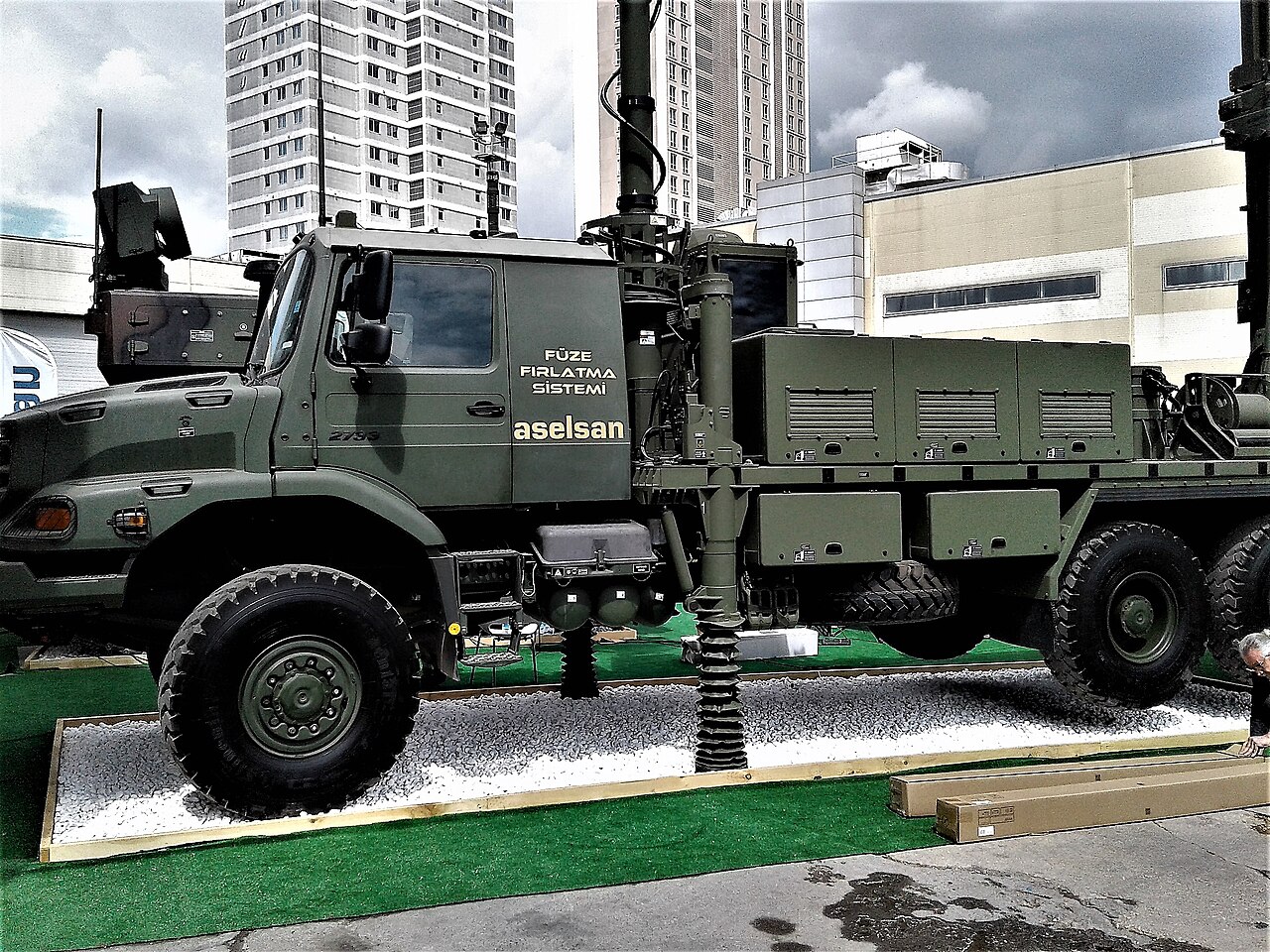
ASELSAN is the designer and integrator of Türkiye’s layered “Steel Dome” (ÇELİKKUBBE) air defence architecture and the prime contractor for the HİSAR missile systems, the KORKUT 35 mm gun system and the GÖKDENİZ naval close-in weapon. Roketsan supplies most of the missiles. For African and Middle Eastern buyers, the parts with export evidence so far are the İHTAR counter-drone system, KORKUT and GÖKDENİZ.
Photo: an ASELSAN missile launching system (“Füze Fırlatma Sistemi”) vehicle, filed on Commons under HİSAR-O, at the IDEF 2019 defence fair in Istanbul. Credit: CeeGee, CC BY-SA 4.0, via Wikimedia Commons.
Direct answer
ASELSAN builds or co-develops every layer of Türkiye’s air defence: SİPER 1/2 (long range), HİSAR O 100 (medium), HİSAR A 150 (short), the GÜRZ gun-and-missile system, the KORKUT 35 mm guns and a counter-drone layer led by İHTAR and the GÖKBERK 10 laser. ASELSAN supplies the command and control, radars, launchers and guns; Roketsan develops the HİSAR, SİPER and SUNGUR missiles. Documented exports are İHTAR (contracts with Angola, Niger, Kyrgyzstan and Northern Cyprus, reported April 2023), a first overseas KORKUT 150/35 delivery in 2025 to an unnamed customer, and GÖKDENİZ on Pakistan’s Babur-class corvettes (reported). As of September 2026 no African or Arab state has been officially named as a buyer of HİSAR, SİPER, KORKUT or Steel Dome.
| Architecture | Steel Dome (ÇELİKKUBBE): Türkiye’s layered, networked air and missile defence. ASELSAN is designer and integrator |
| ASELSAN-built layers | C2 (HAKİM 100, HERİKKS 600, ÇELİKKUBBE 100 TAC/RAD), radars, HİSAR launchers, KORKUT, GÖKDENİZ, GÜRZ, İHTAR, GÖKBERK 10 |
| Missile supplier | Roketsan (HİSAR, SİPER, SUNGUR); TÜBİTAK SAGE reported as SİPER warhead partner |
| Recent contracts (SSB) | US$1.9 bn (Sept 2025); €780 m (June 2026); €1.47 bn (July 2026) |
| Export evidence | İHTAR: Angola, Niger, Kyrgyzstan, Northern Cyprus (contracts, AA, April 2023). KORKUT 150/35: first overseas delivery 2025, customer unnamed. GÖKDENİZ: Pakistan (reported) |
| MENA status | Qatar evaluating a Steel Dome offer (reported, Nov 2025); no contract announced |
What is Steel Dome, and what does ASELSAN do in it?
Steel Dome (Çelik Kubbe) is Türkiye’s programme to link every air defence sensor and weapon, from long-range missiles to anti-drone jammers, into one network. ASELSAN’s catalogue tags each Steel Dome element, and two of its C2 products carry the name: ÇELİKKUBBE 100 TAC, a point air defence operations centre for air bases and critical sites, and ÇELİKKUBBE 100 RAD, a radar network manager that ASELSAN says can connect up to 256 radars. The HAKİM 100 air C2 and HERİKKS 600 early-warning systems sit above them. Trade press describes ASELSAN as designer and integrator, with Roketsan, MKE and TÜBİTAK SAGE supplying missiles, guns and warheads. Milestones:
- August 2025: 47 new Steel Dome components were delivered in a ceremony attended by President Erdoğan (ASELSAN 2025 annual report). Quwa values that batch at about US$460 million.
- September 2025: ASELSAN signed a US$1.9 billion air defence contract with the Presidency of Defence Industries (SSB), with deliveries from 2027 to 2031 (Breaking Defense).
- 20–21 May 2026: all four missile layers (SİPER, HİSAR-O, HİSAR-A and SUNGUR) were deployed together for the first time at Exercise EFES 2026, alongside KORKUT, GÜRZ, MKE’s TOLGA and ASELSAN electronic warfare systems (Quwa).
- 17 June 2026: a further €780 million (about US$900 million) Steel Dome contract, with deliveries from 2028 to 2032. The announcement did not say which systems it covers (Breaking Defense).
- 10 July 2026: a €1.47 billion SSB contract to expand serial production of HİSAR-A, HİSAR-O, HAKİM, KORKUT, GÜRZ and the SİPER family (Quwa).
Capacity is being added at ASELSAN’s US$1.5 billion Oğulbey base, whose first phase was due to open in the third quarter of 2026 (ASELSAN, August 2026). Steel Dome itself is a national architecture; for export, ASELSAN offers its parts individually.
Which system covers which layer?
| System (catalogue name) | Layer / range class | ASELSAN role | Missiles or guns by | Status in Türkiye | Exports |
|---|---|---|---|---|---|
| SİPER 1 / SİPER 2 | Long range: 70+ km / 150+ km interception (ASELSAN) | Co-developer: C2, radars (ALP 310 surveillance radar), communications | Roketsan missiles; TÜBİTAK SAGE warheads (reported) | SİPER 1 serial acceptance and deliveries completed in 2025 (annual report) | None officially named |
| HİSAR O 100 | Medium range: >25 km intercept, >15 km altitude | Prime: launchers, fire control, radar, EO | Roketsan (IIR and RF-seeker missiles) | Serial deliveries continuing (2025 annual report) | None officially named |
| HİSAR A 150 | Short range: >15 km intercept, >10 km altitude | Prime: all-in-one tracked vehicle | Roketsan (4 ready IIR missiles) | HİSAR launcher serial deliveries continuing (2025 annual report) | None officially named |
| GÜRZ (not in catalogue) | Very short range, hybrid gun and missile | Developer (reported) | 35 mm gun; SUNGUR (Roketsan) and GÖKSUR missiles (reported) | “Production and test activities continue” (2025 annual report) | None |
| KORKUT 140/35, 150/35, 130/35 | Very short range gun: 4 km effective | System maker; ATOM 35 mm airburst ammunition is also ASELSAN’s | 35 mm twin gun | In service; new KORKUT 240/35 and 250/35 contract signed 2025 | First overseas 150/35 delivery 2025 (customer not named); Pakistan shown Sept 2026 (reported) |
| GÖKDENİZ 100/35, 100/35StA | Naval close-in weapon: 4 km | System maker | 35 mm twin gun | Turkish Navy | Pakistan, Babur class (reported); acceptances for Asia-Pacific and East European users (2025 annual report) |
| İHTAR / İHTAR 100 | Counter-drone: detect, jam, cue hard-kill | System maker | RF jammer; can cue KORKUT 25, ŞAHİN 40 mm, EJDERHA, GÖKBERK | Critical sites (reported) | Angola, Niger, Kyrgyzstan, Northern Cyprus (contracts, AA, April 2023) |
| GÖKBERK 10 | Counter-drone laser: 150 m–2 km focusing | System maker | Laser, up to 10 kW | Firing test with Turkish and foreign delegations (2025 annual report) | None |
Ranges are ASELSAN brochure figures (±10% tolerance, subject to change). Press reports sometimes give longer SİPER ranges.
KORKUT: the 35 mm gun layer
KORKUT protects moving armoured units and fixed sites against aircraft, helicopters, drones and cruise missiles. The catalogue lists the wheeled KORKUT 140/35, the tracked KORKUT 150/35, the KORKUT 130/35 towed-gun upgrade and the KORKUT 130 FCS fire control, which can also command HİSAR 100 launchers.
Per ASELSAN’s March 2026 brochure, a platoon is three gun vehicles and one C2 vehicle whose 3D search radar tracks a fighter from more than 35 km. Each gun vehicle has a fire-control radar, EO sensors and a stabilised 35 mm twin gun (1,100 rounds a minute, 200 ready rounds), with a 4 km effective range using ASELSAN’s ATOM 35 airburst ammunition. The vehicles come from other firms.
Export record. KORKUT was among eight products that won international contracts in the first half of 2024 (Defence Industry Europe, September 2024); the customer was not named. The 2025 annual report records the first overseas KORKUT 150/35 delivery, again unnamed. In September 2026 the Pakistan Air Force showed KORKUT publicly; variant, quantity and contract are not established (Quwa, reported). The 2025 report also notes a KORKUT 141/35 integrated on a vehicle of a Middle East-based company and demonstrated to the end user.
For a Turkish-language technical breakdown, see Envanter Media’s KORKUT profile.
GÖKDENİZ: the naval close-in weapon
GÖKDENİZ 100/35 is the naval counterpart of KORKUT: a fully autonomous twin 35 mm CIWS (1,100 rounds a minute, 4 km effective range with ATOM airburst rounds). The 100/35StA version has its own 3D search radar. ASELSAN says it was qualified against a sea-skimming target drone faster than 180 m/s (brochure, October 2025).
It serves with the Turkish Navy. Pakistan’s Babur-class (MILGEM) corvettes carry it, according to Baird Maritime (July 2024) and Quwa (reported; not confirmed by ASELSAN). The 2025 annual report cites acceptances and new contracts for unnamed Asia-Pacific and East European users.
HİSAR A 150 and HİSAR O 100: who makes what?
ASELSAN is prime contractor for HİSAR. It designed the launchers, C2, fire control, 3D search radar and EO sensors; Roketsan develops the missiles (Army Technology). HİSAR A 150 puts radar, IFF, EO, four vertically launched infrared-seeker missiles and a 7.62 mm weapon station on one tracked vehicle. HİSAR O 100 is a battery of fire-control centre, radar, three launchers, EO and reload vehicle, using infrared and RF-seeker missiles with a mid-course datalink, at least 18 ready missiles per battery, and Link 16, Link 11B and JREAP. The press names “HİSAR-A+” and “HİSAR-O+” are not in the current catalogue.
SİPER and GÜRZ
SİPER is developed by ASELSAN and Roketsan, and both list it in their catalogues; reference sources add TÜBİTAK SAGE for the warheads. ASELSAN’s brochure gives SİPER 1 70+ km interception at 20 km altitude and SİPER 2 150+ km at 30 km, with 20 missiles guided in 10 simultaneous engagements per battery and ASELSAN’s ALP 310 as battalion surveillance radar.
GÜRZ, a mobile 35 mm gun and short-range missile hybrid, was presented at IDEF 2025 (Army Recognition). It is not in ASELSAN’s online catalogue as of 29 September 2026, though the 2025 annual report says production and tests continue. Press reports say it carries Roketsan’s SUNGUR and the GÖKSUR missile (reported). It deployed at EFES 2026.
Counter-drone systems: İHTAR, GÖKBERK and jammers
This is the layer most relevant to African forces facing small commercial and FPV drones flown by armed groups.
İHTAR is ASELSAN’s AI-assisted counter-UAV system for mini and micro drones. The current version uses an AESA surveillance radar in either X-band (15 km instrumented range, panel under 15 kg) or S-band (25 km; four panels give 360° cover). It adds TV and thermal cameras, RF detection and a jammer covering 400–6,000 MHz, expandable to 8,000 MHz, against drone control links, FPV video links and satellite navigation. It also offers “dynamic spoofing”. It can be vehicle-mounted or fixed and can cue KORKUT 25, ŞAHİN 40 mm, MİĞFER, EJDERHA microwave or GÖKBERK laser effectors (brochure). The earlier İHTAR 100 pairs a Ku-band radar with an RF jammer that also covers RCIED bands. The 2025 annual report records a contract for İHTAR 150-V and 150-T systems and İHTAR 100 field acceptances “in Türkiye and abroad”, customers unnamed.
GÖKBERK 10 is a towed laser weapon of up to 10 kW that engages Class I drones at 150 m to 2 km (brochure, April 2026). A live-fire test was held in 2025 before Turkish and foreign delegations (annual report). No customer is named.
Other catalogue items include the GÖKALP interceptor-drone launcher, the EJDERHA/AD 200 microwave system, the KANGAL/AD 100 jammer and the AURA 200-G base-protection radar. The drone-carried ANTIDOT pods include the 3SP 100 communications and counter-drone jammer; users are not disclosed. See our electronic warfare glossary entry.
Is there African evidence for ASELSAN air defence?
ASELSAN told defenceWeb in September 2024 that its African sales “concentrate on the fields of border security, air defence, air platform payloads and jammer systems”, with equipment in service in 21 African countries. The company did not name the countries or say which systems each operates. Named product evidence is thinner:
- Angola and Niger (İHTAR): Anadolu Agency reported on 9 April 2023 that ASELSAN had signed İHTAR export contracts with Angola, Niger, Kyrgyzstan and the Turkish Republic of Northern Cyprus. Status: ordered. Delivery and service entry in Angola and Niger have not been publicly confirmed. Kyrgyz media (24.kg) separately reported that country’s 2022 agreement.
- Nigeria: the Nigerian Air Force said in September 2025 that it had discussed radar, air defence, anti-drone and precision-guidance cooperation with ASELSAN. No contract or product was named. ASELSAN opened a Nigeria office in Abuja in 2025.
- Somalia: an ALP-100G low-altitude early-warning radar was reported delivered to Mogadishu in February 2026 (reported; operator and terms not stated).
For a side-by-side view of the counter-drone options in African service, including the Lithuanian EDM4S SkyWiper fielded by Nigeria and systems from Nigerian and South African firms, see our guide to counter-drone systems for African armies. For the wider picture, see ASELSAN in Africa and Turkish systems in African service.
Why it matters in the Middle East
Gulf air forces mostly field US, European or Chinese systems in the upper layers; ASELSAN pitches the lower layers and the network. The clearest case is Qatar. Army Recognition reported in November 2025 that Doha was evaluating a Turkish proposal for Steel Dome after defence ministers met in Ankara on 28 October 2025, framed as a layer beneath Qatar’s existing Patriot and NASAMS. No contract has been announced (status: under evaluation, reported). ASELSAN already has a joint venture in Qatar, BARQ, with Barzan Holdings; see Qatar military strength.
In June 2024 chief executive Ahmet Akyol told Defense News that ASELSAN aimed “to expand our presence in Middle East” with its air defence solutions. The KORKUT 141/35 vehicle integration for a Middle East-based company, noted in the 2025 annual report, is the only concrete regional step disclosed so far.
How does it compare with rival systems?
The table compares systems of the same class using manufacturer figures and the same criteria for each. It does not rank them. Guns and missiles are not directly comparable: a missile layer such as Sky Dragon 30 competes with HİSAR, not with KORKUT.
| System | Maker (country) | Class | Effector | Stated range | African / MENA evidence |
|---|---|---|---|---|---|
| KORKUT 150/35 | ASELSAN (Türkiye) | Gun VSHORAD | 35 mm twin, airburst | 4 km | None named |
| Skyranger 35 / 30 | Rheinmetall (Germany) | Gun VSHORAD, missile option | 35 mm or 30 mm revolver, AHEAD airburst | 4 km / 3 km | None named by maker |
| GÜRZ | ASELSAN (Türkiye) | Hybrid gun and missile | 35 mm gun plus missiles (reported) | Not published by ASELSAN | None |
| FK-2000 | CASC (China) | Hybrid gun and missile | 2 × 30 mm Gatling, 12 missiles | Up to 25 km (GlobalSecurity) | UAE (reported, Military Watch) |
| HİSAR A 150 | ASELSAN / Roketsan (Türkiye) | Short-range SAM | IIR missiles | >15 km | None named |
| Sky Dragon 30 | Norinco (China) | Short-range SAM | IR-seeker missiles | 30 km | Burkina Faso (tested, video Sept 2026) |
Burkina Faso’s test of a Chinese Sky Dragon 30 system, its first confirmed dedicated ground-based air defence, shows where ASELSAN’s competition in the Sahel now comes from. See Burkina Faso’s Sky Dragon 30.
Frequently asked questions
What air defence systems does ASELSAN make?
ASELSAN makes or co-develops systems for every layer of Türkiye’s air defence: SİPER 1/2 (long range, with Roketsan), HİSAR O 100 and HİSAR A 150 (medium and short range, ASELSAN prime, Roketsan missiles), the GÜRZ hybrid system, the KORKUT 35 mm guns, the GÖKDENİZ naval CIWS, and counter-drone systems including İHTAR and the GÖKBERK 10 laser. It also builds the command-and-control and radar networks that link them.
What is ASELSAN’s role in Steel Dome?
ASELSAN is the designer and integrator of Steel Dome and supplies its C2, radars and many of its weapons. It signed a US$1.9 billion air defence contract with SSB in September 2025, a €780 million Steel Dome contract in June 2026 and a €1.47 billion serial-production contract in July 2026.
What is the KORKUT air defence system?
KORKUT is a 35 mm twin-gun very short range air defence system on wheeled (140/35) or tracked (150/35) vehicles. It uses ATOM airburst ammunition and has a 4 km effective range. ASELSAN says the first overseas delivery of KORKUT 150/35 took place in 2025, without naming the customer. Pakistan showed KORKUT publicly in September 2026 (reported).
What is ASELSAN’s anti-drone system?
İHTAR is ASELSAN’s counter-drone system. It combines an AESA radar, cameras, RF detection and a 400–6,000 MHz jammer, and can cue guns, microwave or laser weapons. Anadolu Agency reported in April 2023 that ASELSAN had export contracts for it with Angola, Niger, Kyrgyzstan and Northern Cyprus.
Does ASELSAN have a laser counter-drone weapon?
Yes. GÖKBERK 10 is a towed laser weapon of up to 10 kW that engages Class I drones at 150 m to 2 km, according to ASELSAN’s April 2026 brochure. No customer has been announced.
Has any African country bought ASELSAN air defence?
The only named African contracts are for the İHTAR counter-drone system in Angola and Niger (reported April 2023; delivery not publicly confirmed). ASELSAN says its African sales include air defence and jammers across 21 countries, but it has not named them.
Related on DefenceMENA
- ASELSAN: company profile, products and exports
- ASELSAN in Africa
- Counter-drone systems for African armies
- Burkina Faso’s Sky Dragon 30 air defence
- KORAL electronic warfare system
- ASELSAN remote weapon stations
- Turkish systems in African service
- Qatar military strength
- Nigeria military strength
Sources
- ASELSAN: Faaliyet Raporu 2025 (2025 Annual Report)
- ASELSAN: 2026 first-half financial results
- ASELSAN: KORKUT 150/35 brochure
- ASELSAN: KORKUT 140/35 brochure
- ASELSAN: GÖKDENİZ 100/35 and 100/35StA brochure
- ASELSAN: HİSAR A 150 brochure
- ASELSAN: HİSAR O 100 brochure
- ASELSAN: SİPER 1 and 2 brochure
- ASELSAN: İHTAR counter-UAV system brochure
- ASELSAN: İHTAR 100 brochure
- ASELSAN: GÖKBERK 10 laser weapon system brochure
- ASELSAN: ÇELİKKUBBE 100 RAD brochure
- ASELSAN: ÇELİKKUBBE 100 TAC brochure
- ASELSAN: ANTIDOT 3-U 100 communication EW pod brochure
- Anadolu Agency: Turkish defense giant Aselsan begins to export anti-drone system IHTAR (9 April 2023)
- 24.kg: Kyrgyzstan agrees with ASELSAN on supply of anti-drone systems
- Breaking Defense: Turkey’s Aselsan inks $1.9B deal with military for air defense systems (September 2025)
- Breaking Defense: Aselsan lands $900M deal to help Turkey build Steel Dome (June 2026)
- Quwa: Aselsan signs €1.47 billion contract to expand Steel Dome production (July 2026)
- Quwa: Türkiye deploys Steel Dome layered air defence for the first time at EFES 2026
- Quwa: ASELSAN Korkut, 35 mm air defence and Pakistan (September 2026)
- Defence Industry Europe: ASELSAN achieves record growth in first half of 2024
- Baird Maritime: Vessel review, Babur (July 2024)
- Army Technology: HİSAR-O medium-altitude air defence missile system
- Army Recognition: ASELSAN presents GÜRZ at IDEF 2025
- Army Recognition: Qatar weighs Türkiye’s ASELSAN Steel Dome after ministerial talks (November 2025)
- Defense News: Aselsan CEO Akyol talks export strategy, embargoes, air defense (June 2024)
- defenceWeb: Africa an important market for ASELSAN (September 2024)
- Military Africa: Nigeria forges ahead with ASELSAN on radar upgrades and air defence (October 2025)
- Caspian Post: Türkiye delivers ALP-100G early warning radar to Somalia
- Rheinmetall: Skyranger mobile air defence
- GlobalSecurity: FK-2000 self-propelled air defense system
- Military Watch: United Arab Emirates deploys Chinese FK-2000 air defence systems
Data as of 29 September 2026. Specifications are ASELSAN’s published figures, which the company says may change without notice. “Reported” means a trade-press or media report without official confirmation. A signed contract does not mean the system has been delivered or is in service. ASELSAN does not name most export customers.