What Is the C-130 Hercules, and Which Countries Fly It in Africa and the Middle East?

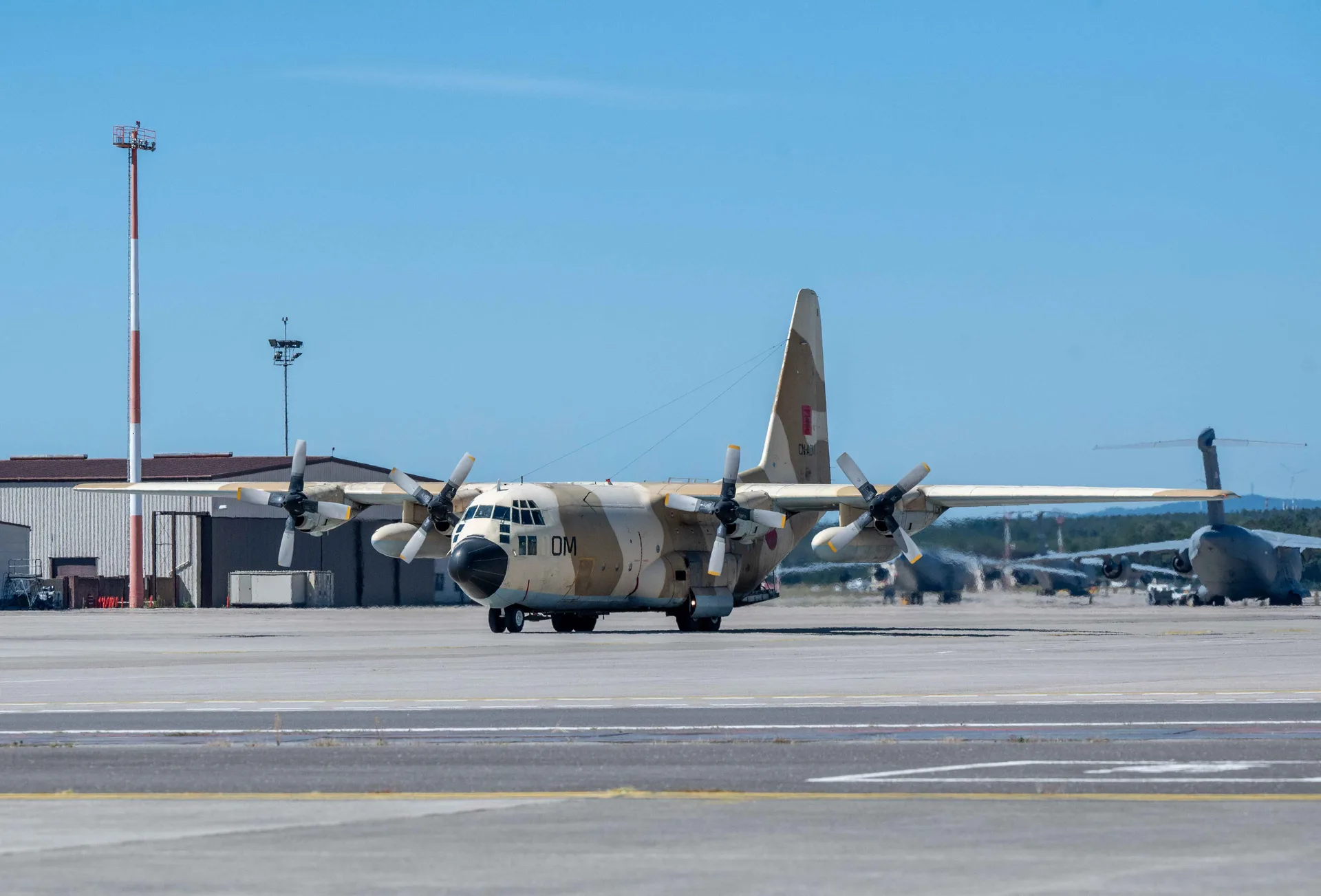


The C-130 Hercules is Lockheed Martin’s four-engine turboprop tactical transport aircraft, in continuous production since 1954 and flown by more Moroccan, Tunisian, Algerian, Egyptian, South African, Nigerian and Nigerien air force squadrons than any other heavy transport type on the continent. The current-production model is the C-130J Super Hercules, re-engined and modernised in the late 1990s; most African and several Middle Eastern air forces still fly earlier C-130H-series airframes alongside newer J-model deliveries.
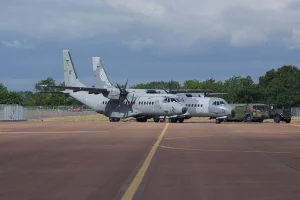
Photo: A Royal Moroccan Air Force C-130H Hercules taxis in after landing at Ramstein Air Base, Germany, during exercise Arcane Thunder, 16 August 2024. Credit: U.S. Air Force photo by Airman 1st Class Dylan Myers, Public domain, via Wikimedia Commons.
C-130J Super Hercules: quick specifications
- Manufacturer: Lockheed Martin, Marietta, Georgia, USA
- Type: Four-engine turboprop tactical airlifter (armed gunship and special-mission variants exist but are not standard export transport configurations)
- Crew: 2 pilots + 1 loadmaster (C-130J); legacy C-130H uses a 5-person crew (2 pilots, navigator, flight engineer, loadmaster)
- Length: 97 ft 9 in / 29.8 m (C-130J); stretched C-130J-30: 112 ft 9 in / 34.7 m
- Wingspan: 132 ft 7 in / 40.4 m
- Height: approx. 38 ft 10 in / 11.8 m
- Engines: 4 × Rolls-Royce AE 2100D3 turboprops, 4,700 shp each, six-blade composite propellers (C-130J); legacy C-130H uses 4 × Allison T56-A-15 turboprops, reported at 4,300–4,591 shp depending on source
- Max speed: about 417 mph / 362 kt (Mach 0.59) at 22,000 ft
- Max takeoff weight: 155,000 lb / 70,300 kg (C-130J); 164,000 lb / 74,400 kg (C-130J-30)
- Max payload: 42,000 lb / 19,090 kg (C-130J); 44,000 lb / 19,958 kg (C-130J-30)
- Range: roughly 2,160 nm / 4,000 km with 40,000 lb payload (C-130J-30, per Lockheed Martin fast facts); shorter at maximum payload — figures vary by source and load condition
- Service ceiling: 26,000–28,000 ft at maximum payload
- Capacity: up to 92 paratroopers, 128 combat troops, 97 litters, or multiple 463L pallets, within weight limits
- Unit price: Not publicly disclosed as a single figure — see Price and contract data below
What Is the C-130 Hercules, and Who Makes It?
The C-130 Hercules is a tactical military transport aircraft built by Lockheed Martin’s Aeronautics division at its Marietta, Georgia plant. First flown in 1954, it is the longest continuously produced military aircraft in the world. Lockheed Martin states the C-130J Super Hercules — the current production model — has been delivered to more than 20 countries, with over 545 aircraft built across the J-model program as of recent company statements.
The aircraft’s core role is tactical airlift: moving troops, cargo, vehicles and supplies into short, unprepared or austere airstrips that larger strategic transports cannot use. Beyond the baseline transport, Lockheed Martin and its partners build dedicated variants for aerial refuelling (KC-130J), special operations (MC-130J), combat search and rescue (HC-130J), armed gunship missions (AC-130J, operated only by the United States) and a civilian freighter derivative (LM-100J).
Development
The Hercules was designed in the early 1950s to meet a US Air Force requirement for a dedicated tactical transport, first flying as the YC-130 prototype in August 1954 and entering USAF service in 1956. Lockheed progressively stretched, re-engined and modernised the airframe through the A, B, E and H series over the following four decades, while keeping the same basic high-wing, T-tail, four-turboprop layout and rear cargo ramp that defines the type.
The most significant modernisation came with the C-130J, which first flew in 1996 and entered US service around 1999. It replaced the analogue cockpit with a digital “glass” flight deck, swapped the Allison T56 turboprops for more powerful Rolls-Royce AE 2100D3 engines driving six-blade composite propellers, and cut the standard flight crew from five to three. The C-130J-30 is a fuselage-stretched version offering roughly 25% more cargo volume. The J-model remains in production, and Lockheed Martin continues to market it alongside sustainment and overhaul programmes for the large worldwide fleet of older C-130H aircraft still in service — including most African and several Middle Eastern air forces.
Mission, Mobility, Protection, Weapons, Sensors
Mission: tactical troop and cargo transport, airdrop and airland resupply, aeromedical evacuation, and — in dedicated variants — aerial refuelling, special-operations infiltration/exfiltration and combat search and rescue. The baseline C-130H/C-130J transport carries no offensive weapons; the AC-130 gunship family is a separate, heavily modified variant operated exclusively by US special operations forces and is not part of the standard export product line.
Mobility: the Hercules’s defining feature is short- and rough-field performance — reverse-thrust propellers, a robust undercarriage and a design optimised for unprepared dirt or gravel strips, which is why it remains the backbone of airlift for African and Sahelian air forces operating far from paved runways.
Protection: the standard transport airframe has no armour protection. Many military operators, including some African and Middle Eastern customers, fit missile-warning systems and countermeasures dispensers as self-protection options, but DefenceMENA has not found a publicly disclosed, country-specific list of which African or MENA C-130 fleets carry which defensive suites; treat any such detail as not publicly disclosed unless a specific source is cited.
Sensors: the C-130J’s standard avionics include a digital glass cockpit, dual mission computers, GPS/INS navigation and weather radar. Special-mission variants (MC-130J, HC-130J) add podded ISR, electronic-warfare and air-to-air refuelling equipment not found on the standard transport.
Variants
| Variant | Role | Notes |
|---|---|---|
| C-130A/B/E | Early tactical transport | Largely retired from first-line service worldwide; some African air forces historically operated early-series airframes |
| C-130H / C-130H-30 | Tactical transport (standard / stretched) | The most common variant across Africa and much of the Middle East; analogue cockpit, T56 engines |
| C-130J Super Hercules | Tactical transport, current production | Glass cockpit, Rolls-Royce AE 2100D3 engines, 3-person crew |
| C-130J-30 | Stretched current-production transport | ~25% more cargo volume than standard C-130J; chosen by Tunisia, Egypt (on order), Qatar and others |
| KC-130J | Aerial tanker / transport | Selected by Saudi Arabia and Kuwait among others for Gulf tanker fleets |
| MC-130J Commando II | Special operations | US and allied special-operations use; not standard export configuration |
| HC-130J Combat King II | Combat search and rescue | US use; not a standard regional export type |
| AC-130J Ghostrider | Armed gunship | US special operations only — not exported; DefenceMENA has found no evidence of African or MENA gunship operators |
| LM-100J | Civilian freighter | Commercial derivative, no military armament |
Who Operates the C-130 Hercules?
| Country / operator | Status | Detail |
|---|---|---|
| Morocco | OPERATIONAL + UNDER MODERNIZATION | Existing legacy C-130H fleet in service (current precise fleet size not publicly confirmed); two further ex-US C-130H airframes transferred via the US Excess Defense Articles programme (approved 2019–2020) are undergoing a life-extension overhaul with L3Harris at Waco, Texas — the second airframe arrived there in August 2026 |
| Tunisia | OPERATIONAL | First African C-130J operator: 2 × C-130J-30 Super Hercules ordered 2010, delivered 2013 and 2014–15. Fleet expanded with additional ex-US C-130H airframes delivered in 2021, May 2024, November 2024 and January 2026, per defenceWeb-sourced reporting; exact current total differs slightly between trackers |
| Algeria | OPERATIONAL | Operates a tactical airlift fleet built around legacy C-130H and stretched C-130H-30 aircraft, plus 2 × C-130J Super Hercules delivered 2021–2022 |
| Egypt | OPERATIONAL + ORDERED | Long-standing C-130H/C-130H-30 operator with one of the region’s larger legacy fleets (estimated at roughly two dozen airframes by aggregated fleet trackers — not an official figure); ordered 2 × C-130J-30 Super Hercules in September 2024 under a US Foreign Military Sale, becoming the 23rd C-130J operator worldwide. DefenceMENA found no confirmed delivery of the J-30s as of this writing |
| South Africa | OPERATIONAL (reduced serviceability) | 28 Squadron, SAAF, flies the C-130BZ (upgraded C-130B/H) from a nominal fleet of around seven to nine airframes; public reporting over the years has repeatedly described serviceability as low, with a sustained operating capacity of around two to three aircraft. A 2022-era proposal for a roughly R1.6bn life-extension upgrade, and reports the US offered surplus C-130H airframes, have not been confirmed as contracted |
| Nigeria | OPERATIONAL (reduced fleet) | Nigerian Air Force has operated C-130H/H-30 aircraft since the mid-1970s; fleet numbers have fallen over decades of underfunding, with one 2025-era report describing only around two aircraft flying. Airframes have undergone programmed depot maintenance, including work at OGMA in Lisbon, as part of a serviceability-recovery effort |
| Niger | OPERATIONAL | Received three ex-US C-130H aircraft between 2021 and December 2022 to expand counter-terrorism airlift capacity in the Sahel |
| Saudi Arabia | OPERATIONAL | Operates the largest C-130 fleet outside the United States — widely reported at around 50–65 aircraft, with reporting suggesting roughly 50 remain operational — plus newer KC-130J tankers |
| Qatar | OPERATIONAL | First C-130J operator in the Middle East; flies the stretched C-130J-30 |
| Kuwait | ORDERED / OPERATIONAL | Operates legacy C-130 variants and has ordered new-build KC-130J tankers to operate alongside its C-17 fleet |
| Jordan | OPERATIONAL | Royal Jordanian Air Force flies a small fleet of legacy C-130B/H aircraft and C-130T models acquired from the United States; public fleet figures are dated and should be treated as approximate |
Operator status terms follow DefenceMENA’s standard scale: RUMOURED, EVALUATED, SELECTED, ORDERED, CONTRACTED, DELIVERED, OPERATIONAL, UNDER MODERNIZATION, RETIRED. A trade-show appearance or an approved Foreign Military Sale notice is not, by itself, evidence of delivery.
Africa and MENA in Focus
The C-130 Hercules is the dominant tactical airlifter across Africa’s Sahel and North Africa sub-regions, valued for its ability to operate from unpaved strips in counter-terrorism and UN-mission logistics roles — documented use cases include Sahel counter-terrorism resupply (Niger, Mali-region operations historically) and cross-border humanitarian and peacekeeping airlift. Morocco and Tunisia illustrate the two parallel paths African operators are taking: extending the life of existing C-130H airframes through Western overhaul partners (L3Harris for Morocco) while also operating or evaluating newer C-130J-30 aircraft. Notably, Morocco joined the rival Embraer C-390 Millennium user group in October 2024, and a 2025 report said Morocco was close to a contract for four to five C-390s — reported as a potential eventual replacement for its oldest C-130 Hercules airframes. No contract for either additional C-130J or C-390 aircraft had been confirmed for Morocco as of this writing, so DefenceMENA treats Morocco’s long-term fleet direction as EVALUATED, not decided.
In the Gulf, Saudi Arabia, Qatar and Kuwait between them operate one of the densest concentrations of C-130 variants outside the United States, spanning legacy C-130H, stretched C-130J-30 transports and KC-130J tankers.
Exports and Industrial Partnerships
Lockheed Martin sells the C-130J family through the US Foreign Military Sales system and direct commercial sales, with DSCA notifications typically covering the aircraft alongside spares, training, support equipment and sometimes additional systems in a single package. In Morocco, C-130H sustainment work is carried out locally by Maintenance Aero Maroc, a joint venture established in 2022 between Lockheed Martin and Moroccan partners providing F-16 and C-130H maintenance, repair and overhaul — though the current Waco, Texas overhaul of the two EDA-transferred airframes is being performed by L3Harris, a separate contractor, not Lockheed Martin directly.
Price and Contract Data
Lockheed Martin and the US government do not publish one single, universal “price” for the C-130J; published figures depend heavily on what is included in a given sale.
- DSCA-notified Foreign Military Sale packages state a total case value covering aircraft, spares, support equipment, training and sometimes other systems — not a per-aircraft price. Egypt’s September 2024 order for 2 × C-130J-30 was valued at an estimated $2.2 billion in the original underlying State Department approval, which covered a planned total of up to 12 aircraft plus support; this figure should not be divided by aircraft count and presented as a unit price, since it also plans for future tranches and support.
- US Air Force budget documents have cited a gross weapon-system unit cost for recent C-130J production lots in the range of roughly $110 million per aircraft, while older USAF flyaway-cost figures from the mid-2010s were lower, around $67 million. These figures are not directly comparable across years because of inflation, configuration changes and lot size.
- DefenceMENA has not found an official, current, single per-aircraft list price for African or Middle Eastern C-130J customers and treats third-party “$70–100 million” range estimates circulating online as unsourced unless tied to a specific contract.
Competing Systems
| Aircraft | Manufacturer / Country | How it compares |
|---|---|---|
| Airbus A400M Atlas | Airbus, Europe | Larger and faster, with roughly 30–37 tonnes of payload against the C-130J’s approximately 19–20 tonnes, and a wider cargo box; reported as markedly more expensive per unit. No confirmed African or MENA operator of the A400M as a Hercules replacement has been found by DefenceMENA to date |
| Embraer C-390 Millennium | Embraer, Brazil | Faster cruise speed and greater payload than the C-130J on shorter-range missions, marketed directly as a C-130 replacement; Morocco joined the C-390 user group in October 2024 and South Africa has evaluated the type, though neither has confirmed a purchase contract |
| Antonov An-32 / Il-76 family | Ukraine / Russia | Operated by some legacy Soviet-aligned African air forces; generally lower sustainment standards and parts availability reported in Western and African trade press compared with the C-130 support network, though DefenceMENA has not independently verified comparative readiness rates |
| Shaanxi Y-9 | China | Broadly comparable tactical transport class marketed to African customers; DefenceMENA has not found a confirmed Y-9 operator directly displacing an existing African C-130 fleet as of this writing |
FAQ
What is the C-130 Hercules used for?
Tactical military airlift — moving troops, vehicles, cargo and supplies, including airdrop, into short or unprepared airstrips that larger strategic transports cannot use. Dedicated variants also perform aerial refuelling, special operations support and combat search and rescue.
Which African countries fly the C-130 Hercules?
Confirmed current or recent operators documented by DefenceMENA include Morocco, Tunisia, Algeria, Egypt, South Africa, Nigeria and Niger. Fleet sizes and serviceability vary significantly, and several — notably South Africa and Nigeria — have publicly reported serviceability problems with ageing airframes.
What is the difference between the C-130H and C-130J?
The C-130J is a substantially modernised design: a digital glass cockpit, more powerful Rolls-Royce AE 2100D3 engines with six-blade composite propellers, and a reduced three-person crew, versus the C-130H’s analogue cockpit, Allison T56 engines and five-person crew. Most African and several MENA air forces still operate the older C-130H alongside newer C-130J deliveries.
How much does a C-130J cost?
There is no single published unit price. US Foreign Military Sale notifications state total package values that include spares, training and support, not a per-aircraft figure; US Air Force budget documents have cited unit costs of roughly $110 million for recent production lots. See Price and contract data above.
Does any African or Middle Eastern country operate the AC-130 gunship?
No. The AC-130J Ghostrider gunship variant is operated exclusively by US special operations forces. DefenceMENA has found no evidence of an African or Middle Eastern gunship export.
Related Pages
- Lockheed Martin: What It Makes, Who Owns It and Who Operates Its Systems
- L3Harris Begins Multi-Year Overhaul of Morocco’s C-130H Fleet
- What Does Morocco’s Military Arsenal Look Like in 2026?
- Military Transport Aircraft Used by African Air Forces
- Which Tactical Transport Aircraft Fit African Air Forces’ Short-Field Airlift Needs?
- What Is HIMARS, and Which Countries Operate It?
Sources
- Lockheed Martin, C-130J-30 Super Hercules product page and C-130J Fast Facts sheets, lockheedmartin.com
- Air & Space Forces Association, C-130J Super Hercules weapon system fact page, airandspaceforces.com
- GlobalSecurity.org, C-130H Hercules specifications
- Euro-SD / Breaking Defense / Overt Defense, Egypt C-130J-30 order coverage, September–October 2024
- Morocco World News, Royal Moroccan Air Force C-130H modernisation at Waco, Texas, August 2026
- en.hespress.com, Morocco C-130H / L3Harris life-extension agreement, 2025
- Armyrecognition.com, Algerian Air Force C-130J deliveries, 2022; Morocco–Embraer C-390 user group and Sahel marketing coverage, 2024–2025
- Military.Africa, Niger C-130H deliveries 2021–2022; Nigerian Air Force C-130 depot maintenance reporting
- SAAirForce.co.za and South African parliamentary committee question replies, SAAF C-130BZ serviceability reporting
- Aviation Week, Saudi Arabia, Qatar and Kuwait C-130/KC-130J fleet coverage
- DSCA notifications and US State Department press guidance, Egypt C-130J-30 Foreign Military Sale, 2022 and 2024