Rooivalk in the DRC: What Combat Use Actually Showed

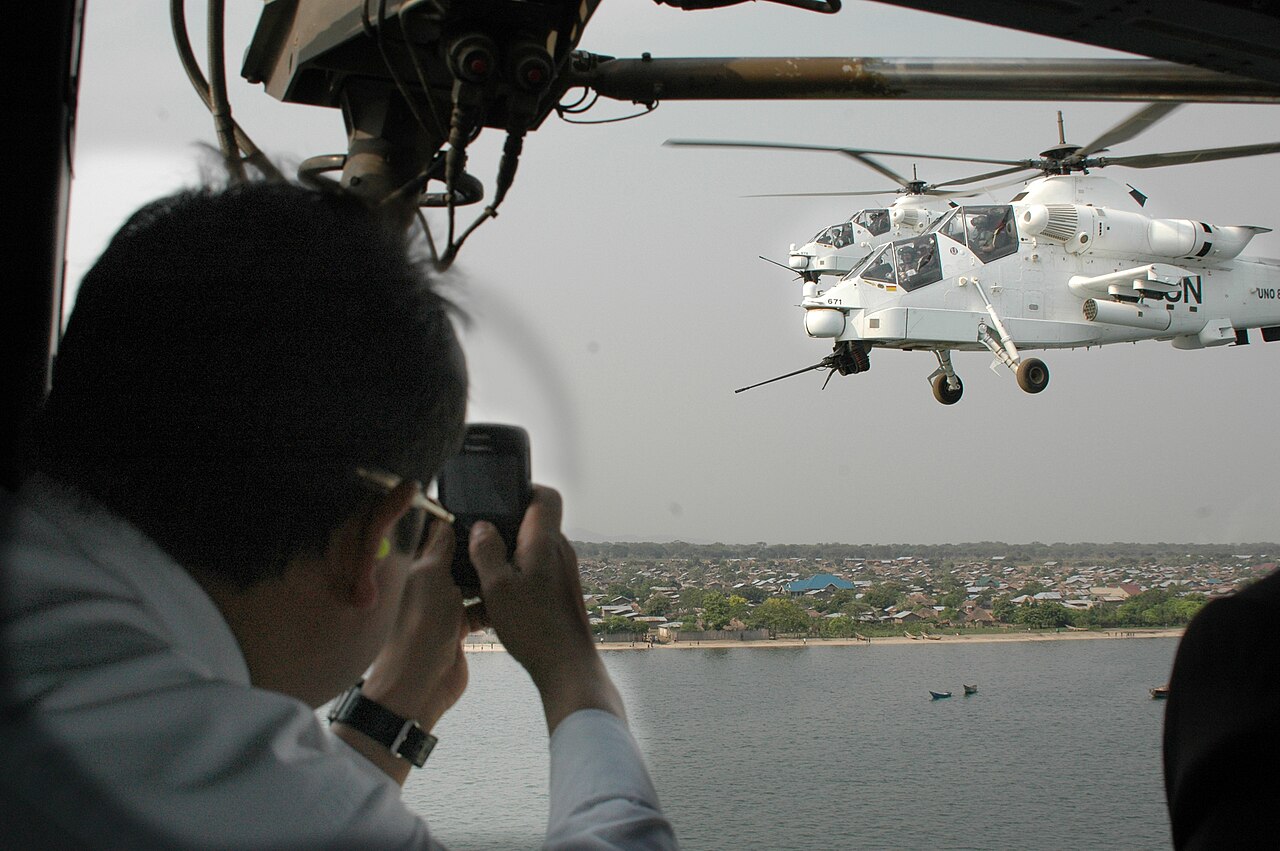


For eleven years, South Africa’s Rooivalk attack helicopter flew combat and escort missions over eastern Congo under the UN flag — the only sustained, documented combat record any Rooivalk has ever built. In December 2024 the last three aircraft were flown home in poor condition, grounded since 2022 for lack of money to fly them. The record shows a locally built strike platform that performed when it flew, and a fleet that funding could not keep flying.
Photo: Two South African Air Force Rooivalk attack helicopters, in UN colours, escort a MONUSCO delegation flight between Beni and Kiwanja, North Kivu, DR Congo. Credit: MONUSCO/Clara Padovan, CC BY-SA 2.0, via Wikimedia Commons.
Direct answer
South Africa’s Denel AH-2 Rooivalk flew its first and only sustained combat deployment in the eastern Democratic Republic of Congo, supporting the UN’s Force Intervention Brigade (FIB) against M23 and the Allied Democratic Forces (ADF) from October 2013. The public record shows confirmed strikes, a defence-ministry claim linking the helicopter to M23’s November 2013 surrender, and no confirmed Rooivalk loss or serious combat damage in over a decade of flying. What the record also shows is a fleet that SAAF and the UN stopped being able to afford to operate: flying all but ceased by 2022, and the last three aircraft were airlifted home in December 2024 in poor condition, with the SAAF’s wider maintenance budget still billions of rand short in 2025.
| System | Denel AH-2 Rooivalk attack helicopter |
| Operator | South African Air Force (SAAF), 16 Squadron — sole operator |
| Airframes built | 12 (not publicly disclosed how many remain airworthy) |
| Combat deployment | Eastern DRC, under MONUSCO’s Force Intervention Brigade, October 2013 – December 2024 |
| Armament used in DRC | 20 mm F2 cannon, 70 mm unguided rockets |
| Confirmed losses in DRC | None publicly documented |
| Current status | Returned to South Africa, undergoing assessment; no confirmed return-to-service date |
Where was it used?
The Rooivalk’s combat history is almost entirely confined to one theatre: North and South Kivu provinces in eastern DRC, where three aircraft from 16 Squadron, Air Force Base Bloemspruit, deployed on rotation from October 2013. They operated under MONUSCO’s Force Intervention Brigade (FIB), a UN peace-enforcement force with an offensive mandate against armed groups — unusual for a UN mission, and the reason the Rooivalk ended up flying live weapons at all. Flights ran out of Goma and Beni, the FIB’s main operating bases in North Kivu, against targets held by M23, the ADF and other armed groups operating in the region.
This was also, by most public accounts, the only time the type has fired its weapons at a real adversary. The Rooivalk entered SAAF service in the late 1990s and flew two decades of training, air-show and demonstration sorties in South Africa before the DRC deployment gave it a combat record at all.
What was the mission?
In the DRC, Rooivalk crews flew two recurring roles for the FIB: direct fire support for FARDC (Congolese army) and FIB ground operations against rebel positions, and armed escort for transport helicopters and VIP flights moving through contested airspace in North Kivu. Captain Siboniso Maseko, spokesperson for the SANDF’s Operation Mistral, described a typical escort sortie as a Rooivalk pair covering a SAAF Oryx transport for roughly six hours through South Kivu — a routine task that, unlike the strike missions, rarely made the news.
The fire-support role is better documented because it produced confirmed engagements: coordinated strikes called in by FARDC or FIB ground commanders against identified rebel positions, using 20 mm cannon fire and 70 mm rocket salvoes.
What does the public evidence show?
| Claim / event | Date | Evidence level | Source |
|---|---|---|---|
| First Rooivalk combat mission: strike on an M23 position near the Rwandan border, destroying a 14.5 mm gun position and hitting an ammunition bunker with 70 mm rockets | 4 Nov 2013 | OFFICIALLY CLAIMED | SANDF/SAAF account, reported by defenceWeb |
| M23 ends its 20-month rebellion and surrenders | 5–7 Nov 2013 | CONFIRMED (independently reported by multiple outlets) | Contemporary international reporting |
| Defence minister statement crediting the Rooivalk with forcing M23’s retreat (“We believe M23 had to retreat because of the Rooivalk”) | Nov 2013 | OFFICIALLY CLAIMED — causal link not independently verified | Min. Nosiviwe Mapisa-Nqakula, via defenceWeb |
| Strike supporting FARDC against ADF fighters holding Kamango; MONUSCO reported 12 dead (5 FARDC, 7 civilians) and 13 wounded in the wider clash | 25–26 Dec 2013 | INDEPENDENTLY REPORTED (MONUSCO casualty figures, SAAF account of the strike) | SAAF/MONUSCO |
| Strike on an ADF base at Saha Sitisa, Mbau area, near Beni | 1 Mar 2014 | OFFICIALLY CLAIMED | SAAF account |
| 2013–2015 cumulative activity: roughly 1,163 flight hours; totals of fired 70 mm rockets and 20 mm rounds reported, with 2014 rocket counts conflicting between sources | 2013–2015 | DISPUTED on exact figures; aggregate activity CONFIRMED | SAAF-sourced statistics, conflicting between reports |
| No serious combat damage recorded; one undated account of a single small-arms round passing through a horizontal stabiliser | Undated | UNVERIFIED (single, undated, uncorroborated account) | SAAF |
| UN reduces rotorcraft tasking from 2020; Rooivalk flying activity falls sharply, then stops entirely from August 2022 for lack of SAAF/UN funding | 2020–2022 | CONFIRMED | SAAF, Armscor, defenceWeb |
| Armscor tells Parliament only a fraction of the 11-aircraft operational pool is serviceable, citing unfunded maintenance contracts | 2023 | OFFICIALLY CLAIMED | Armscor briefing to Parliament, Parliamentary Monitoring Group record |
| Three Rooivalks airlifted from Goma to Waterkloof on a chartered Il-76, found in poor, corrosion-affected condition | 27 Nov–2 Dec 2024 | CONFIRMED | SAAF |
| Armscor discloses a roughly R7.7 billion SAAF-wide maintenance shortfall; Rooivalk’s own R2.5 billion contract funded to only R469 million | Jun 2025 | OFFICIALLY CLAIMED | Armscor briefing to Parliament, reported by IOL |
| Denel pitches a phased Mk1.1 upgrade to the SAAF; proposal submitted but not funded or contracted | Sept 2026 | OFFICIALLY CLAIMED | defenceWeb, via DefenceMENA |
What worked?
Where the record documents an engagement, it describes the Rooivalk doing what it was designed for: hitting point targets — gun positions, bunkers, a rebel base — with cannon fire and unguided rockets, coordinated with ground forces that had no other close air support. UN and FIB officers, quoted anonymously by South African outlets, reportedly welcomed its performance, and several accounts say UN troops preferred requesting the Rooivalk over the FIB’s other attack helicopter, the Ukrainian-operated Mi-24. Crews avoided 14.5 mm and small-arms fire during the November 2013 mission without being hit, by SAAF’s own account. Across more than a decade of DRC flying, no source reviewed for this article documents a Rooivalk shot down, written off, or seriously damaged in combat.
Its twin-engine redundancy and crashworthy cockpit, standard for its design generation, are consistent with that record, though no source attributes it specifically to those features rather than to the threats actually faced.
What problems appeared?
The problems that emerge from the record are sustainment problems, not combat ones. UN budget pressure from the late 2010s reduced MONUSCO’s rotorcraft tasking, and SAAF/UN funding for Rooivalk flying hours fell with it. By 2023, Armscor told Parliament that only a minority of the 11-aircraft pool it then counted as operational was serviceable, citing a fixed-cost maintenance contract running tens of millions of rand short and an on-demand contract left largely unfunded. Flying in the DRC stopped altogether from August 2022. When the last three airframes were flown home in December 2024, the SANDF described them as further deteriorated from lack of ground runs, needing urgent repair, with DRC humidity worsening corrosion.
South African reporting has also linked the Rooivalk’s unavailability to wider SANDF vulnerabilities on the ground in the DRC — unescorted Oryx transport helicopters taking small-arms fire, and troops killed by mortar fire without attack-helicopter cover — though this is presented as a contributing factor suggested by analysts and reporters, not a cause confirmed by the SANDF itself.
Confirmed losses and limitations
No Rooivalk airframe is publicly documented as lost, shot down or written off in DRC combat. The only damage account found is a single, undated, uncorroborated reference to one small-arms round through a horizontal stabiliser — UNVERIFIED. The confirmed limitation is availability: the operational fleet fell to a minority of serviceable airframes by 2023, flying stopped entirely from August 2022, and the aircraft that did fly for over a decade came home in 2024 needing extensive repair. Measured by combat outcomes, the record shows no confirmed failure. Measured by whether South Africa could keep it flying, it shows a persistent, worsening funding shortfall across the SAAF’s rotary fleet.
What is still disputed?
Three things are unsettled. First, how much credit the Rooivalk deserves for M23’s November 2013 collapse: the minister’s statement is an official claim, not a verified causal finding, and the surrender followed a wider FIB ground and artillery offensive alongside Tanzanian and Malawian troops, not an air campaign alone. Second, the exact scale of 2014 activity: sources give conflicting rocket-expenditure totals that this article cannot resolve from public data. Third, whether the grounding contributed to specific SANDF casualties in 2024–2025 — reporters and analysts have drawn that link, but it rests on inference about missing air cover, not a confirmed investigative finding.
Did the manufacturer or operator change anything?
Denel and Airbus Helicopters signed a memorandum of understanding in September 2016 to modernise the fleet to a Mk1.1 standard, targeting reliability, sensors and weapons integration, alongside a longer-term Mk2 export concept. A decade later, there is no public evidence that Mk1.1 work was ever funded or contracted. What has changed, reported by DefenceMENA in September 2026, is that Denel Aeronautics — now the only consistently profitable division in the state-owned Denel group — has pitched the SAAF a new, phased Mk1.1 proposal meant to spread cost across budget cycles. It has been submitted, not funded. Separately, a comparatively small R33 million Rooivalk cannon-reliability project was fully funded and completed successful flight testing at AFB Overberg — a narrow, concrete fix against far larger unfunded contracts.
Did other countries buy it afterwards?
| Year | Development | Source |
|---|---|---|
| Late 1990s | Rooivalk competed against the Eurocopter Tiger for export orders, including in Australia’s attack-helicopter competition; no sale resulted | SAAF/aviation trade reporting |
| Reported c. 1998 | A Turkish purchase was reportedly blocked by the South African government over concerns linked to Turkey’s Kurdish policy; DISPUTED, sourced only to informal enthusiast-forum accounts | SAAF forum discussion |
| By 2013 | Malaysia, the UK and Turkey had reportedly been approached or shown interest at various points; no order placed | Aviation trade press |
| 2016 | Denel marketed a new-build Mk2 variant, citing interest from Poland, Nigeria and Egypt and setting a threshold of roughly 75 aircraft committed at launch to make the programme viable; no launch customer materialised | SAAF news, trade press |
No country other than South Africa has ever bought a Rooivalk. Twelve airframes were built, all for the SAAF, and none exported in roughly three decades. Industry reporting attributes this to competition from the Tiger and Apache, persistent doubts about Denel’s financial stability and support capacity, dependence on some French-sourced systems, and — one trade-press allegation, not a confirmed fact — reported US pressure steering export-minded air forces toward the Apache. The DRC combat record has not changed that outcome.
What does this mean for African procurement?
The Rooivalk’s DRC record is a case study in a distinction African air forces increasingly have to make: a platform can be combat-proven and still become operationally unavailable, not because the technology failed but because the maintenance budget behind it did. South Africa built, owns and exclusively operates the only indigenous African-designed attack helicopter with a real combat record — and still could not keep three aircraft flying continuously for one ongoing mission. The SAAF’s broader hardware crisis, documented separately, shows the same pattern across other fleets.
The timing underlines the point. South Africa’s SAMIDRC force, deployed from late 2023, collapsed under M23 pressure around Goma and Sake in January 2025 and was formally withdrawn by mid-2025 — a defeat analysts tied partly to a lack of sustainable aerial support. The three Rooivalks that might have provided some of it had already been flown back to South Africa weeks earlier, not because the mission no longer needed air cover, but because neither the SAAF nor MONUSCO could fund flying them. Pretoria has since announced it will end its 27-year MONUSCO deployment under Operation Mistral by the end of 2026. For African buyers weighing locally sustained legacy platforms against new imports, the lesson is less about the airframe than the commitment behind it: a proven system on an underfunded contract is, in practice, not much more available than no system at all.
South Africa’s indigenous, tandem-seat attack helicopter. Only 12 airframes were ever built; the SAAF’s 16 Squadron is the sole operator.
North and South Kivu provinces, flying from Goma and Beni under MONUSCO’s Force Intervention Brigade, October 2013 to December 2024.
Strikes on rebel positions called in by FARDC/FIB ground forces, plus armed escort for transport helicopters and VIP flights.
Confirmed engagements against M23 and the ADF in 2013–2014; a ministerial claim links the Rooivalk to M23’s surrender, not independently verified.
No aircraft lost or seriously damaged in over a decade of DRC flying; serviceability and funding collapsed instead, grounding the fleet from August 2022.
The last three aircraft returned to South Africa in poor condition in December 2024; a 2026 Mk1.1 upgrade has been pitched to the SAAF but not funded.
A locally built, battle-tested platform still went unavailable for lack of maintenance funding — a sustainment lesson, not a technology one.
What is the Rooivalk attack helicopter?
The Denel AH-2 Rooivalk is a South African-designed, tandem-seat attack helicopter that entered SAAF service in the late 1990s. Only 12 were built, and South Africa remains the type’s only operator.
Has the Rooivalk ever been used in combat?
Yes. From October 2013 to December 2024, Rooivalk helicopters flew fire-support and escort missions in eastern DRC under the UN’s MONUSCO Force Intervention Brigade, with confirmed strikes against M23 and ADF positions, most documented in 2013 and 2014.
Is the Rooivalk better than the Apache?
There is no independently verified head-to-head combat comparison. The Rooivalk has a documented, damage-free DRC combat record over more than a decade, but it has never faced the volume of modern air-defence and loitering-munition threats that recent Apache operators have encountered elsewhere, and the two aircraft have different design priorities and export histories.
Why are South Africa’s Rooivalks no longer in the DRC?
Funding, not combat losses. UN and SAAF budget cuts reduced flying from 2020, grounded the fleet entirely from August 2022, and the last three aircraft were airlifted home to South Africa in November–December 2024 in poor, corrosion-affected condition.
Has any other country bought the Rooivalk?
No. Despite competing for export orders since the late 1990s and a 2016 Mk2 marketing push citing interest from Poland, Nigeria and Egypt, the Rooivalk has never secured a foreign customer. All 12 airframes built remain South African.
Is the Rooivalk still in service today?
The three airframes flown home in December 2024 are undergoing assessment and repair at Denel facilities. No public source confirms a return-to-service date, and a 2025 Armscor briefing to Parliament described the SAAF’s wider rotary-wing maintenance budget, Rooivalk included, as still running billions of rand short.
Sources
- defenceWeb — DRC Rooivalks notch up a first
- SAAF — First ever combat for Rooivalk
- SAAF — Rooivalk in Christmas Day DRC action
- SAAF — SA attack helicopters in renewed action in the DRC
- SAAF — Rooivalks the ‘blue eyed boys’ of UN mission in the DRC
- SAAF/defenceWeb — Rooivalk remaining in the DRC
- SAAF — SAAF Rooivalks return from the DRC
- SAAF — A year’s worth of work ahead to make three Rooivalks airworthy after DRC return
- SAAF — What went wrong with the Rooivalk
- SAAF — Denel pushing Rooivalk Mk 2, export orders
- Metalworking News — Lack of maintenance funds hits Rooivalk and Oryx serviceability
- Parliamentary Monitoring Group — Armscor briefing, Portfolio Committee on Defence and Military Veterans
- IOL — Armscor discloses alarming R7.7 billion budget shortfall impacting SAAF maintenance
- EWN — South Africa to withdraw troops from DRC peacekeeping mission by year-end
- Daily Maverick — South African and other SADC troops finally begin withdrawal from war-torn DRC
- DefenceMENA — Denel Aeronautics Pitches Rooivalk Mk1.1 Upgrade
- DefenceMENA — South Africa’s Military Has Advanced Hardware It Can Barely Keep Running
- Wikimedia Commons — image source and licence
More from Battlefield Proven
- Bayraktar TB2 in Libya: What Did Its Combat Use Actually Show?
- Sudan War Drones: What the Evidence Shows on SAF and RSF Since 2023
- Pantsir-S1 in Libya: What the Battlefield Record Revealed
- Drones in the Ethiopia War: What Is Confirmed and What Remains Unverified
- Wing Loong II in Libya: How Did China’s Armed Drone Perform in Combat?
- Bayraktar TB2 and Akinci in Mali and Burkina Faso: What Combat Use Has Shown
- Nigeria Super Tucano: What Five Years of Combat Use Have Shown
- BMC Kirpi in Africa: What Is Publicly Known About Its Mine and IED Protection Record
- Mi-24 and Mi-35 Attack Helicopters in Africa: What Combat in Nigeria, Mali and Uganda Has Shown
- Casspir and Mamba: What South Africa’s Mine-Protected Vehicles Proved in African Combat
This article relies on South African Air Force and defenceWeb-sourced reporting for most DRC-specific combat details, supplemented by Armscor and parliamentary records for funding figures; independent, non-SAAF-linked confirmation of individual strike outcomes is limited, and this is noted throughout. This article will be updated at the same URL if significant new evidence appears.