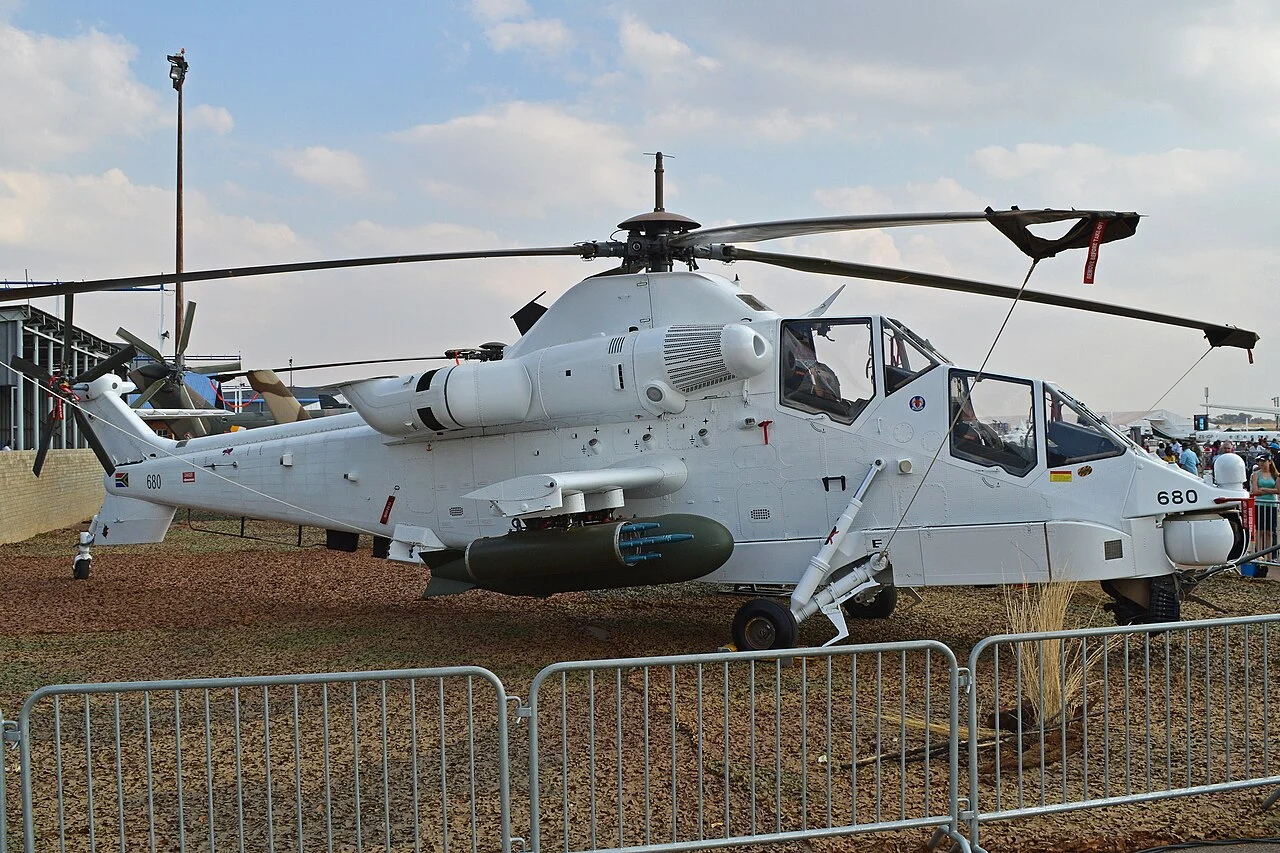
Denel Aeronautics has submitted a proposal to the South African Air Force to upgrade its Rooivalk attack helicopters to a new Mk1.1 standard, part of a wider recovery in which the division has become the only unit inside the troubled state-owned group posting consistent profits. New agreements with Embraer and Airbus, disclosed at AAD 2026, extend that turnaround into export and support work.
Photo: A South African Air Force Rooivalk Mk1 attack helicopter on static display at the Africa Aerospace and Defence exhibition. Credit: Alan Wilson, CC BY-SA 2.0, via Wikimedia Commons
Denel Aeronautics has pitched the South African Air Force (SAAF) a phased upgrade of its Rooivalk attack helicopter fleet to a Mk1.1 standard, defenceWeb reported, as the aerospace division reported itself the only consistently profitable unit within the state-owned Denel group and outlined roughly R2.1 billion (about $115 million) in near-term revenue opportunities across its programmes.
The Rooivalk upgrade proposal
Only 12 Rooivalk airframes were ever built, and the SAAF’s 16 Squadron has operated the type for two decades with persistent complaints from South African defence analysts about a shrinking serviceable fleet and no replacement programme in sight. The Mk1.1 proposal, submitted to the Air Force rather than yet funded or contracted, would upgrade the helicopter’s systems in phases rather than as a single block change — a format intended to spread cost for a defence budget that has repeatedly deferred major SANDF re-equipment decisions. DefenceWeb’s report did not detail which specific systems — avionics, sensors, weapons integration or engines — the Mk1.1 package would touch, and Denel has not published a formal specification.
The proposal lands against a backdrop of chronic underfunding: Denel Aeronautics has spent recent years fighting to keep the existing Rooivalk fleet airworthy at all, and any upgrade commitment depends on Treasury and SANDF budget decisions that have not historically favoured legacy platform investment over new procurement.
Order book and international partnerships
Denel Aeronautics said it recently secured an order for a new surveillance drone from an undisclosed client, which it described as having potential to scale into other applications — one contributor to the R2.1 billion pipeline the division is now pursuing. The division also disclosed a collaboration agreement with Brazil’s Embraer covering the KC-390 Millennium transport aircraft and the Super Tucano light attack/trainer, and a separate arrangement with Airbus for maintenance, repair and overhaul (MRO) of H215 and H225 military helicopters across the African market.
Denel is also in discussions with Rolls-Royce on aero-engine support for South Africa’s C-130 Hercules fleet, and said it has passed certification audits from Airbus, Embraer, Pilatus and Lockheed Martin Aero — a set of qualifications that positions the division to bid for regional MRO and component-manufacturing work beyond South Africa’s own fleet. The division’s Overberg Test Range, used for airborne weapons trials, reported new contracts from Middle Eastern and Asian customers, and its Training Academy has expanded technical training in aircraft mechanics, avionics and engineering — capacity that Denel is positioning as a regional service hub rather than a manufacturer competing only on new-build aircraft.
Existing Rooivalk inventory and prior support gaps
South Africa built the Rooivalk domestically through the 1990s as an Apache-class attack helicopter developed without the export licensing constraints of buying from the United States or Europe, and it remains the only indigenously designed attack helicopter operated on the continent. The SAAF’s aircraft inventory and the South African Army’s equipment list both reflect the same pattern Denel Aeronautics is now trying to reverse: platforms designed and built locally during the apartheid-era sanctions period, followed by a post-2000 decline in sustainment funding that left fleets like the Rooivalk flying on a fraction of their original numbers.
Alternatives African operators are weighing
Outside South Africa, African air forces looking for attack-helicopter capability have mostly bought Russian Mi-24/Mi-35 variants or, more recently, Turkish and Chinese armed helicopters and UAVs offered with fewer end-use restrictions than Western platforms. A funded Rooivalk Mk1.1 upgrade would keep South Africa as the only African operator of a genuinely indigenous attack helicopter design, rather than adding it to the list of countries dependent on Moscow, Ankara or Beijing for rotary-wing strike capability — though without a signed contract, that outcome remains a proposal rather than a commitment.
Why it matters for Africa
Denel’s turnaround matters beyond South Africa because the group has functioned as a de facto regional MRO and munitions supplier for years, even while its own balance sheet was in crisis. A financially stable Denel Aeronautics — backed by Embraer, Airbus and Rolls-Royce partnerships rather than reliant solely on SANDF orders — gives other African air forces flying Western or Brazilian-built aircraft a continental maintenance option instead of routing support work through Europe or the Gulf. A funded Rooivalk upgrade would also be a rare case of an African-designed combat platform being modernised rather than retired in favour of an imported replacement, at a moment when most of the continent’s attack-helicopter fleets are ageing Soviet-era airframes with increasingly difficult parts supply chains.