This Denel company profile explains who owns South Africa’s state-owned defence group, what it builds, which customers it has in Africa and the Middle East, and where its finances stand after years of crisis. Denel makes artillery, guided missiles, armoured vehicles, ammunition and unmanned aircraft, and it supports helicopters and transport aircraft of the South African Air Force (SAAF). It was formed in 1992 from the manufacturing arms of Armscor and is wholly owned by the South African government. The South African National Defence Force (SANDF) remains its main customer, although several products have found buyers abroad.
Denel Company Profile: Overview and History
Denel SOC Ltd was established in April 1992, when Armscor’s manufacturing subsidiaries were separated so that Armscor could act purely as the procurement agency for the SANDF. The new group inherited most of Armscor’s production and research facilities and more than 15,000 employees.
The head office is on Nellmapius Drive in Irene, Pretoria, and the group operates campuses at Irene, Lyttelton and Kempton Park. Its shareholder is the Department of Defence and Military Veterans. At the latest Africa Aerospace and Defence exhibition, Denel said it was taking part for the first time with the department in that role.
The recent history is troubled. In Denel’s own account, mismanagement, state capture and governance failures caused a sharp downturn, and outstanding salaries were settled only in August 2022. The group exited its Aerostructures subsidiary in 2020 after agreeing with customers to move parts manufacturing to other suppliers. A new dispute involving Denel PMP and the Solidarity union shows that labour and governance questions have not gone away.
Denel now groups its work into four capability areas: aerospace, guided weapons, landward systems and integrated systems solutions. Its website also lists Denel Mechem, Denel PMP, Denel Maritime, Denel S3, the Overberg Test Range and the Denel Technical Academy.
Key Products and Programmes
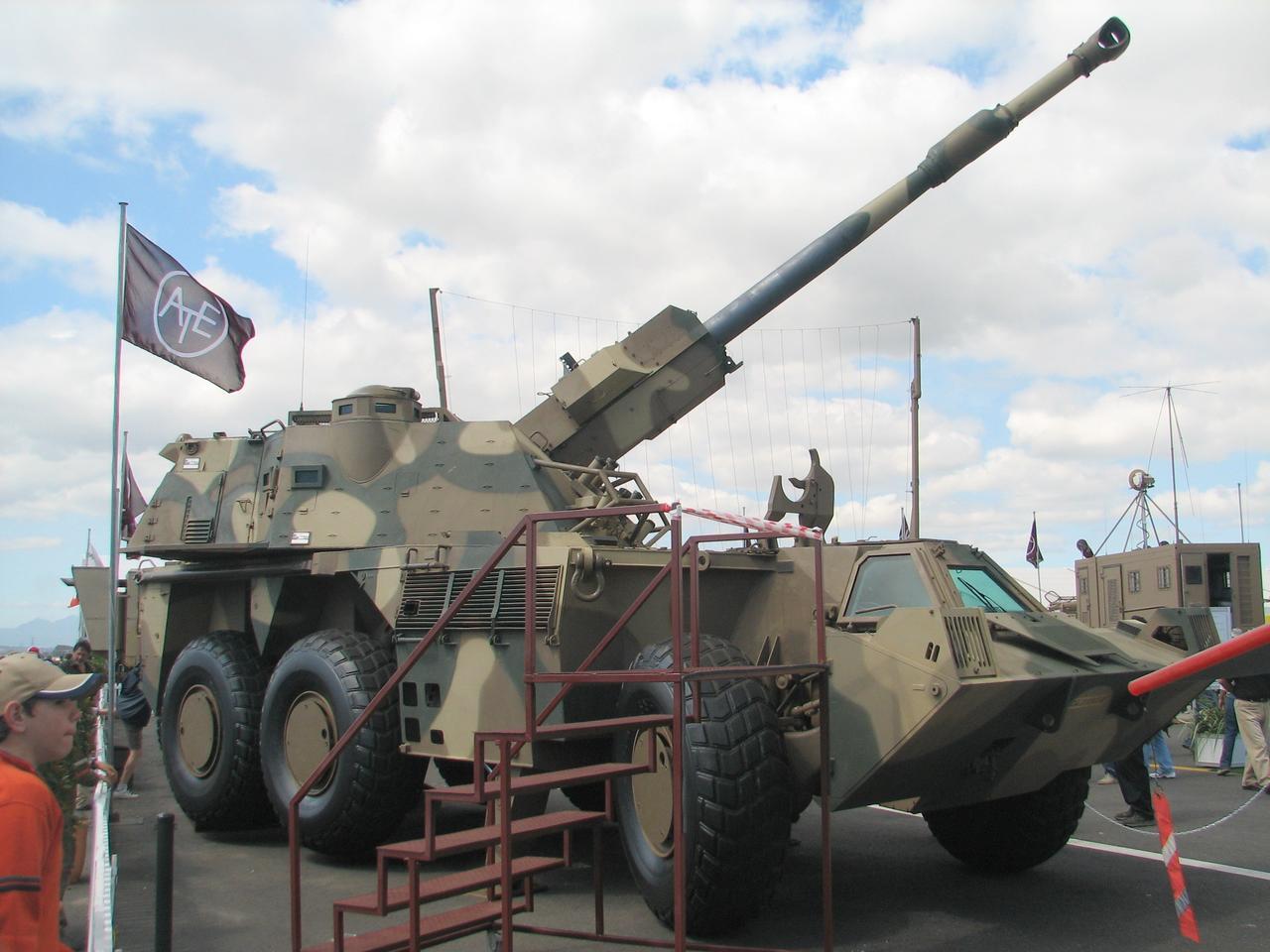
Artillery is the group’s best-known export line. The G6 is a 155 mm wheeled self-propelled howitzer designed in South Africa, and defenceWeb lists the South African Army, the United Arab Emirates and Oman as operators. The lighter T5-52 truck-mounted gun fired three rounds beyond 60 km during an Alkantpan trial in August 2023, with the longest shot recorded at 61.29 km using velocity-enhanced projectiles.
In missiles, Denel Dynamics builds the Umkhonto surface-to-air missile, the Ingwe and Mokopa anti-tank missiles and the A-Darter short-range air-to-air missile, which remains in production for the SANDF. Denel quotes up to 16 hours of endurance and a 250 km line-of-sight range for the Seeker 400 unmanned aircraft.
Denel Aeronautics is design authority for the Oryx medium helicopter and supports the Rooivalk attack helicopter, for which it has proposed a phased upgrade to Mk1.1 standard to the SAAF. Denel PMP makes small and medium calibre ammunition from 5.56 mm to 35 mm. On the ground, the Badger infantry fighting vehicle is being built with Patria under Project Hoefyster.
| Product | Division | Role | Status and known users |
|---|---|---|---|
| G6 155 mm howitzer | Land Systems | Wheeled self-propelled artillery | In service with the South African Army, UAE and Oman; upgrade contract for an unnamed Middle East customer |
| T5-52 155 mm gun | Land Systems | Truck-mounted artillery | Demonstrated beyond 60 km; no export contract publicly named |
| Badger | Land Systems with Patria | Infantry fighting vehicle | SANDF programme; phase one progressing, mine-blast testing delayed |
| Casspir NG2000, RG31, RG32M | Vehicle Systems | Mine-protected vehicles | African clients, the UN, UAE and Namibia |
| Umkhonto-IR | Dynamics | Naval and ground air defence | South African Navy, Finnish Navy, one unnamed North African navy |
| Mokopa | Dynamics | Anti-tank guided missile | Integrated on Rooivalk in 2016, no SAAF order; exported to a North African customer |
| Seeker 200 and 400 | Dynamics | Tactical UAV | Seeker 200 with a Middle East customer; Seeker 400 launched with the SANDF |
| Rooivalk | Aeronautics | Attack helicopter | SAAF only; Mk1.1 upgrade proposed |
Contracts and Customers in Africa and the Middle East
Denel’s African business has centred on vehicles. In July 2017 the company said an unnamed African client had ordered 45 Casspir NG2000 vehicles for a new peace support contingent intended mainly for African Union missions. Twenty-four had been delivered in December 2016 and 21 more were ready for shipment. Denel added that more than 200 Casspirs had been sold to African clients and the United Nations since production began in 2010.
Namibia is a named customer. Denel announced in January 2017 that it was on track to deliver eight RG32M armoured patrol vehicles and four SDROW remote weapon stations by the end of March 2017. The contract value was not stated. A separate North African navy bought both the Mokopa and the Umkhonto, according to defenceWeb, which did not name the country. A reported missile deal with Egypt did not go ahead after local banks declined to finance it.
In the Middle East, the United Arab Emirates is the longest-standing customer. In 2016 Denel shipped the first of 24 RG31 mortar-carrier vehicles ordered in June 2015 through International Golden Group, and said 73 earlier vehicles were already in service. The Seeker 200 has been with a Middle East customer for over a decade, and the UAE reportedly bought it.
The largest recent export item is a five-year G6 upgrade contract worth about R2 billion for an unnamed Middle East customer, as reported by defenceWeb. It covers testing, integration and an upgrade facility in the customer’s country, with phased deliveries through June 2030. The customer has not been named publicly. Denel also exhibited in Saudi Arabia and at IDEX in Abu Dhabi, but neither press statement named a new contract. Wider market context is in our guides to arms suppliers to Africa and African countries that manufacture weapons.
Partnerships and Local Production
Several of Denel’s capabilities sit in joint ventures. Rheinmetall Denel Munition is 51 per cent owned by Rheinmetall and 49 per cent by Denel, and its dividends contributed to the latest cash flow. Hensoldt South Africa is 70 per cent Hensoldt and 30 per cent Denel, and Barij Dynamics is 51 per cent Barij and 49 per cent Denel.
The Badger vehicle is a joint effort with Finland’s Patria. Denel reached a settlement with Patria in December 2022, and Patria stopped all legal action. On the aircraft side, Denel works with Airbus on maintenance and refurbishment of H215 and H225 military helicopters for African operators, and it signed a memorandum of understanding with Embraer on the KC-390 at the LAAD exhibition in April 2025. That document covers possible aerostructures and maintenance work, not a firm order.
A technology roadmap links the group with the CSIR and Armscor, and the G6 upgrade for the Middle East customer includes a facility built in that country. For a comparison with another state-linked supplier, see our Roketsan company profile.
Financial Snapshot and Workforce
The financial figures in this denel company profile come from the annual report that Denel presented to Parliament’s defence committee on 9 October. Revenue rose 15.8 per cent to about R1.473 billion. The company still posted an operating loss of R364 million, and a net profit of R156 million came mainly from a 74 per cent rise in its share of profit in associate companies.
| Indicator | Latest annual report | Comparison |
|---|---|---|
| Group revenue | R1.473 billion | R1.272 billion previous year |
| Gross profit margin | 24% (R361 million) | 11% previous year |
| Operating loss | R364 million | R370 million previous year |
| Net profit | R156 million | Driven by associate companies |
| Cash from operations | R261 million | Loss of R122 million in 2024 financial year |
Aerospace produced R880 million of revenue, Land Systems R478 million, Denel Dynamics R84 million and the integrated systems division R29 million. Denel PMP reported R157 million against a target of R235 million. Of R3.378 billion in recapitalisation received since 2023, R81 million remained at 30 April.
Governance is the weakest point. The Auditor-General issued a disclaimer for the ninth consecutive year and found the financial statements not credible. Denel also said liquidity was projected to turn negative in September, with interventions under way.
The total headcount was not stated in the sources reviewed. Employee turnover was 11.4 per cent, with 186 people leaving. For scale, the group reported 3,137 employees in its 2020 financial year, down from more than 15,000 at its creation. Budget context is in our report on South Africa’s military strength, budget and personnel.
Strengths, Challenges and Outlook
Denel lists its opportunity pipeline at more than R30 billion. Its strengths are a deep artillery and missile heritage, established export references in the UAE, Oman and Finland, and a test range that serves outside customers. The G6 export upgrade is understood to be ahead of schedule.
The challenges are plain. Revenue growth of 15 per cent fell short of the 25 per cent annual target. Mine-blast testing on Project Hoefyster slipped beyond the reporting year, and the SAAF has not ordered the Mokopa, while the Rooivalk upgrade remains a proposal. Chief executive Tsepo Monaheng told Parliament that financial performance is secondary to delivering sovereign capability, a position that sits uneasily with the audit record.
The stated priorities are to execute existing programmes, strengthen financial and internal controls, win new business and invest in technologies and people. Whether this denel company profile changes depends on converting the pipeline into paid orders and clearing the audit disclaimer, which the board has promised to address.
Frequently Asked Questions
Who owns Denel?
Denel SOC Ltd is wholly owned by the South African government. The shareholder is the Department of Defence and Military Veterans, which Denel described as a new arrangement at the latest Africa Aerospace and Defence show.
What does Denel make?
Denel makes artillery such as the G6 and T5-52, missiles including the Umkhonto, Ingwe and A-Darter, armoured vehicles such as the Casspir and Badger, small and medium calibre ammunition, and the Seeker unmanned aircraft. It also maintains SAAF helicopters and transport aircraft and runs the Overberg Test Range.
Which African countries buy from Denel?
Publicly named African customers are limited. Namibia ordered RG32M vehicles and weapon stations, South Africa is the main customer, and an unnamed African client bought 45 Casspirs for peace support use. An unnamed North African navy bought the Mokopa and Umkhonto. Denel has not disclosed full export customer lists or values.
Is Denel profitable?
Denel reported a net profit of R156 million in its latest annual report, but that came largely from associate companies. The group still recorded an operating loss of R364 million, and its auditors issued a ninth consecutive disclaimer. Profitability from its own operations has therefore not yet been shown.
Sources
- Denel official website
- Denel press release on its annual report presentation
- Denel statement on restructuring results
- Denel statement on its Africa Aerospace and Defence participation
- Denel statement on the recapitalisation
- Denel statement on Casspir deliveries to an African client
- Denel statement on the Namibia contract
- Denel statement on RG31 vehicles for the UAE
- Denel statement on the T5-52 range trial
- Embraer and Denel memorandum on the KC-390
- defenceWeb on Denel’s financial results and audit outcome
- defenceWeb on Denel Landward