From F-5 Tiger II to F-16 Block 72: Morocco’s Fighter Transition

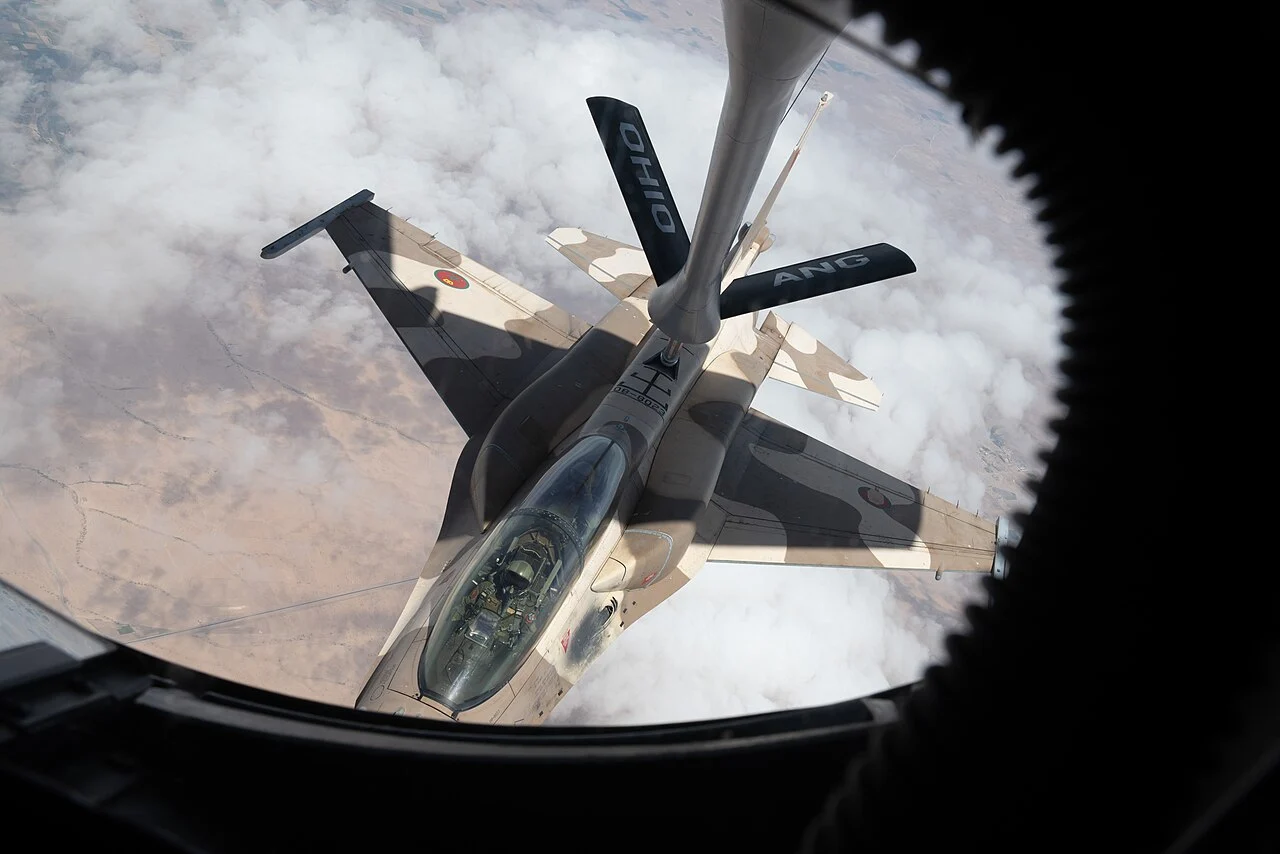


The Royal Moroccan Air Force is replacing its Vietnam-era F-5E/F Tiger II fighters with 25 new-build F-16C/D Block 72 Vipers, a transition from a day/visual-range fighter to an AESA-radar multirole platform. The new jets were approved for sale in 2019 and remain undelivered; this comparison uses data current to October 2026.
DEFENCE AFRICA | Old vs new | Data as of October 2026
Morocco has flown Northrop F-5 Tiger IIs since the early 1980s, when Rabat took delivery of F-5E/F airframes under US Foreign Military Sales to supplement older F-5A/Bs acquired in the 1970s. More than four decades later, the type is being pushed toward retirement as the Royal Moroccan Air Force absorbs its most expensive fighter order in a generation: 25 new-build F-16C/D Block 72 aircraft, approved by the US State Department in March 2019 in a package valued at roughly $3.8 billion, according to the Defense Security Cooperation Agency notification reported by Defense News on 25 March 2019.
The first aircraft from that order, a two-seat F-16D, completed its maiden test flight at Lockheed Martin’s Greenville, South Carolina production line on 6 October 2026, the manufacturer confirmed. No delivery date has been published, so the jets remain ordered, not delivered or operational. DefenceMENA covered the flight itself in Morocco’s First F-16 Block 72 Completes Maiden Test Flight and the state of the existing Viper fleet in Morocco’s F-16 Fleet Explained. This piece focuses on the capability gap the new jets are meant to close: what the F-5 could and could not do, and what changes once the Block 72s arrive.
Key facts
- Morocco ordered 25 new-build F-16C/D Block 72 fighters, approved by the US State Department in March 2019 for an estimated $3.787 billion (Defense News, DSCA notification, 2019).
- A parallel $985.2 million notification covers upgrading Morocco’s roughly 23 in-service Block 50/52 F-16s toward F-16V/Block 52+ standard (Defense News, 2019).
- The Block 72 package includes 29 Pratt & Whitney F100-PW-229 engines and 26 Northrop Grumman AN/APG-83 AESA radars (DSCA notification, Federal Register, 2019).
- The first Moroccan Block 72, an F-16D, flew for the first time on 6 October 2026 (Lockheed Martin, 2026); no delivery date has been disclosed.
- Morocco upgraded its F-5E/F fleet to “Tiger III” standard between 2001 and 2004 with France’s SOGERMA and Israel’s Elbit/IAI-Lahav division, fitting an Elta EL/M-2032 multimode radar (Altair aviation report).
- Army Recognition reported in 2022 that Morocco was considering integrating Elbit’s Delilah cruise missile on its F-5 fleet, indicating the type was still active that year.
| Category | F-5E/F Tiger III (old) | F-16C/D Block 72 (new) |
|---|---|---|
| Role | Day/visual-range light fighter, secondary ground attack (manufacturer specifications, Northrop legacy data) | All-weather multirole fighter: air superiority, strike, suppression of enemy air defences (Lockheed Martin product literature, 2025) |
| Generation | Third-generation fighter, originally fielded in the 1960s-70s; Morocco’s examples delivered from the early 1980s | Fourth-generation-plus “Viper” standard, the most advanced F-16 configuration offered for export (Lockheed Martin, 2025) |
| Sensors | Elta EL/M-2032 multimode radar fitted during the 2001-2004 Tiger III upgrade (Altair aviation report); no AESA capability | Northrop Grumman AN/APG-83 Scalable Agile Beam Radar (SABR), an AESA set sharing software lineage with F-22/F-35 radar technology (Lockheed Martin product card, Jan 2025) |
| Weapons | Short-range AIM-9 Sidewinder-class air-to-air missiles; no confirmed beyond-visual-range missile integration | Compatible with AIM-120 AMRAAM-class beyond-visual-range missiles under the standard Block 72 weapons fit; Morocco’s specific munitions package was not itemised in the public DSCA notification |
| Range | Combat radius under 500 nautical miles on internal fuel (Northrop-era published specifications for F-5E) | Extended range available via conformal or external fuel tanks and aerial refuelling; Morocco’s jets will retain probe-and-drogue refuelling compatibility used during Exercise African Lion (US Africa Command, 2025) |
| Survivability | No internal electronic warfare suite beyond the Tiger III-era radar warning receiver (Altair aviation report) | Lockheed Martin’s Viper Shield internal electronic warfare suite, offered as standard on Block 70/72 jets (Lockheed Martin product card, 2025) |
| Networking | No datalink capability confirmed in public sources | Link 16 datalink included in the 2019 DSCA notification, enabling data-sharing with other Moroccan and allied aircraft |
| Maintenance | Sustained through French (SOGERMA) and Israeli (Elbit/IAI-Lahav) industrial support during the 2001-2004 upgrade; airframe nearing the end of its structural life after more than four decades of service | New-build airframe rated for a 12,000-hour structural service life (Lockheed Martin product card, 2025); maintained alongside the existing Block 50/52 fleet under the same basic F-16 logistics chain |
| Operational relevance | Retained for training and secondary roles into the 2020s; reported in 2022 as a candidate for a stand-off weapons upgrade rather than retirement (Army Recognition, 2022) | Intended to give the Royal Moroccan Air Force a larger, AESA-equipped Viper fleet once combined with the upgraded Block 50/52 aircraft (Defense News, 2019) |
What capability existed before?
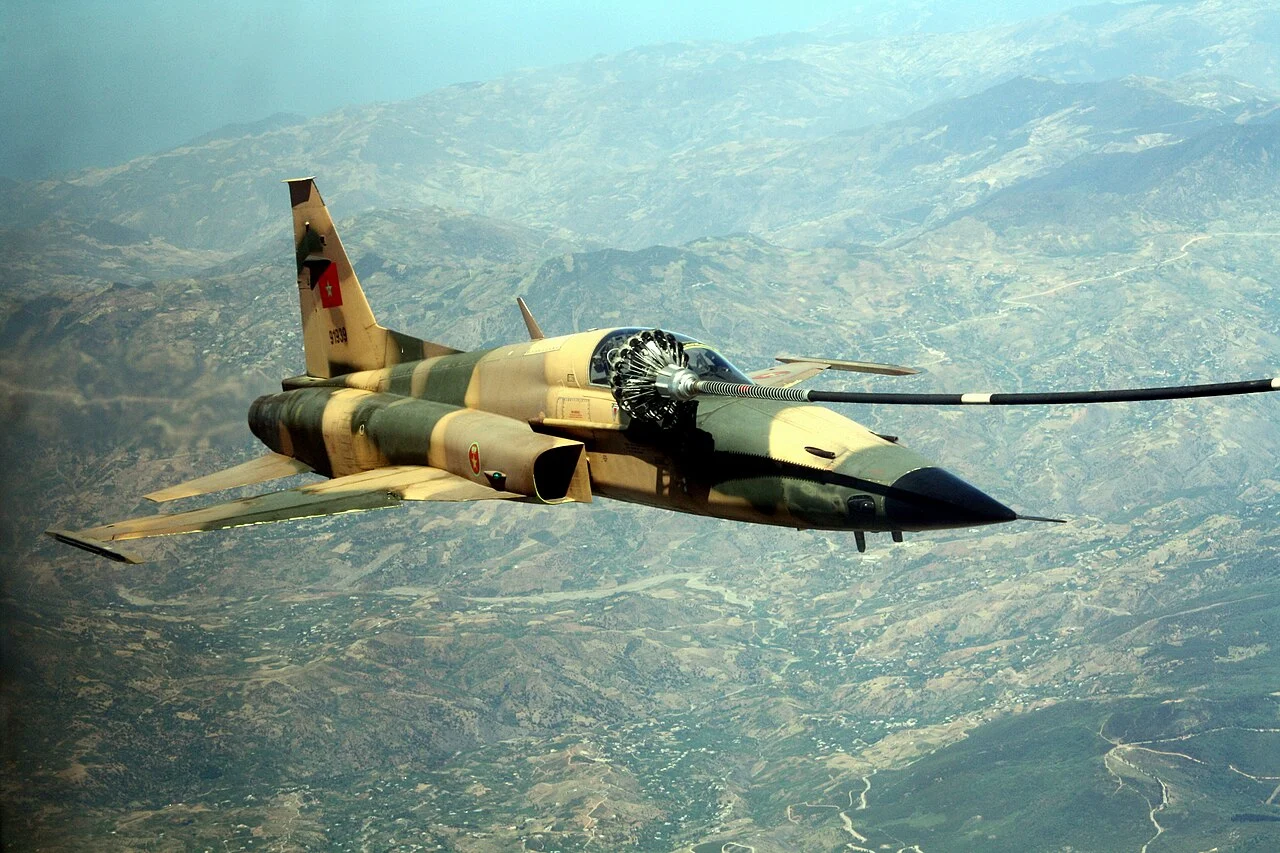
Morocco’s F-5 fleet dates to US Foreign Military Sales deliveries that began in the 1970s with early F-5A/Bs and continued into the early 1980s with F-5E/F Tiger IIs, according to Royal Moroccan Air Force history summarised by aviation reference sources. The type was designed as a light, day-visual fighter: a clear-air-mass interceptor with a short-range radar-ranging set rather than a true fire-control radar, armed only with short-range AIM-9 Sidewinder-class missiles and an internal gun. Between 2001 and 2004, SOGERMA of France and Israel’s Elbit Systems/IAI-Lahav division upgraded the fleet to “Tiger III” standard, fitting an Elta EL/M-2032 multimode radar, a hands-on-throttle-and-stick cockpit, a radar warning receiver and new displays, according to a Polish aviation industry report (Altair.com.pl). Even after that upgrade, no public source confirms a beyond-visual-range missile or an AESA radar on the type. Army Recognition reported in 2022 that Morocco was evaluating Elbit’s Delilah cruise missile for the F-5 fleet, confirming the type remained active that year, though no source reviewed here gives a current (2024-2026) squadron strength or retirement date.
Why was replacement or modernization needed?
The F-5 Tiger II’s core limitation is structural as much as technological: a 1960s-design airframe that Morocco has now operated for more than four decades, which even a radar and cockpit upgrade cannot give a beyond-visual-range missile, a modern electronic warfare suite or a datalink of the kind a purpose-built fourth-generation-plus fighter carries from the factory. Morocco had already taken a first step by acquiring F-16C/D Block 52 Vipers in the 2000s: Lockheed Martin confirmed the production contract in June 2008 and delivered the first aircraft in August 2011. The 2019 order for 25 further, newer-standard Block 72 jets extended that same logic, giving the air force an AESA-radar fighter in larger numbers, while a parallel $985.2 million notification funded upgrading the roughly 23 already-delivered Block 50/52 jets toward F-16V/Block 52+ standard, Defense News reported in March 2019. No US or Moroccan official statement citing the specific driver for the order’s scale was found in the sources reviewed; some defence commentary links it to the regional air power balance with Algeria’s Su-30MKA fleet, a framing that belongs to that outlet rather than to an official Moroccan statement.
What does the new platform add?
The headline addition is the Northrop Grumman AN/APG-83 Scalable Agile Beam Radar, an active electronically scanned array set that Lockheed Martin’s product literature says shares software and hardware lineage with the radars on the F-22 and F-35. An AESA set can track more targets at once, resist jamming more effectively and cue weapons at longer range than the mechanically scanned or ranging-only sets on the F-5. The March 2019 DSCA notification itemised 26 AN/APG-83 radars and 29 F100-PW-229 engines (four spares) for the 25-aircraft buy, per the Federal Register text. Lockheed Martin also offers the Block 70/72 configuration with its Viper Shield internal electronic warfare suite and rates the new-build airframe for a 12,000-hour structural service life. The package includes Link 16 datalink equipment, letting the new jets share a tactical picture with other Link 16-equipped aircraft, something the F-5 cannot do. The specific air-to-air missile Morocco selected is not confirmed in the public record; AIM-120 AMRAAM-class weapons are the standard option offered with the APG-83, but no DSCA line item names a variant for this sale, so none is asserted here.
What capabilities remain unchanged?
Morocco is not making a clean-sheet transition to an unfamiliar type. The air force has flown F-16s since 2011, so pilots, maintainers and basing already exist for the same base airframe family; the Block 72s will be integrated alongside, not instead of, the roughly 23 Block 50/52 jets already in service, which are being upgraded under the parallel $985.2 million F-16V notification rather than retired. Aerial refuelling procedures, including the probe-and-drogue method practised during Exercise African Lion with US tankers, carry over from the existing fleet to the new jets. The F-5’s niche as a lower-cost training and secondary-role airframe has also not disappeared outright: Army Recognition’s 2022 reporting on a proposed stand-off weapons upgrade suggests Rabat was still weighing a continued role for the type that year, though no source reviewed here confirms its 2026 status.
Why it matters for Africa
Morocco’s transition is one of the clearest publicly documented examples on the continent of a staged fighter modernization: a visual-range, 1960s-design airframe upgraded twice over four decades before being supplemented, not replaced in a single step, by a purpose-built AESA-radar successor. The approach is relevant to African air forces weighing how far to push legacy Western fighter fleets against committing to a new type: incremental avionics upgrades, as Morocco did with Tiger III, can extend an airframe’s relevance for a decade or more, but cannot substitute for the sensor and networking generation gap that only a new-build platform closes. The scale of Morocco’s commitment, a combined order and upgrade package valued at roughly $4.8 billion across the 2019 notifications, shows how costly that jump is even for one of the continent’s best-funded air forces. It also shows the limits of a single-supplier relationship: Morocco’s F-5 upgrade drew on French and Israeli industrial support despite the airframe itself being American, a pattern of mixed-supplier sustainment common elsewhere on the continent.
Sources
- Defense News, “Morocco cleared for massive F-16 fighter buy,” 25 March 2019
- US Defense Security Cooperation Agency notification, Federal Register, 2019
- Lockheed Martin, announcement of first flight of Morocco’s first F-16 Block 72, 6 October 2026
- The War Zone, “The First F-16 Block 72 Has Flown,” 7 October 2026
- The Aviationist, “Morocco’s First F-16 Block 72 Has Flown,” 7 October 2026
- Lockheed Martin press release, production contract for Morocco’s F-16s, 6 June 2008
- Lockheed Martin press release, first F-16 delivery to Morocco, 4 August 2011
- Army Recognition, on proposed Delilah integration for Moroccan F-5 fighters, 2022
- DefenceMENA, “Morocco’s First F-16 Block 72 Completes Maiden Test Flight in the US”
- DefenceMENA, “Morocco’s F-16 Fleet Explained”
- DefenceMENA, “Algeria’s Su-30MKA Fleet”