


Is Jordan’s Military Financed by Washington More Than It Is Supplied by It?



Jordan flies American F-16s, fields a British-trained army and hosts US Patriot and THAAD batteries that spent much of 2026 shooting down Iranian missiles over its own territory. None of that makes its defence dependency simple — because the deepest dependency is not a platform at all, it is a cheque.
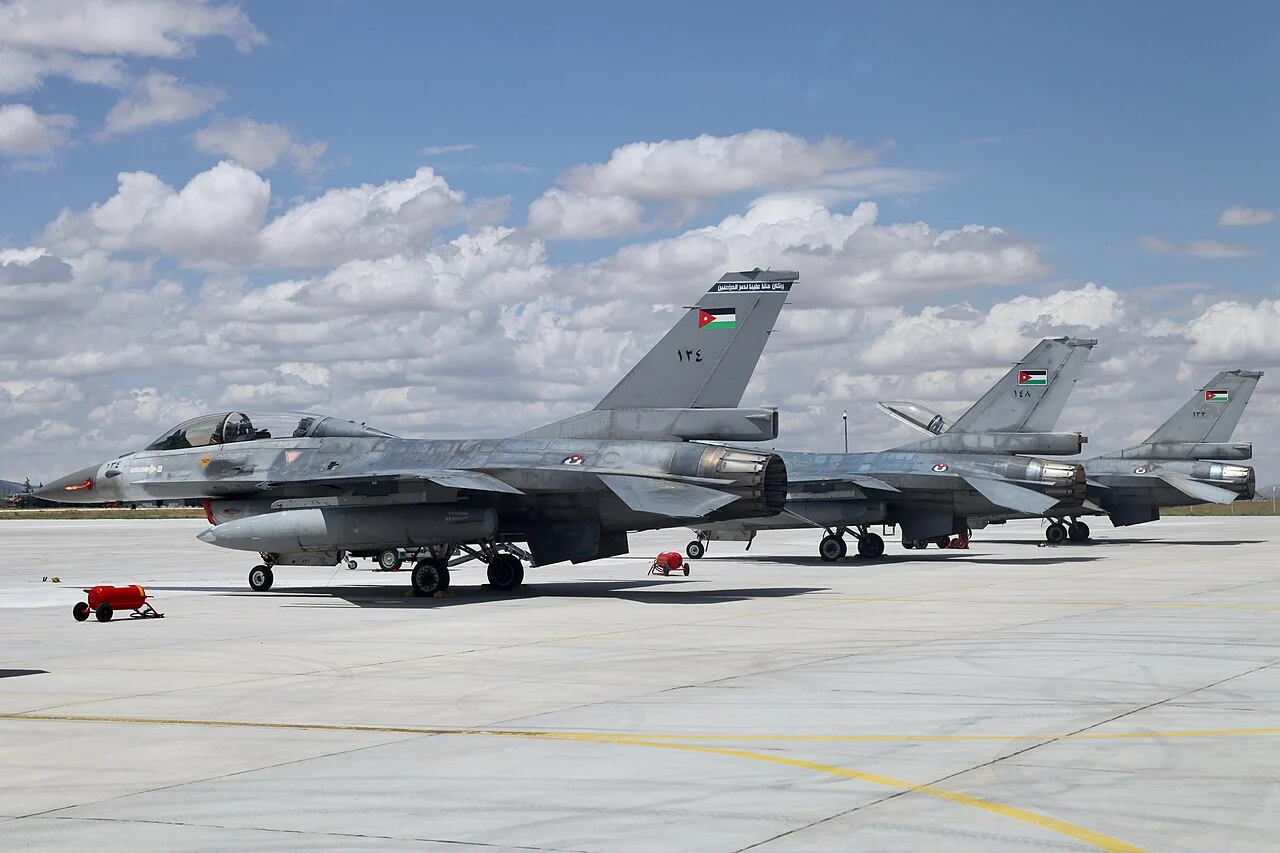
Photo: Royal Jordanian Air Force F-16s at Konya Air Base, Türkiye, during Anatolian Eagle 2022. Credit: Colin Cooke Photo, CC BY-SA 2.0, via Wikimedia Commons
- Jordan’s defence relationship with Washington runs on money as much as metal: State Department Foreign Military Financing (FMF) has run at roughly $425 million a year under a 2022 bilateral agreement covering FY2023-FY2029, with cumulative US assistance since independence put at about $33.8 billion by the Congressional Research Service.
- The Royal Jordanian Air Force’s most capable jets — a dozen Lockheed Martin F-16 Block 70s carrying Northrop Grumman’s APG-83 SABR AESA radar — were ordered, in large part, with that same US financing, not national procurement budgets.
- During the 2026 Iran war, projectiles aimed at US and allied facilities on Jordanian soil were intercepted mainly by US-operated Patriot and THAAD batteries, not by any Jordanian-owned long-range air-defence system — Jordan has none.
- The King Abdullah II/Jordan Design and Development Bureau (JODDB) gives Jordan a genuine, if narrow, domestic industrial base in small arms, light ammunition and armoured-vehicle assembly, built up since 1999.
- Jordan carries essentially no CAATSA exposure — it operates no significant current Russian-origin combat systems — but its exposure to US domestic politics, via annual appropriations fights, is arguably a sharper and more immediate risk than sanctions law.
- The country’s Defence Autonomy Index score is among the lowest yet assessed in this series, reflecting a security relationship built less on diversified sourcing than on sustained external subsidy.
A military financed more than it is bought
Most entries in this series start with a supplier-share table drawn from SIPRI’s Arms Transfers Database. Jordan resists that framing, because so much of its force structure was not purchased in the ordinary sense — it was granted, financed or donated. The US-Jordan bilateral framework, renewed in 2022 for FY2023-2029, sets an annual target of roughly $1.45 billion in combined economic and military assistance, subject to congressional appropriation each year. Of that, Foreign Military Financing — grant funding that Jordan then spends, largely with US contractors, on US-origin equipment — has run near $425 million annually in recent years, according to the US Commerce Department’s country guide and Congressional Research Service reporting. A January 2026 CRS update on US-Jordan relations records total bilateral assistance since the relationship began at about $33.8 billion across State and Defense accounts, and notes that a House move to cut up to $500 million from support for Jordan’s armed forces in the FY2026 defense appropriations bill was defeated by a wide 30-400 margin — a sign of how little domestic US appetite exists for reducing the relationship, even amid broader aid-budget scrutiny.
That financing, not an independent defence budget, is what pays for Jordan’s most visible modernisation: the Royal Jordanian Air Force’s contracted batch of Lockheed Martin F-16 Block 70 aircraft, fitted with the AN/APG-83 Scalable Agile Beam Radar built by Northrop Grumman, AN/AAQ-33 Sniper targeting pods, Link 16 datalinks and JDAM-capable weapons integration, per the original State Department notification and subsequent reporting by Jane’s and AIN Online. Jordan’s own letter of offer and acceptance has moved between eight and twelve aircraft across different reports since 2022 — treat the exact tranche size as unresolved pending a clear delivery announcement — but the pattern is consistent: a US-financed, US-built, US-controlled fighter upgrade layered onto an air force whose older F-16 A/B/C/Ds (several tranches since the 1980s) already depend on the same supply chain for spares, software updates and mission-data loads.
| Capability | Main supplier | Dependency level | Main risk | Alternative |
|---|---|---|---|---|
| Fighter aircraft | United States (Lockheed Martin F-16, multiple tranches) | High | FMF-funded acquisition, ITAR-controlled software/mission data, single-type fleet since Mirage F1 retirement (2010) | None fielded; a second Western type would duplicate training, munitions and basing costs with no financing mechanism in sight |
| Air defence | United States (Patriot/THAAD, US-operated); legacy I-Hawk (ageing) | High | Jordan owns no modern long-range SAM battery of its own; 2026 interceptions were performed by US CENTCOM-operated systems defending US-used bases | Domestic procurement of Patriot or an equivalent (NASAMS, Turkish Hisar) would require financing Jordan does not currently have earmarked |
| Tanks/armour | United Kingdom (retired Challenger 1), Netherlands (Leopard 1 recovery vehicles) | Medium | Challenger 1 fleet fully retired by 2023 with no confirmed like-for-like replacement; armour inventory is ageing and multi-sourced | Surplus Leopard 2 or M1 variants from European or US stocks, subject to financing and delivery timelines |
| Helicopters | United States (Bell-designed AH-1F/S Cobra, UH-60 Black Hawk) | High | Core attack-helicopter fleet includes airframes donated secondhand (16 ex-Israeli Air Force Cobras, 2015, US-approved and US-funded overhaul) and modernised by a US contractor rather than built new | Limited; Jordan’s helicopter fleet composition reflects donation availability more than open competition |
| Naval systems | Mixed Western (small coastal/patrol fleet, Aqaba-based) | Medium | Small, lightly armed force; limited independent sustainment capacity | Modest — fleet size limits the stakes of any single supplier relationship |
| UAVs | Emerging/limited — mostly US and allied-origin reconnaissance types; no confirmed large armed-drone programme | Medium | Jordan has not published a comparable armed-UAV procurement to neighbours’ Bayraktar or CH-4 fleets; capability gap relative to regional peers | Turkish (Bayraktar/Aksungur), Chinese (Wing Loong/CH-4) or domestic KADDB-line development, none yet confirmed at scale |
| Missiles/munitions | Mixed — JODDB/JAWS for small-calibre and light ammunition; United States for guided munitions, JDAM kits and air-defence interceptors | High (for precision/guided stocks) | Local capacity covers bullets and some artillery/tank ammunition; JDAM kits, Patriot/THAAD interceptors and guided air-to-ground weapons are entirely foreign-supplied and, per a July 2026 CSIS study cited by Militarnyi, part of a US interceptor stockpile reported to have fallen below 1,000 Patriot rounds amid the Iran war | Co-production agreements would require technology transfer Jordan has not yet secured for guided munitions |
Dependency levels are DefenceMENA’s editorial assessment based on the sources listed below, not an official rating.
Dependency by category
Platform. The air force is effectively a single-type fast-jet fleet: F-16s of varying blocks, after the 2010 retirement of the Mirage F1 fleet that had served since 1981. That concentration simplifies training and logistics but means any disruption to the F-16 supply chain — spares, software, munitions clearance — has no fallback type to absorb it.
Engine. F-16 powerplants (Pratt & Whitney F100 or General Electric F110, depending on block and tranche) are American, sustained through the same Foreign Military Sales channel as the airframes; Jordan has no domestic jet-engine overhaul capacity for fast jets.
Weapons/munitions. This is where Jordan’s dependency structure is least like its Gulf neighbours’. JODDB’s ammunition plant, expanded under a 2019 agreement with an international partner, targets production of up to 30 million rounds of light ammunition annually and covers a meaningful share of small-arms and some artillery/tank ammunition needs. But precision-guided munitions — JDAM tail kits for the F-16, and any Patriot or THAAD interceptors used on Jordanian soil — are entirely US-supplied, consumed from a global stockpile that outside analysis (a CSIS study reported via Militarnyi in July 2026) described as under strain after sustained use during the 2026 Iran war.
Sensor. The APG-83 SABR radar on the newer F-16s, and the AN/TPY-2 radar associated with THAAD batteries on Jordanian territory — one of which was reported destroyed in March 2026 and subsequently replaced by US forces — are both Northrop Grumman/US-government systems operated and sustained outside Jordanian national control.
Software. Mission data, radar warning libraries and Link 16 datalink configuration for the F-16 fleet are managed through the US Foreign Military Sales process, meaning software-level sovereignty over the RJAF’s premier combat aircraft remains limited, consistent with how most FMS F-16 operators function worldwide.
Maintenance. A 2026 Foreign Military Sale case, approved under emergency authority (bypassing the standard congressional notification window) for roughly $70.5 million, covers F-16, F-5 and C-130 aircraft support and spare parts — a reminder that sustainment, not just acquisition, runs through Washington. Jordan’s AH-1F Cobra modernisation was likewise performed by Science & Engineering Services of Huntsville, Alabama, not a domestic depot.
Political. Every major platform above is either FMS-delivered or FMF-financed, which means Jordan’s force readiness is tied to the annual US congressional appropriations cycle — a dependency that is renewed (so far reliably) rather than resolved. The failed House attempt in the FY2026 cycle to cut up to $500 million from support for Jordan’s armed forces illustrates both the risk and, given its 30-400 defeat, the durability of bipartisan support to date.
Industrial. JODDB/JAWS covers a genuine slice of small-arms and light-ammunition demand and has pursued export sales to dozens of countries historically, but by its own officials’ acknowledgement its weakest point is electronics, sensors and systems integration — precisely the categories where Jordan’s most capable platforms depend on foreign suppliers.
Sanction and export-control exposure
Jordan is close to a clean case on CAATSA: it fields no significant current-generation Russian combat system comparable to Algeria’s Su-30/S-400 inventory or Egypt’s shelved Su-35 deal, so Countering America’s Adversaries Through Sanctions Act exposure is minimal as things stand. Its real exposure runs through ordinary ITAR and FMS mechanics rather than sanctions law: end-use monitoring on US-origin systems, congressional notification requirements for new sales (waived in 2026 for the emergency F-16/F-5/C-130 support case, a signal of urgency rather than routine), and the broader reality that a large share of the force is only operational because FMF financing keeps being appropriated. The clearest 2026 illustration of this dependency was not a sanctions dispute but a battlefield one: when Iran struck US-used bases in Jordan between February and September 2026, the systems that intercepted the bulk of the incoming fire — Patriot and, at peak intensity, THAAD, with the Wall Street Journal reporting 60-70 Patriot interceptors and more than a dozen THAAD interceptors fired in a single engagement on 9 September — were American-operated, not Jordanian-owned. Jordan’s own air force and air-defence units are confirmed in several reports to have intercepted additional projectiles, but the heaviest, most capability-intensive layer of the defence was supplied, crewed and restocked from outside the country entirely.
Local industry and what it can take over
JODDB (formerly KADDB), established in 1999, is a real industrial achievement by regional standards: its product lines span small arms through its JAWS unit, light and some heavier ammunition, armoured and tactical vehicles, and protective equipment, with a 2015 director-general estimate (now dated, but the most specific public figure available) putting local coverage of Jordanian armed-forces and security equipment needs at 40-70 percent. A 2019 expansion agreement with an international partner aimed to lift the ammunition plant’s capacity toward 30 million rounds a year. What JODDB cannot yet take over is the high end: guided munitions, airborne sensors, radar and the software stacks that run modern fighter and air-defence systems — the officials’ own acknowledged weak spot has historically been electronics, surveillance equipment and systems integration, which still arrive through imports layered onto locally built platforms.
Alternatives
For the fighter fleet, a genuine alternative to continued F-16 dependence would mean a second Western type (a limited Rafale or Eurofighter buy, as Egypt and Qatar have done) or, less likely given training and interoperability ties, a shift toward Korean FA-50/KF-21-family aircraft already being marketed regionally. None has been reported as under negotiation for Jordan. For air defence, the obvious partial alternatives are NASAMS (Norwegian/US, already fielded by several MENA states as a mid-tier layer) or Turkish Hisar-family systems, both of which would still require financing Jordan does not currently have earmarked outside the FMF channel — switching the supplier does not, by itself, solve the funding dependency. For munitions, deeper co-production of guided weapons with either a US or European partner — rather than the current arrangement, where JODDB covers unguided ammunition and the US covers precision weapons — would be the most direct way to close the gap, but no such agreement has been publicly reported.
Switching cost
Jordan’s switching cost is less about hardware and more about the financing architecture itself. Moving away from a largely FMF-funded force would mean either a national defence-budget increase Jordan’s economy is not well positioned to absorb, or renegotiating the entire 2022-2029 bilateral framework — a political undertaking with no obvious trigger. At the platform level, a second fighter type would require a new maintenance ecosystem, a new munitions family, new pilot and groundcrew training pipelines, and new basing/hangar infrastructure, all layered on top of — not replacing — the existing F-16 fleet’s sunk costs in spares, simulators and qualified personnel. Air-defence diversification carries a parallel cost: NASAMS, Hisar or any other system would need its own radar, fire-control and IFF integration with Jordanian and allied networks, built from zero rather than inherited from an existing inventory.
Diversification: what financing solved, and what it complicated
Jordan has pursued a narrower kind of diversification than Egypt’s multi-supplier model: rather than spreading platform purchases across many countries, it has layered a domestic industrial niche (JODDB/JAWS ammunition and light vehicles) underneath an almost entirely US-financed, US-sourced top end (fighters, precision munitions, air defence), with secondary UK and Dutch contributions to the now-retired or support-role armour fleet. That approach solved a real problem for a country whose overall order of battle this site has mapped separately — Jordan could not otherwise afford a modern air force or sustained ammunition supply at all — but it complicated strategic autonomy in a different way than diversification elsewhere in the region: Jordan is not juggling incompatible logistics chains from seven suppliers the way Egypt is, it is simply reliant on one funding relationship holding steady year after year, with the 2026 congressional near-miss on aid cuts as a reminder of how that reliance can become visible with little warning.
DefenceMENA Autonomy Index
| Criterion | Weight | Score | Justification |
|---|---|---|---|
| Domestic manufacturing | 20 | 8 | JODDB/JAWS produce small arms, light ammunition and some vehicles; no fighter, radar or air-defence manufacturing |
| Local maintenance | 15 | 3 | Core F-16, Cobra and air-defence sustainment runs through US contractors (SES, FMS support cases) rather than Jordanian depots |
| Local ammunition | 15 | 6 | Meaningful light/small-calibre coverage (up to 30 million rounds/year target); guided munitions and interceptors fully imported |
| Supplier diversification | 15 | 3 | Overwhelmingly US-centric across fighters, financing, air defence and maintenance; UK/Dutch armour contributions are legacy or support-role only |
| Critical components | 15 | 2 | Radar, mission software, guided-weapon seekers and air-defence interceptors are entirely foreign-sourced |
| Technology transfer | 10 | 3 | JODDB operates largely on licensed assembly and joint ventures rather than deep technology transfer in high-end systems |
| Export-control exposure | 10 | 4 | Minimal CAATSA risk (little Russian equipment), but very high practical exposure to US congressional appropriations and ITAR/FMS conditions |
Total: 29/100. DefenceMENA editorial analytical index, not an official ranking.
Why it matters for the MENA region
Jordan is a useful corrective to the assumption that defence dependency is mainly a hardware story. Its F-16s, Cobras and the Patriot/THAAD batteries that shielded US-used bases through the 2026 Iran war are all American, but the deeper structural fact is that Jordan’s entire force posture rests on a financing relationship renewed year to year by a foreign legislature. That is a different — and in some ways more exposed — kind of dependency than Egypt’s multi-supplier juggling act, Morocco’s three-state balancing or the single-supplier platform concentration this series has examined in Saudi Arabia, the UAE, Qatar and Iraq: Jordan cannot easily diversify its way out of a funding dependency the way it might diversify away from a single arms supplier, because the alternative to US financing is not another supplier, it is a defence budget Jordan would have to build largely on its own.
Sources
- Congressional Research Service, “Jordan: Background and U.S. Relations,” 8 January 2026
- US International Trade Administration, Jordan Country Commercial Guide
- Washington Institute for Near East Policy, analysis of Jordan FMF appropriations
- Janes, “Jordan signs LOA for F-16 Block 70s”
- AIN Online, “Jordan Buys AESA-equipped F-16 Fighters,” 19 June 2022
- Overview of the Jordan/King Abdullah II Design and Development Bureau (JODDB/KADDB)
- The War Zone, on Jordan’s AH-1F Cobra modernisation by Science & Engineering Services
- Army Recognition, on Israel’s 2015 donation of 16 AH-1F Cobras to Jordan, US-approved and US-funded overhaul
- Overview of the 2026 Iranian strikes on US-used bases in Jordan, with dates and intercept figures
- Militarnyi, “USA Used More Than 60 Patriot Missiles to Repel Iranian Attack,” citing a CSIS interceptor-stockpile study, September 2026
- Defense News, “Jordan asks US to deploy Patriot air defense systems,” 30 October 2023
- GlobalSecurity.org, Royal Jordanian Air Force equipment and modernisation history


