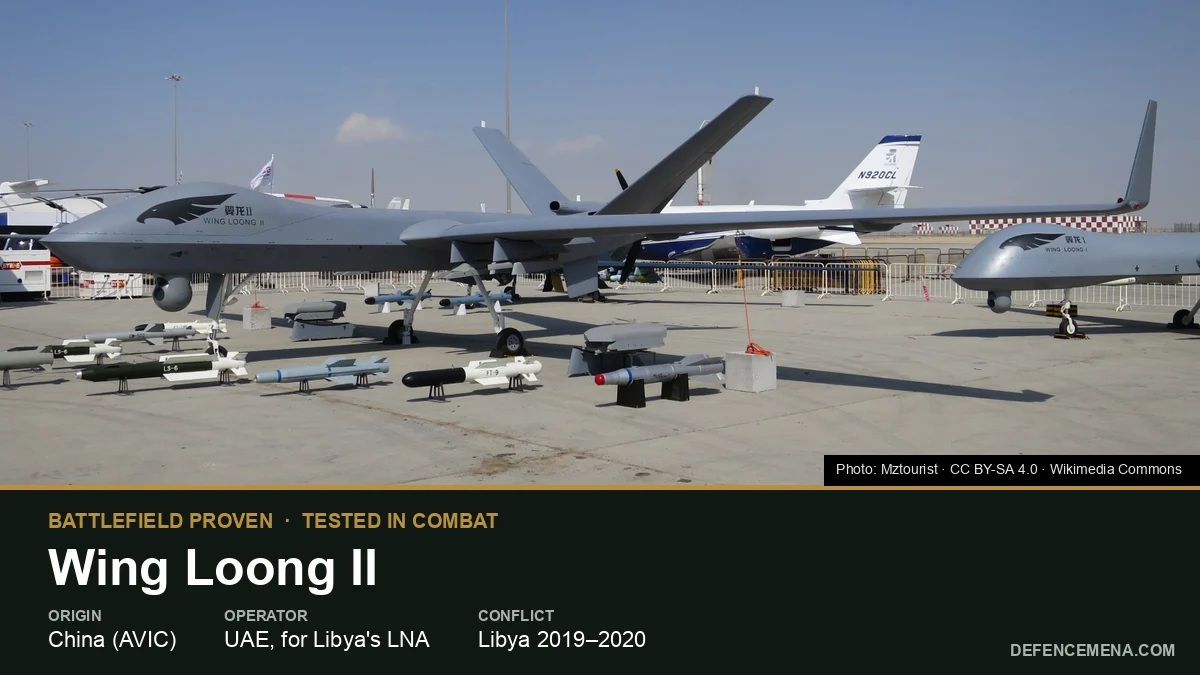
The Wing Loong Libya record is one of the best-documented combat histories of any Chinese armed drone, but it is not a Libyan story. UN investigators found that the Wing Loong II aircraft striking targets across Libya in 2019 and early 2020 were supplied, maintained and operated by the United Arab Emirates in support of Khalifa Haftar’s Libyan National Army (LNA). The evidence shows a long-range, heavily armed drone that gave one side a strike advantage for about a year, lost airframes once air defences thickened, and was moved across the border as the Tripoli offensive failed.
Photo: A Wing Loong II at the 2017 Dubai Airshow. The UN found the type was supplied to and operated by the UAE in Libya. Credit: Mztourist, CC BY-SA 4.0, via Wikimedia Commons. Credit: Mztourist, CC BY-SA 4.0, via Wikimedia Commons.
Direct answer
For most of 2019 the Wing Loong II did what its operator needed: the UN Panel of Experts found it could reach all of Libya over a satellite link, carried far more ordnance than the opposing drones and gave the LNA side its only precise night-strike capability. The UN and the BBC also linked it to strikes that killed civilians and unarmed cadets. Documented losses rose from late 2019 as the Government of National Accord (GNA) and Turkey added air defences, and in February 2020 at least nine aircraft were moved to Egypt. Because the operator was the UAE, the record says little about how the drone performs in national African service.
| System | Wing Loong II medium-altitude long-endurance (MALE) armed drone; Wing Loong I also present from 2016 |
| Manufacturer | Chengdu Aircraft Industry Group (AVIC); exported through CATIC |
| Origin | China |
| Operator(s) in this conflict | United Arab Emirates, in support of the LNA (UN Panel of Experts finding); aircraft were not an LNA purchase |
| Main munition | Blue Arrow 7 (BA-7) laser-guided air-to-surface missile |
| Period | Wing Loong I at Al Khadim from at least June 2016; Wing Loong II strikes documented from April 2019; transfer out of Libya from February 2020 |
| Evidence level summary | Basing, munitions, supplier: UN findings. Strikes: UN remnant analysis, BBC investigation. Losses: open-source visual documentation. Sorties and fleet size: not publicly disclosed. |
Where was it used?
The UN Panel of Experts, citing Janes, recorded a UAE Wing Loong I at Al Khadim air base in eastern Libya from at least 24 June 2016. Its December 2019 report (S/2019/914) said the whole series had been supplied to the UAE after 2011 and that it had not established when the Libyan fleet moved to the Wing Loong II.
After Haftar’s forces attacked Tripoli in April 2019, the Wing Loong II became the LNA side’s main long-range strike asset. The Panel linked Blue Arrow 7 missile remnants to strikes on Tripoli’s southern approaches between 20 and 25 April 2019, cited satellite imagery of Wing Loong IIs at Jufra air base in August and September 2019, and attributed the August 2019 strikes on Murzuq in the south-west to the same type. The BBC reported that by January 2020 the aircraft flew from one Libyan base only, Al Khadim. Our overview of the UAE’s armed forces covers the wider inventory behind the deployment.
What was the mission?
Strike and surveillance in support of LNA ground operations, mainly around Tripoli. In the Murzuq case the UN found the strikes were planned and directed by the LNA and executed by a member state acting in its direct operational support.
The Panel said the aircraft was flown over a satellite data link covering the whole country, could deliver more than eight times the explosive payload of the GNA side’s drones, and was the LNA side’s only asset able to strike precisely at night. Its Blue Arrow 7 laser-guided missile was, according to Janes as cited by the Panel, in operational use only in China, Kazakhstan and the UAE.
What does the public evidence show?
The evidence comes from UN sanctions investigators, a BBC investigation and open-source imagery. The operator never published its own record.
| Claim / event | Date | Evidence level | Source |
|---|---|---|---|
| UAE Wing Loong I based at Al Khadim air base | From at least 24 June 2016 | Confirmed (UN finding, citing Janes) | UN Panel of Experts, S/2019/914, para. 108 |
| Blue Arrow 7 remnants recovered after strikes on Tripoli’s southern approaches | 20–25 April 2019 | Confirmed (UN remnant analysis) | S/2019/914, paras. 108–109 |
| Crashed Wing Loong II found with five BA-7 missiles near Abu Ghrayn | 3 August 2019 | Visually documented; confirmed by UN | S/2019/914, para. 109 and annex 47 |
| Murzuq air strikes; aircraft “almost certainly” a Wing Loong II flown by a member state | 5 August 2019 | UN finding | S/2019/914, annex 16 |
| Wing Loong II imaged at Jufra air base | 28 August and 19 September 2019 | Visually documented (satellite imagery cited by UN) | S/2019/914, figures V–VI |
| UAE in non-compliance with the arms embargo for transferring Wing Loong II and BA-7 to Libya | December 2019 | UN finding; denied by UAE in general terms | S/2019/914, para. 110 |
| Drone strikes in support of the LNA “well above 800” since April 2019 (all types, not only Wing Loong) | 18 November 2019 | Officially claimed (UN mission estimate) | UNSMIL briefing to the Security Council |
| Tripoli military academy hit by a BA-7 from a Wing Loong II based at UAE-run Al Khadim | 4 January 2020 | Independently reported (BBC); LNA denied; UAE did not respond | BBC Africa Eye / BBC Arabic, August 2020 |
| At least nine Wing Loong II moved from Al Khadim to an air base in Egypt | 10 February 2020 | UN finding; BBC satellite analysis | UN Panel of Experts, S/2021/229; BBC |
| Eight Wing Loongs downed or crashed in Libya in the first half of 2020 | January–June 2020 | Visually documented (open-source compilation) | Drone Wars UK, July 2020 |
For the academy strike, the BBC matched shrapnel to a Blue Arrow 7 and found the Wing Loong II was the only aircraft over Tripoli able to fire it. The UN Panel’s 2021 report, citing a GNA health ministry figure of 30 dead (other sources give 26), found the attack almost certainly violated international humanitarian law.
What worked?
By the UN Panel’s account the Wing Loong II delivered the capability it was sent for. Its 2021 report said the drone, with LNA jets and attack helicopters, gave Haftar’s forces local air superiority over most of Libya at the end of 2019. Satellite control meant one aircraft type could strike over Tripoli and Murzuq, more than 700 km apart, and the Blue Arrow 7 pairing hit the targets the UN examined in April and August 2019. The LNA did not have to sustain any of this itself: on the UN’s findings, the supplying state handled basing, maintenance and munitions.
That success came mostly against limited air defence. Our TB2 vs Wing Loong II vs CH-4 comparison sets out how the designs differ on payload and range.
What problems appeared?
Attribution. Because the Blue Arrow 7 was paired only with the Wing Loong II in Libya, recovered fragments pointed to one aircraft type and one supplier. The UN used that chain to find the UAE in breach of the arms embargo; the BBC used it for the academy strike.
Civilian harm. The UN attributed the 5 August 2019 Murzuq strikes, with 42 dead according to hospital records, to a Wing Loong II flown by a member state for the LNA, and said that state had highly probably violated international humanitarian law. This reflects the operator’s targeting, not the airframe.
A tougher threat environment. After the Turkey–GNA military cooperation agreement of 27 November 2019, the UN recorded Turkish frigates offshore and surface-to-air systems around Tripoli and Misrata. Documented Wing Loong losses rose over the following months.
Confirmed losses and limitations
There is no official loss figure; the UAE has never acknowledged operating the aircraft. What exists:
- UN-confirmed: one Wing Loong II crashed near Abu Ghrayn on 3 August 2019 with five Blue Arrow 7 missiles nearby. The UN did not state the cause.
- Claimed: the GNA announced several shoot-downs around Misrata and elsewhere in 2019 and 2020, reported by Military Africa among others; not all were independently verified.
- Aggregated visual documentation: Drone Wars UK counted eight Wing Loongs downed or crashed in the first half of 2020, using only photo, video or reliably sourced cases. defenceWeb in 2024 put the war total at “at least ten”, citing ground fire, air strikes and friendly fire.
Fleet size is not established: the BBC cited an arms registry showing 15 Wing Loongs bought by the UAE in 2017, and the UN recorded at least nine moved out in February 2020. The counts may mix Wing Loong I and II airframes, and without sortie numbers no attrition rate can be calculated. For context, the same Drone Wars UK compilation recorded 16 Turkish-supplied TB2s lost on the GNA side in those six months, which reflects how dense air defences had become on both sides rather than a weakness of either design.
What is still disputed?
- Who flew the aircraft. A UN annex lists the Wing Loong IIs as maintained and operated by the UAE, and the BBC reached the same conclusion. The UAE denies military involvement in Libya.
- The academy strike. The BBC attribution rests on fragment and basing evidence; the LNA blamed local shelling and the UAE did not respond.
- Flights after February 2020. Losses were still documented over Libya after the reported move to Egypt; public evidence does not show where those sorties launched from.
- The 2024 Italian seizure. Drones disguised as wind-turbine parts and bound for Benghazi were seized in Italy in June 2024. Early reports called them Wing Loongs; Janes, cited by defenceWeb, identified them as Fei Long-1s from another Chinese maker.
Did the manufacturer or operator change anything?
The clearest change was the operator’s. The UN Panel’s 2021 report says at least nine Wing Loong IIs were transferred from Al Khadim to Uthman air base in Egypt on 10 February 2020, a further embargo violation; the BBC placed the aircraft at a base near Siwa. After the LNA lost Al Watiyah air base on 18 May 2020 and withdrew from the Tripoli front in June, the strike campaign faded. No public evidence reviewed here shows UAE Wing Loong II operations in Libya after 2020.
AVIC has kept developing and marketing the family, but has made no public statement linking design changes to Libya.
Did other countries buy it afterwards?
African orders continued, but none can be tied directly to Libya; buyers pointed to counter-insurgency and surveillance needs. The full list is on our page on which African countries operate the Wing Loong, and the wider pattern in why African countries buy Chinese drones.
| Country | Variant | Year | Status | Source |
|---|---|---|---|---|
| Egypt | Wing Loong I | 2016 | Operational | Oryx |
| Egypt | Wing Loong 1D (32 reported) | 2018 order reported | No delivery evidence found | Army Recognition; Oryx |
| Nigeria | Wing Loong II | First delivery November 2020; more reported 2023 | Operational | The Defense Post; Janes; Army Recognition |
| Algeria | Wing Loong II (24 reported ordered) | Order reported 2021; seen May 2023 | Operational | Hespress, citing satellite imagery |
| Ethiopia | Wing Loong I | 2021 | Operational | PAX |
| Morocco | Wing Loong I (reportedly from the UAE); Wing Loong II | 2020; 2022 | Delivered; no official commissioning statement | Hespress; The Defense Post |
| Côte d’Ivoire | Wing Loong II (2) | Contract June 2024; shown August 2026 | Operational | Military Africa |
| DR Congo | Wing Loong II (3) | Talks reported 2025 | No signed contract found | Military Africa |
Nigeria has the clearest public combat record: the Nigerian Air Force assigned its Wing Loong IIs to the banditry-hit north-west and later released strike footage attributed to the type. See also Côte d’Ivoire’s Wing Loong II confirmation and which African countries operate the CH-4.
What does this mean for African procurement?
Libya shows the fully supported upper bound. The UAE brought satellite communications, trained crews, maintenance and munitions, and flew from a base it controlled. An African air force has to build all of that itself.
Satellite links and munitions decide reach. Buyers should confirm whether satellite communications are in the package, who provides the bandwidth, and how many missiles come with the aircraft.
Air defence changes the picture. MALE drones suit counter-insurgency against lightly armed groups and are more exposed where an opponent fields surface-to-air systems. Our survey of counter-drone systems in African service shows how fast such defences are spreading.
Attribution is lasting. Distinctive munitions let investigators trace strikes to a supplier, so targeting rules and legal review matter as much as the aircraft.
Judge on use, not origin. Libya supports neither a claim that Chinese drones are unreliable nor that they are invincible. See our guide to military drones operated across Africa.
Battlefield file: 7 cards
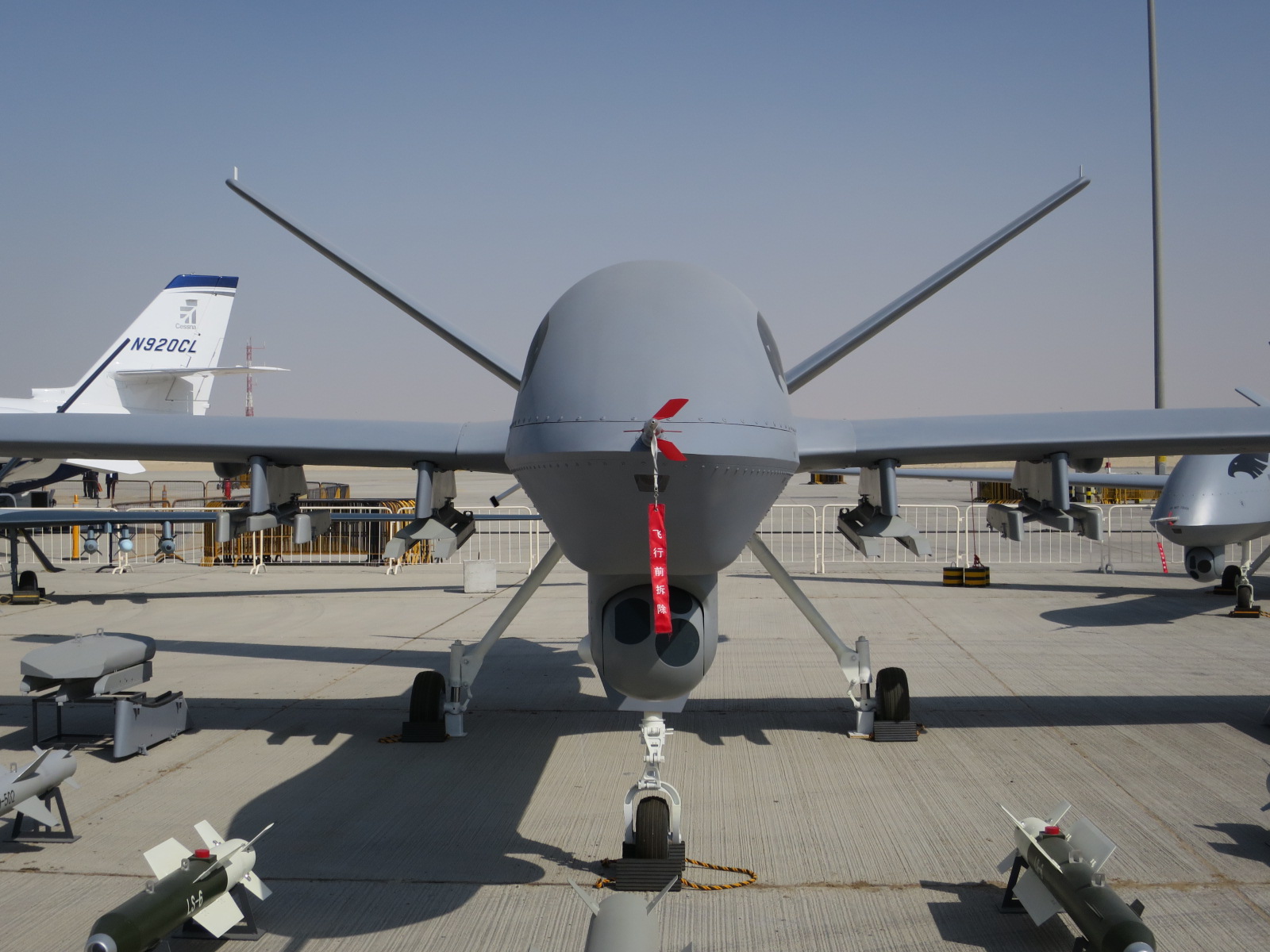
A MALE armed drone flown in Libya with Blue Arrow 7 laser-guided missiles. The UN found it was satellite-controlled with country-wide reach.
Strikes around Tripoli, Jufra and Murzuq in 2019–2020, flown from Al Khadim air base in the east, which the UN and BBC said was UAE-run.
The UN found strikes were planned by the LNA and executed by a member state, giving Haftar’s forces a precision night-strike capability.
Blue Arrow 7 remnants tied strikes to the Wing Loong II, including the 4 January 2020 Tripoli military academy strike, as reported by the BBC.
Drone Wars UK counted eight Wing Loongs downed or crashed in the first half of 2020; fleet size and sortie numbers are not disclosed.
The UN recorded at least nine aircraft transferred from Al Khadim to an Egyptian air base; no UAE Wing Loong II activity in Libya was documented after 2020.
Nigeria, Algeria, Morocco and Côte d’Ivoire now fly the Wing Loong II. Satellite links, munitions and air-defence threats will shape their results more than Libya does.
FAQ
Wing Loong Libya: who actually flew the drones?
The UN Panel of Experts found the UAE transferred the Wing Loong II to Libya and listed it as maintained and operated by the UAE, flying from Al Khadim air base in support of Haftar’s LNA. The UAE has denied military involvement in Libya.
What did the Wing Loong 2 do in Libya?
It flew strike and surveillance missions for the LNA side from 2019 to early 2020, mainly around Tripoli, using Blue Arrow 7 guided missiles.
Was the Wing Loong shot down in Libya?
Yes, several were lost. The UN confirmed one crash in August 2019, and Drone Wars UK documented eight Wing Loongs downed or crashed in the first half of 2020. No official total exists.
Did a Wing Loong II strike the Tripoli military academy?
A BBC Africa Eye investigation concluded that a Blue Arrow 7 missile fired by a UAE-operated Wing Loong II killed the cadets on 4 January 2020. The LNA denied responsibility and the UAE did not respond.
Which African countries operate the Wing Loong II?
Nigeria, Algeria and Côte d’Ivoire have documented Wing Loong II service, and Morocco has received the type. Egypt and Ethiopia fly the earlier Wing Loong I.
Does Libya prove the Wing Loong II is a good drone?
It shows the drone performed well in uncontested airspace with a well-resourced operator and lost aircraft as air defences grew. It does not settle how it performs for African air forces.
Sources
- UN Security Council, Final report of the Panel of Experts on Libya, S/2019/914 (9 December 2019)
- UN Security Council, Final report of the Panel of Experts on Libya, S/2021/229 (8 March 2021)
- UNSMIL, SRSG Ghassan Salamé briefing to the Security Council (18 November 2019)
- BBC News, UAE implicated in lethal drone strike in Libya (28 August 2020)
- Middle East Eye, UAE involved in drone strike that killed 26 Libyan cadets: report
- Drone Wars UK, Libyan war sees record number of drones brought down to earth (1 July 2020)
- Military Africa, Libya: Wing Loong II UCAV shot down by GNA (August 2019)
- defenceWeb, Italy intercepts Chinese UAVs being smuggled to Libya (2024)
- The War Zone, drones disguised as wind turbine parts seized by Italy (3 July 2024)
- Armada International, Wing Loong II: market success and a tougher test in the field (August 2026)
- The Defense Post, Nigeria takes delivery of Chinese drones (10 November 2020)
- Janes, Nigeria receives Wing Loong II UAVs from China
- Army Recognition, Nigerian Air Force receives further Wing Loong II drones (2023)
- Hespress, Algeria tests Chinese Wing Loong II drones (2023)
- The Defense Post, Morocco and Chinese military drones (4 October 2022)
- PAX, Ethiopia now confirmed to fly Chinese armed drones
- Oryx, The Middle East’s game of drones: Egypt’s UAV arsenal (December 2021)
- Army Recognition, Egypt purchased 32 Pterodactyl-1D UAVs (2018)
- Military Africa, Ivory Coast confirms Chinese Wing Loong II drones (August 2026)
- Military Africa, DR Congo acquiring Wing Loong II drones (April 2025)
Evidence note: the Wing Loong II’s operator in Libya never published sortie, strike or loss data, and the UAE denies military involvement. This article relies on UN Panel of Experts findings, a BBC investigation and open-source visual documentation; loss counts are minimums, not totals, and casualty figures are those given by the named sources. This article will be updated at the same URL if significant new evidence appears.