Saudi Arabia spends more on weapons than almost any country on earth, and Vision 2030 has set a target of building half of that spending at home by 2030. The gap between the ambition and the current 15% localisation rate shows how far the kingdom still has to go, and how much of its air force, missile defence and armour still runs on foreign supply chains.
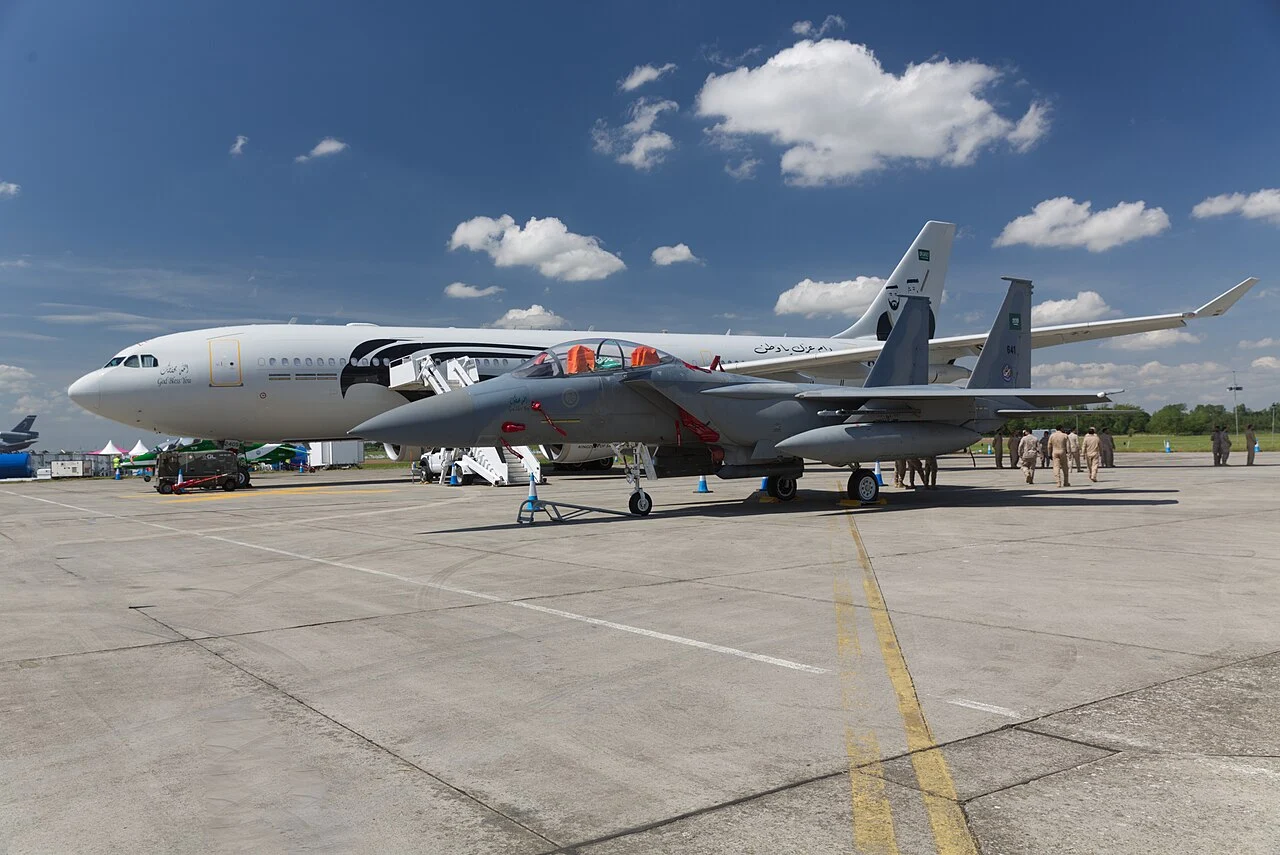
Photo: A Royal Saudi Air Force F-15SA Eagle and A330-202MRTT tanker at RIAT, 2024. Credit: Ronnie Macdonald, CC BY 2.0, via Wikimedia Commons
Key points
- SIPRI data for 2021-25 puts the United States at roughly 75% of Saudi arms imports by trend-indicator value, with France and the United Kingdom making up most of the remainder.
- The State Department approved a potential $24.3 billion sale of 48 F-35s in September 2026, which would make Saudi Arabia the first Arab F-35 operator, though the deal still faces a congressional review and unresolved concerns about Chinese access to the jet’s technology.
- Saudi Arabian Military Industries (SAMI) has reached only around 15% actual localisation against a 2030 target of 50%, even as it opens new subsidiaries for land systems, munitions and autonomous platforms.
- Munitions remain heavily import-dependent: a September 2026 notification alone covers nearly 10,000 JDAM-ER kits and matching bombs, on top of recurring precision-munitions packages tied to the Yemen conflict.
- Riyadh has hedged with Chinese ballistic-missile and drone cooperation for years, which is precisely the kind of relationship Washington cites when it raises technology-security concerns about deeper US arms sales.
The supplier picture: three states, one overwhelming share
Saudi Arabia’s arsenal looks diversified on a map of flags but concentrated on a ledger of dollars. SIPRI’s trend-indicator-value data for 2021-2025 puts the United States at roughly three-quarters of Saudi arms imports, with France in a distant second place and the United Kingdom rounding out the top three; the kingdom was again one of the five largest arms importers in the world over the period, and the single largest destination for US arms exports, absorbing around 12% of all American arms exports in those years. That is a narrower supplier base than it looks from a hardware inventory alone, because the two next-largest relationships, the UK’s Al Yamamah/Salam Typhoon programme and France’s naval and helicopter sales, sit a long way behind Washington in value, not alongside it.
The inventory itself is genuinely spread across sources. The Royal Saudi Air Force operates more than 200 Boeing F-15 variants (the second-largest F-15 fleet after the US Air Force itself), 72 BAE Systems Typhoons delivered under the Al Yamamah and Salam programmes, and a smaller fleet of ageing Panavia Tornados being phased toward retirement. The army runs US-supplied M1A2 Abrams tanks alongside French-origin and other Western armour; air defence rests on US Patriot batteries; the navy is adding French-designed Avante-class corvettes built partly in-kingdom with Navantia technology, plus a pending US frigate package. Layered underneath all of that is a smaller but genuine Chinese track: armed Wing Loong and CH-4 drones bought from 2014 onward, a licensed Wing Loong production line, and a ballistic-missile development relationship that US intelligence has tracked for close to two decades.
| Capability | Main supplier | Dependency level | Main risk | Alternative |
|---|---|---|---|---|
| Fighter aircraft (F-15SA, Typhoon) | United States (Boeing), United Kingdom (BAE Systems) | High | FMS/DCS licensing, engine and software support tied to OEM and government approval | France (Rafale), pending F-35 if approved; no domestic alternative |
| Air defence (Patriot, PAC-3) | United States (Raytheon/Lockheed Martin) | High | Congressional notification and end-use monitoring on every interceptor buy | Limited; some Chinese systems exist but are not integrated into RSAF architecture |
| Tanks/armour (M1A2 Abrams) | United States (General Dynamics), engines via Honeywell | Medium-High | Powerpack and spares remain US-sourced even as hulls age in-country | SAMI Land Co./HEET programme (early stage); French or Korean armour in theory |
| Naval systems | Spain (Navantia design), France, United States (pending frigates) | Medium | Combat-system integration and long-lead components still foreign | Partial localisation already underway via Avante-class local assembly |
| UAVs | China (CASC/CAIG Wing Loong, CH-4), United States (MQ-9 reportedly sought) | Medium | Political friction: Chinese UAV ties feed US technology-security objections to F-35 and other sensitive sales | Domestic SAMI Autonomous Co. programmes still maturing |
| Missiles/munitions (JDAM, PGMs, tank ammunition) | United States (Boeing, Raytheon), with a Saudi-Korean ammunition JV emerging | High | Stock replenishment for precision munitions tracks US congressional and policy decisions on Yemen-linked exports | SAMI-Hanwha Munitions Systems JV (South Korea) for conventional ammunition |
Dependency levels are DefenceMENA’s editorial assessment based on the sources listed below, not an official rating.
Dependence by category: platform is the easy part
Breaking the relationship down by function shows why “diversified” and “independent” are not the same thing.
Platform: the F-15SA and Typhoon fleets are delivered, in-service aircraft, not aspirational orders, and both depend on their respective OEMs for structural life extension and major upgrades. The prospective F-35 sale, if it clears Congress, would add a third Western fighter type rather than replace either of the first two, which is its own kind of dependency: three separate logistics, training and software ecosystems running in parallel.
Engine: Pratt & Whitney supplies the F135 engines named in the F-35 notification, while the F-15SA’s F110 engines and the Typhoon’s EJ200s are similarly Western and non-transferable to Saudi production in the near term. The Abrams fleet’s AGT-1500 gas-turbine engines, covered in the September 2026 notification for 60 replacement units, are built and overhauled by Honeywell in Alabama; no Saudi facility currently produces or majorly overhauls that engine.
Weapons/munitions: this is where the gap between owning a platform and owning its ammunition is starkest. The September 2026 package alone covers roughly 10,000 JDAM-ER guidance kits with matching BLU-111 and BLU-117 bomb bodies, principal contractor Boeing, on top of a $1.96 billion Advanced Precision Kill Weapon System (APKWS) rocket and warhead sale approved in mid-2026 with BAE Systems as contractor. Every large air campaign the RSAF has flown has drawn down a US-replenished stockpile.
Sensor: the Typhoon’s Captor radar and the F-15SA’s AN/APG-63(v)3 AESA radar are both foreign-built and foreign-maintained; Saudi technicians handle organic-level maintenance but depot-level radar and electronic-warfare-suite work still routes through BAE Systems and Boeing-linked supply chains via Advanced Electronics Company (AEC), a joint venture rather than a wholly domestic capability.
Software: mission software, weapons-integration code and data-link protocols for both fighter types are OEM-controlled. Saudi Arabia cannot independently add a new weapon or modify a mission-system function on the F-15SA or Typhoon without vendor and, for the American jet, US government sign-off, because that work touches ITAR-controlled technical data.
Maintenance: this is the category where Saudi Arabia has made the most real progress. Alsalam Aircraft Company runs F-15 airframe maintenance under a five-year, SAR 1.42 billion ($380 million) Royal Saudi Air Force contract and builds F-15SA wings and forward fuselage sections in-kingdom, while Alsalam and BAE Systems jointly operate a Typhoon repair facility, and AEC handles avionics repair transferred from the UK in 2014. Depot-level engine overhaul and the deepest structural work, however, still route back to Boeing and BAE Systems.
Political: every US sale to Saudi Arabia runs through the Arms Export Control Act’s congressional notification process, which has repeatedly produced holds, delayed votes and, historically, actual blocks on offensive-munitions sales tied to the Yemen war. The pending F-35 sale carries an additional layer: US officials and lawmakers have flagged the risk that sensitive F-35 technology could leak toward China given Riyadh’s parallel defence and economic relationship with Beijing, a concern serious enough that it remains unresolved even after State Department approval.
Industrial: SAMI, wholly owned by the Public Investment Fund, reports roughly 15% actual localisation of defence spending against a public 2030 target of more than 50%, with over $10 billion in contract backlog. At the World Defense Show in Riyadh in February 2026 it unveiled SAMI Land Co., SAMI Autonomous Co., a new Al Kharj industrial complex and the domestically-branded HEET vehicle programme, alongside the Sami-Hanwha Munitions Systems joint venture with South Korea’s Hanwha Group for ammunition production.
Sanction and export-control exposure
Saudi Arabia carries none of the CAATSA exposure that shapes Algeria’s or Egypt’s calculus, because it has not fielded major Russian platforms. Its exposure runs almost entirely through the US Arms Export Control Act and FMS process: every significant sale, from the 2026 F-35 notification to the JDAM and Abrams-engine package, requires State Department certification, a congressional notification period, and standing end-use monitoring once delivered. That process has teeth. Congressional Democrats blocked or delayed precision-guided-munitions sales during the Yemen war’s most intense years, and the Biden administration formally paused offensive-capability transfers pending review in 2021. Those precedents mean any future escalation in Yemen, or any perceived diversion of US-origin munitions, is a live risk to future notifications, not a settled matter.
The F-35 case adds a distinct, non-Yemen risk: technology security. US officials have openly linked the jet’s approval to conditions on distancing Saudi-Chinese military-technical cooperation, an echo of the same argument Washington has made to the UAE over its own stalled F-35 ambitions. Riyadh’s parallel track with China, licensed Wing Loong drone production and a long-reported ballistic-missile development relationship, is the specific behaviour that keeps this concern alive even as the kingdom courts the West’s most sensitive aircraft.
Local industry and what it can take over
SAMI’s realistic near-term ceiling is components, sustainment and conventional munitions, not sovereign design of combat aircraft or precision-guided weapons. Alsalam’s F-15 structural work and BAE-AEC’s Typhoon avionics repairs are genuine transfers of depot-level capability that reduce turnaround time and foreign-currency outflow, and the Sami-Hanwha ammunition joint venture should meaningfully cut import dependence for conventional rounds once it reaches volume production. What remains firmly outside Saudi reach for the foreseeable future is engine manufacture, radar and EW-suite production, and any software or mission-system code tied to US or UK export-controlled technical data.
Alternatives
For fighter aircraft, France’s Rafale is the most politically available Western alternative to further US dependence and has already been floated in regional discussions, though it would add a fourth parallel logistics chain rather than consolidate the existing three. Chinese systems, already present in the UAV and missile-development space, offer fewer political strings but come with their own integration costs and are precisely what complicates the F-35 case; a wholesale pivot to Chinese combat aircraft is not realistically on the table given the depth of the US security relationship. For munitions, the Sami-Hanwha joint venture is the most credible near-term diversification, since South Korea supplies technology transfer with fewer of the end-use conditions attached to US sales. None of these options make a “must-buy” case; each trades one dependency for a different one.
Switching cost
Three parallel fighter fleets, or four if the F-35 sale proceeds, is itself the switching cost made visible: pilots, maintainers and simulators exist separately for the F-15SA, Typhoon and any future F-35 force, each with its own munitions-integration profile, data-link standards and basing infrastructure. Alsalam and AEC’s facilities are tooled specifically around Boeing and BAE Systems airframes; retooling for a different OEM’s structural or avionics standards would take years, not a budget cycle. Munitions stockpiles built around JDAM and APKWS cannot simply be replaced by a different supplier’s weapon without new integration and testing on every carrying aircraft. That is the practical reason Saudi Arabia’s diversification, where it happens, tends to add suppliers rather than substitute them.
What diversification solved, and what it complicated
Layering the UK Typhoon programme onto the US-built F-15 fleet decades ago gave Saudi Arabia a genuine hedge against any single supplier’s political leverage, and it is the reason today’s air force is not held hostage to one capital’s decisions. But it also means the kingdom sustains two entirely separate depot ecosystems (Alsalam-Boeing and Alsalam/AEC-BAE) rather than one efficient one, and a prospective F-35 fleet would add a third. The Chinese drone and missile-development track diversifies away from the West still further but reintroduces political risk from the opposite direction, feeding the very technology-security objections that now complicate the F-35 sale. Vision 2030’s answer to both problems, building enough at home that the choice of foreign supplier matters less, remains at an early stage: 15% localisation today against a 50% target for 2030 is real progress but a long way from the finish line. It is a different diversification path from the one Egypt has taken by spreading platforms across seven suppliers, or the narrower balancing act Morocco runs between three.
DefenceMENA Autonomy Index: Saudi Arabia
| Criterion (weight) | Score | Justification |
|---|---|---|
| Domestic manufacturing (20) | 5/20 | SAMI reports ~15% actual localisation; most platforms remain foreign-built |
| Local maintenance (15) | 9/15 | Alsalam and AEC run genuine depot-level F-15 and Typhoon MRO in-kingdom |
| Local ammunition (15) | 4/15 | Sami-Hanwha JV is early-stage; current munitions are almost entirely imported |
| Supplier diversification (15) | 7/15 | Three Western suppliers plus a smaller Chinese track, but US share still ~75% |
| Critical components (15) | 3/15 | Engines, radars, EW suites and mission software remain foreign-controlled |
| Technology transfer (10) | 5/10 | Real transfers in airframe structures and avionics repair; none in engines or software |
| Export-control exposure (10) | 4/10 | Heavy FMS/AECA exposure plus emerging technology-security conditions on F-35 |
| Total | 37/100 |
DefenceMENA editorial analytical index, not an official ranking.
Why it matters for the MENA region
Saudi Arabia is the clearest test case in the Gulf of whether a state can buy its way to strategic autonomy. It has the budget to run three parallel Western fighter fleets and still fund a fourth-generation industrial strategy, something few other MENA militaries can attempt. Whether Vision 2030’s localisation targets close the gap between spending power and actual self-reliance, or whether the F-35 case shows that even the deepest-pocketed buyer still answers to Washington’s technology-security calendar, will shape how every other Gulf state calibrates its own supplier strategy over the rest of this decade. See DefenceMENA’s full rundown of Saudi Arabia’s military arsenal for the platform-by-platform inventory behind this analysis.
Sources
- SIPRI, “Trends in International Arms Transfers, 2025” fact sheet (March 2026)
- Al-Monitor, “Trump administration approves $24B sale of F-35 jets to Saudi Arabia” (September 2026)
- Defense Daily, “State Department Approves More Than $24 Billion Sale of 48 F-35As to Saudi Arabia” (September 2026)
- Army Recognition, “US approves $5 billion JDAM sale to Saudi Arabia” (September 2026)
- The Defense Post, on the $1.96 billion APKWS air-defence sale approval (July 2026)
- Arab News, “Saudi defense localization advances as SAMI launches new subsidiaries” (2026)
- Breaking Defense, on SAMI’s localisation progress and industrial strategy (2023)
- BAE Systems, on the Saudi Typhoon repair and maintenance facility
- FlightGlobal, on Alsalam Aircraft Company’s F-15 maintenance contract
- The Aviationist, on President Trump’s F-35 sale statements (March 2026)
- Al Jazeera, on the initial F-35 sale announcement (November 2025)