Jordan fields one of the Middle East’s smallest defence budgets and one of its most tested armed forces. Its air force flies second-hand European F-16s and waits for new American ones, its army mixes British, American, Italian, French and Chinese hardware, and since February 2026 its air defences have been intercepting missiles and drones aimed at or crossing the kingdom. This profile sets out what is in service, what is on order and where the open-source numbers are thin.
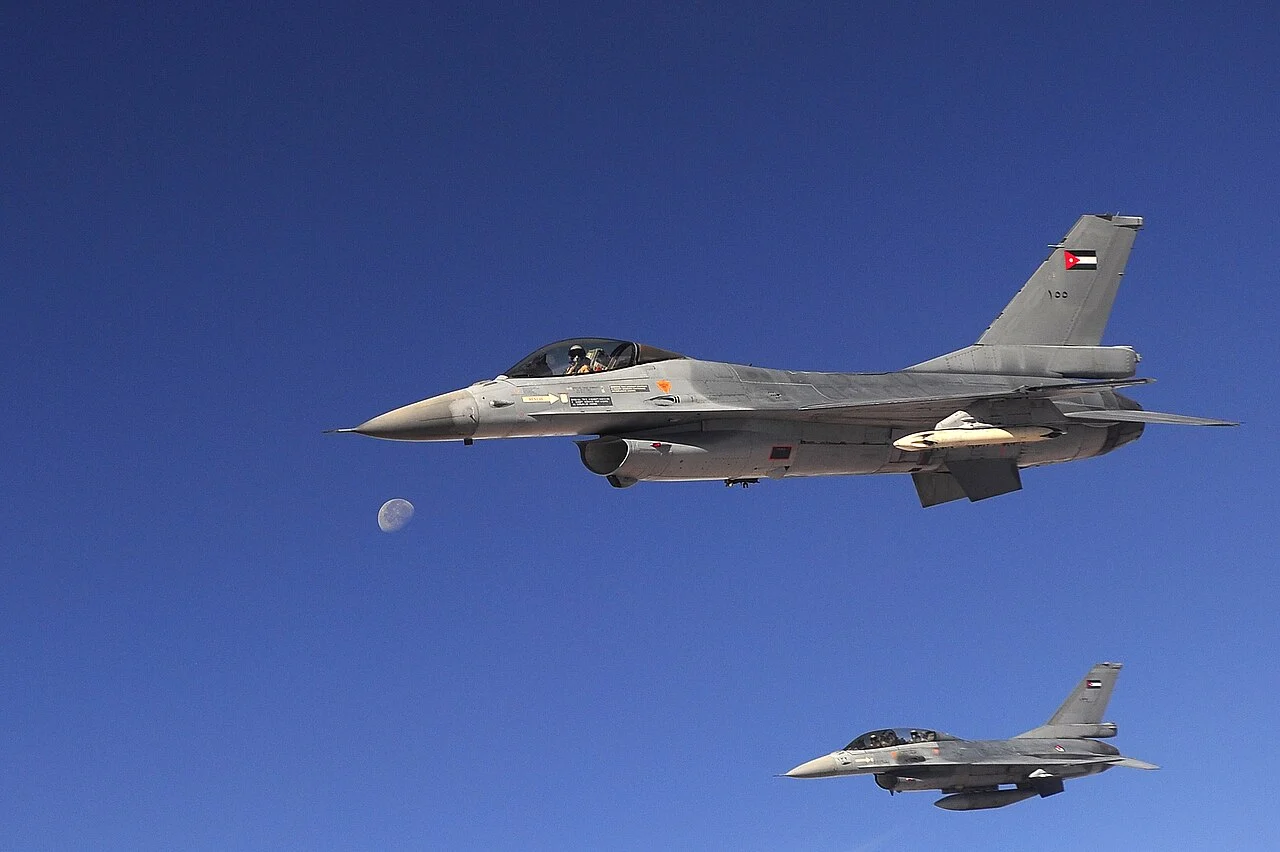
Photo: A Royal Jordanian Air Force F-16 of Squadron One on an air-refuelling mission over Muwaffaq Salti Air Base, 17 October 2011. Credit: SrA Asha Kin, US Air Force, public domain, via Wikimedia Commons
The short answer to how strong Jordan’s military is: small, professional, heavily dependent on the United States and unusually well trained for its size. The Jordan Armed Forces (JAF, the “Arab Army”) have roughly 114,500 active personnel according to IISS figures reproduced in open sources, a defence budget of about US$2.5 billion, and a fleet of around 60 F-16s that is older than the pilots flying it. What the country lacks in volume it partly makes up through US Foreign Military Financing, a domestic design bureau (KADDB, now branded JODDB) and a decades-long training relationship with Western forces. Every table below labels each line Operational, Delivered, Ordered, Reported or Status unclear, because an order is not a delivery and a delivery is not an operational unit.
| Indicator | Figure | Year / source |
|---|---|---|
| Active personnel | About 114,500 (reserves about 100,000) | IISS Military Balance 2021 as reproduced in open sources; no recent official figure (Estimated) |
| Conscription | Reinstated from February 2026 after more than 30 years; first intake reported at 6,000 | Jordanian government and press reports, 2025–26 |
| Military expenditure | US$2.56 billion in 2024 (US$2.45 billion in 2023) | SIPRI series via Trading Economics; no verified 2025 figure |
| US assistance | At least US$1.45 billion a year sought under the 2022–29 MOU, including US$400 million in Foreign Military Financing | US–Jordan MOU, September 2022; Congressional Research Service |
| Fighter aircraft | About 61–62 F-16A/B (MLU); 12 F-16 Block 70 on contract | Breaking Defense, January 2023; open-source directories (Estimated) |
| Main battle tanks | Roughly 450 in service across four types, plus large stored stocks | Open-source directories, 2026 (Estimated) |
| Navy | Small coastal force at Aqaba, about 27 patrol boats and more than 700 personnel | Shephard / open sources (Estimated) |
| Defence industry | KADDB / JODDB, founded 1999, Mafraq industrial park since 2009 | Royal decree, 24 August 1999 |
Security environment and current posture
Jordan’s planning problems are documented and specific. To the north and east lies a border of roughly 375 kilometres with Syria, where narcotics smuggling by ground and, increasingly, by drone has forced the army to change its rules of engagement and deploy counter-drone and surveillance systems. To the west sits Israel, with which Jordan has had a peace treaty since 1994. And since 28 February 2026, the kingdom has been under repeated overflight and targeting by Iranian missiles and drones during the wider US–Iran conflict. On 24 July 2026 the General Command said its aircraft shot down seven missiles and six drones with no casualties; on 29 July an army spokesman said air defences dealt with five missiles. Jordan hosts about 4,000 US troops, according to Al-Monitor, and a January 2021 defence cooperation agreement gives Washington access to designated facilities.
That context explains why the JAF’s stated priorities have moved from armour towards air and missile defence, counter-drone systems and border surveillance. It also means many 2026 announcements are emergency or sustainment purchases rather than new capability. For the wider regional picture see the Middle East desk, the Jordan tag desk, and the Lebanon military strength profile, which sets out why Beirut’s own army cannot be measured without separating it from Hezbollah.
Defence budget: what the numbers show
Jordan does not publish a line-by-line defence budget that maps neatly onto SIPRI’s definition. SIPRI’s series, reproduced by Trading Economics, puts military spending at US$2.56 billion in 2024 and US$2.45 billion in 2023, which is about 4% of GDP by one open-source estimate. Some aggregators quote higher figures around US$5 billion; the definition behind them is not stated, so they are not used here. No verified 2025 SIPRI figure was available at the time of writing.
Two things sit outside that number. First, US assistance: the memorandum of understanding signed on 16 September 2022 covers fiscal years 2023–2029 and commits successive administrations, in principle and subject to appropriations, to seek at least US$1.45 billion a year in economic and military aid. About US$400 million a year of that is Foreign Military Financing for the JAF, alongside US$610 million a year in Economic Support Funds. Second, donations and second-hand transfers, such as the 80 Leclerc tanks the UAE gave Jordan in 2020, which never appear as a purchase.
Personnel and force structure
The JAF have three services: the Royal Jordanian Army, the Royal Jordanian Air Force (about 14,000 personnel) and the Royal Jordanian Navy. Since the 2000s the army has moved from a divisional structure of two armoured and two mechanised divisions to a lighter, more mobile force built largely around brigades, with a Special Operations Command and a Quick Reaction Force that draw on the best-trained units. Jordan reinstated compulsory service in February 2026 after a suspension that lasted since 1992; the first intake was reported at about 6,000 men aged 18, with reported pay of JD100 a month, and the government describes the measure as national service and reserve training rather than an expansion of the standing force.
Army
The army’s heavy core is old. Jordan received about 400 Challenger 1 tanks from the United Kingdom in 2002 and renamed them Al Hussein; around 190 are usually listed in service. A locally developed Falcon turret and a hybrid-turret upgrade never reached series production. The US-supplied M60A3 fleet, with one Raytheon/KADDB “Phoenix” upgraded battalion and further fire-control upgrades, remains in service alongside newer additions. In 2020 the UAE donated 80 French Leclerc tanks, which appeared in a JAF exercise in October 2020 and equip part of the 3rd Armoured Division.
| System | Origin | Quantity | Status | Source |
|---|---|---|---|---|
| Al Hussein (Challenger 1) | UK | About 190 in service, about 210 stored | Operational (Estimated) | Open-source directories; supply 2002 |
| M60A3 Patton (partly Phoenix-upgraded) | USA | About 182 | Operational (Estimated) | Raytheon / KADDB upgrade record; open-source directories |
| Leclerc | France (donated by the UAE) | 80 | Delivered, in service | Army Recognition, September and October 2020 |
| Khalid (Chieftain), Tariq (Centurion), M60A1 | UK / USA | Several hundred | Stored / Retired | Open-source directories (Estimated) |
| B1 Centauro tank destroyer | Italy | About 141 | Operational, some modernised (Estimated) | Open-source directories |
| Marder 1A3 infantry fighting vehicle | Germany | About 75 | Operational (Estimated) | Open-source directories |
| YPR-765 | Netherlands / Belgium | About 550 (IFV and APC) | Operational (Estimated) | Open-source directories |
| FNSS ACV-15 | Türkiye | About 130 | Reported | Open-source directories; FNSS export record |
| M113 family, M577 | USA | Several hundred | Operational (Estimated) | Open-source directories |
| M109A2 self-propelled howitzer | USA / Netherlands | About 358 | Operational (Estimated) | Open-source directories |
| M142 HIMARS | USA | 12 reported | Delivered (Reported) | DSCA GMLRS notification, February 2022; open-source directories |
| WM-120 and SR-5 rocket launchers | China | About 24 and 12 | In service (Estimated) | Shown at the 9 June 2024 parade; Janes, Army Recognition |
| Cyclone rocket launcher | Jordan (KADDB) | About 36 | Reported in service since 2024 | Open-source directories |
The Chinese rocket launchers deserve a careful reading. Jordan showed WM-120 and SR-5 systems at the parade for the 25th anniversary of King Abdullah II’s reign on 9 June 2024, and reporting says they entered service in 2023. Neither government has published contract details, so the quantities above are estimates. The Turkish FNSS ACV-15 is likewise an older acquisition and the only Turkish system in this table; no verified Turkish combat aircraft, drone or air-defence sale to Jordan was found for this profile.
Air Force
The Royal Jordanian Air Force (RJAF) is the country’s most capable service and the one with the most visible modernisation programme. Its fighter fleet is entirely F-16: the first F-16A/B Block 15 aircraft arrived from US stocks in 1997, and Jordan then bought used aircraft from Europe. A letter of intent in April 2006 covered 22 mid-life-update (MLU) aircraft, 14 from Belgium and 8 from the Netherlands; Belgian aircraft arrived in batches from 2008 to 2011. In 2013 the Royal Netherlands Air Force sold a further 15 F-16AM/BM, delivered between October and December 2017. Open sources put the current MLU fleet at roughly 61 or 62 aircraft (43–44 single-seat, 18 twin-seat), and figures above 70 include stored or older airframes.
The next step is new-build. The US State Department approved on 4 February 2022 the sale of up to 16 F-16 Block 70 aircraft with equipment and JDAM tail kits, at an estimated ceiling of US$4.21 billion. Jordan signed a contract on 20 January 2023 for 12 aircraft, to be built at Lockheed Martin’s Greenville plant, with first deliveries expected in 2027. As of this profile no Block 70 delivery to Jordan had been confirmed in the sources reviewed.
| System | Origin | Quantity | Status | Source |
|---|---|---|---|---|
| F-16AM/BM Block 20 MLU (ex-Belgian, ex-Dutch, ex-USAF) | USA (Belgian and Dutch transfers) | About 61–62 in service | Operational (Estimated) | Breaking Defense, 2023; F-16.net; Defense Industry Daily |
| F-16C/D Block 70 | USA | 12 contracted (up to 16 approved) | Contracted, first delivery expected 2027 | DSCA / State Department, 4 Feb 2022; contract signed 20 Jan 2023 |
| F-5 (support only) | USA | Not verified | Status unclear; still named in the 2026 DSCA support case | Al-Monitor, 19 March 2026 |
| AC-235 gunship | Spain / Indonesia (Airbus CN235) | 2 delivered 2011–14 | Status unclear; offered for sale in 2019 | Flight Global; Aviation International News, January 2019 |
| C-130H Hercules | USA | About 7 | Operational (Estimated) | Open-source directories; DSCA 2026 sustainment case |
| AH-1F Cobra (upgraded avionics) | USA (16 supplied by Israel) | Up to about 32 listed | Operational, part transferred abroad (Estimated) | Flight Global; Northrop Grumman SES upgrade; defenceWeb |
| UH-60A/L/M Black Hawk | USA | About 32, with 2 to 4 more on order | Operational; additional aircraft Ordered | The Defense Post, July 2024; open-source directories |
| MD530F / AH530 Block II | USA | 6 in service; 6 AH530 ordered, 4 delivered December 2024 | Delivered / Under delivery | Open-source directories (Reported) |
The AC-235 entry shows why a fleet count must be read with its date. The Spanish-designed CN235 gunships, fitted with a 30 mm chain gun, were delivered between 2011 and 2014, depending on the source, and served with special operations. Aviation International News reported in January 2019 that two were being offered for sale as part of a fleet rationalisation, and more recent directories still list them, so their status is unclear.
Navy and maritime security
The Royal Jordanian Navy works from Aqaba at the head of the Gulf of Aqaba. Its principal vessels are the three British-built Hawk-class (Al Hussein) patrol boats, commissioned in 1991, and a set of US-built patrol boats, including two 37-metre boats ordered from Marine Group Boat Works. Open sources credit the service with about 27 patrol boats and more than 700 personnel. Its missions are border, search and rescue and anti-smuggling work in the Gulf of Aqaba, not blue-water operations.
Air defence by tier
Jordan’s ground-based air defence is a mixed, ageing system that has been stretched since February. In the long-range tier, it operates a small number of Patriot batteries (estimated at 3 to 6, some donated from Germany), while in October 2023 an army spokesman said Jordan had asked Washington to deploy US Patriot systems because the system was too expensive to acquire on its own. The medium tier rests on MIM-23 Hawk, of which open sources list ten Phase III batteries and more than 400 missiles delivered in 2014–16. Short range and point defence use Igla-S man-portable missiles, M163 Vulcan guns and Strela-10 launchers. Counter-drone equipment, including CerbAir HYDRA 300, DroneShield DroneGun Tactical and a JODDB-developed system, is reported in service.
| Tier | System | Origin | Quantity | Status | Source |
|---|---|---|---|---|---|
| Long range | MIM-104 Patriot | USA / Germany | About 3–6 (Estimated) | Operational, Estimated | Defense News, October 2023; open-source directories |
| Medium range | MIM-23 Hawk Phase III | USA | About 10 batteries | Operational (Estimated) | Open-source directories; RJAF listings |
| Short range | 9K35 Strela-10; Igla-S | USSR / Russia | About 92; about 180+ launchers | Operational (Estimated) | Open-source directories |
| Guns | M163 Vulcan, ZSU-23-4 | USA / USSR | About 100 and about 48 | Operational (Estimated) | Open-source directories |
| Counter-UAS | HYDRA 300, DroneGun, JODDB system | Various | Not published | Reported | Open-source directories |
For a comparison of how larger neighbours layer their defences, see Evolution of the UAE’s Integrated Air and Missile Defence and 5 Alternatives to Patriot for MENA. The interceptions Jordan reported in 2026 were credited to its aircraft as well as ground systems, and to US forces operating in the country alongside them; open sources do not break down which system made which kill.
Drones and border security
Jordan’s most recurring drone story is defensive. Jordan Times, Arab News and the Middle East Institute have documented drug-carrying drones from Syria, at a pace the MEI put at an average of about 51 intercepted a month between January and mid-July 2025. The army responded by loosening its rules of engagement on the northern border and adding radars, surveillance drones and counter-drone tools. In May 2026, reports said the RJAF struck what Jordan described as narcotics and weapons facilities in southern Syria, saying the action was coordinated with the Syrian authorities; a local armed group publicly disputed the description. Jordan’s own inventory of armed drones is small: the sources reviewed list Cessna 208B and Air Tractor aircraft in ISR roles but no verified armed unmanned system, and none of them should be described as a strike drone fleet.
Defence industry and localisation
KADDB was founded by royal decree on 24 August 1999 to supply scientific and technical services to the JAF, and it has since become a manufacturer of armoured vehicles, small arms and rocket systems. It opened its Mafraq industrial park in 2009 and builds the Al-Thalab long-range patrol vehicle, the Nashab RPG-32 grenade launcher and, according to open sources, the Cyclone rocket system. It has also formed a joint venture with South Africa’s Paramount Group to build armoured vehicles and aircraft in Jordan, including the Mbombe 6×6, according to Jordan Times reporting. Jordan hosts SOFEX in Amman (scheduled for 27–29 October 2026) and has set up a drone and electronic-warfare test range, per Shephard. Export volumes are modest: SIPRI listed Jordan among the world’s top 25 arms exporters in 2020–24, mostly for second-hand equipment it had previously imported.
Main foreign suppliers
SIPRI’s country-level import shares for Jordan in 2021–25 could not be verified for this profile, so the table below groups suppliers by documented deals rather than by a share figure. The United States dominates in both quantity and value, followed by European second-hand transfers.
| Supplier | Main items | Channel | Source |
|---|---|---|---|
| United States | F-16, C-130, Black Hawk, Cobra, HIMARS, M60, M109, Javelin, Hawk, Patriot | FMS, FMF, excess defence articles | DSCA; CRS; Breaking Defense |
| United Kingdom | Challenger 1, Scimitar, Scorpion, Hawk-class boats | Government-to-government, 2002 tank deal | Open-source directories |
| Belgium, Netherlands | F-16 MLU, YPR-765, M109A2-90 | Second-hand sales | F-16.net; Defense Industry Daily |
| Italy, Germany | Centauro; Marder; donated Patriot | Second-hand and donations | Open-source directories |
| UAE / France | 80 Leclerc tanks | Donation, 2020 | Army Recognition |
| China | WM-120, SR-5 rocket launchers | Reported purchase, in service 2023 | Janes; Army Recognition |
| Türkiye | FNSS ACV-15 | Reported purchase | Open-source directories |
Recent procurement and events, 2025–2026
| Date | Event | Value | Status |
|---|---|---|---|
| December 2024 / June 2025 | Four, then two, AH530 Block II light attack helicopters reported delivered | Not published | Delivered (Reported) |
| November 2025 | Parliament backs a law reinstating conscription | n/a | Law passed |
| February 2026 | First conscription intake begins; Jordanian forces report the first interceptions of Iranian missiles and drones on 28 February | n/a | Under way |
| 19 March 2026 | US emergency notification of US$70.5 million in F-16, C-130 and F-5 spares and support | US$70.5 million | Notified, delivery not confirmed |
| May 2026 | Jordan reported air strikes on smuggling infrastructure in southern Syria | n/a | Reported |
| 24 and 29 July 2026 | Jordanian forces report shooting down Iranian missiles and drones | n/a | Reported by the General Command |
| Through June 2027 | Sikorsky UH-60M contract for Jordan and Croatia (US$251.4 million in total) | US$251.4 million (both countries) | Ordered |
| 2027 | First F-16 Block 70 delivery expected | Up to US$4.21 billion approved for 16 | Contracted |
Modernisation priorities
Four priorities stand out in Jordanian statements and US notifications. The first is fighter renewal through the Block 70 programme, with 12 aircraft contracted and up to 16 approved. The second is ground-based air and missile defence, given the October 2023 request for US Patriot cover and the 2026 interceptions. The third is counter-drone capability for the northern border. The fourth is keeping the older fleets flying: the March 2026 support case and the Cobra and Black Hawk upgrades are all sustainment items. How these compare with neighbours is covered in the sister pillars for Saudi Arabia, the UAE and Iraq, and in Main Battle Tanks of Arab Armies in 2026. The Egyptian equivalent, with a much larger fleet and a different supplier mix, is in How Strong Is Egypt’s Military in 2026?
What is changing
The clearest change is that Jordan’s air defence has moved from a background function to a daily one. The second change is manpower: conscription returns a training pipeline that Jordan gave up in 1992. The third is supply: sustainment funds from Washington are flowing fast, while the major aircraft purchase will not deliver until 2027 at the earliest. Everything beyond that is speculation, and this profile does not offer any.
A note on the numbers
Jordan does not publish a detailed order of battle. The counts in this profile combine open-source directories, US notifications, manufacturer statements and press reports, and disagree with one another by margins of 5% to 50% depending on whether stored and retired airframes are counted. Where a figure comes from a directory rather than an official notice it carries the label Estimated. Personnel figures date from 2021 because no more recent IISS number could be verified. Stored tanks, in particular, are not combat power. Rankings such as Global Firepower’s are indicative composite indices, not inventories, and are not used for any count here.
Sources
- Congressional Research Service, Jordan: Background and U.S. Relations
- US Department of State, Joint statement on the US–Jordan memorandum of understanding (September 2022)
- The Times of Israel, US approves F-16 sale to Jordan (February 2022)
- Breaking Defense, Jordan inks deal for 12 Block 70 F-16s (January 2023)
- Defense Industry Daily, Jordan buys F-16 MLUs from the Netherlands and Belgium
- F-16.net, Jordan acquires Dutch and Belgian F-16 MLUs
- Al-Monitor, US fast-tracks arms sales to UAE, Jordan and Kuwait (March 2026)
- Al-Monitor, Jordan intercepts 7 missiles and 6 drones (July 2026)
- The Defense Post, Jordan army says it intercepted Iranian missiles (29 July 2026)
- Defense News, Jordan asks US to deploy Patriot air defense systems (October 2023)
- The Defense Post, Sikorsky wins US$251 million Black Hawk deal with Jordan and Croatia
- Aviation International News, Gunships for sale as part of Jordanian sell-off (January 2019)
- Army Recognition, UAE to donate 80 Leclerc tanks to Jordan (2020)
- Army Recognition, Jordan reveals acquisition of Chinese SR5 and WM-120 launchers (2024)
- Janes, Jordanian military displays SR5 MRLs for the king’s silver jubilee
- Middle East Institute, The soaring threat of drug drones from Syria
- Asharq Al-Awsat, Jordan parliament passes law reinstating conscription
- Trading Economics, Jordan military expenditure (SIPRI data)
- SIPRI, Trends in International Arms Transfers 2025 (March 2026)
- Flight Global, Jordan takes delivery of AC235 gunship
- Wikipedia, Royal Jordanian Air Force (used for discovery and cross-checked against the sources above)