Ethiopia’s Su-35 Fighter Programme: What’s Delivered, What’s Disputed


Ethiopia’s acquisition of the Sukhoi Su-35 multirole fighter is tracked here from the first leaked contract reports through the October 2026 handover at Zhukovsky airfield and the still-unconfirmed S-400 follow-on, using Rosoboronexport’s own statements alongside independent reporting from the handover ceremony. Data as of November 2026.
DEFENCE AFRICA | Programme tracker | Data as of November 2026
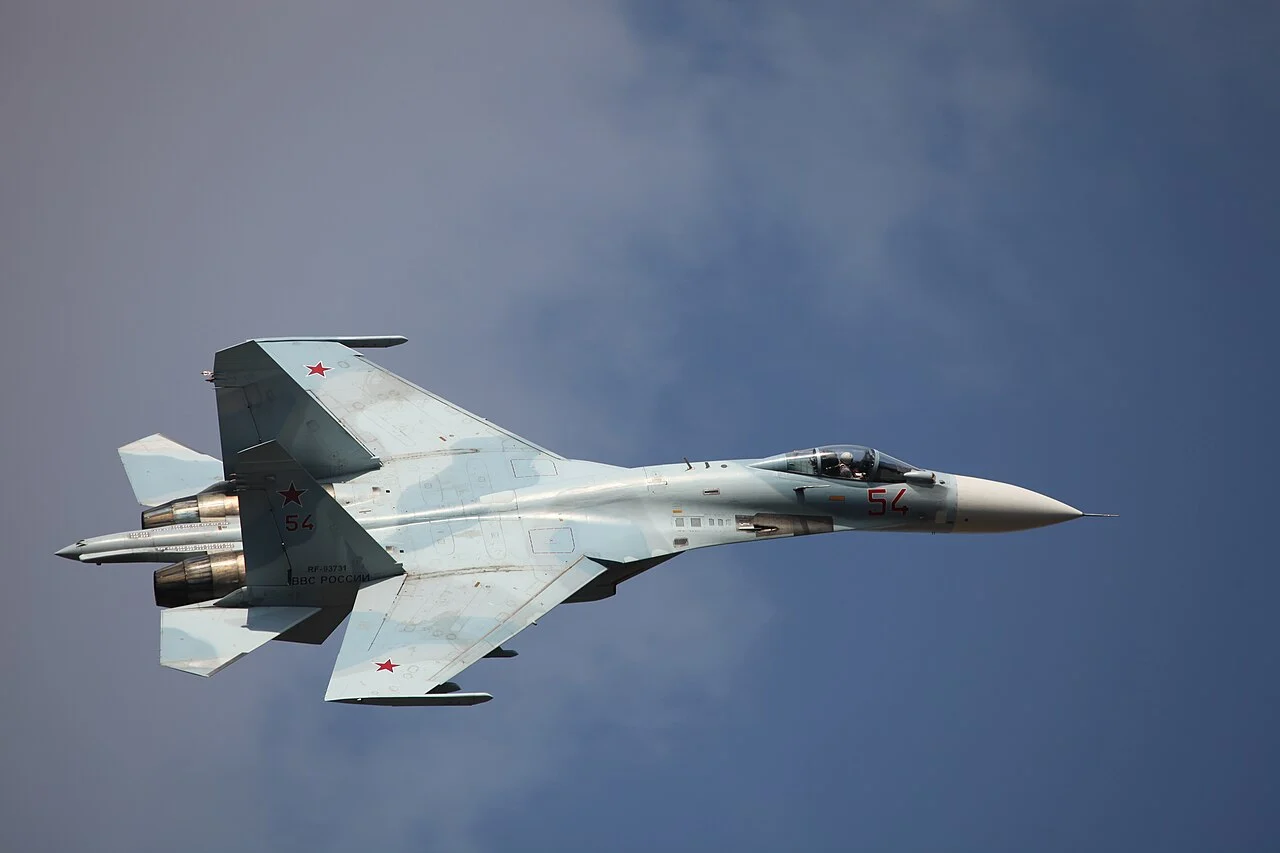
Photo: A Sukhoi Su-35 fighter (illustrative example, MAKS air show, Russia). Credit: Doomych, public domain, via Wikimedia Commons
Ethiopia’s Su-35 programme surfaced in public reporting in two stages: first as a leak, then as a ceremony. In October 2025, leaked Rostec documents reported by the Ukrainian outlet Militarnyi indicated that Ethiopia had signed a contract for six Su-35 fighters, a deal neither Addis Ababa nor Moscow had previously confirmed. A year later, on 28 October 2026, Prime Minister Abiy Ahmed announced on social media that Ethiopia had received “the first twelve Su-35 4++ Generation fighter jets,” and that Ethiopia would also receive four S-400 long-range air-defence batteries. Russia’s state arms exporter Rosoboronexport confirmed the same day that it had handed over a first batch at Zhukovsky airfield outside Moscow, timed to the Russia-Africa Summit.
The two statements do not describe the same thing. Photographs and video released by the prime minister’s office, analysed by Janes and Aviation Week, show two aircraft, serials 2551 and 2552. Interfax, citing Russia’s Vesti news service, likewise reported a handover batch of two. Neither Rosoboronexport nor the Kremlin has reconciled “twelve” with the two airframes shown on camera, and this tracker treats the gap as what it is: published figures that vary, not a settled total.
The Su-35 is not Ethiopia’s first post-Soviet fighter purchase. The Ethiopian Air Force has operated Su-27 and Su-27UB Flankers acquired from Russia in the 1990s, alongside older MiG-23s, and in January 2024 took delivery of two refurbished, ex-Indian Air Force Su-30K aircraft that had sat in storage for years. The Su-35 programme extends that Russian-supplier relationship rather than replacing it outright, and it sits alongside a separate build-up of Ethiopia’s military drone fleet within the same modernisation drive. For the force structure this fits into, see DefenceMENA’s Ethiopia military profile.
Key facts
- Contract reportedly signed 2022, for six Su-35s, per leaked Rostec documents disclosed October 2025 (Militarnyi)
- Public confirmation and first handover: 28 October 2026, Zhukovsky airfield, Russia-Africa Summit, Moscow
- Aircraft shown at handover: two, serials 2551 and 2552 (Janes; Aviation Week; Rosoboronexport statement)
- Ethiopian government’s own figure: “the first twelve” delivered (Abiy Ahmed, 28 October 2026) — unreconciled with the above
- Reported total order: twelve aircraft, per Vedomosti, originally scheduled for 2027 delivery
- Associated air-defence announcement: four S-400 batteries “to follow,” no contract value, date or battery type disclosed
Timeline
| Date | Event | Status | Source, year |
|---|---|---|---|
| 1990s | Ethiopia acquires its original Su-27/Su-27UB fleet from Russia | operational | GlobalSecurity; CAST, 2026 |
| Early 2022 | Ethiopia reportedly confirmed as a customer for China’s Hongdu L-15 light fighter/trainer, to replace the MiG-23 fleet | reportedly under negotiation | HNGN, 2022 |
| 2022 (month undisclosed) | Contract for six Su-35 fighters reportedly signed with Rosoboronexport | contracted (reported; not confirmed by either government) | Leaked Rostec documents, via Militarnyi, 2025 |
| January 2024 | Two refurbished, ex-Indian Air Force Su-30K fighters delivered, supplementing the Su-27 fleet | delivered | Aviation Week; CAST, 2026 |
| October 2025 | Leaked Rostec documents reveal the previously unconfirmed Su-35 contract | reported (leak) | Militarnyi, 2025 |
| 28 October 2026 | Rosoboronexport hands over a first batch (2 aircraft, serials 2551/2552) at Zhukovsky airfield; Ethiopian PM announces “the first twelve” received | delivered (count disputed) | Rosoboronexport statement; Janes; Aviation Week; TWZ, 2026 |
| 28 October 2026 | Abiy Ahmed states Ethiopia “will receive” four S-400 long-range air-defence batteries | reportedly under negotiation | Abiy Ahmed statement, via Al Jazeera, Anadolu, 2026 |
Delivered vs pending
What is independently confirmed: two Su-35 airframes, tail numbers 2551 and 2552, physically handed over at Zhukovsky airfield on 28 October 2026, witnessed by Ethiopian Air Force officers and photographed for release by the Ethiopian prime minister’s office. Rosoboronexport’s own statement to Reuters described this first batch as two aircraft, matching the Janes and Aviation Week counts.
What is disputed: Abiy Ahmed’s statement describes “the first twelve” as delivered. Vedomosti separately reports the total contracted quantity as twelve, originally scheduled for delivery in 2027 — implying the October 2026 handover came ahead of schedule, at least for the aircraft actually shown. The 2022 leak reported by Militarnyi put the original contract at six. No source reconciles these three figures (two delivered on camera, twelve claimed delivered, six or twelve under contract), and neither Moscow nor Addis Ababa has published a contract figure, delivery schedule or total order size. This tracker records all three as reported, not as fact.
Entirely pending and unconfirmed: the four S-400 batteries. No contract value, delivery date, launcher count or missile variant has been disclosed by Rosoboronexport, Rostec or the Kremlin; the sole public source remains Abiy Ahmed’s own statement.
Industrial participation and offsets
Unlike Egypt’s K9A1 EGY self-propelled howitzer programme, which includes licensed local production at an Egyptian state factory, Ethiopia’s Su-35 deal shows no sign of local assembly or manufacturing. It follows the standard pattern of Russian fighter exports to Africa: a government-to-government sale with Russian-built airframes shipped complete.
The offset, such as it is, is in training and sustainment rather than production. Rosoboronexport chief executive Alexander Mikheyev told Russia’s Vesti that Russian personnel will train Ethiopian pilots and engineering staff on the Su-35, and that Ethiopia already operates a maintenance and service base for Su-27-family aircraft that can be adapted for the newer type. Mikheyev also said a support programme covering the warranty period and the aircraft’s service life “has been agreed,” though Rosoboronexport has not published its terms or value.
The handover visit also showed the Ethiopian delegation an Il-78M-90A aerial refuelling tanker and, according to Aviation Week, the Su-57 fifth-generation fighter. Neither has been announced as a purchase; both appear to have been presented as options for a future phase of the relationship rather than confirmed acquisitions.
Alternatives considered
Ethiopia’s fighter modernisation has not run on a single track, which complicates any claim that the Su-35 was chosen over a specific rival. Three other programmes sit alongside it:
Sukhoi Su-30. Russia had reportedly offered Ethiopia a batch of ex-Indian Air Force Su-30 aircraft years earlier; two refurbished Su-30K jets were actually delivered in January 2024, supplementing rather than replacing the Su-27 fleet. Operators: Ethiopia (delivered, January 2024).
Hongdu L-15 (China). Reported in 2022 as Ethiopia’s chosen replacement for its MiG-23 light-fighter/trainer requirement, a different mission class from the Su-35 and therefore not a direct competitor for the same money. Status: reportedly under negotiation; no delivery confirmed.
Chengdu J-10C (China). No contract, offer or negotiation for the J-10C has been reported for Ethiopia. Military Watch Magazine has named it as a theoretically cost-effective option for Ethiopia’s broader fleet renewal, given warmer China-Ethiopia economic ties, but this is analyst commentary, not a reported acquisition, and it carries no status label here.
Taken together, the pattern looks less like a head-to-head contest and more like supplier diversification across mission types — Russian Su-27/Su-30/Su-35 for the high end, a Chinese trainer for the light end — with no Western option on the table, consistent with Ethiopia’s non-aligned procurement posture and its distance from US and European export controls.
Why it matters for Africa
Ethiopia’s Su-35 acquisition is one of the largest fighter deals reported on the continent in 2026, and it illustrates a recurring African procurement pattern: governments announcing numbers that outrun what manufacturers or independent observers can verify on the ground. For regional air forces, the programme is also a case study in sustainment economics — reusing an existing Su-27 maintenance base lowers the entry cost of a more capable type, a route several African Su-27/Su-30 operators could in principle follow rather than buying a wholly new logistics tail. The unresolved S-400 announcement matters for the wider Horn of Africa balance: a functioning long-range air-defence layer would be a first for the sub-region, but until Rosoboronexport or the Kremlin confirm a contract, it remains a stated intention rather than a procurement fact. Combat experience is not yet part of the record — none of the delivered aircraft has been reported in operational use — so claims about what the Su-35 adds to Ethiopia’s position relative to Egypt or Eritrea remain provisional until deliveries, training and basing are independently confirmed.
Sources
- The War Zone: “Ethiopia Gets 12 Russian Su-35 Fighters, Eyes S-400 Air Defenses”
- Janes: “Ethiopia announces Su-35, S-400 acquisitions”
- Aviation Week: “Ethiopia Eyes Air Force Expansion, Modernization, New Acquisitions”
- The Aviationist: “Ethiopia receives first Su-35 fighters”
- AIN Online: “Ethiopia Receives First Russian Su-35 Fighters”
- Militarnyi: “Ethiopia receives first batch of Su-35 fighter jets from Russia”
- Militarnyi: leaked Rostec documents on Ethiopia’s Su-35 contract
- Army Recognition: “Russia delivers first Su-35 fighter jets to Ethiopia with S-400 air defense systems to follow”
- HNGN: “Ethiopia-China L-15 Falcon Light Fighter Jet to Replace MiG-23s”
- Military Watch Magazine: options to modernise Ethiopia’s air force
- CAST: “Ethiopia Eyes Air Force Expansion, Modernization, New Acquisitions”