Tanzania Is Spending More on Defence. Its Hardware Hasn’t Changed Much




Tanzania is raising its defence budget faster than almost any other country in East Africa, with a 17.57% jump approved for the 2026/27 fiscal year and a new national Defence Headquarters opened in Dodoma in February 2026. The hardware tells a different story: a Chinese-built fighter fleet acquired in 2009, Soviet-era tanks and air defence, no navy warship bigger than a patrol boat, and a landmark local armoured-vehicle venture that is still a building site.
The short answer to how strong Tanzania’s military is in 2026: modest by the open-source numbers, and smaller than regional rival Kenya’s on most measures that can be checked, but growing its budget at a pace officials describe explicitly as modernisation. The longer answer is that very little of that money has yet turned into new equipment. The Tanzania People’s Defence Force (TPDF) still flies 1970s-design Chinese fighters, fields Cold War-era Soviet air defence of unconfirmed current status, and operates no frigate, corvette, offshore patrol vessel or submarine despite an Indian Ocean coastline and three Great Lakes. The sections below go service by service, with a status label on every line: Operational, Delivered, On contract, Ordered, Under modernization, Estimated, Retired or Reported (unconfirmed).
| Indicator | Figure | Year / source |
|---|---|---|
| Active personnel | Estimated 25,000–28,000 (a dated 2020 breakdown gives roughly 22,000 Army, 1,000 Navy, 3,000 Air Force) | CIA Factbook (2020 breakdown); DefenceMENA compilation, October 2026 |
| Reserves / paramilitary | About 80,000 People’s Militia (dated figure) | Open source, 2005 |
| Conscription | No conscription into the regular TPDF; National Service (JKT) training is compulsory for Form Six school leavers on the mainland under the National Service Act (1964, revised 2002) | National Service Act; The Citizen, Daily News |
| Military expenditure | SIPRI-linked estimate US$920.8 million (2024). Separately, the official defence budget for FY2026/27 is Sh4.29 trillion (about US$1.62 billion), up 17.57% on FY2025/26 – a different measure from the SIPRI figure | Trading Economics (SIPRI-sourced); The Citizen, May 2026 |
| Foreign military aid | No confirmed grant or loan figure. China and Russia have both publicly offered continued modernisation support and training in the past 12 months, with no signed agreement or value disclosed | The Citizen (China, Jul 2025); Daily News (Russia, Mar 2026) |
| SIPRI importer rank and main suppliers | SIPRI’s public fact sheets do not break out a Tanzania country line. Historically China-dominant (J-7G fighters, Type 63A tanks); legacy Soviet/Russian equipment widespread; no confirmed major Western or Turkish platform supplier in current service | SIPRI Arms Transfers fact sheet (confirmed no country line); secondary reporting, 2021–22 |
| Combat aircraft | About 12 Chengdu J-7G fighters plus 2 two-seat trainers; older F-5/F-7 airframes reported to fly rarely | MilAvia assessment cited on Wikipedia, 2026 |
| Main battle tanks | About 52 (32 T-54, 15 Type 59G, 5 Norinco VT-2) | GlobalMilitary.net, 2026 (single-tracker estimate) |
| Major ships / submarines | 0 frigates, corvettes, OPVs or submarines; only a small number of patrol boats, mostly attributed to civil agencies rather than the Navy | DefenceMENA research, 2026 |
Current military overview
The TPDF comprises an Army, Navy and Air Force Command, plus National Service (JKT), the parastatal youth-training arm run separately from the regular forces. General Jacob John Mkunda has served as Chief of Defence Forces since succeeding General Venance Mabeyo. On 24 February 2026 President Samia Suluhu Hassan opened a new, unified National Defence Headquarters at Kikombo in Dodoma – the first permanent joint headquarters for the Ministry of Defence and the TPDF since the force’s founding in 1964, built on a foundation stone laid by the late President John Magufuli in 2019.
Tanzania’s geography sets an unusual planning problem: an Indian Ocean coast running from Tanga to Mtwara via Dar es Salaam and Zanzibar, plus three of Africa’s Great Lakes – Victoria, Tanganyika and Nyasa – and land borders with eight countries, more neighbours than almost any other African state. That has pushed Dar es Salaam toward lake and riverine security questions as much as coastal ones, and toward regional peacekeeping: Tanzanian troops have served in the UN mission in the DRC (MONUSCO) and in the SADC-led response to the insurgency in Mozambique’s Cabo Delgado region. This sits inside DefenceMENA’s East Africa desk and Tanzania tag, alongside the site’s existing comparison of how Kenya and Tanzania are building very different militaries.
Tanzania’s defence posture has historically been non-aligned, rooted in Cold War-era ties to China, and that pattern still shows in an inventory more Chinese- and Soviet-equipped than most of its neighbours.
Defence budget: what the numbers do and do not show
Tanzania’s government has been unusually explicit about the trajectory of defence spending, if not always consistent about the exact figure. Minister for Defence and National Service Dr Rhimo Nyansaho presented the FY2026/27 estimates to Parliament on 19 May 2026; MPs approved Sh4.29 trillion, Parliament’s Defence and Security Committee chair Najma Giga confirmed, up 17.57% (about Sh640.58 billion) on the Sh3.65 trillion allocated for FY2025/26. Of the increase, recurrent spending rose by Sh532.84 billion and development spending by Sh107.74 billion, a 33.78% jump. The Chanzo separately reported a Sh4.2 trillion figure for the same fiscal year, a reminder that Tanzanian budget reporting is not fully consistent across outlets.
That is a different number from SIPRI’s cross-country military-expenditure estimate, which put Tanzania at US$920.8 million in 2024 (down from US$946.2 million in 2023) – the standard figure for comparing Tanzania against other countries, as opposed to the official Treasury allocation. Budget documents say the increase funds modernised equipment, technology and communications systems, soldiers’ welfare (training, healthcare, housing), expanded National Service infrastructure, the reserve force, protection of strategic national projects, defence-related industries and private-sector partnerships, plus border security and cooperation with the UN, AU, SADC and EAC. No confirmed major foreign military aid or grant underpins this budget; China’s and Russia’s 2025–26 offers of support (below) remain statements of intent rather than financed programmes.
Active personnel
Open-source personnel figures for Tanzania cluster more tightly than for some neighbours, but they are dated. A 2020 CIA Factbook estimate gives 26,000 active personnel – about 22,000 Army, 1,000 Navy and 3,000 Air Force – and a broader October 2026 DefenceMENA compilation across African militaries puts the range at 25,000–28,000. The People’s Militia reserve was last reliably put at about 80,000 in 2005; that figure, too, is old rather than current. There is no conscription into the regular TPDF. National Service (JKT) training is a separate, compulsory programme under the National Service Act (No. 16 of 1964, revised 2002) for secondary-school (Form Six) leavers on the mainland – Zanzibari youth have historically been exempt, and a 2026 directive to extend the requirement to Zanzibar has drawn objections from the opposition ACT Wazalendo. JKT recruitment criteria for the TPDF itself have separately been the subject of parliamentary debate.
Army
Tanzania’s land forces picture is thinner in public reporting than most of its neighbours’, and the figures below come from a single open-source tracker rather than an official order of battle.
| System | Origin | Quantity | Status | Source |
|---|---|---|---|---|
| Type 59-II / T-54 main battle tank | China / USSR | 32 T-54; status unclear | Estimated | GlobalMilitary.net, 2026 |
| Type 59G main battle tank | China | 15 | Estimated | GlobalMilitary.net, 2026 |
| Norinco VT-2 main battle tank | China | 5, first publicly shown at the 2021 independence parade | Delivered (Estimated) | Army Recognition, Dec 2021 |
| Infantry fighting vehicles (type undisclosed) | Unconfirmed | About 12 | Estimated | GlobalMilitary.net, 2026 (single-tracker, uncorroborated) |
| WZ-551 and other armoured personnel carriers | China and others | About 75 | Estimated | GlobalMilitary.net, 2026; defenceWeb (WZ-551 reference) |
| Light armoured vehicles | Unconfirmed, mixed origin | About 163 | Estimated | GlobalMilitary.net, 2026 (single-tracker, uncorroborated) |
| Artillery, all types (towed, self-propelled, MLRS combined) | Mixed, mainly Soviet/Chinese legacy | About 285 pieces | Estimated | GlobalMilitary.net, 2026 (single-tracker, uncorroborated) |
| Type 63A amphibious tank; A100 MLRS | China | Reported received; quantity and delivery date unconfirmed | Reported (unconfirmed) | defenceWeb (tag reference) |
| Modern anti-tank guided weapon | – | None confirmed in service | – | DefenceMENA research |
Every quantity in that table should be read with real caution: GlobalMilitary.net is the only tracker DefenceMENA could find with a full Tanzanian order of battle, its figures are not corroborated by a second source, and it shows internal inconsistencies across its own comparison pages. The one unambiguous, independently reported development on the land-forces side is industrial rather than a hardware delivery: on 29 September 2025, the Tanzania Automotive Technology Centre (TATC, also called Nyumbu) at Kibaha signed a partnership with the United Arab Emirates’ Streit Group FZ-LLC to manufacture, repair and sell armoured vehicles, starting with military variants – described by Streit as the first such deal of its kind in Africa and by Daily News as the basis for what would become the largest vehicle-manufacturing complex in East Africa. Streit’s chief executive said Tanzania was chosen for its economic, political and geographic position as a base for distributing vehicles across East and Central Africa. No investment figure, production target or 2026 construction update has been published since the signing.
Air Force
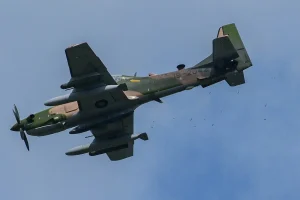
The Tanzania Air Force Command’s fighter fleet is small, Chinese and ageing: about 12 Chengdu J-7G single-seat fighters plus 2 two-seat trainer variants, acquired from China starting in 2009 and now around 17 years into service with no announced successor. Older F-5 and F-7 airframes are reported, per a MilAvia assessment reproduced on Wikipedia, to fly only rarely because of airworthiness problems – a caution against treating any published “total aircraft” figure as an active, flyable count. GlobalMilitary.net’s 2026 estimate of 43 total aircraft of all types includes helicopters, transports and trainers, and is not a fighter count.
Transport modernisation is lagging. A January 2024 contract for two Leonardo C-27J Spartan transports had not been confirmed as delivered as of November 2026, nearly three years after signature. No dedicated jet or turboprop trainer fleet comparable to Kenya’s Grob G120TP line at Laikipia was found for the Tanzania Air Force Command. Air Force personnel are estimated at around 3,000 (defenceWeb estimate). No armed or combat-capable UAV, Turkish or Chinese, is confirmed in Tanzanian air force service – a gap covered in the UAV section below.
Navy
Tanzania has an Indian Ocean coastline running through Tanga, Dar es Salaam, Mtwara and Zanzibar, so this section covers a genuine navy rather than a landlocked footnote – but by the number of hulls that could reasonably be called warships, there is not much navy to describe. No frigate, corvette, offshore patrol vessel or submarine is confirmed in TPDF Navy service. The only vessels clearly attributed to the Navy itself in open sources are two patrol boats donated by the United States and handed over in 2022.
Most of the recent maritime-security investment has gone to other state bodies rather than the Navy proper, which matters for reading “Tanzania buys boats” headlines as a naval build-up. Two Japanese-built, Yamaha-constructed 50-knot Sailfish-class speedboats, reported launched in July 2026 at a cost of about US$1.6 million, were commissioned via the Prime Minister’s office for the Dar es Salaam–Zanzibar route, not the Navy, following a related Japanese Official Security Assistance-funded handover at the Port of Dar es Salaam in March 2026. A Turkish contract placed by the Tanzania Shipping Agencies Corporation (TASAC) – not the Navy – covers patrol and inspection boats for Mtwara Port on the Indian Ocean coast and Bukoba Port on Lake Victoria, chosen, TASAC’s director general said, for their importance to regional trade. A separate, roughly US$1.7 million TASAC contract with a different Turkish firm funds a lake ambulance boat for Lake Victoria, a project inspired by the 1996 MV Bukoba ferry sinking.
Given how thin the hull count is, DefenceMENA treats “total vessels” as a weak measure of Tanzanian naval strength here: a handful of coastal patrol boats and a separate, civil-agency-run set of lake craft are not comparable with a frigate or a proper offshore patrol vessel – and neighbouring Kenya, per DefenceMENA’s existing comparison, does not operate one either.
UAV and drone fleet
No confirmed military UAV or loitering-munition inventory was found for Tanzania. The country’s visible drone activity is civilian: a domestically built agricultural-drone sector has been profiled by IEEE Spectrum, but no Chinese Wing Loong, CH-4 or other combat drone type, and no Turkish Bayraktar TB2, Akıncı or Anka, was found in TPDF service – a sharp contrast with neighbouring Kenya’s confirmed Bayraktar TB2 and Anka-S fleet, or with other African states such as Nigeria, Ethiopia and Algeria that operate Chinese combat UAVs. This is treated here as an absence of evidence from open sources, not as a confirmed negative; Tanzania’s military procurement is less transparently reported than most of its neighbours’.
Air defence
Tanzania has no confirmed modern surface-to-air missile system of any range. What open sources describe is almost entirely historical: SA-3 systems first identified in Tanzania in 1976 (among the earliest sightings in Sub-Saharan Africa) and SA-6 systems first identified in 1979, both Soviet-era and of unconfirmed current operational status, plus 9K32 Strela-2 man-portable systems shown at a 2021 army parade. Army Recognition’s dated order-of-battle reference lists two air-defence artillery battalions in the TPDF’s structure. In 2022 a Tanzanian defence delegation visited India’s Bharat Dynamics Limited, which offered the Akash and Medium Range SAM (MRSAM) systems; no confirmed follow-on contract has been reported since. On present evidence, Tanzania’s air-defence layer is materially weaker than Kenya’s single SPYDER medium-range battery, fielded in December 2025, let alone the multi-tier systems in service across North Africa.
Missiles and artillery
No guided anti-ship, land-attack or ballistic missile system is confirmed in current Tanzanian service. Strike capability rests on the artillery fleet described in the Army section – an estimated 285 towed, self-propelled and rocket pieces combined, overwhelmingly of Soviet or Chinese origin and design – rather than on any precision-guided system. No modern anti-tank guided weapon was found in Tanzanian service either, a gap that stands out next to Kenya’s Milan and Carl Gustaf inventories.
Defence industry
Tanzania’s industrial base is organised around a handful of state- and army-linked bodies rather than a single ordnance corporation. Mzinga Corporation handles ammunition and ordnance production. SUMA JKT, run by National Service, is a diversified industrial conglomerate whose activities extend well beyond defence manufacturing into construction and commercial goods. The Tanzania Automotive Technology Centre at Nyumbu, Kibaha, is the site of the 2025 Streit Group partnership described above, which is intended eventually to supply institutional and export vehicles across East Africa as well as the TPDF. None of Tanzania’s industrial base currently supports large-scale export or complex platform production; the country remains import-dependent for combat aircraft, modern armour and any form of air defence.
Main defence suppliers
SIPRI’s public Arms Transfers fact sheet for 2021–25 does not break out a country-level figure for Tanzania – a direct check of the underlying PDF this run confirmed no Tanzania line, with the country folded into regional sub-Saharan Africa totals instead. The picture that does exist comes from older, secondary reporting rather than a current SIPRI pull.
| Supplier | Main items / period | Basis |
|---|---|---|
| China | J-7G fighters (from 2009), Type 63A tanks and VT-2 tanks (2014-era acquisition and after); named as Tanzania’s historically dominant supplier | SIPRI-period secondary reporting, 2021–22; DefenceMENA research |
| Russia / USSR (legacy) | T-54 tanks, SA-3/SA-6 air defence, Strela-2 MANPADS | Open-source trackers, dated sightings |
| France, Netherlands | Named as secondary suppliers in SIPRI-linked data covering roughly 2011–19, now dated | Statista reproduction of SIPRI-era data |
| United Arab Emirates (Streit Group) | Armoured-vehicle manufacturing and repair partnership signed 2025 | The Citizen; Daily News |
| Türkiye (civil maritime only) | TASAC patrol, inspection and ambulance boats for Mtwara and Lake Victoria ports – not TPDF Navy platforms | Daily News, TASAC reporting |
Sub-Saharan Africa as a whole has shifted its supplier mix toward China and Russia in the 2020–2024 period, which SIPRI says together accounted for 39% of the region’s arms imports – a pattern broadly consistent with Tanzania’s long-standing China- and Russia-leaning inventory, even without a country-specific figure to confirm the current scale.
Recent procurement, 2025–2026
| Date | Event | Value | Status |
|---|---|---|---|
| 25 Jul 2025 | China’s ambassador pledges continued TPDF modernisation support (technology, capacity-building, knowledge transfer) | Undisclosed, no figure given | Reported (offer, no contract) |
| 29 Sep 2025 | TATC Nyumbu signs armoured-vehicle manufacturing and repair partnership with UAE’s Streit Group | Undisclosed | On contract (JV signed) |
| 24 Feb 2026 | President Samia Suluhu Hassan opens new National Defence Headquarters, Dodoma | n/a | Completed |
| 2 Mar 2026 | Russian ambassador offers weapons, technology and training; confirms about 300 Tanzanian cadets training in Russian academies | Undisclosed, no figure given | Reported (offer, no contract) |
| Mar 2026 | Japan hands over Official Security Assistance-funded vessel at Port of Dar es Salaam | Undisclosed | Delivered (to a civil agency) |
| 19 May 2026 | Parliament approves FY2026/27 defence budget of Sh4.29 trillion, up 17.57% | Sh4.29tn (~US$1.62bn) | Approved |
| Jul 2026 (reported) | Two Japanese-built Sailfish-class speedboats launched for the Dar es Salaam–Zanzibar route | ~US$1.6m | Delivered (to the Prime Minister’s office, not the Navy) |
| 2026 (undated) | TASAC contracts a Turkish yard for patrol/inspection boats at Mtwara and Bukoba ports | Undisclosed | On contract (civil agency) |
| Ongoing since Jan 2024 | Two Leonardo C-27J Spartan transports on contract; delivery still not confirmed as of November 2026 | Undisclosed | On contract (delivery unconfirmed) |
Turkish systems in Tanzania
No Turkish-origin military platform is confirmed in Tanzania People’s Defence Force service. The only Turkish defence-sector activity DefenceMENA could verify involves civil maritime agencies rather than the armed forces: TASAC’s contracts with Turkish shipyards for patrol and inspection boats at Mtwara and Bukoba ports, and a separate Turkish-built ambulance boat for Lake Victoria, all sit with the Tanzania Shipping Agencies Corporation, not the Navy. No Bayraktar TB2 or Akıncı, no Turkish armoured vehicle such as the Ejder Yalçın, Kirpi or Cobra, and no ASELSAN, ROKETSAN or MKE system was found in TPDF service, and no announced Turkish defence-industrial deal comparable to the UAE’s Streit Group armoured-vehicle partnership has been reported. Tanzania’s closest equivalent systems – the J-7G fighter fleet and VT-2/Type 63A tanks – are Chinese, not Turkish, which makes this a case of an absent relationship rather than an unconfirmed or a disputed one: Türkiye’s defence-industrial push into East Africa, tracked on DefenceMENA’s East Africa desk, has so far reached Kenya and Ethiopia with armed drones and armoured vehicles but not Tanzania.
What is changing?
Four shifts stand out from the past twelve months. The budget is rising faster, in percentage terms, than almost any other East African defence budget DefenceMENA tracks, with a new permanent headquarters in Dodoma as the most visible symbol of that intent. The Army’s one concrete modernisation move is industrial rather than a platform purchase: the Streit Group partnership aims to build vehicles domestically rather than import a new type, though a year on from signature it remains a construction project rather than a production line. Maritime investment is going mostly to civil agencies – TASAC and the Prime Minister’s office – rather than the Navy itself, which means improved port security and lake safety, including in direct response to the 1996 MV Bukoba disaster, without a parallel increase in blue-water or even coastal-patrol naval capability. And two of Tanzania’s historical partners, China and Russia, have both publicly reaffirmed their willingness to support TPDF modernisation in the past year, without either producing a disclosed contract, so neither should be read as a confirmed new capability yet.
How Tanzania compares in Africa
Within East Africa, Tanzania sits behind Kenya on most measures DefenceMENA can check: fewer and older combat aircraft, no confirmed armed drone against Kenya’s Bayraktar TB2 and Anka-S fleet, and no networked air-defence system against Kenya’s single SPYDER battery. Its artillery count, where trackers put it ahead of Kenya, is the clearest counter-example, though it rests on the same uncorroborated single-tracker figures as the rest of the Army table above; the full side-by-side is in DefenceMENA’s Kenya vs Tanzania comparison. Set against the continent’s largest forces in Egypt, Algeria and Nigeria, Tanzania is not in the same category by any conventional measure. DefenceMENA’s look at which African country has the biggest army and its ranking of African defence budgets give the continental context; Envanter Media’s ranking of Africa’s strongest militaries in 2026 places Tanzania toward the lower-middle of the continental table, consistent with the picture here.
A note on the numbers
Tanzania publishes no public inventory of its armed forces, and most of the equipment figures in this profile come from a single open-source tracker, GlobalMilitary.net, whose Tanzania-specific counts could not be corroborated against a second source and which shows internal inconsistencies across its own comparison pages – a weaker evidentiary base than DefenceMENA uses for most African profiles, and flagged throughout as Estimated. Personnel, budget and procurement figures draw on Tanzanian government statements reported by The Citizen, the Daily News and The Guardian (Tanzania), on SIPRI’s published fact sheets (checked directly for a Tanzania-specific line, which does not exist), and on specialist defence reporting including Army Recognition, Janes, Military Africa and Eurasian Times. Global Firepower’s composite index is not used as an inventory source anywhere in this profile. Where sources disagreed or a figure was dated, this profile states the range or the age of the figure rather than presenting a single current-looking number. This profile was published on 3 November 2026 and will be updated as deliveries are confirmed; the Tanzania desk carries the running news.
Sources
- SIPRI, Trends in International Arms Transfers 2025 (Fact Sheet, March 2026)
- Trading Economics, Tanzania military expenditure (SIPRI-sourced)
- The Citizen, Government raises defence budget by 17.57pc to boost modernization
- The Chanzo, Defence budget increases amid border security challenges and defense technology evolution
- Daily News, Tanzania’s Commander-in-Chief opens Defence Headquarters
- Daily News, Tanzania’s defense sees a new dawn in the new Nyumbu-Streit project
- The Citizen, Tanzania picks UAE firm in landmark armoured vehicles deal
- Army Recognition, Tanzanian army parades with Russian-made 9K32 Strela-2 systems
- Wikipedia, Tanzania People’s Defence Force (open-source compilation, with references)
- GlobalMilitary.net, Tanzania military forces (open-source tracker)
- Eurasian Times, Tanzania could be India’s next defense customer: key BDL
- The Citizen, China renews military modernisation support to Tanzania
- Daily News, Russia, Tanzania strengthen bilateral cooperation through defence and education
- DefenceMENA, Kenya and Tanzania Are Building Very Different Militaries