ASELFLIR 500 is a 15-inch-class electro-optical/infrared (EO/IR) targeting turret made by ASELSAN for fixed-wing aircraft and drones. It combines thermal, day-TV and SWIR cameras with a laser designator rated to 35 km. ASELSAN supplies the sensor; aircraft makers such as Baykar and Paramount build the platforms it flies on.
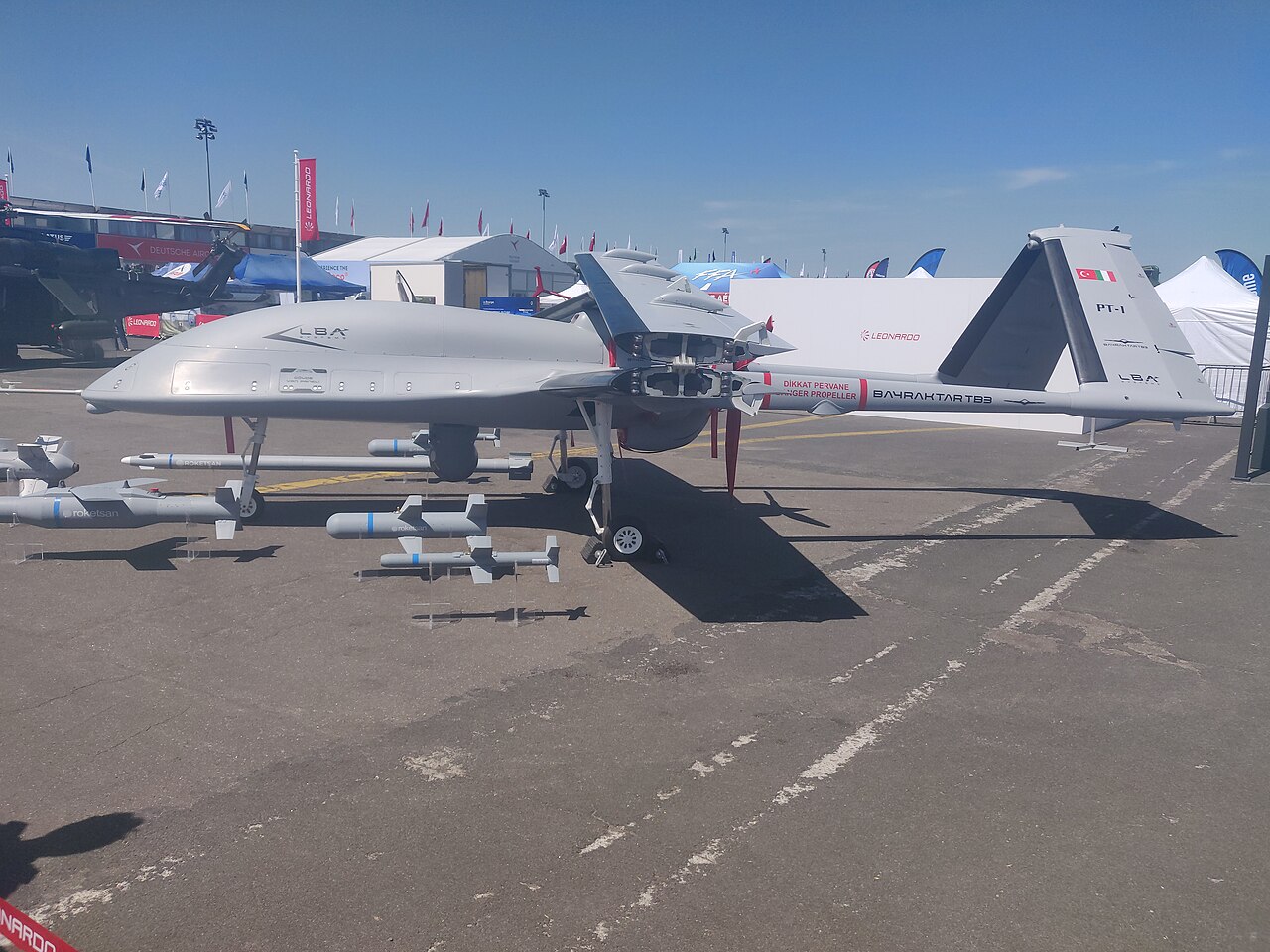
Photo: a Bayraktar TB3, one of the Baykar drones on which ASELFLIR 500 has been flown, on static display at the Paris Air Show, June 2025. The turret fitted to this exhibit is not identified. Credit: Tpe.g5.stan, CC0, via Wikimedia Commons.
Direct answer
ASELFLIR 500 is ASELSAN’s “Electro-Optical Reconnaissance, Surveillance and Targeting System” for fixed-wing aircraft, including unmanned aerial vehicles (UAVs). It is a stabilised gimbal, or turret, that hangs under an aircraft and carries several sensors behind one shared 220 mm optical aperture. According to ASELSAN’s brochure (dated 08.2026), it weighs 54 kg ±5%, and its laser range finder and designator is rated to 35 km. It entered serial production in March 2024. ASELSAN’s 2025 activity report, as reported by TURDEF in May 2026, says it has been exported to 22 countries, with deals signed by 25. The buyers are not named. ASELSAN makes the sensor only. The drones and aircraft that carry it are built by other companies, mainly Baykar and TUSAŞ in Türkiye and, since July 2026, Paramount in South Africa.
| Official name | ASELFLIR 500 Electro-Optical Reconnaissance, Surveillance and Targeting System |
| Maker | ASELSAN, Microelectronics and Electro-Optical Systems (MEOS) sector |
| Class | 15-inch gimbal, for fixed-wing aircraft and UAVs |
| Sensors | HD MWIR thermal (1280×1024), Full HD day TV (1920×1080), HD SWIR (1280×1024) |
| Laser | 1064 nm range finder/designator, up to 35 km; 808 nm laser pointer |
| Weight | 54 kg ±5% (ASELSAN brochure, 08.2026) |
| Serial production | First units off the line in March 2024 (ASELSAN CEO, reported by Defence Turkey) |
| Exports | 22 countries, 25 with signed deals (ASELSAN 2025 activity report, via TURDEF, May 2026); countries not named |
| Predecessor | CATS (Common Aperture Targeting System) |
| Unit price | Not publicly disclosed |
What is ASELFLIR 500?
ASELFLIR 500 is a sensor ball. It lets the crew of a drone or light aircraft find, watch, track and mark targets by day and night. ASELSAN’s product page describes it as “a high performance electro-optical reconnaissance, surveillance and targeting system in 15 inch gimbal category” developed for fixed-wing platforms, including UAVs and aeroplanes.
The design uses a common aperture. The thermal, day-TV and short-wave infrared (SWIR) cameras share a single 220 mm primary mirror. ASELSAN says this gives the three cameras common fields of view and collects more light, which it links to better image quality and range. The turret also carries a laser range finder and target designator, which guides laser-homing munitions, and a laser pointer that shows up in night-vision goggles.
ASELSAN lists other functions on its product page. They include AI-based image processing, multi-target tracking on all three video channels at once, target geo-location, and working out the course and speed of a moving target. The Turkish-language page adds laser spot tracking and “see spot”, which means seeing the designator’s laser spot in every imaging channel.
Who makes it, and what is ASELSAN’s role?
ASELSAN designs and manufactures the turret in its MEOS sector in Ankara. It does not build the aircraft. The chain works like this:
- Product: ASELFLIR 500 EO/IR turret (ASELSAN).
- Platform: a drone or light aircraft, such as the Bayraktar TB2, TB3 or AKINCI (Baykar), ANKA-III or AKSUNGUR (TUSAŞ), or Mwari (Paramount).
- Prime contractor: the aircraft maker, which usually holds the export contract.
- User: the air force, army or security agency that buys the aircraft.
So when a country buys a Turkish drone, the turret usually arrives as part of that deal. This is why ASELSAN can report 22 export countries without naming them. It also means a country that flies TB2s does not necessarily fly ASELFLIR 500. Earlier TB2s used other turrets (see below).
How was it developed, and when did serial production start?
The programme grew out of an export ban. In October 2020 Canada suspended export permits for optical and targeting systems made by L3Harris WESCAM, after reports that they were being used on Turkish drones in the Nagorno-Karabakh war. In April 2021 Canada’s foreign minister, Marc Garneau, cancelled 29 permits. Turkish drone makers had been using the WESCAM MX-15D turret.
ASELSAN’s first answer was CATS, a common-aperture targeting system for UAVs. ASELFLIR 500 followed as its successor, as TURDEF reported in May 2026. Key dates:
- 24 February 2024: Baykar said a Bayraktar AKINCI hit a moving target at sea, an Albatros unmanned surface vessel, in the first test of ASELFLIR 500.
- March 2024: ASELSAN President and CEO Ahmet Akyol announced the first ASELFLIR 500 and ASELFLIR 410 units off the serial production line and “prepared for delivery to users” (Defence Turkey, 17 March 2024).
- 27 March 2024: Baykar said the Bayraktar TB3 flew with ASELFLIR 500 for the first time, on its 25th test flight.
- September 2024: ASELSAN signed agreements with Azerbaijan’s Ministry of Defence at ADEX 2024 covering ASELFLIR 500, for use on AKINCI drones.
- 27 July 2026: integration of ASELFLIR 500 on the Paramount Mwari was announced in South Africa.
ASELFLIR 500 specifications: what ASELSAN publishes
The figures below come only from ASELSAN’s English brochure, stamped “MEOS – ASELFLIR 500 – 08.2026”. ASELSAN notes that specifications may change without notice and that all tolerances are within ±10%.
| Item | Specification |
|---|---|
| Primary mirror diameter | 220 mm (common aperture) |
| HD IR camera | 1280×1024, 3-5 µm MWIR; horizontal FOV 1.3°, 4.3°, 7.7°, 13.9°, 25° |
| HD day TV camera | 1920×1080; FOV 0.5° and 0.9°, plus continuous zoom 2.6° to 24° |
| HD SWIR camera | 1280×1024; FOV 0.67° and 1.1° |
| Laser range finder and designator | 1064 nm; up to 35 km; STANAG 3733 (Edition 3) coding |
| Laser pointer | 808 nm, NIR/SWIR, compatible with night-vision goggles |
| Field of regard | 360° continuous azimuth; +90° to -90° elevation |
| Stabilisation | 4-axis mechanical plus 2-axis optical |
| Interfaces | RS-422 and MIL-STD-1553B; 4x SMPTE-292M HD-SDI video (1080p); 28 VDC power |
| Size | 480 mm wide, 520 mm high (forward position) |
| Weight | 54 kg ±5% |
| Temperature | Operating -40 °C to +52 °C; storage -55 °C to +70 °C |
Which ASELFLIR 500 figures does the press get wrong?
- Weight. Some articles give about 52 kg. ASELSAN’s current brochure says 54 kg ±5%.
- Camera resolution. A January 2026 TURDEF article gave a 4096×2880 day camera and a 1280×720 infrared camera. ASELSAN’s brochure lists 1920×1080 day TV and 1280×1024 MWIR and SWIR.
- “15 inches” and “220 mm”. The 15-inch figure is ASELSAN’s class label for the gimbal. The 220 mm figure is the diameter of the primary mirror. Neither is the outer diameter of the ball. ASELSAN gives width (480 mm) and height (520 mm), not a diameter.
- Range. The 35 km figure is the laser range finder/designator rating. ASELSAN does not publish detection, recognition or identification ranges for the cameras. Any “detects a vehicle at X km” figure is not from ASELSAN.
Which platforms carry ASELFLIR 500?
ASELSAN’s 2025 activity report, as summarised by TURDEF on 4 May 2026, lists integration on the Bayraktar TB2, Bayraktar TB3, AKSUNGUR, AKINCI and ANKA-III. The Mwari integration was announced in July 2026.
| Platform | Platform maker | Status | Source and date |
|---|---|---|---|
| Bayraktar AKINCI | Baykar (Türkiye) | Integrated; first live test 24 Feb 2024 | Baykar, Feb 2024 |
| Bayraktar TB3 | Baykar | Integrated; first flight 27 Mar 2024 | Baykar, Mar 2024 |
| Bayraktar TB2 | Baykar | Integrated | ASELSAN 2025 activity report, via TURDEF, May 2026 |
| AKSUNGUR | TUSAŞ (Türkiye) | Integrated | Same |
| ANKA-III | TUSAŞ | Integrated | Same |
| Mwari | Paramount (South Africa) | Integrated; no customer named | defenceWeb, 27 Jul 2026; FlightGlobal, 6 Aug 2026 |
The Mwari is a manned light surveillance and strike aircraft (originally the AHRLAC). FlightGlobal reported in August 2026 that Paramount is now also promoting it for counter-drone work, against slow aerial targets. No Mwari buyer with ASELFLIR 500 has been announced.
Who uses ASELFLIR 500?
ASELSAN says the turret has been exported to 22 countries, with 25 having signed deals. That figure comes from its 2025 activity report, as reported by TURDEF in May 2026. defenceWeb described it in July 2026 as “over 20 countries”. ASELSAN does not name the countries. Where a user can be named, it is because another source links the turret to that country.
| Country | Platform (maker) | Status | Source |
|---|---|---|---|
| Türkiye | AKINCI, TB2, TB3, AKSUNGUR, ANKA-III | Integrated; in production since 2024 | Baykar; ASELSAN via TURDEF |
| Azerbaijan | AKINCI (Baykar) | Ordered (Sept 2024); delivery not officially confirmed | Defence Industry Europe, 25 Sep 2024 |
| South Africa | Mwari (Paramount) | Integrated (industry); no government order | defenceWeb, Jul 2026 |
| Kenya | Bayraktar TB2 (Baykar), 6 aircraft | Reported (single source) | Techweez, 2 Jan 2025 |
The Kenya entry needs care. Kenyan outlet Techweez wrote in January 2025 that Kenya’s six TB2s “are equipped with Aselsan’s Aselflir-500” turrets. Neither Baykar, ASELSAN nor the Kenya Defence Forces have confirmed the sensor fit. We list it as a single-source report.
Other African and Middle Eastern states fly Baykar or TUSAŞ drones that can carry ASELFLIR 500. They include AKINCI operators reported in Somalia, and TB2 operators across West Africa and the Sahel. Whether their aircraft carry ASELFLIR 500, CATS or an older turret depends on the delivery date and the contract. No source confirms it country by country, so we do not assume it.
How does ASELFLIR 500 relate to CATS and other ASELFLIR models?
ASELSAN sells several EO/IR turrets under the ASELFLIR name, plus CATS. They differ in size, platform and whether they carry a designator. All figures below are from ASELSAN brochures.
| System | Role and class | Main sensors | Laser | Weight |
|---|---|---|---|---|
| CATS | UAV targeting turret; ASELFLIR 500’s predecessor | MWIR 640×512, HD TV, NIR | Designator, up to 35 km | 55 kg ±5% |
| ASELFLIR 500 | 15-inch; fixed-wing aircraft and UAVs | MWIR 1280×1024, Full HD TV, SWIR | Designator, up to 35 km | 54 kg ±5% |
| ASELFLIR 600 | 25-inch; HALE-class UAVs | MWIR 1280×1024, Full HD TV, SWIR | Designator, “up to 35” (unit not printed) | 120 kg +10% |
| ASELFLIR 410 | Helicopters, vehicles, border and coast | MWIR 1024×768, Full HD TV, SWIR 640×512 | Designator, up to 30 km | 57 kg ±5% |
| ASELFLIR 400 | Surveillance only; same uses as 410 | As 410 | Eye-safe range finder, 20 km; no designator | 57 kg |
| ASELFLIR 300T | Manned aircraft and helicopters | LWIR 1440×576, 3-CCD TV | Designator, 20 km | 95 kg turret + 23 kg electronics |
ASELFLIR 300T is the version most visible in Africa. Nigeria’s six T129 ATAK attack helicopters, built by TUSAŞ, carry it. defenceWeb reported that the first two arrived in November 2023, with the rest due by early 2024. As on the drones, ASELSAN supplied the sensor and TUSAŞ the helicopter.
Some press reports claim ASELFLIR 600 can image targets at 225 km. That figure is not in ASELSAN’s brochure.
What are ASELFLIR 500’s competitors?
ASELFLIR 500 competes in the crowded 15-inch class of drone turrets. We list rivals only where a source ties them to the same kind of platform. We compare them on the same points: who makes them, which platforms carry them, and whether export limits apply. Detailed range claims from different makers are not comparable, because each uses its own test conditions.
| System | Maker (country) | Typical platforms | African users (reported) | Export factor |
|---|---|---|---|---|
| ASELFLIR 500 | ASELSAN (Türkiye) | TB2, TB3, AKINCI, ANKA-III, AKSUNGUR, Mwari | Kenya (single-source report) | Turkish export licence; sold mostly with Turkish drones |
| WESCAM MX-15D | L3Harris WESCAM (Canada) | Early Bayraktar TB2s, many Western aircraft | Morocco TB2 (reported) | Canada cancelled Turkish permits in April 2021 |
| Chinese EO/IR turrets | Chinese suppliers; exact model not published | Wing Loong II (AVIC), CH-4 (CASC) | Nigeria, Algeria, Morocco, Egypt, Côte d’Ivoire (Wing Loong family) | Sold as part of Chinese drone packages |
For buyers, the choice is usually made at the platform level. A country that buys TB2s from Baykar today will receive a Turkish turret. A country that buys Wing Loong II will get a Chinese one. For a side-by-side look at the drones themselves, see our comparison of the TB2, Wing Loong II and CH-4 in Africa.
What does ASELFLIR 500 cost?
The price is not publicly disclosed. People search for “ASELFLIR 500 price”, but there are three reasons no reliable figure exists.
- It is sold inside larger packages. Most turrets are exported as part of a drone deal with Baykar or TUSAŞ. That deal also covers aircraft, ground stations, training, spares and munitions.
- Contract values are rarely published. The Azerbaijan agreement of September 2024 was announced without a value.
- Configurations differ. Software, integration work and support terms change the price for each buyer.
Any online figure for a single ASELFLIR 500 should be treated as an estimate. Dividing a package contract by the number of drones does not give a turret price.
Why does ASELFLIR 500 matter for Africa?
ASELSAN told defenceWeb in September 2024 that its equipment is in service in 21 African countries. It named “air platform payloads” as one of its main business areas on the continent, but did not list the countries. Turkish drones are now common in African air arms, and the EO/IR turret is what allows them to find and strike targets. Three points stand out for African buyers.
- A non-Western supply chain. After Canada’s 2021 decision, Turkish drones no longer depend on Canadian optics. For buyers, that removes one outside veto over spares and upgrades.
- A local link. The Mwari integration is the first announced case of ASELFLIR 500 on an African-built aircraft. ASELSAN has had a South African subsidiary in Pretoria since 2011, which works on airborne EO sensors.
- Counter-insurgency use. Laser designation lets a drone guide its own munitions or mark targets for other aircraft. That matters in the Sahel, the Lake Chad basin and the Horn of Africa, where drones are used against insurgent groups.
For more on how ASELSAN equipment reaches African forces, see ASELSAN in Africa. For a Turkish-language technical breakdown, see Envanter Media’s ASELFLIR 500 profile.
Frequently asked questions
What is the range of ASELFLIR 500?
ASELSAN rates the laser range finder and designator at up to 35 km. It does not publish detection or identification ranges for the cameras. Those depend on target size, weather and altitude.
How much does ASELFLIR 500 weigh?
54 kg ±5%, according to ASELSAN’s brochure dated 08.2026. The turret is 480 mm wide and 520 mm high. Figures of about 52 kg appear in some press reports but do not match the current brochure.
Is ASELFLIR 500 fitted to the Bayraktar TB2?
Yes. ASELSAN lists the TB2 among its integrated platforms, according to its 2025 activity report as reported by TURDEF. Early TB2s used the Canadian WESCAM MX-15D, and later ones CATS, so not every TB2 in service carries ASELFLIR 500.
What is the ASELFLIR 500 on the Mwari aircraft?
In July 2026 it was announced that ASELSAN’s ASELFLIR 500 had been integrated on the Mwari light surveillance and strike aircraft built by South Africa’s Paramount. Paramount is also promoting the aircraft for counter-drone work. No customer has been announced.
How much does ASELFLIR 500 cost?
The price is not publicly disclosed. The turret is usually sold as part of a drone package, and contract values are rarely published.
What is the difference between CATS and ASELFLIR 500?
CATS came first and has a 640×512 thermal camera. ASELFLIR 500 is its successor, with a 1280×1024 thermal camera, a Full HD day camera and a SWIR channel behind the same 220 mm aperture.
Related on DefenceMENA
- ASELSAN: company, products and global presence
- ASELSAN in Africa
- MURAD AESA radar explained
- KORAL electronic warfare system
- ASELSAN air defence and counter-UAS systems
- TB2 vs Wing Loong II vs CH-4 in Africa
- Turkish systems in African service
- Nigeria military strength
- Kenya army weapons
- South Africa army weapons
Sources
- ASELSAN: ASELFLIR 500 brochure (08.2026)
- ASELSAN: ASELFLIR 500 product page
- ASELSAN: CATS brochure (08.2026)
- ASELSAN: ASELFLIR 600 brochure (08.2026)
- ASELSAN: ASELFLIR 410 brochure (08.2026)
- ASELSAN: ASELFLIR 400 brochure (08.2026)
- ASELSAN: ASELFLIR 300T brochure (08.2025)
- Baykar: Türkiye’s new advanced drone camera undergoes 1st test (Feb 2024)
- Baykar: Bayraktar TB3 flies with ASELFLIR-500 (Mar 2024)
- Global Affairs Canada: Statement from Minister Garneau on the cancellation of export permits to Turkey (Apr 2021)
- Defence Turkey: Serial production of ASELFLIR-500 electro-optical systems began (Mar 2024)
- TURDEF: ASELSAN exports ASELFLIR 500 EO/IR system to 22 countries (May 2026)
- Defence Industry Europe: ASELSAN signs agreements to provide Azerbaijan with advanced defence solutions (Sep 2024)
- defenceWeb: ASELSAN’s ASELFLIR-500 integration with the Paramount Mwari (Jul 2026)
- FlightGlobal: Paramount’s Mwari gets ASELSAN sensor as focus shifts to counter-drone mission (Aug 2026)
- defenceWeb: First Nigerian T-129 helicopters delivered (Nov 2023)
- defenceWeb: Africa an important market for ASELSAN (Sep 2024)
- Techweez: Kenya’s Bayraktar TB2 drones delivered (Jan 2025)
- Military Africa: Ivory Coast confirms Chinese Wing Loong II drones (Aug 2026)
Data as of 29 September 2026. Specifications are taken from ASELSAN’s brochures, which ASELSAN says may change without notice. Export totals are ASELSAN’s own figures and do not name countries. Operator entries are labelled by status: an order is not a delivery, and a platform in service does not confirm which turret it carries.