EU Mission Commander: 154 Insurgent Attacks Hit Mozambique’s Cabo Delgado in Five Months



An EU training-mission commander says Mozambique’s security forces recorded 154 insurgent attacks in Cabo Delgado and neighbouring Niassa province between June and the end of October, as Islamic State-linked fighters widen their reach across the province’s north.
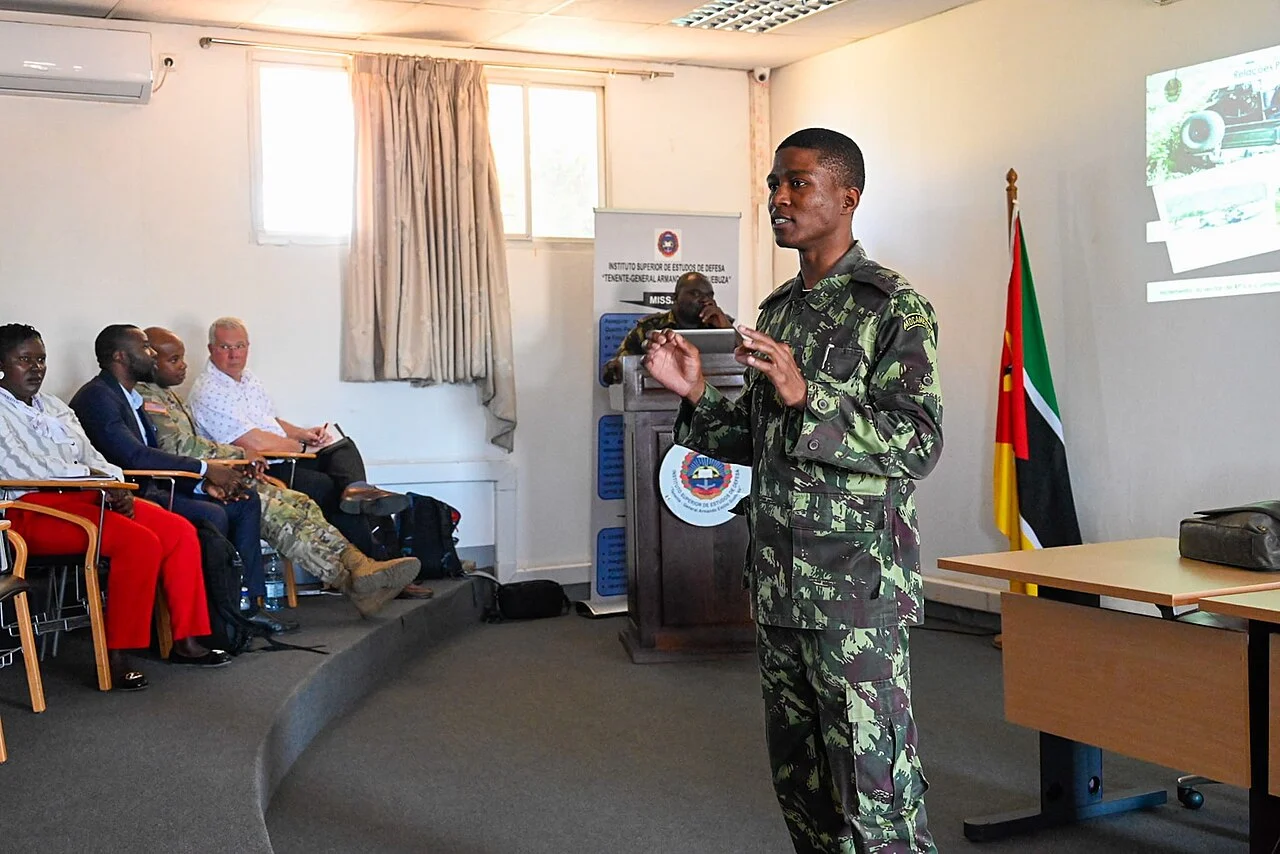
Photo: Mozambican Armed Forces (FADM) officer during a briefing in Maputo. Credit: U.S. Army SETAF-AF / Capt. Billy Lacroix, Public domain, via Wikimedia Commons
Brigadier General Sérgio Estrela, force commander of the EU Military Assistance Mission in Mozambique (EUMAM), gave the attack count at a lecture in Maputo hosted by the Strategic Analysis Centre of the Community of Portuguese-Speaking Countries, according to defenceWeb. The attacks spread across 16 districts and roughly 120 localities — 15 districts in Cabo Delgado and one in Niassa — which Estrela said is stretching the Mozambican armed forces’ (FADM) ability to respond.
A widening, more mobile insurgency
Estrela pointed to kidnapping and ransom demands as a tactic the insurgency has increasingly adopted alongside its established pattern of village raids and ambushes. The group operating in Cabo Delgado, locally known as al-Shabaab (unrelated to the Somali movement of the same name) and recognised internationally as Islamic State Mozambique, has fought an insurgency in the gas-rich province since 2017.
The toll in recent days illustrates the pattern Estrela described. According to the Mozambique Times, at least five people were beheaded on farms in the Muidumbe and Mueda districts on 30 and 31 October, and three more were reportedly killed in Muatide village while producing nipa, a traditional sugarcane spirit that the insurgents consider forbidden. On 1 November, Islamic State Mozambique claimed responsibility for killing 13 people it described as Christians in Muidumbe and Mueda over the preceding week — a claim DefenceMENA is reporting as an attributed statement by the group, not a verified casualty figure. Local residents told reporters that FADM presence in the low-lying areas of both districts is minimal or absent.
Years of foreign support, limited results on the ground
Mozambique’s fight against the insurgency has drawn in a wider set of foreign partners than almost any other conflict in Africa. Rwandan troops and a SADC force intervened from 2021, Rwanda’s deployment continues under a bilateral arrangement, and the EU has run training missions since 2021 to build up FADM’s own quick-reaction capability rather than deploy combat troops directly.
Institute for Security Studies researcher Borges Nhamirre told the same forum that nine years after the first Cabo Delgado attacks, outside training and equipment support has not yet translated into results on the ground, with affected communities still facing inadequate security and, in some cases, rights abuses by security forces. He noted that the EU alone has channelled €89 million into non-lethal equipment and training, and that EUMAM has put more than 1,600 personnel through 11 FADM quick-reaction force courses.
DefenceMENA reported in October that FADM has continued to lose ground in Cabo Delgado even as the roster of foreign partners training and equipping it has grown, a pattern this latest EUMAM briefing reinforces rather than reverses. South Africa, which deployed troops to Mozambique under the SADC mission before its 2024 drawdown, has since kept a bilateral channel open; defence chiefs from Pretoria and Maputo reviewed security cooperation earlier this year.
Why it matters for Africa
Cabo Delgado sits on top of some of the largest untapped natural gas reserves in Africa, and the insurgency has already forced a multi-year suspension of TotalEnergies’ $20 billion LNG project near Palma. A security picture that EUMAM’s own commander describes as spreading rather than contracting keeps that project’s restart timeline uncertain and reinforces the case other SADC states have made for staying engaged rather than drawing down, even as training missions struggle to show results nine years into the conflict. For Southern African governments watching Mozambique, the lesson Estrela and Nhamirre both pointed to is the same: equipment and training packages do not substitute for a ground presence capable of protecting the rural districts where the insurgency actually operates.
Sources
- defenceWeb: “Over 150 insurgent attacks recorded over five months in northern Mozambique”
- DefenceMENA: “Mozambique’s Army Is Losing Ground in Cabo Delgado as Foreign Partners Multiply”
- DefenceMENA: “South Africa and Mozambique Defence Chiefs Review Security Cooperation in Pretoria”
- DefenceMENA: Mozambique coverage