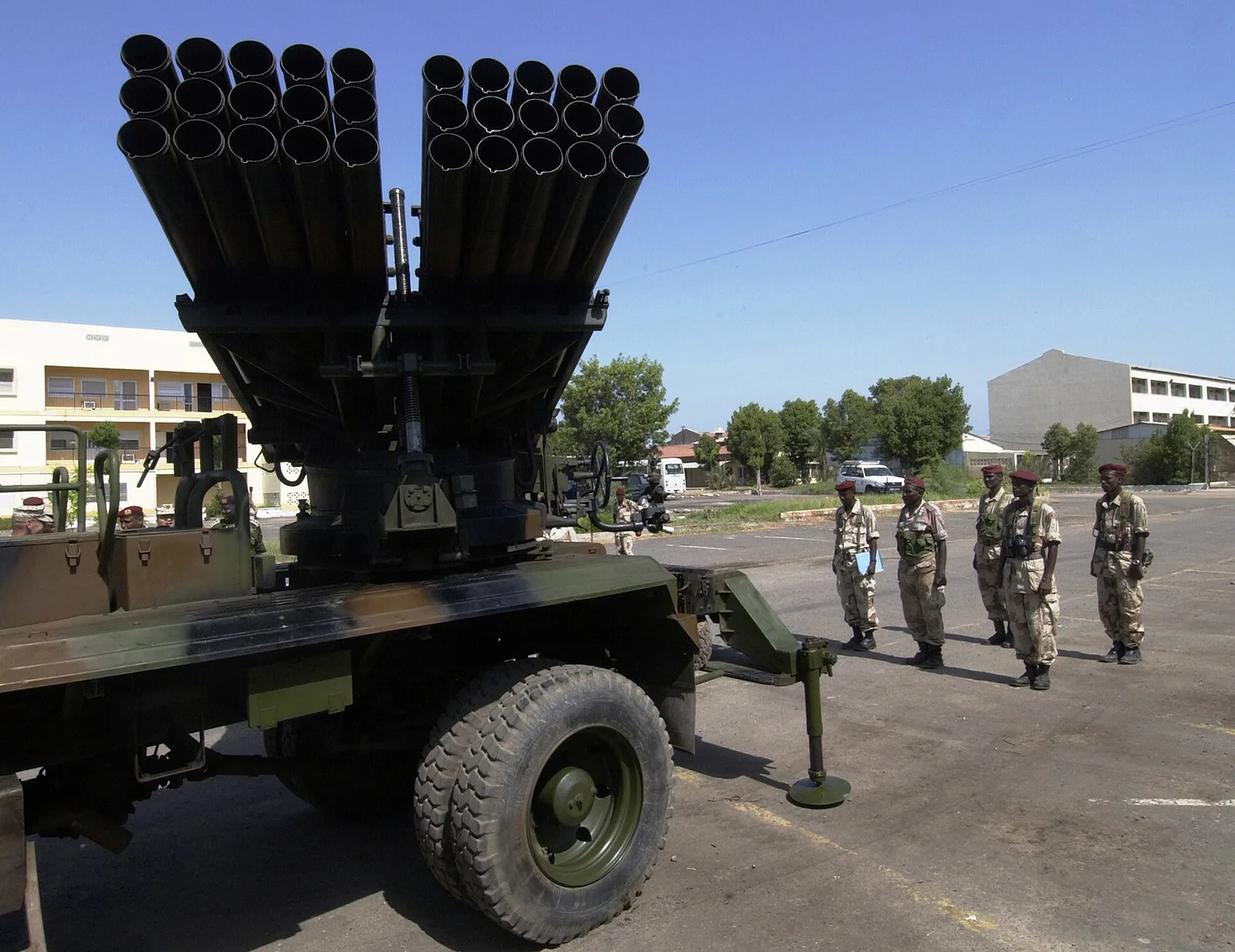
Multiple rocket launchers (MRLs) are among the most widespread heavy weapons in African armies. The Soviet-designed 122 mm BM-21 Grad and its copies are still the most common. The longest-range systems documented in Africa are 300 mm-class launchers: China’s PHL-03 in Morocco and Ethiopia, the A-200 in Ethiopia, the A-100 in Tanzania and the WS-1B in Sudan, plus Russia’s TOS-1 in Algeria. Egypt fields the US M270. Morocco has added Israel’s PULS and has 18 US HIMARS on order, though SIPRI records none of the HIMARS as delivered yet.
Photo: A Djiboutian Army multiple rocket launcher, June 2006. Credit: Roger S. Duncan, U.S. Navy, Public domain, via Wikimedia Commons.
What is a multiple rocket launcher?
A multiple rocket launcher (MRL, MLRS or rocket artillery) fires a salvo of unguided or guided artillery rockets from a cluster of launch tubes, usually mounted on a truck or tracked vehicle. A howitzer fires one shell at a time from a single barrel that is loaded through the breech. A rocket launcher instead saturates an area in seconds and then has to reload. Modern systems such as HIMARS, PULS and the PHL-03 can fire guided rockets with much greater precision and range.
- Rocket: a projectile carrying its own motor. An artillery rocket has no seeker unless it is a guided variant.
- Mortar: a short, high-angle, muzzle-loaded weapon used at infantry level for close indirect fire.
- Fire adjustment: correcting the aim of indirect fire, using observers, drones or radar, so that rounds land on target.
- Firing platform: the vehicle or mount the weapon fires from.
- Heavy weapon: a crew-served weapon too heavy for one soldier. The category includes mortars, heavy machine guns, artillery and rocket launchers.
For tube artillery (towed and self-propelled howitzers), see our guide to artillery for African armies.
Quick answer, verified 3 November 2026 (SIPRI, orders since 2000)
- 300 mm-class long-range MRL: Morocco (PHL-03), Ethiopia (PHL-03, A-200), Tanzania (A-100), Sudan (WS-1B 302 mm)
- US-made: Egypt (M270, 38 delivered 2003–05); Morocco (HIMARS, 18 ordered 2023, not yet delivered according to SIPRI)
- Israeli-made: Morocco (PULS, 4 delivered 2023)
- Thermobaric TOS-1: Algeria (4, 2016)
- Chinese SR-5: Algeria (2017), Burkina Faso (2025), Mali (2025)
- BM-21 Grad family: widespread, including Angola, DR Congo, Mali, Nigeria, Senegal, Sudan and South Sudan
| Country | System | Calibre | Number | Delivered |
|---|---|---|---|---|
| Algeria | TOS-1; SR-5 | 220 mm; 122/220 mm | 4; 18 | 2016; 2017 |
| Angola | BM-22 Uragan (modernised); BM-21 Grad | 220 mm; 122 mm | 4; 32 | 2017–2019 |
| Burkina Faso | SR-5 | 122/220 mm | 4 | 2025 |
| Egypt | M270 MLRS | 227 mm | 38 | 2003–2005 |
| Ethiopia | PHL-03; A-200 | 300 mm; 301 mm | 4; 4 | 2018–2020 |
| Ghana | Type 81 | 122 mm | 3; 4 | 2004; 2023 |
| Libya | T-122/300 (Türkiye) | 122/300 mm | 1 | 2020 |
| Mali | BM-21 Grad; SR-5 | 122 mm; 122/220 mm | 48; 5 | 2013–2016; 2025 |
| Morocco | PHL-03; PULS; HIMARS | 300 mm; multi-calibre; 227 mm | 12; 4; 18 | 2010; 2023; HIMARS on order |
| Nigeria | RM-70; BM-21 Grad | 122 mm | 7; 10 | 2015 |
| Sudan | Type 63 (incl. local TAKA-1); BM-21; WS-1B | 107 mm; 122 mm; 302 mm | 460; 42; 6 | 2001–2014 |
| Tanzania | A-100 | 300 mm | 12 | 2013 |
Additional SIPRI entries since 2000 not shown above: Chad, Côte d’Ivoire, DR Congo, Eritrea, Gabon, Guinea, Mauritania, Rwanda, Senegal, South Sudan, Uganda and Zimbabwe. All are 107–220 mm systems.
North Africa: the most modern rocket artillery
Morocco has the most varied modern rocket artillery in Africa. It has had Chinese PHL-03 300 mm launchers since 2010 and received Israeli PULS in 2023. In April 2023 the US approved a proposed sale of 18 HIMARS launchers to Morocco, with ATACMS missiles and GMLRS rockets, worth up to $524.2 million. SIPRI records the order but no deliveries yet. Until they arrive, the HIMARS are an order, not inventory. See HIMARS M142 explained and Morocco military strength. Egypt’s 38 M270 launchers arrived in 2003–05 under US military aid (Egypt military strength). Algeria bought Russian TOS-1 thermobaric launchers and Chinese SR-5 systems in 2016–17.
East Africa: Chinese long-range launchers
Ethiopia received PHL-03 and A-200 300 mm-class launchers between 2018 and 2020 (Ethiopia army weapons). Tanzania took 12 A-100s in 2013. Sudan has the WS-1B 302 mm system and very large numbers of 107 mm Type 63 launchers, including a locally produced version, TAKA-1 (Sudan military strength).
Sahel and West Africa: Grad and SR-5
Sahel armies mostly operate second-hand BM-21 Grads. Mali and Burkina Faso both received Chinese SR-5 launchers in 2025, according to SIPRI. Nigeria added second-hand RM-70 and BM-21 launchers in 2015 for counter-insurgency operations in the north-east.
Turkish rocket artillery in Africa
SIPRI records one Turkish T-122/300 launcher supplied to Libya as aid in 2020.
Frequently asked questions
Does Morocco have HIMARS?
Morocco ordered 18 HIMARS in 2023. SIPRI recorded no deliveries as of its latest data, so they are on order, not yet in service.
Which African country has the longest-range rocket artillery?
The 300 mm-class PHL-03, A-100 and A-200 launchers in Morocco, Ethiopia and Tanzania have the longest published ranges among documented African systems.
What is the difference between MLRS and a howitzer?
A howitzer fires single shells from a barrel and can sustain fire. An MLRS fires a rapid salvo of rockets to cover an area or, with guided rockets, a precise point, and then reloads.
Sources
- SIPRI Arms Transfers Database – multiple rocket launcher entries for African recipients, 2000–2025 (accessed 3 November 2026)
- US Defense Security Cooperation Agency, April 2023 – Morocco: HIMARS proposed sale (18 launchers, up to $524.2 million)
- Reuters, April 2023 – US approves potential sale of HIMARS to Morocco
- Global Firepower 2026 – MLRS totals by country (estimates)
Method: deliveries and orders are SIPRI records. Orders are not counted as inventory. Global Firepower totals are estimates, used for context only. The article gives no tactical or targeting detail.
Last verified: 3 November 2026