Who Actually Controls Yemen’s Military in 2026?



Yemen has not had one army since 2014. It now has at least five armed forces that answer to different chains of command, and in October 2026 two of them opened the widest offensive the country has seen in years. This profile sets out what each side actually fields, who backs it, and why none of the numbers in this piece should be added into a single national total.
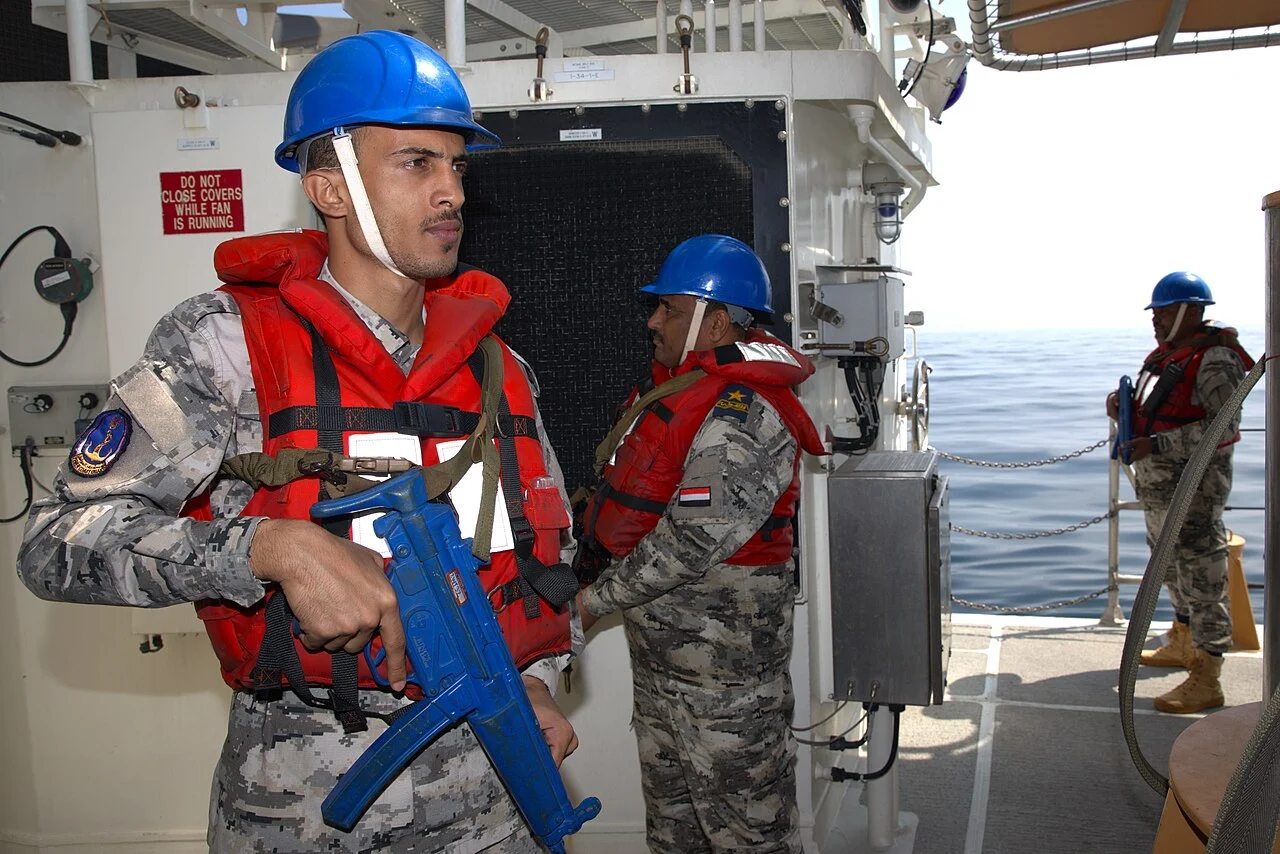
Photo: Members of the Yemeni Coast Guard take part in a boarding exercise aboard a US Coast Guard cutter during a multinational maritime exercise. Credit: Spc. Bryan Clay / US Department of Defense, Public domain, via Wikimedia Commons
Asking “how strong is Yemen’s military” assumes there is one military to measure. There is not. The internationally recognised government, led by an eight-member Presidential Leadership Council (PLC) under Rashad al-Alimi, has been based in Aden since the Houthi movement (Ansar Allah) seized the capital, Sanaa, in 2014–15. Houthi forces hold Sanaa and most of the populous north and west. Several nominally pro-government factions — the Giants Brigades, the National Resistance Forces, the Nation’s Shield Forces and what remains of the Southern Transitional Council’s (STC) units — fight alongside the government’s own forces but keep separate chains of command, separate foreign backers and, in the STC’s case, a separatist agenda the government does not share. Saudi Arabia has led an international coalition backing the government since 2015; Iran is widely assessed to back the Houthis.
In October 2026 this patchwork went back to open war. The government launched Operation Dawn of Yemen on 5 October, aiming to retake all Houthi-held territory including Sanaa, after the Houthis had declared a naval blockade of Saudi Arabia in July and opened an offensive toward the Red Sea coast in September. Every figure in this profile carries a status label — In service, Reported (unconfirmed), Estimated or Status unclear — because neither side publishes a verifiable order of battle, and because claims made by combatants in an active offensive are, by definition, unconfirmed until an independent source checks them.
| Indicator | Figure | Year / source |
|---|---|---|
| Internationally recognised government forces | About 122,000 troops, with armoured vehicles, anti-tank rockets and air-defence guns; IISS notes only “limited control” over some allied factions | 2026, IISS Military Balance (Estimated) |
| Houthi-administered forces (Sanaa’s own count) | Houthi-run military registries claim over 200,000 fighters, plus Popular Committees volunteers; independent estimates range roughly 200,000–350,000 | 2026, Sanaa registries via Al Jazeera; outside estimates (Reported/Estimated, wide variance) |
| Giants Brigades (Al-Amaliqa, southern, anti-Houthi) | Estimated 15,000–30,000 fighters; reportedly the best-equipped southern faction | 2026, open-source estimates (Estimated) |
| Nation’s Shield Forces (Saudi-aligned) | Estimated around 45,000 personnel | 2026, open-source estimates (Estimated) |
| Saudi-led coalition air support (October 2026 offensive) | Coalition said about 100 fighter jets provided air cover over the Bab al-Mandeb area during Dawn of Yemen | October 2026, coalition statement via The National (Reported) |
| UAE funding to southern forces (Giants Brigades) | The Guardian reported the UAE agreed to resume funding, with Saudi air cover in return; neither government has confirmed it, and an Emirati academic close to Abu Dhabi disputed the report | 17–18 October 2026 (Reported, unconfirmed by either government) |
| Houthi missile strike on Aden presidential compound | Houthi missiles struck the al-Maashiq presidential palace on 15 October 2026, reportedly killing at least five people; two further missiles landed near Aden airport’s runway on 16 October | October 2026, Yemen’s information minister (Reported) |
Four or five armies, one country: who controls what in 2026
The Yemeni Armed Forces, on paper, answer to the PLC and are organised into seven military regions, but the force structure that exists on the ground in 2026 diverges sharply from that chart. Outside the formal structure, several factions do the bulk of the government side’s actual fighting. The Giants Brigades (Al-Amaliqa), a southern formation estimated at 15,000–30,000 fighters, has previously intercepted alleged weapons shipments bound for the Houthis around the Bab al-Mandeb strait and is widely described by foreign reporting as the most capable anti-Houthi ground force. The National Resistance Forces, led by Brigadier General Tariq Saleh (a nephew of the late president Ali Abdullah Saleh), operate mainly on the Red Sea coast. The Nation’s Shield Forces, estimated at roughly 45,000 and Saudi-aligned, helped restore government control in parts of the south after factional clashes in late 2025. The Yemen Emergency Forces, stood up by the government in late 2025, operate along the border with Saudi Arabia. On 10 January 2026 PLC chairman Rashad al-Alimi launched a Higher Military Committee, under coalition command, to try to unify these factions into a single chain of command; how far that restructuring has actually progressed is Status unclear, and claims of mass Houthi defections to the government side come from a single outlet and are Reported (unconfirmed).
The Southern Transitional Council (STC) is a separate, and separately complicated, case. Backed by the UAE since 2017 with funding, training and equipment through its “Security Belt” forces, the STC pursued a southern-secession agenda that put it at odds with the Aden government. Per Guardian reporting, the STC attempted and failed to assert control across the south and push for a secession referendum in late 2025; Saudi Arabia then struck ships off Mukalla that it said were carrying UAE weapons and vehicles for STC forces (the UAE disputed that characterisation), the PLC ordered Emirati forces out of the country within 24 hours, and the UAE’s Ministry of Foreign Affairs said its forces had completed a full withdrawal, “including the transfer of all equipment, weapons and assets,” on 2 January 2026. STC leader Aidarous al-Zubaidi relocated to Abu Dhabi. Yemeni government sources describe the STC as now dissolved; that is the government’s own framing and has not been independently verified, and the STC itself has not agreed to send its remaining fighters north of the former South Yemen border.
The October 2026 escalation: Dawn of Yemen and the Houthi Red Sea offensive
Hostilities resumed at scale after the Houthis declared a naval blockade on Saudi Arabia in July 2026 and began striking Saudi territory and shipping; a Houthi offensive aimed at the Red Sea coast and the Bab al-Mandeb strait followed in September, which The National reported (citing a single source) involved an Iranian Revolutionary Guard Corps operative identified only as “Shadow Man.” In early August, Houthi missile and drone strikes on government military camps in Hadramout and Marib governorates reportedly killed at least 30 government soldiers; days later the government said it had carried out 181 operations against Houthi-held areas in 24 hours, a claim from its own statement. On 4 October the Houthis seized Al Turbah, a town south of Taiz on the road to Aden, and on 5 October al-Alimi declared a general mobilisation and launched Operation Dawn of Yemen, with the stated goal of retaking all Houthi-held territory, including Sanaa.
What followed is contested. Coalition spokesman Major General Turki al-Maliki said the coalition had struck 324 “high-value targets,” and a government spokesman claimed more than 1,150 Houthi fighters had been “neutralised” in some 1,900 strikes across multiple fronts in a single 24-hour period — both are unverified military claims, Reported (unconfirmed). Independent accounts are considerably more cautious: Al Jazeera reported the Houthis retained the battlefield initiative through mid-October, and Al-Ahram’s analysis said the offensive had lost momentum against a Houthi counter-attack. The Guardian reported only limited government-side progress around Majzar, near Marib, and near Bab al-Mandeb, while the Houthis continued pushing toward Taiz and Marib. The war reached the seat of government itself on 15 October, when Houthi missiles struck the al-Maashiq presidential palace in Aden, reportedly killing at least five people; two further missiles landed near Aden airport’s runway the following day, according to Yemen’s information minister. DefenceMENA has also covered an earlier, narrower government-aligned claim around Dhubab near Bab al-Mandeb.
Defence budget and foreign funding: a war paid for by others
Yemen publishes no credible unified defence budget; both sides’ forces are substantially funded, trained and equipped from outside the country, which is itself one of the clearest indicators of how little independent military-industrial capacity either side retains. On the government side, Saudi Arabia pays military and security salaries tied to the Higher Military Committee — announced by Saudi ambassador Mohammed Al-Jaber in January 2026 — and funded a Saudi-led demining project that has cleared 552 Houthi-laid mines, according to Arab News. Saudi Arabia and the UK launched a maritime-security partnership in September 2025 aimed at rebuilding the Yemeni Coast Guard’s civilian-facing capacity through training, equipment and institutional support over a ten-year horizon. On the UAE side, funding to southern forces including the Giants Brigades was reportedly cut off when the UAE withdrew in January 2026 and, per the unconfirmed October 2026 Guardian report described above, may be resuming in exchange for Saudi air cover for UAE-aligned units. On the Houthi side, Iran is the principal reported external backer of money, weapons components and expertise, though Tehran disputes the extent of this and the group also raises revenue domestically, including through taxation and smuggling, which is outside the scope of this military profile.
Personnel and force structure
Put the two main claimed totals side by side and the gap says as much as either number. The IISS Military Balance puts pro-government forces at about 122,000 troops; Houthi-administered registries in Sanaa claimed, as of mid-2026, more than 200,000 fighters plus volunteer Popular Committees, a figure Al Jazeera’s own reporting cautioned may include reserve or inactive names and therefore overstate real combat strength. A separate open-source analysis put Houthi strength as high as 350,000, but that figure comes from a single outlet and should be treated as an outlier rather than a consensus estimate. No authoritative, independently verified personnel count exists for either side, and this profile does not attempt to produce one by splitting the difference.
Army: ageing armour split across two front lines
Government-aligned forces field a mix of Soviet-era and donated armoured vehicles, together with anti-tank rockets and towed air-defence guns, per the IISS assessment cited above; much of this equipment predates the 2014–15 split and has seen a decade of attrition with limited resupply. Houthi forces operate equipment captured from government stocks after 2014–15, supplemented by locally modified vehicles and, per UN and Conflict Armament Research (CAR) documentation, components for artillery rockets and anti-tank guided missiles assessed as Iranian-designed or Iranian-supplied. Neither side publishes an inventory, and third-party aggregator databases that attempt a national tank count for Yemen produce headline figures running into the thousands that are not corroborated by any individually sourced delivery or capture record; this profile excludes those uncorroborated totals rather than repeat a false-precision number.
Air force and navy: largely destroyed, partly rebuilt, split in two
Yemen’s air force was largely destroyed in the fighting that followed 2015, and independent assessments describe the government side’s air arm as being reconstituted only partially, with foreign (chiefly Gulf) training. Aggregator databases list Yemen’s on-paper aircraft and naval-vessel totals (around 150 active aircraft and under 30 active naval vessels in recent counts), but these figures are not reconcilable with independently sourced orders of battle, do not distinguish government-controlled from Houthi-controlled assets, and are presented here as indicative only, not as verified inventory — the same caution this profile applies to any composite ranking site. One single-sourced report said government aircraft resumed strikes in July 2026, including on the runway at Houthi-held Sanaa airport; DefenceMENA could not find independent confirmation and flags it as Reported (unconfirmed). The navy is split between the two sides and is best understood as a coast-guard-scale force on the government side — the subject of the Saudi-UK training partnership described above — rather than a blue-water fleet on either side.
Houthi missiles and drones: Iran’s role and a growing domestic arsenal
The Houthis have built the most capable missile and drone force of any non-state armed group in the region, and this is the capability that most directly drives the “security environment” coverage around Yemen. SIPRI’s arms-transfer data for 2010–2022 records Iran as the only identified state supplier to the Houthis, including one documented 2015 delivery of Iranian-made Qiam-1 ballistic missiles. Since then, CAR’s analysis of a June 2025 weapons seizure linked recovered components to at least a dozen weapon systems, including ten missile types, and CAR says it has documented more than 800 missile and drone components recovered from Red Sea maritime seizures in 2024–25 alone. Research by Century International found that, by country of origin, about 35% of materials in seizures of Houthi-bound shipments between 2021 and 2025 were Chinese-made components, against 21% Iranian-made — a reminder that “Iranian-backed” describes financing and design lineage more than it describes every physical part. A UN Panel of Experts has said weapons recovered from Houthi use match Iranian designs, including Shahed-derived drones.
The Houthis’ own declared systems include the Palestine-2, a two-stage, solid-fuel ballistic missile first unveiled in 2024 and assessed by Army Recognition as resembling Iran’s Fattah-1 design; its claimed range is reported anywhere from 1,500 km to 2,150 km depending on the source, a spread wide enough that this profile labels the range itself Status unclear rather than citing one figure as fact. The group has also displayed the Zulfiqar, a solid-fuel missile linked to the Iranian Fateh-110 family, with claimed ranges reported from about 700 km to over 2,000 km — again Status unclear, and partly sourced to Iranian state media. Both missiles are Reported in service by Houthi and Iranian statements rather than confirmed by an independent inspection.
Red Sea shipping attacks and the international response
Houthi attacks on Red Sea shipping, ongoing since late 2023, drew a US- and UK-led naval protection effort (Operation Prosperity Guardian) and US/UK air strikes on Houthi targets inside Yemen beginning in January 2024, continuing intermittently since. Houthi forces have also struck Saudi territory repeatedly through 2026 — DefenceMENA has documented claimed or confirmed strikes and interceptions at Ras Tanura, Riyadh and Abha airports, and elsewhere — and occasionally at Israel. In response, external partners have reinforced Saudi Arabia’s own air defences rather than Yemen’s: the UK sent RAF Typhoons to help defend Saudi Arabia, and in September 2026 agreed to add an RAF Voyager air-to-air refuelling aircraft to that deployment at Saudi request, according to the UK Ministry of Defence. None of this foreign air-defence support is based inside Yemen itself, which is one more reason the country’s own military strength cannot be read off the intensity of the wider regional response to it.
Main external backers by side
| Side | Principal external backer(s) | Nature of support | Status |
|---|---|---|---|
| PLC government forces | Saudi Arabia (coalition lead since 2015) | Air cover, salaries for Higher Military Committee-linked forces, financing | In service / ongoing |
| Nation’s Shield Forces, Yemen Emergency Forces | Saudi Arabia | Alignment, reported financing and equipment | Reported |
| Giants Brigades (southern) | UAE (training/financing historically); funding reportedly resuming Oct 2026 with Saudi air cover | Historically UAE-trained and financed; resumption unconfirmed by either government | Reported (unconfirmed) |
| Yemeni Coast Guard | Saudi Arabia and the UK (joint partnership, Sept 2025) | Training, equipment, institutional support, 10-year programme | Under delivery |
| Houthi movement (Ansar Allah) | Iran (principal reported backer; disputed by Tehran) | Missile/drone components, design assistance, financing (CAR, UN Panel of Experts assessments) | Reported |
| Saudi Arabia’s own air defence (not Yemen’s forces) | United Kingdom | RAF Typhoons (air defence) and an RAF Voyager (air-to-air refuelling), at Saudi request | In service / delivered, Sept 2026 |
Recent developments: a 12-month timeline
| Date | Event | Status |
|---|---|---|
| September 2025 | Saudi Arabia and the UK launch a 10-year maritime-security partnership to rebuild the Yemeni Coast Guard | Under delivery |
| Late 2025 | STC attempts to assert southern control and push a secession referendum; fails | Reported |
| Dec 2025–Jan 2026 | Saudi-led coalition strikes ships off Mukalla carrying alleged UAE weapons/vehicles for STC forces; PLC orders Emirati forces out | Reported, disputed by UAE |
| 2 January 2026 | UAE Ministry of Foreign Affairs says its forces completed full withdrawal from Yemen, including equipment and weapons | Confirmed (UAE statement) |
| 10 January 2026 | PLC chairman al-Alimi launches a Higher Military Committee to restructure army and security forces under coalition command | Reported |
| July 2026 | Houthis declare a naval blockade of Saudi Arabia and escalate strikes on Saudi territory and shipping | Reported |
| September 2026 | Houthis launch an offensive toward the Red Sea coast and Bab al-Mandeb; UK agrees to send an RAF Voyager to Saudi Arabia | Reported / In service |
| 4–5 October 2026 | Houthis seize Al Turbah; government declares general mobilisation and launches Operation Dawn of Yemen | Reported |
| 13–18 October 2026 | UAE-Saudi foreign-minister phone call; Guardian reports a UAE funding deal for the Giants Brigades, unconfirmed by either government and disputed by an Emirati academic | Reported (unconfirmed) |
| 15–16 October 2026 | Houthi missiles strike the al-Maashiq presidential palace in Aden and land near Aden airport’s runway | Reported |
What is changing
Three things are moving at once. First, the Saudi-UAE rift over the STC that opened in late 2025 shows tentative, still-unconfirmed signs of mending, which matters because a reunified coalition funding stream for southern forces would be a bigger shift in the government side’s cohesion than any single weapons delivery. Second, the government’s October offensive has not, on the evidence available, produced the territorial gains its own statements claim, while the Houthis have demonstrated they can strike the seat of government in Aden directly — a capability gap that any ceasefire negotiation will have to address before troop or equipment numbers become the relevant metric. Third, the external military footprint around Yemen keeps growing even as it stays outside Yemen’s own borders: UK air-defence assets in Saudi Arabia, a Saudi-UK coast-guard programme, and (per unconfirmed reporting) a possible UAE return to funding southern forces are all additive layers of outside involvement rather than evidence of either Yemeni side building independent capacity.
A note on the numbers
This profile deliberately does not publish a single “Yemen military strength” total. Doing so would require adding together figures that come from incompatible sources (an IISS professional assessment for one side; the other side’s own, unaudited registries), that are measured in different years, and that in several cases are contested even by the governments involved. Composite ranking sites that assign Yemen one overall score or one national equipment count are treating two separate, mutually hostile force structures as a single military; this profile treats that approach as a methodological error and declines to replicate it. Where this piece gives a number, it gives the source and the status label attached to it, and where sources disagree by a wide margin — as they do on Houthi personnel strength and on missile ranges — it says so rather than picking the middle.
Sources
- The National, “From Iranian proxies to Giants Brigades: who’s who in Yemen conflict” (5 October 2026)
- Al Jazeera, “Yemen faces a new challenge amid prospects of confrontation” (23 July 2026)
- Al Jazeera, on Taiz attacks and the Marib front (13 October 2026)
- Al-Ahram Online, “Yemen’s dangerous front” (13 October 2026)
- Khaleej Times, on the launch of Operation Dawn of Yemen
- The New Arab, on UAE support to southern forces
- GlobalSecurity.org, on the STC’s Security Belt forces
- Conflict Armament Research, on Houthi missile components
- Army Recognition, on the Palestine-2 missile
- GlobalSecurity.org, on the Zulfiqar / Palestine-2 missile family
- Arab News, on the Saudi-funded demining project in Yemen
- The National, on the Saudi-UK maritime security partnership (17 September 2025)
- DefenceMENA, on the reported UAE funding deal for the Giants Brigades
- DefenceMENA, on the Dhubab / Bab al-Mandeb claim
- DefenceMENA, on UK RAF Typhoons deployed to defend Saudi Arabia
- DefenceMENA, on Houthi strikes claimed against Saudi Arabia