Military Drones in the Sahel: Who Operates What, and Who Is Actually Supplying Them



Mali, Niger, Burkina Faso and Chad have all bought Turkish combat drones since 2021–22, and Baykar and TUSAS remain the only confirmed suppliers to any Sahel air force. In 2026, that picture got more complicated: Human Rights Watch and Bellingcat have now independently traced Shahed-type one-way attack drones, likely linked to Russia’s Africa Corps, into Mali’s own strikes — a separate, far less transparent channel running alongside the Baykar contracts. China’s only reported foothold, in Chad, rests on a single unconfirmed sighting.
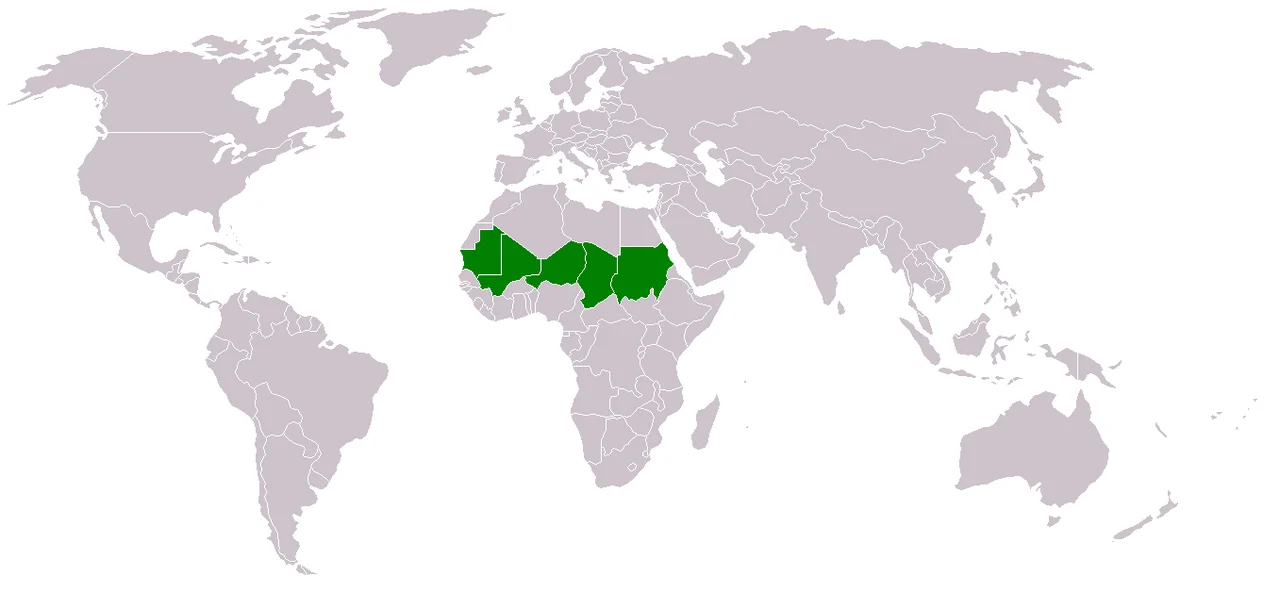
Photo: Location map of the Sahel states — Mali, Niger, Burkina Faso and Chad among them. Credit: Public domain, via Wikimedia Commons.
Four Sahel states fly military drones with confirmed combat use: Mali, Niger and Burkina Faso since the 2022–23 break with French forces, and Chad alongside its own counter-insurgency and border-security operations. Every confirmed airframe in that fleet — Bayraktar TB2, Bayraktar Akıncı, TUSAS Anka-S and TUSAS Aksungur — was bought from Türkiye, on bilateral contracts negotiated capital to capital, not through any pooled procurement mechanism of the Alliance of Sahel States (AES). What changed this year is the emergence, documented independently by Bellingcat, Jeune Afrique, The Sentry and Human Rights Watch, of a second and far less transparent drone channel in Mali: one-way attack munitions resembling Iran’s Shahed-136, linked to Russia’s Africa Corps rather than to any disclosed government contract. This page sets out who operates what, who actually supplies it, and where the evidence runs out.
| Indicator | Figure | Source |
|---|---|---|
| Sahel states with a confirmed drone fleet | 4 – Mali, Niger, Burkina Faso, Chad | DefenceMENA compilation, this page |
| Confirmed supplier to all four | Türkiye (Baykar: Bayraktar TB2/Akıncı; TUSAS: Anka-S/Aksungur) | DefenceMENA compilation; Janes; Overt Defense |
| New entrant, 2026, Mali only | Shahed-type one-way attack drones, likely linked to Russia’s Africa Corps – not an officially disclosed sale | Bellingcat (24 Jul, 16 Sep 2026); Human Rights Watch (19 Oct 2026) |
| Reported but unconfirmed | China – ≥4 CH-3A/CH-4B airframes reportedly at Abéché air base, Chad, single-source video | Militarnyi, citing Unmanned Africa (Aug 2026) |
| Mali drone-strike trend, Apr–Aug 2026 vs same period 2025 | 47 strikes / 94 civilian deaths, up from 22 strikes / 44 deaths (Reuters, citing ACLED); HRW’s own count for the same window gives 49 strikes / 89 deaths | ACLED, via Reuters; Human Rights Watch, 19 Oct 2026 |
Last updated: 21 October 2026.
Confirmed drone fleets: Mali, Niger, Burkina Faso, Chad
All four states’ confirmed fleets trace back to Baykar or TUSAS, Türkiye’s two drone manufacturers, bought on national contracts after each government broke with or scaled back French military cooperation. No contract has been published in full; reported quantities and values below come from parade appearances, serial-number tracking, presidency statements or trade-press reporting, with status labelled accordingly.
| Country | System | Manufacturer / Origin | Reported quantity | Order year | Delivery year | Status | Source | Last verified |
|---|---|---|---|---|---|---|---|---|
| Mali | Bayraktar TB2 | Baykar, Türkiye | ≥3 (2022) + 3 (2023); FAMa imagery shows serial TZ-17D; a Shephard Media operator table lists 17 delivered of 17 ordered, a single trade-press source not adopted as a confirmed figure | 2021–22 | 2022–2024, ongoing | OPERATIONAL | Wikipedia; Military Africa; Shephard Media; FAMa imagery | 2026-10-19 |
| Mali | Bayraktar Akıncı | Baykar, Türkiye | 6 under a reported ~$210m August 2024 contract (The Sentry’s estimate, not an official figure); roughly 8 airframes inferred across three delivery batches through mid-2026; 2 reportedly lost in 2025 | 2024 | Nov 2024; early/mid 2026 | OPERATIONAL | Overt Defense, 4 Dec 2024; Janes; The Sentry, Sep 2026 | 2026-10-21 |
| Niger | Bayraktar TB2 (+ Hurkuş-C package) | Baykar / TUSAS, Türkiye | 6 | 2021 | 2022 | OPERATIONAL | Presidency statements; DefenceMENA | 2026-10-19 |
| Niger | TUSAS Aksungur | TUSAS, Türkiye | Quantity undisclosed; unit reportedly valued at 12bn FCFA each per the defence ministry’s own presentation at Air Base 101, Niamey; a drone squadron has been operational at the base since 2023 | Not officially announced | 2024–25 (post-coup acquisition) | OPERATIONAL (per official presentation); exact delivery date not independently confirmed | fr.apanews.net; afrique-sur7.fr, Niger defence ministry presentation | 2026-10-21 |
| Burkina Faso | Bayraktar TB2 | Baykar, Türkiye | 5 | 2022 | April 2022 | OPERATIONAL | DefenceWeb; Seneplus | 2026-10-19 |
| Burkina Faso | Bayraktar Akıncı | Baykar, Türkiye | ≥2, part of a reported ~dozen-airframe mixed TB2/Akıncı handover; the exact split between the two types is disputed between outlets | 2024 | 8 April 2024 | OPERATIONAL | Janes, 10 Apr 2024; Overt Defense, 12 Apr 2024 | 2026-10-19 |
| Chad | TUSAS Anka-S | TUSAS, Türkiye | 2 | Reported Feb 2023 | Unveiled July 2023 (Adji Kossei air base) | OPERATIONAL | DefenceMENA, why-chad-bought-anka-aksungur-drones | 2026-10-05 |
| Chad | TUSAS Aksungur | TUSAS, Türkiye | ≥1 confirmed (serial 23013), armed with MAM-L munitions in released footage | Not announced | First armed flight, April 2024 | OPERATIONAL | Overt Defense, 24 Apr 2024; Janes | 2026-10-05 |
Burkina Faso opened a dedicated drone training centre in October 2024, the only confirmed training investment among the four states; none has a confirmed local-assembly, maintenance-transfer or joint-venture arrangement with Baykar or TUSAS – all four fleets are bought-and-flown, not locally supported, as far as public evidence shows.
The new entrant: Shahed-type drones linked to Russia’s Africa Corps, Mali only
Russia’s role in Mali’s air war is a separate story from the Baykar contracts, and a much less transparent one. On 24 July 2026, Bellingcat and Jeune Afrique geolocated footage and satellite imagery confirming strikes on 12 and 17 July in Inafarak and Talahandak, describing the clearest open-source evidence to date of Shahed-136-type one-way attack drones operating in Mali; one strike, on a truck in Talahandak, killed one civilian. Analysts matched wreckage to parts associated with the Shahed family, including what appeared to be an MD-550-type piston engine, and judged Russian manufacture likely given the presence of the Kremlin-controlled Africa Corps, while stopping short of confirming the exact variant or supply route. A joint Bellingcat/Jeune Afrique/Sentry investigation published 16 September 2026 then geolocated more than a dozen further Malian drone strikes with civilian casualties, describing a pattern it called “guilt by location” in state broadcasts, without establishing that Russia directly supplies or crews the drones. (DefenceMENA’s Arabic-language sister site has separately examined how the Shahed-136 family has performed in combat and what air defences have learned from facing it in dense numbers: Shahed-136 in combat, in Arabic.)
Human Rights Watch’s 19 October 2026 report, Mali: Military Attacks on Civilians, Insurgent Abuses, added forensic weight: HRW analysed 12 photographs of debris from the 29 July strike on a health centre in Talahandak, Kidal region, describing control surfaces, brackets and internal construction consistent with a Shahed-type delta-wing drone, and separately documented a 19 August strike on a cattle market in Tombonkore, Bandiagara region, that killed six men and injured at least 20, which it could not attribute to a specific drone type. HRW states that Mali’s military and the Russia-controlled Africa Corps (the rebranded Wagner Group) are the only known forces in Mali operating large drones of the kind described by witnesses, and that Russia has supplied drones and aircraft to Africa Corps personnel in the country since 2022 — a general statement about the relationship, not a confirmed record of a specific Shahed transfer. No Malian or Russian government source has confirmed the acquisition, and the Malian army did not respond to HRW’s questions.
| Country | System | Manufacturer / Origin | Reported quantity | First evidence | Status | Source | Last verified |
|---|---|---|---|---|---|---|---|
| Mali | Shahed-136-type one-way attack drone | Likely Russian manufacture (unconfirmed variant); linked to Russia’s Africa Corps, not to a disclosed Malian government contract | Unknown; used in at least a dozen-plus strikes per Bellingcat/Jeune Afrique/Sentry | Debris and footage first geolocated 24 Jul 2026; debris forensics corroborated by HRW, 19 Oct 2026 | OSINT ASSESSMENT (multi-source: Bellingcat, Jeune Afrique, The Sentry, Human Rights Watch) – not an official confirmation of transfer, operator or country of manufacture | Bellingcat, 24 Jul and 16 Sep 2026; HRW, 19 Oct 2026; The Defense Post, 4 Aug 2026 | 2026-10-21 |
| Chad | CH-3A/CH-4B | CASC, China | ≥4 reported at Abéché air base | Video posted to X, reported Aug 2026 | UNVERIFIED SOCIAL CLAIM – single secondary outlet relaying one video; no official Chadian acquisition announcement found | Militarnyi, Aug 2026, citing Unmanned Africa | 2026-10-07 |
Procurement mechanics: bilateral deals, not a pooled AES tender
The Alliance of Sahel States formally activated its unified 5,000-strong joint force on 20 December 2025 at Bamako, and Niger’s defence minister said at the time that the force would eventually field its own air assets. In April 2025, Russia’s government separately pledged to help the juntas acquire “major and high-performance military equipment and appropriate training” for that force, without naming specific systems, financing or a delivery timeline. Neither commitment has translated, on the evidence found this run, into a pooled AES drone-procurement mechanism: every confirmed drone contract above was negotiated nationally — Mali with Baykar directly (the reported ~$210m Akıncı package), Niger presenting its Aksungur through its own ministry of defence, Burkina Faso’s handovers announced from the office of the head of state. The AES’s joint-force rhetoric and the reality of continued bilateral national purchasing are two separate tracks that have not yet merged.
Financing terms are rarely disclosed in full. The $210m figure for Mali’s Akıncı package is The Sentry’s own estimate, not a published contract value; Niger’s 12bn FCFA Aksungur unit figure comes from the ministry’s own presentation and should not be read as a total programme cost. Where no contract value has been published, this page records that fact rather than estimating one.
Who actually supplies the Sahel’s drones, by the same criteria
Judged against the same measures – confirmed users, published or reported contracts, delivered airframes, training, and any local industrial cooperation – Türkiye is the only supplier with a clean record across all four Sahel states: four confirmed government customers, airframes delivered and flown in each case, and one confirmed training investment (Burkina Faso’s October 2024 drone training centre). No confirmed technology transfer, local assembly or joint-venture arrangement exists in the Sahel specifically; Baykar and TUSAS sell complete airframes on national contracts and the aircraft remain Turkish-supported in service.
Russia’s position cannot be assessed on the same terms because the basic facts of a transfer are not public: no contract, delivery date, quantity or price has been disclosed for the Shahed-type drones in Mali, and HRW, Bellingcat and The Sentry all stop short of confirming whether Russia’s state sold, gave or simply flew the aircraft through Africa Corps personnel. That evidentiary gap is the finding, not a judgement on Russian drones as a category.
China’s confirmed footprint elsewhere in Africa is large – DefenceMENA’s continental drone database counts roughly 587 Chinese-built airframes across about 20 countries – but in the Sahel specifically there is, as of this run, exactly one reported sighting (Chad’s CH-4s) and zero confirmed government acquisitions.
The human cost, and where the evidence stops
ACLED’s conflict-event data, as cited by Reuters, recorded 47 drone strikes by Malian forces and Africa Corps between April and August 2026, killing 94 civilians, roughly double the 22 strikes and 44 deaths ACLED recorded over the same months in 2025. HRW’s own report cites a close but not identical count for the same period — 49 airstrikes and 89 civilian deaths — which may reflect a broader “airstrike” category than drone strikes specifically; this page reports both figures rather than reconciling them. In the Tombonkore case, Mali’s army chief of staff said on 20 August that the strike had hit a “terrorist hideout” and “neutralised” about 20 fighters; HRW says witnesses named six men killed, aged 21 to 54, and that none were members of JNIM. The two accounts cannot be reconciled from public information, and no independent investigation of the strike has been announced by either Mali or the African Union, which HRW’s report urges to act.
Methodology and definitions
Status labels used on this page: CONTRACTED (a contract or firm order reported but not yet delivered); DELIVERED (airframes confirmed to have arrived); OPERATIONAL (the operator has flown the type, including in parades, training or combat); OSINT ASSESSMENT (a conclusion reached through open-source geolocation, debris or imagery analysis by one or more independent investigators, not an official government confirmation); UNVERIFIED SOCIAL CLAIM (sourced to social media or a single secondary outlet). A reported quantity is the buyer’s, manufacturer’s or an investigator’s own figure, or a serial-number count; where sources disagree, both figures are shown rather than averaged. Casualty and strike-count statistics from ACLED and Human Rights Watch are reproduced as those organisations’ own figures, using their own methodologies, not DefenceMENA estimates. This page does not use Global Firepower rankings, which apply GFP’s own internal methodology and are cited elsewhere on this site only with that caveat attached.
A note on the numbers
Several figures on this page carry real uncertainty by design, not by omission. Mali’s Bayraktar TB2 count of “17 delivered of 17 ordered” comes from one trade-press operator table (Shephard Media) and is flagged, not adopted, as this page’s headline figure. Burkina Faso’s April 2024 TB2/Akıncı split is reported differently across Janes and Overt Defense and is shown as a range. Niger’s Aksungur quantity and exact delivery date have not been independently confirmed beyond the ministry’s own presentation. The Shahed-type drone in Mali is the clearest example: three independent investigators (Bellingcat, Jeune Afrique, The Sentry) and Human Rights Watch have each found consistent physical and circumstantial evidence pointing to Russia’s Africa Corps, but none has published a contract, a manufacturer confirmation or an official transfer record, so this page labels it OSINT ASSESSMENT rather than CONFIRMED or OPERATIONAL under a named supplier.
Frequently asked questions
Which Sahel countries operate military drones?
Mali, Niger, Burkina Faso and Chad all have confirmed drone fleets, built on Turkish Bayraktar TB2, Bayraktar Akıncı, TUSAS Anka-S and TUSAS Aksungur airframes bought since 2021–22. Mauritania and Senegal have no confirmed military drone acquisitions as of this run.
Who supplies Mali’s drones?
Türkiye’s Baykar supplies Mali’s confirmed Bayraktar TB2 and Akıncı fleet on national contracts. Separately, Human Rights Watch, Bellingcat, Jeune Afrique and The Sentry have independently found evidence of Shahed-type one-way attack drones in Mali linked to Russia’s Africa Corps, which is not a confirmed, officially disclosed transfer.
What is the Shahed-type drone found in Mali?
A delta-wing, one-way attack drone resembling Iran’s Shahed-136. Bellingcat and HRW have geolocated footage and analysed debris consistent with the design, including parts resembling a Shahed-family engine, and judge Russian manufacture likely given Africa Corps’ presence, but no party has confirmed the exact variant, manufacturer or how it reached Mali.
Does Niger have Bayraktar Akıncı drones?
No confirmed Akıncı purchase; Niger’s confirmed post-2022 fleet is 6 Bayraktar TB2s plus a TUSAS Aksungur presented by its defence ministry at Air Base 101 in Niamey. Mali and Burkina Faso, not Niger, are the confirmed Akıncı operators in the Sahel.
Has the Alliance of Sahel States set up joint drone procurement?
No. The AES activated a unified 5,000-strong joint force in December 2025 and Russia pledged in April 2025 to help equip it, but every confirmed Sahel drone contract found this run was negotiated bilaterally by an individual government, not through a pooled AES tender.
How many civilians have died in Mali’s drone strikes in 2026?
ACLED data cited by Reuters puts it at 94 civilian deaths across 47 drone strikes between April and August 2026; Human Rights Watch’s own count for the same window is 89 deaths across 49 airstrikes. Both are independent organisations’ figures, not a DefenceMENA estimate, and are reproduced here as reported.
Sources
- Human Rights Watch, “Mali: Military Attacks on Civilians, Insurgent Abuses” (19 October 2026)
- Bellingcat, “Shahed-Type Drones Filmed During Mali Village Attacks” (24 July 2026)
- Bellingcat / Jeune Afrique / The Sentry, joint drone-strike investigation (16 September 2026)
- The Defense Post, “Russian-Made Shahed Drones Reach Mali’s Battlefield: Report” (4 August 2026)
- Al Jazeera, “Mali’s military and armed groups committing abuses against civilians: HRW” (19 October 2026)
- Reuters, via The Star/TimesLive/Polity, “Mali forces, Russian backers kill scores of civilians in drone strikes, report says” (19 October 2026)
- Janes, “Burkina Faso receives Akıncı UAVs” (10 April 2024)
- Overt Defense, “The Chadian Air Force Revealed as the Latest Known Operator of TAI Aksungur UAVs” (24 April 2024)
- Overt Defense, “Mali Becomes Fourth African Operator of Bayraktar Akıncı” (4 December 2024)
- Militarnyi, “Chad Expands Its Fleet with Chinese CH-4 UAVs” (August 2026)
- APA News (fr.apanews.net), “Niger : l’armée de l’air présente le drone Aksungur”
- Afrique-sur7.fr, “Le Niger renforce sa puissance militaire avec des drones Aksungur”
- Hespress FR, “L’Alliance des États du Sahel lance une force unifiée de 5.000 soldats”
- Modern Ghana, “Turkey in Mali’s Shadow War: Ankara’s Quiet March”
- Baykar Bayraktar Akıncı technical specifications: envantermedya.com
- DefenceMENA originals: Military Drones in Africa, Which African Countries Operate the Bayraktar TB2?, Bayraktar TB2 and Akinci in Mali and Burkina Faso, Why Chad Bought Anka and Aksungur Drones, Why Mali Expanded Its Drone Fleet, HRW Links Mali Army Drone Strikes to Civilian Deaths, Who Supplies Africa’s Weapons, Strongest Militaries in West Africa
Related on DefenceMENA: Military Drones in Africa · Which African Countries Operate the Bayraktar TB2? · Who Supplies Africa’s Weapons · Strongest Militaries in West Africa