Morocco Deploys AI-Powered Cyber Defence Platform as US Military Ties Deepen



Morocco’s Royal Armed Forces have put an AI-enabled cyber defence platform at the center of day-to-day network protection, according to the US vendor behind the system. The deployment lands alongside a wider push to deepen military-technology ties with Washington, from a planned multidomain training hub at Tan-Tan to a reported request to train pilots on the F-35A.
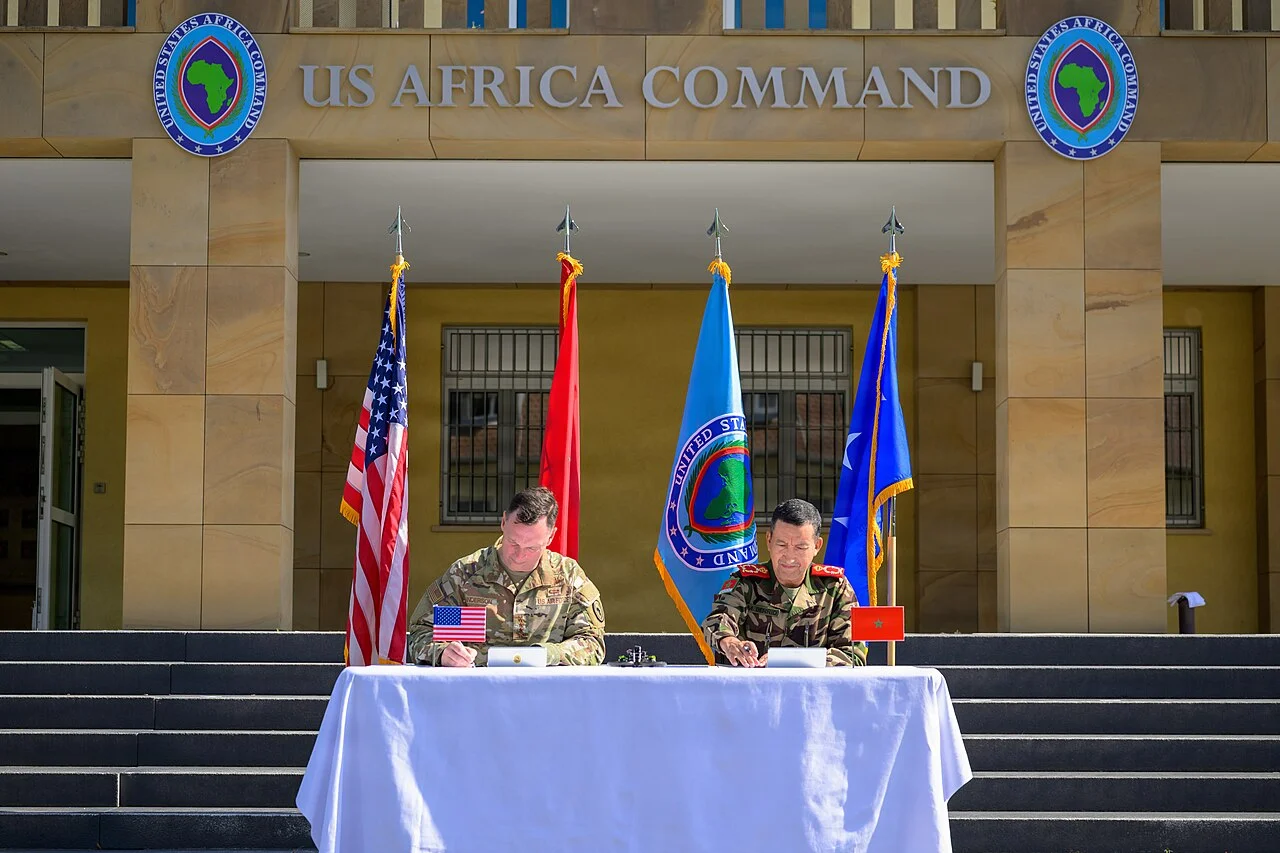
Photo: Gen. Dagvin Anderson, commander of US Africa Command, and Moroccan Gen. Mohammed Berrid sign a memorandum of understanding on the Africa Multidomain Training and Experimentation Center. Credit: David Kimery, U.S. Army SETAF-AF, Public domain, via Wikimedia Commons
US technology company Lyntris says Morocco’s Forces Armées Royales (FAR) have adopted its Garda Cyber Command Suite, an artificial-intelligence-assisted platform built to detect network intrusions, automate incident response and keep military communications running in degraded or jammed environments. According to Africa Defense Forum, which cited Lyntris and a report in The Arab Weekly, the system is now central to how the FAR monitors and defends its own networks.
What Garda Cyber actually does
Garda Cyber bundles several functions that are normally bought separately: security information and event management (SIEM), endpoint detection and response (EDR), intrusion detection and prevention, incident management, and command-and-control tools that fuse data from sensors, radar and electro-optical feeds into a single operational picture. Lyntris says the goal is real-time threat detection paired with automated response, so that a command post can keep functioning even when its communications links are degraded or deliberately jammed — a scenario increasingly common in contested electromagnetic environments.
Per Lyntris’s own figures, reported by ADF, Morocco’s deployment runs with 150 to 200 operators across a main command center, three mobile command-and-control platforms, three regional operations centers, 65 sensor sites and six ships. The company says Garda Cyber and its companion Garda C2 platform are deployed, across Morocco, Taiwan and Armenia combined, at more than 100 monitored sites. Moroccan personnel reportedly completed a two-week training course on the system in San Diego in April.
These figures should be read with some caution: almost all of the detail on scale and capability traces back to Lyntris’s own marketing material rather than an official Moroccan government statement, and neither Rabat nor the FAR has published its own account of the deployment, its cost or when it actually went live. Escudo Digital reports that protection under the platform has also been extended to the Tangier Med port complex, a piece of commercial infrastructure the Moroccan state treats as strategically sensitive.
Why now: US network-security rules and a broader partnership
The timing tracks a known US policy lever. Escudo Digital’s analysis links Morocco’s adoption of Garda to Pentagon requirements that partner militaries secure their own critical networks before they can connect to US systems or receive classified information — in effect, a cybersecurity entry fee for deeper interoperability. Hichem Moatadhid, a security researcher quoted by The Arab Weekly via ADF, said Morocco is increasingly absorbing technology transfer and personnel training across AI, drones, battlefield communications and cyber defence simultaneously, arguing that attacks on military networks can now disrupt decision-making more than conventional weapons.
The cyber platform sits inside a larger build-out of the US-Morocco military relationship. AFRICOM commander Gen. Dagvin Anderson and Moroccan Gen. Mohammed Berrid, the FAR’s inspector general, signed a memorandum of understanding on 1 July 2026 at AFRICOM headquarters in Stuttgart to establish the Africa Multidomain Training and Experimentation Center (AMTEC) at Tan-Tan, in southern Morocco. AMTEC is designed around three pieces: a multidomain training area built to operate across the full electromagnetic spectrum in contested conditions, a drone academy intended to train operators, planners and instructors from Morocco and partner African states against threats emanating from West Africa, and an innovation and experimentation center offering Moroccan and US industry a lower-cost test environment. The project’s first live-fire demonstration with Moroccan and US forces ran from 3 to 7 August 2026, which Moroccan Col. Zouhair El Hamdani, the FAR officer coordinating the project, described as a milestone in turning the plan into reality. AFRICOM has set 2030 as the target date for the center to be fully operational.
The cyber deal also fits a pattern DefenceMENA has tracked through 2026: Morocco reportedly asked the US to begin training pilots on the F-35A ahead of any confirmed purchase, took delivery of AH-64E Apache gunships, and is already planning African Lion 2027, the continent’s largest annual military exercise. Each move reinforces the others: joint exercises build the relationships that produce technology-transfer requests, and technology transfer requires exactly the kind of network-security guarantee Garda is meant to provide.
What Morocco already runs, and what it doesn’t yet have
Morocco’s broader rearmament has leaned heavily on US and Israeli suppliers for hardware — Apache attack helicopters, Barak MX air defence, and a deepening arms relationship with Israel that DefenceMENA has covered in detail. Cyber and electronic warfare are a newer, less visible front. Unlike a fighter jet or an air-defence battery, a cyber-command platform’s presence is hard to verify independently, and Morocco has not disclosed a parallel indigenous cyber-defence program of its own, in contrast to Egypt or South Africa, both of which have invested in domestically run signals and cyber units. That makes Morocco’s approach, for now, one of importing a turnkey US system rather than building sovereign cyber capability — a trade-off that buys speed and interoperability with Washington at the cost of relying on a foreign vendor for a function central to operational security.
Why it matters for Africa
Morocco is positioning itself as a node through which US military technology, training and doctrine flow into the rest of the continent, rather than only as an end user. The AMTEC drone academy is explicitly built to train African partners beyond Morocco’s own forces, and a US-run cyber-defence standard adopted first in Rabat could become the template other African militaries are steered toward if they want similar access to US systems and intelligence-sharing. For African armed forces more broadly, the episode is a reminder that modern procurement increasingly runs through network security and data standards as much as through hardware contracts — a dimension that is harder to see in public records than a jet or an armoured vehicle, but just as consequential for who controls a given country’s command-and-control picture in a crisis.
Sources
- Africa Defense Forum — “Morocco Gets Cyber Defense Upgrade”
- Escudo Digital — “Morocco’s rearmament sparks a new defense industry in the heartland”
- DVIDS / US Africa Command — “Morocco and AFRICOM seek to establish the Africa Multidomain Training and Experimentation Center”
- Morocco World News — on the AMTEC signing