Jabal al-Uqaydat Strike: What Is Known About the Deadly Air Raid on Gold Miners at the Sudan-Egypt Border



An air strike on Saturday 10 October 2026 hit an informal gold-mining site at Jabal al-Uqaydat, in the Shamal al-Wadi area of Sudan’s Red Sea state near the Egyptian border, and killed at least 72 miners, according to the Sudanese rights group Emergency Lawyers. The group, along with survivors and several Sudanese organisations, blames the Egyptian air force. Egypt’s military has not directly addressed the accusation. On Monday it said troops and police were carrying out the third phase of a campaign against illegal gold prospecting near the border, after dropping warning leaflets. Sudan’s army chief Abdel Fattah al-Burhan has ordered a fact-finding inquiry. Here is what each side has said, how far the death toll estimates differ, and what has not been established.
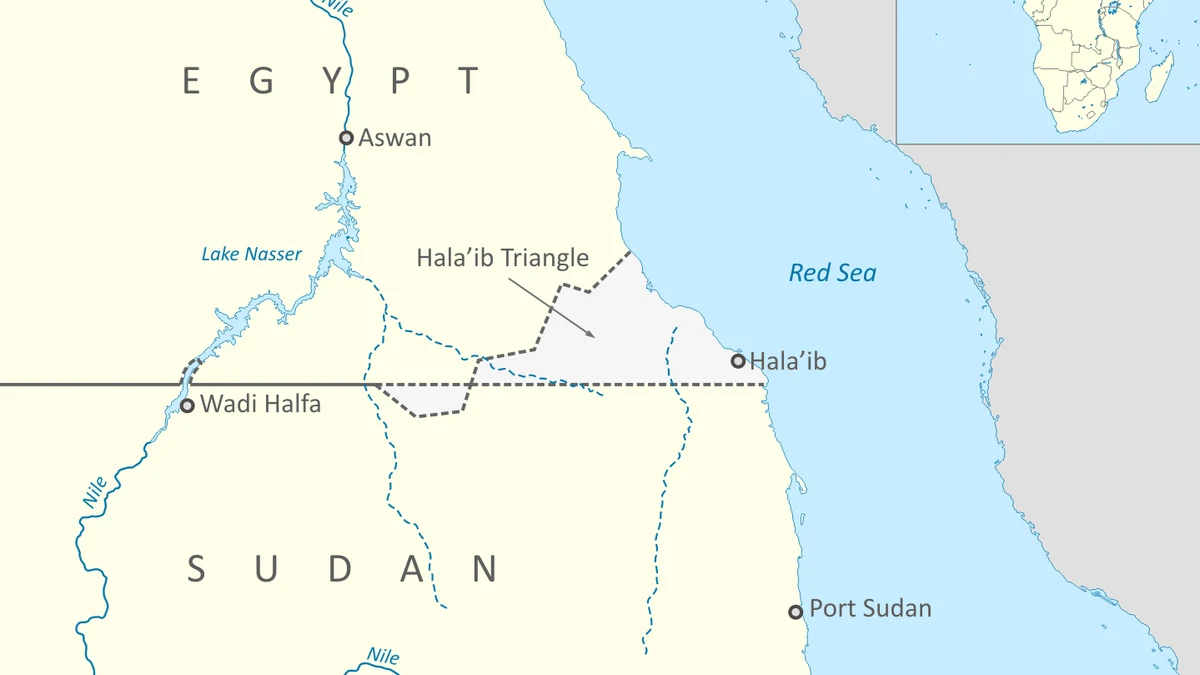
Map: The Egypt–Sudan border, showing the 22nd parallel and the disputed Hala’ib Triangle on the Red Sea coast. Jabal al-Uqaydat is not marked, and its position relative to the competing border lines has not been independently established. Credit: User:Пакко, derivative of maps by NordNordWest and Sting, CC BY-SA 3.0, via Wikimedia Commons
What happened on 10 October
The strike hit miner camps early on Saturday morning. A witness told AFP that a plane carried out several strikes at the mine that morning and that workers panicked. Three survivors who spoke to Sudan Tribune said warplanes struck at around 6 a.m., as miners gathered for the morning shift. They said more than five missiles hit the camps, destroying shelters and hitting shafts that then collapsed on workers inside.
Images and videos shared on social media show bodies in rubble and others wrapped in shrouds. Reuters, AFP and The National all said they could not verify this material.
Jabal al-Uqaydat is a large artisanal gold-mining area in mountainous terrain close to the border. Survivors told Sudan Tribune that an Egyptian patrol had earlier warned miners not to approach part of the area, saying it was Egyptian territory. They also said Egyptian border guards had at one point taken control of the mine and set up a camp there before dismantling it. Neither claim has been confirmed by Egypt.
How many were killed
There is no official death toll from either government, and the figures given so far differ widely:
- At least 72 killed: Emergency Lawyers, a group that documents abuses in Sudan’s war, in a statement on Sunday 11 October. This is the figure Reuters and AFP led with.
- 13 killed and 28 wounded: the Sudan Doctors Network’s initial count, which it said was likely to rise.
- More than 200 killed: survivors interviewed by Sudan Tribune. The National Umma Party and the Darfur Victims Advocacy organisation also put the toll at about 200 dead and around 120 injured, Asharq Al-Awsat reported.
Radio Tamazuj noted that these figures have not been reconciled. Dozens of people are also reported missing. The remote location, and survivors’ accounts of shafts collapsing on workers, make an early independent count unlikely.
Who is blamed, and what Egypt’s military said
Emergency Lawyers blamed the Egyptian air force. Reuters and AFP both said they could not independently verify that claim. The civilian Somoud alliance and the Sudan Doctors Network also condemned the strike, and criticised Sudan’s military-led authorities for failing to protect citizens and the country’s territory, The National reported.
Egypt’s armed forces spokesman, Colonel Ahmed Etman, issued a statement on Monday evening, 12 October. It did not mention an air strike, casualties or Jabal al-Uqaydat. According to Ahram Online and Egypt Today, it said:
- Armed forces and civil police are “continuing to carry out the third phase” of a major campaign against “illegal prospecting for gold ore” in the Eastern Desert.
- The phase followed “the dropping of warning leaflets on the criminal elements operating in the area”.
- Its purpose is “to impose full sovereignty within the borders of the Egyptian state and to protect its national resources and wealth”.
- Ties between Egyptians and Sudanese are deep, and the “peaceful coexistence” of millions of Sudanese living in Egypt proves it.
- People should rely on official sources and not be swayed by “misleading rumours” or “foreign agendas” aimed at damaging relations between the two peoples.
The statement places the operation inside Egypt’s borders. Emergency Lawyers, Somoud and the Sudan Doctors Network all say the strike happened inside Sudan. That difference is the core of the dispute, and neither government has published coordinates, imagery or other evidence of where the strike took place.
An image of a leaflet titled “final security warning” has circulated online. It told miners they were operating on Egyptian territory, threatened “immediate targeting” if they did not leave, and urged them to surrender with their equipment. The National said it could not verify the leaflet’s authenticity.
Sudan’s response
On Monday the Transitional Sovereignty Council said Burhan had formed a fact-finding committee of prosecutors, judicial officials and security representatives “to investigate the circumstances of the incident” and report its findings, Sudan’s Nabaa news agency reported. The council called it an incident “in the border area between Sudan and Egypt” and did not name Egypt as responsible. It said the two countries’ leaderships had been in contact since the incident to protect lives, preserve relations and clarify what happened.
Burhan’s foreign affairs adviser, Amjad Farid, went further. He called the attack an “unjustified and unacceptable crime” and wrote on X that there are many ways to deal with “border violations”, but “the use of airstrikes against civilians cannot be one of them”, AFP reported.
Egyptian Foreign Minister Badr Abdelatty spoke by phone with his Sudanese counterpart, Mohieldin Salem, on Monday. Egypt’s foreign ministry said both stressed respect for each other’s sovereignty and for the safety and integrity of their territories and borders.
Separately, on 12 October a gunman killed two Egyptian truck drivers and wounded a third at a market in southern Khartoum, a Sudanese security official told AFP. The motive was not clear, and there is no evidence linking the attack to the strike.
Not the first strike at the site
This is the second reported strike on Jabal al-Uqaydat this year. In June, strikes reported to have been carried out by Egypt killed 23 workers at the same informal mine, AFP said. Al Jazeera reported that the June attack involved drones and artillery. Egypt did not claim responsibility at the time. Its military said it had run a large-scale operation within Egyptian territory against drug and arms trafficking, illegal migration and illegal gold prospecting, and had detained 223 people (87 Egyptians and 136 foreigners). Sudanese authorities also promised an inquiry after the June incident, Radio Tamazuj noted; no findings have been published.
Why the border is contested
The frontier runs for about 1,200 km. Under an 1899 Anglo-Egyptian agreement, the boundary follows the 22nd parallel. A 1902 British administrative line handed the Hala’ib Triangle on the Red Sea coast to Sudanese administration. Egypt has held the Hala’ib Triangle since Sudanese forces withdrew in 2000, after clashes in the 1990s. In most of the desert the border has never been physically marked, as Al Jazeera noted. Gold-bearing ground lies on both sides of it.
Sudan’s war has made the area more crowded and more lawless. With the economy wrecked since fighting between the Sudanese Armed Forces (SAF) and the Rapid Support Forces (RSF) began in April 2023, and gold at record prices, thousands of people have moved into informal mines in the far north-east. East of the Nile the border is also an established route for gold smuggling, other illicit trade and people trafficking. Much of the gold mined in army-held eastern Sudan is believed to pass through Egypt on its way to markets in the UAE, AFP reported. The National cited estimates that Sudan produced about 70 tonnes of gold in 2025, of which about 20 tonnes were exported formally.
Why it matters for Egypt–Sudan relations
Egypt is one of the SAF’s main regional backers in the war against the RSF. The two governments have aligned closely, including at the El Alamein summit with Eritrea and Somalia. Cairo also treats the war on its southern border as a direct security threat. President Sisi recently called for the armed forces’ highest combat readiness (see what Egypt’s SCAF meeting actually said).
That is why both governments’ public language has been careful. Neither has accused the other, both stress brotherly ties, and the Sovereignty Council has opened an inquiry rather than lodging a public protest. The pressure is coming instead from Sudanese rights groups, civilian coalitions and some political parties, which accuse the military-led authorities of failing to defend Sudanese territory. Elsewhere in Sudan, drone and air attacks on civilians remain frequent; see our coverage of the Ed Damazin and Blue Nile drone strikes and the renewal of the UN Darfur arms embargo.
What is confirmed and what is not
- Confirmed: an air strike hit the Jabal al-Uqaydat mining area on 10 October and killed a large number of miners. Sudan’s Sovereignty Council acknowledged a deadly “incident” in the border area and opened an inquiry.
- Confirmed: Egypt’s military says it is running the third phase of an operation against illegal gold mining near the border, after dropping warning leaflets.
- Alleged, not verified: that the Egyptian air force carried out the strike. Egypt has neither confirmed nor denied it, and Reuters and AFP could not verify it.
- Disputed: whether the site lies in Sudan, as Sudanese groups say, or within what Egypt regards as its territory.
- Unknown: the real death toll (estimates range from 13 to more than 200), the aircraft and weapons used, and whether the leaflet circulating online is genuine.
Sources
- Ahram Online: Egypt army begins 3rd phase of anti-illegal gold mining campaign in Eastern Desert: Statement (12 October 2026)
- Egypt Today: Egypt’s Armed Forces announces continued crackdown on illegal gold ore prospecting in Eastern Desert (12 October 2026)
- Sudan Nabaa: TSC forms fact-finding committee to investigate incident involving Sudanese miners on Egyptian border (12 October 2026)
- Reuters (via CNN): At least 72 Sudanese artisanal miners killed in strike, rights monitor says (12 October 2026)
- AFP (via The Straits Times): Egypt says border operation targeted illegal mining after deadly strike kills 72 (13 October 2026)
- Sudan Tribune: Air strikes kill at least 200 at gold mine near Sudan-Egypt border, survivors say (11 October 2026)
- The National: Dozens of gold miners killed in Sudan strike, rights and political groups say (12 October 2026)
- Asharq Al-Awsat: Sudan’s al-Burhan orders investigation into deadly airstrike on gold mine (12 October 2026)
- Radio Tamazuj: Sudan’s Burhan orders probe into miners’ deaths near Egyptian border (12 October 2026)
- Al Jazeera: Deadly gold mine air strikes highlight Egypt-Sudan border insecurity (12 October 2026)
Evidence note: Casualty figures come from Sudanese rights and medical groups, political parties and survivors; neither government has published a toll. The attribution to Egypt comes from those groups and survivors and has not been verified by international news agencies. Egypt’s position is taken from its armed forces’ 12 October statement, which does not mention a strike. This page will be updated at the same URL if Sudan’s fact-finding committee reports or either government publishes more detail.