Why Did Nigeria Buy the M-346FA?

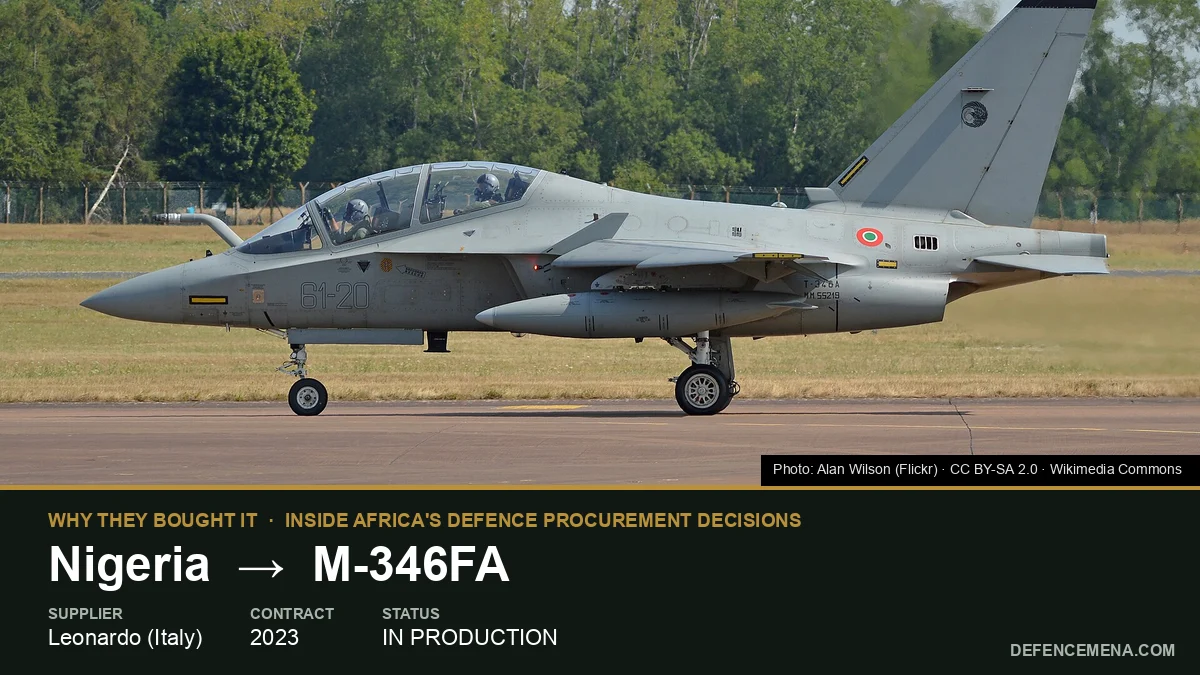


Nigeria bought the Leonardo M-346FA because the Nigerian Air Force needed one jet that could do two jobs: replace the Alpha Jets that have carried its close-air-support burden since the 1980s, and give its pilots a modern lead-in trainer on the way to the JF-17. The programme is for 24 aircraft in four batches of six, with 25 years of logistics support, and the first three jets passed factory acceptance in Italy in July 2026 with deliveries scheduled from October 2026. The contract date, the firm quantity and the real value are less tidy than the headline figure of €1.2 billion suggests, and this article sets out both versions of each.
Photo: An Italian Air Force M-346 Master of 61 Stormo, the Galatina-based wing that will train Nigerian pilots, at RAF Fairford in July 2022. Nigeria's aircraft are the Fighter Attack version. Photo: Alan Wilson, CC BY-SA 2.0, via Wikimedia Commons. Credit: Alan Wilson (Flickr), CC BY-SA 2.0, via Wikimedia Commons.
- Country
- Nigeria (Nigerian Air Force)
- System
- M-346FA Fighter Attack
- Supplier
- Leonardo Aircraft Division (Italy)
- Quantity
- 24 planned (NAF); six firm plus options per Italian financing report
- Contract year
- 2023 (reported); effective November 2025 per Italian report
- Status
- IN PRODUCTION
- Main requirement
- Alpha Jet replacement: close air support, interdiction, reconnaissance and advanced pilot training
- Training
- Pilots and engineers in Italy (Galatina and Decimomannu) with the Italian Air Force
- Localisation
- Maintenance hub in Nigeria (stated intent, no contract text published)
- Known alternatives
- None documented; same-class market: FA-50, L-15, Hürjet, Yak-130
What capability did Nigeria need?
For most of this century the Nigerian Air Force (NAF) has fought a ground war from the air. The insurgency in the north-east, banditry in the north-west and oil theft in the Niger Delta all demand aircraft that can find a target, hit it with precision and come home, and that burden fell on a small and ageing fleet. Military Africa, reporting the loss of an Alpha Jet to ground fire over the Zamfara–Kaduna border on 18 July 2021, called the type the “pointy tip” of the service’s offensive effort.
The Alpha Jets were never designed for that tempo. They entered Nigerian service in the 1980s as trainers with a light-attack option; by 2020 the NAF was running in-country depot maintenance on individual airframes to keep them flying (defenceWeb, November 2020), and it lost two in 2021 alone, one to mechanical failure in March and one to ground fire in July.
The second requirement was a training gap. Nigeria took delivery of three JF-17 Thunder fighters in 2021 and had no modern jet trainer to bridge the step from the turboprop A-29 Super Tucano to a supersonic fighter. The NAF’s own description of the M-346FA’s role, carried by Defense News in April 2024, listed “close air support, air interdiction, and tactical reconnaissance as well as advanced pilot training”. The combat job comes first in that list, the training job second, and the NAF wanted both from one airframe.
What did it already operate?
The Alpha Jet A/E fleet, reported at 13 aircraft by Nigerian media in 2021, did most of the strike work. Fifteen Chengdu F-7Ni fighters provided a nominal air-defence capability; defenceWeb reported in March 2021 that a third had been lost in crashes, with grounded examples being reactivated by Chinese technicians at Makurdi. A handful of L-39ZA jets had been through life extension at Kano. Twelve A-29 Super Tucanos arrived from the United States in 2021 and became the main precision-strike platform; DefenceMENA has covered that decision separately in Why Nigeria bought the Super Tucano.
The JF-17 deserves a short note because it shapes the M-346FA decision. Nigeria funded three JF-17 Block II fighters through its 2018 budget, backed by a $184.3 million sovereign guarantee approved in Pakistan, and the aircraft reached Makurdi in March and April 2021 after pilots trained in Pakistan from mid-2020. Three aircraft is a token fleet, but it gave the NAF a reason to build a proper jet-training pipeline. Military Africa reported in October 2024 that the NAF intends the M-346FA to act as the lead-in fighter trainer for the JF-17, with pilots moving from the A-29 to the M-346FA and then to the Thunder.
The wider inventory is set out in DefenceMENA’s Nigerian Air Force aircraft profile and Nigeria military strength.
What system was selected?
The M-346FA is the Fighter Attack version of Leonardo’s M-346 advanced jet trainer, a twin-engine, two-seat transonic aircraft with quadruple-redundant fly-by-wire controls. The manufacturer’s product page describes the FA as fitted with the mechanically scanned Grifo-M-346 multi-mode radar, seven external hardpoints, and the ability to carry infrared, radar and laser or GPS-guided air-to-air and air-to-surface weapons, gun pods, and reconnaissance or targeting pods. Two Honeywell F124-GA-200 turbofans each give 2,850 kg of thrust.
For Nigeria the attraction is that the FA keeps the full training capability of the baseline M-346, which six air forces including Italy’s use as their advanced trainer, while adding a combat suite. The NAF statement on factory acceptance in July 2026 said the aircraft will let the service conduct “precision strike, close air support, air interdiction, and air combat missions” while serving as an advanced pilot-training platform. The weapons cleared for the Nigerian jets, as reported by Quwa and Military Africa, include AIM-9 Sidewinder and IRIS-T missiles, the AGM-65 Maverick, guided bombs and 20 mm or 12.7 mm gun pods.
One naming detail: Leonardo’s April 2024 statement to Janes said “the M-346 fighter aircraft” without the FA suffix, but every Nigerian release since May 2023 and the Italian financing report specify the Fighter Attack version. Nigeria is receiving the FA.
Which alternatives were considered?
No competition is documented. Nigeria ran no public tender and has named no other type evaluated against the M-346FA. What exists is a long courtship: Nigerian media reported a 24-aircraft order as early as March and May 2021, Leonardo told Shephard on 10 May 2021 that “no such order has been placed by Nigeria” while confirming the country was “looking with interest” at the M-346, and the then Chief of the Air Staff, Air Marshal Oladayo Amao, said at a seminar on 27 October 2022 that 24 M-346s “would be acquired in the future”. The alternatives below are therefore market comparisons, not documented rivals.
| Alternative | Class | Status of consideration | Source |
|---|---|---|---|
| KAI FA-50 (South Korea) | Light fighter / lead-in trainer | SAME-CLASS MARKET ALTERNATIVE (no competition documented) | No Nigerian or Leonardo source names it |
| Hongdu L-15 (China) | Light fighter / lead-in trainer | SAME-CLASS MARKET ALTERNATIVE (no competition documented) | No Nigerian or Leonardo source names it |
| TAI Hürjet (Türkiye) | Supersonic advanced trainer / light attack | SAME-CLASS MARKET ALTERNATIVE (no competition documented) | No Nigerian or Leonardo source names it |
| Yakovlev Yak-130 (Russia) | Advanced trainer / light attack | SAME-CLASS MARKET ALTERNATIVE (no competition documented) | No Nigerian or Leonardo source names it |
| Continued Alpha Jet depot maintenance | Legacy fleet sustainment | REPORTED ALTERNATIVE (in-country PDM continued in parallel, 2020) | defenceWeb, 9 Nov 2020 |
For how the M-346FA fits among the other jets on the continent, see Fighter aircraft of African air forces.
Why was the M-346FA selected?
Alpha Jet replacement (officially stated). Every Nigerian official who has spoken about the programme has framed it as the successor to the Alpha Jet. Air Marshal Amao’s October 2022 remark was reported by defenceWeb in the context of Alpha Jet replacement, and Air Marshal Hassan Abubakar’s October 2024 briefing, as reported by Military Africa, described the M-346FA as replacing the Alpha Jet A/E fleet on a one-to-one basis. This is the core motive and it is not in dispute.
A combat aircraft first, a trainer second (officially stated). The NAF’s April 2024 statement, carried by Defense News and The Defense Post, listed close air support, air interdiction and tactical reconnaissance before advanced pilot training. The July 2026 acceptance statement repeated that order and added precision strike and air combat. Air Marshal Sunday Aneke, the current Chief of the Air Staff, called the aircraft “another strategic step in strengthening the Nigerian Air Force’s operational capability”. The choice of the FA rather than the baseline trainer follows directly from that priority.
A lead-in trainer for the JF-17 (reported by Military Africa). Military Africa reported in October 2024 that the M-346FA will serve as the lead-in fighter trainer for the JF-17, completing a pipeline that runs A-29, M-346FA, JF-17. The NAF has not published that pipeline itself.
Long-term support and a local maintenance hub (officially stated as intent). The NAF said in April 2024 that the contract includes 25 years of logistics support, and Defense News reported that Leonardo would provide maintenance in Nigeria. Air Marshal Abubakar in October 2024 “emphasised the necessity of establishing a maintenance hub in Nigeria”, in Military Africa’s words. The July 2026 statement said the investments “will strengthen indigenous training and technical capacity”. None of this has been published as contract text.
Italian export credit made the programme financeable (documented in Italian financial reporting; analysts assess). Il Messaggero, as relayed by Alliance News on 5 December 2025, reported that a bank pool led by UniCredit with Crédit Agricole and Banco BPM was finalising a “SACE Buyer’s Credit” of about €450 million for the Nigerian Ministry of Defence, in three tranches, 100 per cent guaranteed by SACE, the Italian export-credit agency, repayable until 2037. The first SACE premium of €8.9 million was paid on 17 November, which made the contract effective. Analysts assess that this structure, rather than cash from the federal budget, is what moved the programme from an announced intention in 2022 to aircraft on the production line; no Nigerian official has said so publicly.
Supplier relationship (possible but unconfirmed). Leonardo already supplies the NAF’s AW109 Trekker helicopters (see NAF’s Leonardo and Airbus helicopter expansion); neither side has said whether that influenced the choice of jet.
What was included in the contract?
The NAF’s April 2024 account, repeated by Defense News, The Defense Post and Janes, lists 24 aircraft delivered in four batches of six and a minimum of 25 years of maintenance, technical and logistics support, with pilot and engineering training to be coordinated with Leonardo. Military Africa in October 2024 added that the Italian Air Force would train Nigerian pilots at Galatina and Decimomannu. The Italian financing report names Nexter, Rafael and Thales as weapon-system partners with Leonardo integrating, and the Presidency’s May 2023 infographic showed the aircraft equipping two squadrons.
What the contract does not include, or at least what no source has published, is any Nigerian industrial work share, any local assembly, or the exact composition of the munitions package. The Italian report also says the first six aircraft are financed “in the basic version without armament”, which is best read as airframes and weapons being contracted separately: the three aircraft accepted in July 2026 carried their radar and weapons clearances.
How much did it cost?
Three figures circulate and they measure different things. The €1.2 billion (about $1.4 billion) figure is the programme value for all 24 aircraft with training, weapons and long-term support, as given by Air Marshal Abubakar in October 2024 and repeated by Military Africa, Quwa and BusinessDay. It is a Nigerian figure; Leonardo has never published a value. The $1.2 billion figure in 2021 Nigerian media reports was an estimate for the same 24-aircraft package. The €450 million figure is the SACE-guaranteed credit line reported by Il Messaggero in December 2025, and it covers six firm aircraft, not 24.
No unit price has been published. Dividing €1.2 billion by 24, or €450 million by six, would produce a number that has no basis in any contract document, and we do not do it.
How many were ordered?
This is the main conflict in the record, and it needs to be stated plainly. The Nigerian Air Force, the Nigerian Presidency and every Nigerian statement since 2022 speak of 24 aircraft in four tranches of six for two squadrons. The Italian financial report of December 2025, drawing on the loan documentation, describes a firm order for six M-346FA with options for further aircraft; the Austrian outlet Militär Aktuell summarised the same documents as six firm with options up to 24. Both can be true: a firm tranche of six plus options is a common way to match an export-credit facility to a buyer’s budget cycle, and the NAF’s “four batches of six” fits that structure. In practice, batches two to four depend on Nigeria exercising the options and financing each.
The contract date is the second conflict. Military Africa gave an order date of August 2021; the Presidency’s public confirmation came on 27 May 2023; Quwa and Military Africa’s 2026 reporting place the “order confirmation” in May 2023; Army Recognition and BusinessDay report a contract signed in November 2023; and the Italian report says the contract became effective only on 17 November 2025, when the first SACE premium was paid, “after two years of preparation and approval by the Nigerian government”. The most defensible reading is a commercial agreement in 2023 and a financed contract effective in November 2025; we record those two dates and flag August 2021 as an unverified early report.
Training, maintenance and support
Training is in Italy. Air Marshal Abubakar’s October 2024 briefing placed pilot training with the Italian Air Force at Galatina, home of the International Flight Training School that Leonardo runs with the Aeronautica Militare, and at Decimomannu. Leonardo’s April 2024 statement promised “an early start of pilot and engineering training in 2024”. The July 2026 acceptance delegation discussed pilot and maintenance training and fleet sustainment with Leonardo and inspected the full mission simulator; whether a simulator will be installed in Nigeria has not been disclosed.
Support is the 25-year package. The NAF has described it as a minimum of 25 years of maintenance, technical and logistics support, and Army Recognition’s 2026 report characterises it as covering scheduled maintenance, spare parts and technical assistance. The maintenance hub in Nigeria, which Defense News in 2024 said Leonardo would also use for regional clients, remains a stated plan without a published location or date.
Local production or technology transfer
No local production or assembly is documented and no technology-transfer clause has been published. The only localisation element on record is the planned maintenance hub, which Nigerian officials describe as a requirement and Leonardo has not confirmed in writing. We record localisation as “maintenance hub, stated intent” and technology transfer as “not publicly disclosed”.
Delivery and operational status
The schedule has slipped three times: first six by end-2024 (NAF, April 2024), then first three in 2025 and all by 2026 (Abubakar, October 2024), a date FlightGlobal in July 2026 confirmed had been missed. The Italian financing report dated the start of deliveries to 17 October 2026, and the first three aircraft, NAF 01 to NAF 03, completed factory acceptance at Venegono Superiore between 29 June and 9 July 2026. As of 5 October 2026, first deliveries were scheduled for October 2026 and no aircraft had been reported in Nigeria.
- May 2021Nigerian media report a 24-aircraft M-346FA order; Leonardo tells Shephard “no such order has been placed by Nigeria”.
- 27 Oct 2022Chief of the Air Staff Air Marshal Oladayo Amao says 24 M-346s “would be acquired in the future” (defenceWeb).
- 27 May 2023The Nigerian Presidency publishes an order-of-battle infographic confirming 24 M-346FA for two squadrons (The Aviationist).
- Nov 2023Contract signing reported by Army Recognition and BusinessDay (date not confirmed by Leonardo).
- 19 Apr 2024Leonardo confirms to Janes its “commitment to timely deliver the M-346 fighter aircraft”; NAF expects first six by end-2024.
- Oct 2024Air Marshal Hassan Abubakar: first three in 2025, all 24 by 2026 (Military Africa, FlightGlobal).
- 17 Nov 2025First SACE premium paid; €450 million credit for six firm aircraft; contract effective (Il Messaggero via Alliance News).
- 7 Mar 2026First Nigerian M-346FA flies at Leonardo’s facility (Army Recognition); first aircraft shown in NAF livery on 27 April 2026 (Military Africa).
- 29 Jun–9 Jul 2026Factory acceptance of NAF 01, NAF 02 and NAF 03 at Venegono Superiore; NAF statement 28 July 2026.
- Oct 2026First deliveries scheduled from 17 October 2026 (Italian financing report).
Has it been used operationally?
No. As of 5 October 2026 no Nigerian M-346FA had been delivered, and the type has no combat history in Nigerian service. The only M-346FA export operator before Nigeria is Turkmenistan, and no public account of operational use exists there either. For how the NAF absorbed its last new strike aircraft, see the Super Tucano Nigeria combat record.
Did Nigeria order more?
There is no follow-on order. The open question is the opposite one: whether Nigeria will exercise the options that, on the Italian account, take the firm order of six up to the planned 24. The NAF has consistently described the full 24 as the programme, and the Presidency’s 2023 infographic showed two squadrons. The next public signal will be financing for the second tranche of six.
What does this tell us about African procurement?
The first lesson is about financing. Nigeria did not buy 24 jets with a cheque. It bought six with an Italian export-credit facility, guaranteed by the Italian state and repayable over a decade, and attached options for the rest. That explains why the gap between a chief of air staff announcing a purchase (October 2022) and a contract becoming effective (November 2025) can run to three years, and why headline values are a poor guide to African delivery timelines.
The second lesson is that supplier diversification in Nigeria is settled policy. In five years the NAF has taken fighters from Pakistan and China, light attack aircraft from the United States, attack helicopters from Türkiye and now jets from Italy, with the AH-1Z Viper approved on top, as covered in Why Nigeria bought the AH-1Z Viper. The cost is a logistics burden across six or seven supply chains, and the 25-year support package and maintenance-hub demand show the NAF trying to lock sustainment in at the point of purchase.
The third lesson is about the trainer-fighter category itself. Nigeria’s choice of the FA rather than the baseline M-346 follows a pattern in which African air forces want a combat aircraft that happens to train, not a trainer that happens to fight. For a country whose daily missions are against lightly armed insurgents rather than a peer air force, a transonic jet with a radar, precision weapons and a two-seat cockpit is arguably the most useful aircraft on the market. At €1.2 billion for the programme it is also the NAF’s largest fixed-wing purchase, and the test will be whether tranches two to four are financed on time.
Finally, the record of this programme is a warning about sourcing. For five years the public account consisted of Nigerian media reports, a manufacturer denial, a chief’s aside at a seminar and a Presidency infographic; Leonardo has still not issued a press release. The hard facts came from Italian financial reporting on the loan. African procurement is often opaque not because it is hidden but because nobody publishes the documents.
Procurement record
| Field | Value |
|---|---|
| Country | Nigeria |
| Service | Nigerian Air Force |
| System | M-346FA Fighter Attack |
| Manufacturer | Leonardo Aircraft Division (Venegono Superiore) |
| Origin | Italy |
| Category | Light fighter / advanced jet trainer |
| Requirement | Alpha Jet replacement; close air support, air interdiction, tactical reconnaissance, advanced pilot training (lead-in to JF-17) |
| Order date | Publicly confirmed 27 May 2023 (Presidency); August 2021 reported by Military Africa, unverified |
| Contract date | 2023 (November 2023 reported); effective 17 November 2025 on first SACE premium (Italian report) |
| Quantity | 24 planned in four tranches of six (NAF); six firm plus options (Italian financing report) |
| Contract value | Programme value about €1.2 billion (Nigerian figure, 24 aircraft with training, weapons, support); €450 million SACE-guaranteed credit for six firm aircraft; Leonardo has published no value |
| Delivery | First three (NAF 01–03) accepted at factory 9 July 2026; first deliveries scheduled from 17 October 2026 |
| Operational status | IN PRODUCTION |
| Training | Pilots and engineers in Italy with the Italian Air Force (Galatina IFTS, Decimomannu) |
| Support | Minimum 25 years of maintenance, technical and logistics support |
| Localisation | Maintenance hub in Nigeria (stated intent; location and date not disclosed) |
| Tech transfer | Not publicly disclosed |
| Confirmed competitors | None documented |
| Follow-on order | None; options for tranches two to four pending |
| Primary source | Nigerian Air Force statement, 28 July 2026 (via NAN); Leonardo statement to Janes, 19 April 2024 |
| Last verified | 5 October 2026 |
FAQ
Why did Nigeria acquire the Italian M-346?
To replace its Alpha Jet fleet with a single aircraft that can fly close air support, interdiction and reconnaissance while serving as an advanced trainer and lead-in to the JF-17. The Nigerian Air Force has stated the combat and training roles; the financing came through an Italian SACE-guaranteed export credit.
What is the Nigeria M-346FA jet acquisition worth?
Nigerian officials put the 24-aircraft programme at about €1.2 billion including training, weapons and 25 years of support. Italian financial reporting puts the credit line for the first six firm aircraft at about €450 million. Leonardo has not published a value and no unit price exists.
When was the Nigeria M-346FA first flight?
Army Recognition reported the first flight of a Nigerian M-346FA at Leonardo’s facility on 7 March 2026, and Military Africa reported the first aircraft flying in full Nigerian Air Force livery on 27 April 2026.
How many M-346FA jets has Nigeria ordered?
The Nigerian Air Force says 24 in four tranches of six for two squadrons. The Italian financing report describes six firm aircraft with options for the remainder. Both descriptions can be reconciled as a 24-aircraft programme with a firm first tranche.
When will Nigeria receive its M-346 fighter jets?
The first three aircraft, NAF 01 to NAF 03, passed factory acceptance at Venegono Superiore on 9 July 2026, and first deliveries were scheduled from 17 October 2026 according to the Italian financing report. Earlier targets of end-2024 and 2025 were missed.
Is the Nigerian M-346FA a fighter jet or a trainer?
Both. The FA is the Fighter Attack version of the M-346 trainer, with a Grifo-M-346 radar, seven hardpoints and clearance for AIM-9, IRIS-T, AGM-65 Maverick, guided bombs and gun pods. It keeps the two-seat training capability of the baseline aircraft.
Where will Nigerian M-346 pilots train?
In Italy, with the Italian Air Force at the International Flight Training School at Galatina (Lecce) and at Decimomannu in Sardinia, according to the Chief of the Air Staff’s October 2024 briefing.
More from Why They Bought It
- Why Did Morocco Buy the AH-64E Apache?
- Why Did Nigeria Buy the VT-4 Tank?
- Why Did Côte d'Ivoire Buy the Wing Loong II?
- Why Did Kenya Buy 118 Katmerciler HIZIR Armoured Vehicles?
Sources
- News Agency of Nigeria – NAF completes test for first M-346 Fighter Attack aircraft (28 July 2026)
- Leonardo Aeronautics – M-346FA Light Combat Aircraft (product page, accessed 5 October 2026)
- Janes – Leonardo confirms M-346 contract for Nigeria (22 April 2024)
- Defense News – Nigeria expects first batch of Leonardo M-346 fighter jets this year (19 April 2024)
- The Defense Post – Leonardo to deliver M-346 jets to Nigerian Air Force (24 April 2024)
- Shephard – Leonardo denies Nigerian M-346FA order (10 May 2021)
- Shephard – Nigeria confirms M-346 advanced trainer deliveries for this year (19 April 2024)
- defenceWeb – Nigerian Air Force getting multiple new aircraft types as recapitalisation drive continues (2022)
- defenceWeb – Nigerian Air Force continues to refurbish its fleet (9 November 2020)
- defenceWeb – First Nigerian JF-17 Thunder arrives home (21 March 2021)
- The Aviationist – Nigeria Presidency confirms Leonardo M-346FA acquisition (30 May 2023)
- Military Africa – Delivery timeline set for Nigeria’s M-346FA (October 2024)
- FlightGlobal – Nigeria outlines M-346FA delivery schedule (October 2024)
- Alliance News via MarketScreener, citing Il Messaggero – Leonardo receives maxi order from Nigeria, EUR450 million for aircraft (5 December 2025)
- BusinessDay – Nigeria to acquire 24 Italian M-346 fighter jets in $1.2bn defence deal (17 December 2025)
- Army Recognition – Nigeria’s M-346FA light attack jet performs first flight ahead of official delivery (March 2026)
- FlightGlobal – Nigeria set to receive first three M-346FAs (July 2026)
- Military Africa – Nigerian Air Force completes first set of M-346FA jets for delivery (August 2026)
- Quwa – Nigerian Air Force clears first Leonardo M-346FA aircraft for delivery after factory acceptance testing (July 2026)
- Military Africa – Nigerian Air Force lose another Alpha Jet, pilot rescued (July 2021)
Last updated: 5 October 2026. This article is updated in place when the procurement status changes.