The South African Air Force fields one of the continent’s most sophisticated aircraft catalogues on paper — Saab Gripen fighters, Denel’s homegrown Rooivalk attack helicopter, Italian AW109 utility rotorcraft and a fleet of C-130BZ Hercules transports — and one of its worst-funded in practice. A leaked six-month readiness assessment put overall serviceability across the force at levels that alarmed even South African MPs, with some fleets averaging zero percent availability. This is the 2026 aircraft inventory: what the SAAF actually flies, what is grounded, and who built each type.
In short: no single foreign supplier dominates the SAAF’s order of battle the way China dominates some of its neighbours’ air forces. Sweden (Saab) built the fighter fleet, Italy (Leonardo, assembled locally by Denel) supplied the light utility helicopter fleet, the United Kingdom (BAE Systems) built the trainer jets, and the United States and Spain supplied most of the transport fleet — while South Africa’s own Denel built the Rooivalk attack helicopter, rebuilt the Oryx medium helicopter from embargo-era Puma airframes, and developed the Seeker family of surveillance drones. The unifying story is not who built these aircraft but who can no longer afford to keep them flying: an official defenceWeb assessment covering September 2024 to March 2025 recorded several major fleets averaging under 15 percent availability, and some at zero.
| Origin | Main systems | Share of listed inventory | Era |
|---|---|---|---|
| Sweden (Saab) | JAS 39 Gripen C/D fighter | The entire fixed-wing fighter fleet | 2008–present; sustainment contract lapsed August 2025 |
| Italy (Leonardo/AgustaWestland, assembled by Denel Aviation) | AW109 Light Utility Helicopter | Largest single rotary type by original order (30 aircraft) | 2003–2007 delivery, locally assembled |
| United Kingdom (BAE Systems) | Hawk Mk120 lead-in fighter trainer | Entire advanced jet trainer fleet | 2005–present; support contract to 2029 |
| South Africa (Denel) | Rooivalk attack helicopter, Oryx medium helicopter, Seeker II/400 UAVs | All attack-helicopter and drone capability, plus the largest medium-helicopter type | 1980s–present, indigenous embargo-era lineage |
| United States (Lockheed Martin, Textron, Boeing) | C-130BZ Hercules, Cessna 208 Caravan, Beechcraft King Air, Boeing 737 BBJ | Core airlift and VIP transport | 1960s–1990s acquisition, now under UK-based upgrade |
| Spain (Airbus/CASA) and Switzerland (Pilatus) | C-212 utility transport; PC-7 Mk II “Astra” basic trainer, PC-12 | Light transport and the entire basic pilot-training fleet | 1990s–2000s acquisition |
South Africa’s fighter jets
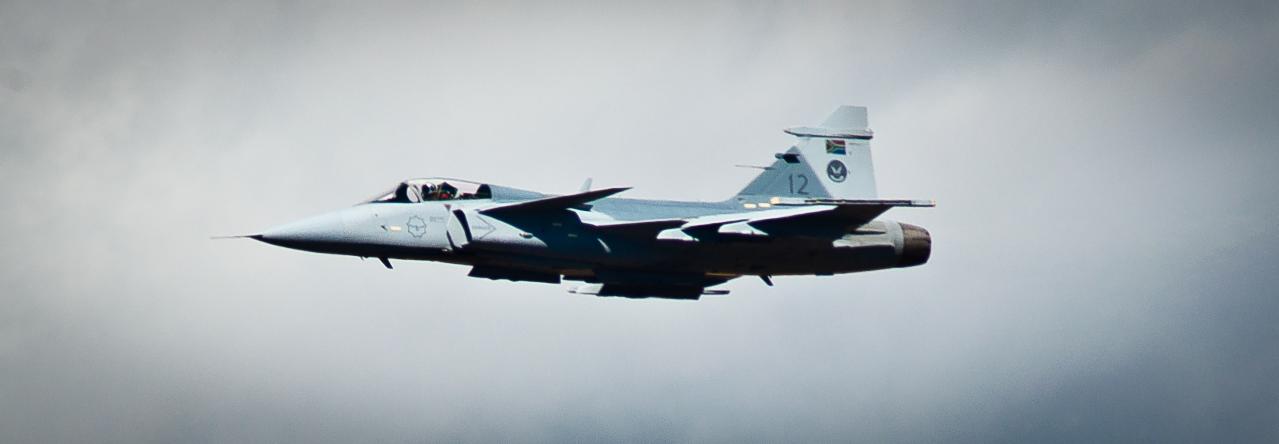
Asked plainly, South Africa’s fighter fleet is small, modern and badly underused. The Gripen is the only fighter type the SAAF has ever operated since retiring the Cheetah, and funding shortfalls — not aircraft age — are what keep most of the fleet on the ground.
| System | Origin (country + manufacturer) | Quantity | Status | Source |
|---|---|---|---|---|
| JAS 39 Gripen C/D | Sweden, Saab | 26 delivered 2008–2013 (17 single-seat C, 9 two-seat D); 1 written off in a 2015 landing accident | Operational; 13 declared serviceable under the Saab support contract that expired August 2025, average availability 54% against a reduced readiness target of two aircraft (Sept 2024–Mar 2025 reporting period) | DefenceWeb, “Setting the record straight” (Mar 2025) |
The Gripen fleet is operated by 2 Squadron at Air Force Base Makhado. Saab’s airframe support contract (September 2022 to August 2025, worth roughly R650 million) covered only 13 of the surviving 25 jets, with the rest kept in storage; DefenceMENA found no confirmed report of a replacement airframe contract since that agreement lapsed. Engine support is separately contracted to GKN Aerospace from August 2023 to July 2026, worth R327 million, of which R145 million was funded as of the most recent parliamentary disclosure — leaving a further R181 million reported as still required.
Trainer aircraft
Two trainer types carry the SAAF’s entire pilot pipeline, and both are in worse shape than the fighters they are meant to feed.
| System | Origin (country + manufacturer) | Quantity | Status | Source |
|---|---|---|---|---|
| Hawk Mk120 | United Kingdom, BAE Systems (SAAF-specific avionics integration with Denel/Aerosud) | 24 originally acquired; 2 damaged in accidents | Operational; 12 airframes under a BAE Systems service contract running to 2029, average availability 71% against a readiness target of four aircraft | DefenceWeb (Mar 2025); DefenceWeb fixed-wing funding report |
| Pilatus PC-7 Mk II “Astra” | Switzerland, Pilatus, locally upgraded avionics | 35 upgraded airframes at the Central Flying School, Langebaanweg | Operational on paper; average availability just 9% (2 of 35) over the same reporting period | DefenceWeb, “Setting the record straight” (Mar 2025) |
The Astra’s 9 percent availability is arguably the SAAF’s most consequential number: without a working basic-trainer fleet, the pipeline that is supposed to produce the next generation of Gripen and Hawk pilots is itself the bottleneck.
Transport and VIP aircraft
Fixed-wing airlift is where the SAAF’s crisis is most acute. Every transport type reported in the March 2025 assessment was flying at reduced availability, and the C-130BZ Hercules — the aircraft the SAAF depends on for both tactical airlift and its international search-and-rescue obligations — was effectively grounded.
| System | Origin (country + manufacturer) | Quantity | Status | Source |
|---|---|---|---|---|
| C-130BZ Hercules | United States, Lockheed Martin | 6 airframes remain on strength (401, 402, 405, 406, 408, 409) | Reported at 0 of 5 operational in the Sept 2024–Mar 2025 window; only 401 flew occasional test sorties without full airworthiness. Aircraft 409 has been at Marshall Aerospace (UK) since August 2023 for a R470 million ADS-B and avionics upgrade, expected back mid-2026, after which 405 follows | DefenceWeb, “Setting the record straight”; DefenceWeb C-130BZ 409 reporting (2026) |
| CASA/Airbus C-212 | Spain, Airbus (CASA legacy) | 3 aircraft | Operational with restrictions; Airbus support contract Aug 2022–Aug 2025 only 67% funded (R47m of R70m required) | DefenceWeb fixed-wing funding report |
| Cessna 208 Caravan | United States, Textron/Cessna | 8 aircraft, 41 Squadron | Awaiting servicing as of Mar 2025; Absolute Aviation support contract 2024–2027 only R17m funded of R90m required | DefenceWeb, “Setting the record straight”; DefenceWeb fixed-wing funding report |
| Beechcraft King Air (300/B200C) | United States, Textron/Beechcraft | Estimated 4 aircraft, 41 Squadron | Support contract only R27m funded of R95m required | DefenceWeb fixed-wing funding report |
| C-47TP Turbo Dakota | United States (Douglas C-47 airframe), turboprop conversion and glass-cockpit rebuild by South African industry | Estimated 5 airframes remain viable (3 maritime-surveillance configured, 2 transport), 35 Squadron | Reported grounded since believed last flight in 2022; SAAF investigating a return to service, squadron nominally continues (change-of-command held September 2026) | DefenceWeb, 35 Squadron reporting; Scramble.nl |
| Boeing 737 BBJ / Dassault Falcon 900 | United States (Boeing) / France (Dassault) | 1 of each in the VIP fleet | Operational with limited availability, one aircraft of each type in service | DefenceWeb, “Setting the record straight” (Mar 2025) |
| Pilatus PC-12 | Switzerland, Pilatus | Small fleet, 41 Squadron | Awaiting servicing as of Mar 2025 | DefenceWeb, “Setting the record straight” (Mar 2025) |
Helicopters
Rotary-wing aviation is the SAAF’s other acute weak point, and it carries real operational consequences: South Africa’s peacekeeping deployment to the Democratic Republic of Congo has repeatedly had to fly with a fraction of its Oryx transport fleet, and the Navy’s frigates cannot always embark the anti-submarine helicopters they are designed to carry.
| System | Origin (country + manufacturer) | Quantity | Status | Source |
|---|---|---|---|---|
| Rooivalk (AH-2) | South Africa, Denel Aeronautics | 11 airframes total | Operational; average availability 30% (2 of 6), largely limited by aircrew currency rather than airframe condition. Denel’s 2024–2027 support contract (R1.015 billion) was only 21% funded (R216m) as of a November 2024 parliamentary briefing | DefenceWeb, “Setting the record straight”; Armscor briefing to Parliament (Nov 2024) |
| Oryx | South Africa, Denel Aviation (rebuilt from Aerospatiale/Eurocopter Puma airframes) | 37 airframes (2 written off in crashes) | Operational; average availability ranged from 0% to 44% (4 of 13) across squadrons. In the DRC, only 1 of 3 deployed Oryx was operational, with one airframe (1247) damaged by ground fire near Goma in February 2024 | DefenceWeb, “Setting the record straight” (Mar 2025) |
| AW109 Light Utility Helicopter | Italy, Leonardo/AgustaWestland, assembled locally by Denel Aviation | 30 ordered 1999, delivered 2003–2007; 24 remain excluding 6 accident losses | Operational; average availability just 11.5% (1 of 9), with some squadrons reporting no serviceable airframes on a given day | DefenceWeb, “Setting the record straight” (Mar 2025) |
| Super Lynx 300 | United Kingdom, Westland/AgustaWestland (now Leonardo) | 4 airframes | Operational but insufficient for demand: the Navy’s frigates are each meant to embark two Super Lynx, and the fleet of four cannot cover simultaneous deployments. Support funding roughly 48% covered (R95m of R200m required) | DefenceWeb, SuperLynx and frigate-support reporting |
| BK117 | Germany/Japan, MBB/Kawasaki (Airbus Helicopters legacy) | Estimated 7 airframes | Utility/VIP role; support funding shortfall reported (R19m funded of R81m required) | DefenceWeb fixed-wing/rotary funding report |
Drones and surveillance UAVs
South Africa developed its own UAV lineage well before most African air forces considered drones, but the SAAF’s UAV status is unusually murky: only two Denel Dynamics types have ever been publicly linked to South African service, and even those have been the subject of official denials, so this page carries them here rather than as a standalone drone inventory.
| System | Origin (country + manufacturer) | Quantity | Status | Source |
|---|---|---|---|---|
| Seeker II | South Africa, Denel Dynamics | Not publicly disclosed | Reported operational for border and anti-poaching surveillance (Kruger National Park, since 2012), flown under Denel-linked arrangements rather than a confirmed SAAF squadron | DefenceWeb Seeker reporting; military.africa |
| Seeker 400 | South Africa, Denel Dynamics | At least 4 systems reportedly delivered to Defence Intelligence from 2015 | Reported (unconfirmed): defenceWeb reported sightings at AFB Ditholo and a planned reactivation of 10 Squadron as the operating unit, but a SANDF spokesman publicly denied routine operations in 2016; Denel displayed the Seeker 400 again at AAD 2026 | DefenceWeb, “SANDF ‘not operating’ UAVs” (2016); DefenceWeb AAD 2026 reporting |
How the arsenal was built
The SAAF’s fleet was assembled in three distinct waves. The first is the embargo era: barred by the 1977 UN arms embargo from buying military aircraft abroad, South Africa turned derelict and grey-market Aerospatiale Puma airframes into the Oryx and developed the Rooivalk attack helicopter and the Seeker UAV family almost entirely in-house through Atlas Aviation and its successor, Denel. The second wave followed the end of apartheid: the controversial 1999 Strategic Defence Package (“the Arms Deal”) brought in the Gripen and Hawk from Sweden and the UK, and the AW109 from Italy, re-equipping the SAAF with genuinely modern types for the first time in a generation — deliveries ran from the early 2000s through 2013.
The third wave is the one this page mostly documents: a decade-plus of budget cuts that has left nearly every fleet type without full sustainment funding. Since the 2016/17 financial year, the SANDF has absorbed a cumulative R39.4 billion in baseline budget cuts (roughly R41.6 billion in real terms once inflation is factored in), according to defence analyst Dean Wingrin, and the SAAF’s own 2025/26 budget increase of 3.9 percent still trailed inflation. The result is the pattern that runs through almost every table on this page: aircraft that are airworthy in principle but grounded for want of spares, engines or contracted maintenance hours. A partial fourth wave began around 2023–2026: GKN Aerospace’s Gripen engine contract, Marshall Aerospace’s C-130BZ avionics upgrade, and Denel’s own relaunch under direct Department of Defence ownership at AAD 2026 all point to an attempt to arrest the decline, though none has yet restored full-fleet availability. Denel has also partnered with Türkiye’s ASELSAN since 2023 on a Rooivalk avionics modernisation — a new glass cockpit, mission computers and helmet-mounted display — but this remains a co-development agreement with no delivered hardware, and DefenceMENA found no other Turkish system in SAAF service or on order.
| Date | Event | Value | Status |
|---|---|---|---|
| September 2025 | Denel and ASELSAN reaffirm collaboration on Rooivalk avionics modernisation | Not disclosed | Reported (co-development, no delivered avionics) |
| 2026 (ongoing) | Marshall Aerospace continues R470m ADS-B/avionics upgrade of C-130BZ 409, expected to return to South Africa mid-2026 | R470 million (covers 409 and 405) | Under modernization |
| September 2026 | Denel exhibits at AAD 2026 as a Department of Defence-owned entity for the first time, including Seeker 400 UAV and Rooivalk modernisation concepts | Not disclosed | Reported (industrial relaunch, not a confirmed new order) |
| September 2026 | 35 Squadron holds a belated change-of-command for the C-47TP Turbo Dakota fleet, signalling the unit continues despite the fleet’s grounded status | Not disclosed | Reported |
How many Gripens does South Africa have?
How many Gripens does South Africa have in total?
South Africa took delivery of 26 JAS 39 Gripen C/D fighters between 2008 and 2012. One was written off in a 2021 ground-handling accident at AFB Makhado, leaving 25 nominal airframes. Readiness has collapsed further since: a written reply to Parliament in April 2026 confirmed only two of the 26 are combat-ready, with R4.96 billion needed to restore the rest — see DefenceMENA’s dedicated breakdown of South Africa’s Gripen fleet for the full readiness history and sourcing.
How many fighter jets does South Africa have?
The Gripen is South Africa’s only fighter type, so the national fighter-jet total and the Gripen total are the same figure: an estimated 25 airframes on the books, of which roughly half were reported flyable as of the last confirmed disclosure.
Why is South African Air Force serviceability so low?
A decade-plus of real-terms budget cuts — a cumulative R39.4 billion since 2016/17 according to defence analyst Dean Wingrin — has left the SAAF unable to fully fund maintenance contracts across almost every fleet type, from the Gripen and Hawk down to VIP and light transport aircraft. Airframes are frequently airworthy in principle but grounded for lack of contracted spares, engine support or flying hours.
Does South Africa’s air force have any working transport aircraft?
Its C-130BZ Hercules fleet, the backbone of tactical airlift and search-and-rescue, was reported at zero of five aircraft fully operational in the most recent assessment, with only one flying restricted test sorties. Smaller types — the Cessna Caravan, King Air and C-212 — remain partially available but under-funded maintenance contracts.
What is the SAAF’s only attack helicopter?
The Rooivalk, designed and built domestically by Denel, is South Africa’s sole dedicated attack helicopter. Only 11 airframes were ever built, and roughly a third are typically available at any time — a capability defence analysts have warned could become unsustainable without a funded upgrade programme.
How South Africa compares
DefenceMENA’s Nigeria vs South Africa military comparison sets this air fleet against Nigeria’s larger but differently structured air force, while the South African Army weapons and equipment list covers the country’s mostly indigenous land arsenal and the same underfunding story playing out in armoured vehicles. DefenceMENA’s roundup of fighter aircraft flown by African air forces places the Gripen fleet alongside other combat types on the continent. A full South Africa military strength profile is planned separately on DefenceMENA as this series continues.
A note on the numbers
Most of the availability figures on this page come from a single leaked defence assessment covering September 2024 to March 2025, reported by defenceWeb in March 2025 and treated here as official-grade sourcing since it drew on an internal SANDF/Armscor readiness report; DefenceMENA has found no more recent official disclosure of fleet-wide availability as of this writing (September 2026), so these percentages should be read as the last confirmed snapshot rather than current-day figures. Fleet totals for older or export-linked types (C-47TP, King Air, BK117) rely on open-source aggregation rather than SANDF confirmation and are marked Estimated. One claim found only in a single defenceWeb passage — that the SAAF operates two Korean-built FA-50 aircraft — could not be corroborated anywhere else and appears inconsistent with every other record of SAAF fleet composition; it has been deliberately excluded from this page rather than repeated unverified. Global Firepower is not cited as a numeric source here, only referenced elsewhere on DefenceMENA as an unofficial index. This page was published on 26 September 2026 and will be updated as new contracts, deliveries or parliamentary briefings are confirmed.
Sources
- DefenceWeb, Setting the record straight on SAAF aircraft availability (March 2025)
- DefenceWeb, SAAF aircraft maintenance facing a nearly R8 billion shortfall
- DefenceWeb, SAAF’s C-130BZ Hercules 409 expected back in service mid-2026
- DefenceWeb, SAAF urgently seeking spares for four types in its fleet
- DefenceWeb, Denel and Aselsan further collaborate on Rooivalk modernisation
- DefenceWeb, Denel ready to stand up and be counted at AAD 2026
- DefenceWeb, SANDF “not operating” UAVs – spokesman
- DefenceWeb, 35 Squadron hands over command amid uncertain future of Dakota fleet
- DefenceWeb, SuperLynx work adds up
- Saab, Saab receives support contract for South African Gripen
- Military Africa, South Africa secures Gripen engine maintenance contract with GKN Aerospace
- SIPRI, Trends in International Arms Transfers 2025 (March 2026)