Egypt buys most of its new equipment from Europe now, but the backbone of its air force, armoured corps and helicopter fleet is still American, and it is kept alive by US$1.3 billion a year in Foreign Military Financing. This anatomy traces what Washington has actually sold, financed and co-produced in Egypt since 1980, with an order-versus-delivery label on every line.
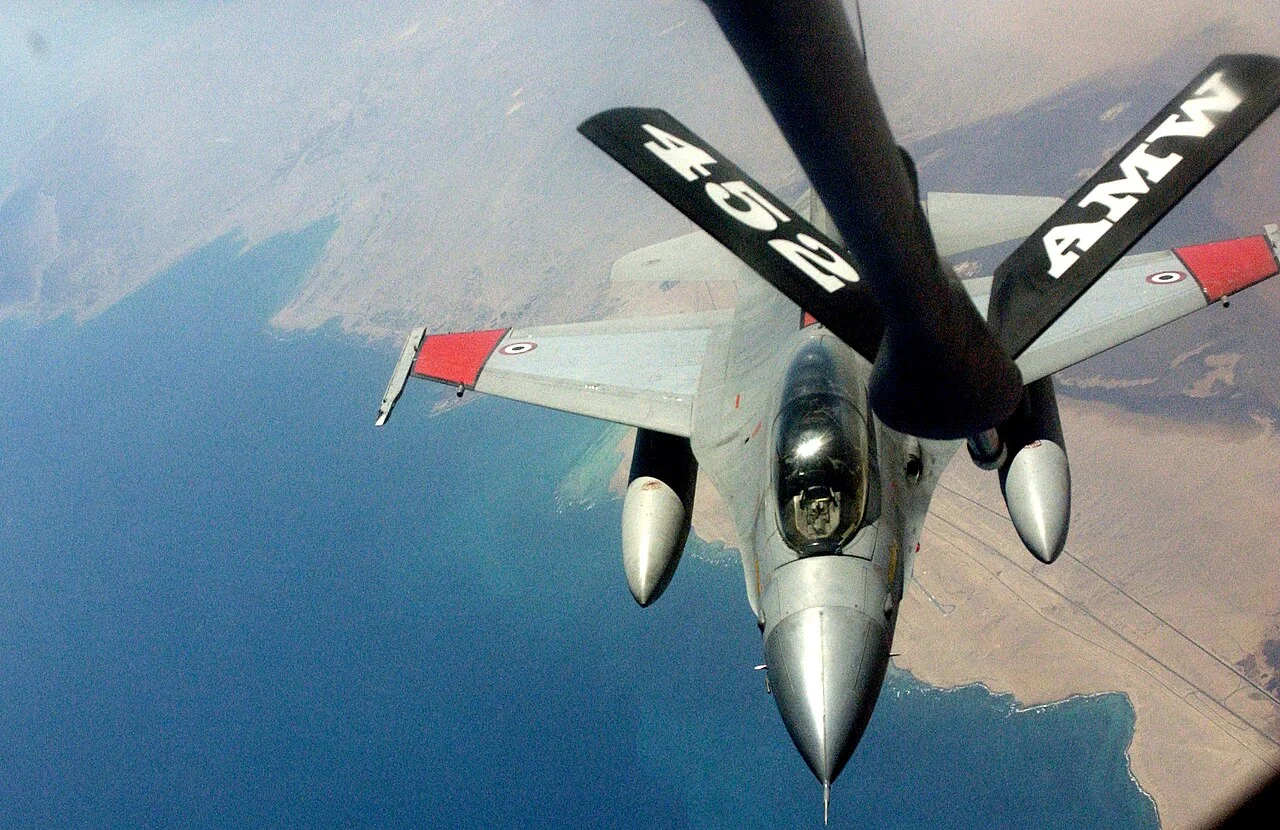
Photo: An Egyptian Air Force F-16 Fighting Falcon approaches a US Air Force KC-135 tanker during refuelling training, November 2007. Credit: U.S. Air Force photo/Staff Sgt. Amy Abbott, public domain, via Wikimedia Commons
The short answer to who armed Egypt is “several countries”, and the share of each has shifted sharply. SIPRI’s March 2026 fact sheet, as summarised on DefenceMENA’s Egypt military strength profile, puts France (39%), Germany (30%) and Italy (18%) at the top of Egypt’s 2021–25 arms imports, which together leave about 13% for every other supplier, the United States included. That is a fall from the decades when American equipment dominated. It does not mean the American footprint has shrunk: the F-16 and Abrams fleets, the Apaches and the C-130s are installed base that needs spares, engines, munitions and upgrades for years, and that is where US financing goes. The Foreign Policy reporting of May 2026 says roughly half of the US aid supports maintenance and sustainment of legacy systems.
This piece follows the North Africa desk method: a chronological table of programmes, then the story by domain, then a comparison with Egypt’s other suppliers. An order is not a delivery, and a delivery is not an operational aircraft or tank. Where sources disagree the figure is given as a range and marked Estimated.
How the relationship formed
Egypt was a Soviet client until the mid-1970s. After the 1979 peace treaty with Israel it became a major recipient of US military assistance, and the aid level of about US$1.3 billion a year has held since a 1987 arrangement, according to Foreign Policy. In total the United States has provided nearly US$60 billion in military aid over 47 years, the same source says.
The first US combat aircraft followed quickly. Egypt received its first F-16s in 1982 under the Peace Vector programme, the first Arab country to buy the type through Foreign Military Sales, and it eventually acquired about 220 of them in successive lots (see the table below). The M1A1 Abrams followed as a co-production project: Egyptian officials expected to assemble 524 tanks under the initial agreement and hoped for up to 1,500 (Wikipedia summary of the co-production programme, with primary references), with the plant in Helwan as the assembly site.
The relationship has been interrupted only once in a way that touched deliveries. After the 2013 removal of President Mohamed Morsi, the US held back F-16 deliveries and froze Abrams kits. Washington lifted the hold in March 2015, and the two programmes restarted the same year (Defense News, November 2015). Since then the friction has moved from shipments to conditions on the money, covered below.
The anatomy table
One row per programme, in chronological order. “Announcement” is the date of the contract or the US congressional notification, which is not a contract.
| System | Manufacturer | Contract / announcement | Quantity | Delivery | Current status | Source |
|---|---|---|---|---|---|---|
| F-16A/B/C/D Blocks 15, 32, 40 (Peace Vector I–VI) | General Dynamics / Lockheed Martin | Orders from 1980 to 1999 | About 220 acquired: 42 Block 15 A/B, 40 Block 32 C/D, 138 Block 40 C/D | From 1982; last Block 40 lots 2001–02 | In service (Estimated: about 218 remain listed) | GlobalSecurity, F-16.net; DefenceMENA Egypt profile |
| M1A1 Abrams co-production | General Dynamics Land Systems; Egyptian Factory 200 | Initial programme late 1980s | 524 planned initially; 1,130 M1A1 in Egyptian service after 2015 kits (Estimated 1,100–1,360) | Assembly in Helwan since 1992 | In service; local assembly | Wikipedia (co-production), Defense News 2015, Army Recognition 2018 |
| F-16C/D Block 52 | Lockheed Martin | Contract 24 December 2009; US$213 million long-lead award March 2010 | 20 (16 C, 4 D) | Final four delivered November 2015 after the 2013 hold | Delivered; in service | Defense News, F-16.net, Lockheed Martin |
| M1A1 kits | General Dynamics Land Systems | 15 October 2015 agreement | 125 kits with engines and armament | Fulfils a 2011 order held up by the aid freeze | Delivered (kits); assembled locally | Defense News, November 2015 |
| AGM-114K/R3 Hellfire II | Lockheed Martin | US State Department approval, April 2015, about US$57 million | Not stated in sources reviewed | No public delivery record | Approved; status unclear | DSCA (via search index) |
| F110 engine life-extension (Pacer Pharaoh) | GE Aviation, StandardAero | July 2019, over US$79 million | Fleet engines, quantity not stated | First engines inducted 2019 | Under way (sustainment) | DVIDS, USAF |
| AH-64E refurbishment | Boeing, Lockheed Martin | DSCA notification 7 May 2020, estimated US$2.3 billion | 43 refurbished helicopters; 88 T700-GE-701D engines | Work reported under way; no delivery date published | Approved; remanufacture reported under way | Defense News; Military Africa 2022 |
| C-130J-30 Super Hercules | Lockheed Martin | DSCA notification January 2022, about US$2.2 billion; order confirmed 5 September 2024 | 12 approved; 2 ordered | Not published | Ordered (2 of 12); 10 remain approved only | Military Africa; Lockheed Martin, 5 September 2024 |
| CH-47F Chinook | Boeing | FMS contract, January 2023, about US$426 million | 12 | First 5 handed over at El Alamein, September 2026 | Under delivery | DefenceMENA; Military Africa; Janes |
| F-16 engineering and technical support (IDIQ) | Lockheed Martin | 2024 award to 2029, about US$31.3 million, lists Egypt among ten FMS customers | Not applicable | Service contract | Contracted | DoD contract announcement (via TheDefenseWatch) |
| Hellfire AGM-114R | Lockheed Martin | DSCA notification 20 December 2024, estimated US$630 million | 2,183 | None announced | Approved; no contract announced | DSCA; Military Africa |
| NASAMS medium-range air defence | RTX, Kongsberg | DSCA notification 24 July 2025, ceiling US$4.67 billion | 4 AN/MPQ-64F1 radars, 100 AMRAAM-ER, 600 AIM-9X Block II | None announced | Approved; no contract announced | Breaking Defense; The Defense Post; Defense Daily |
Air: from Peace Vector to a fleet in transition
The F-16 is the core of the American story. Egypt operates one of the largest Fighting Falcon fleets outside the United States, and the total acquired, about 220 aircraft across Blocks 15, 32, 40 and 52, is stable across the sources reviewed. The oldest Block 15 aircraft entered service in the early 1980s, which is one reason the wider air force has turned to France: Egypt’s Rafale order stands at 54 aircraft with deliveries continuing and a request for a further 24 sent to Dassault, covered in our report on the RFP.
What the United States has done for the F-16 in recent years is sustainment, not replacement. The F110 engine service-life extension started in 2019 and moved overhaul work from Tinker Air Force Base to GE Aviation and StandardAero. A Lockheed Martin engineering-support contract announced in 2024 lists Egypt among the ten FMS customers it covers through 2029. There is no announcement of new F-16s for Egypt since the 2009 order. Reports over the years, including a Fighter Jets World article, say the Egyptian F-16s were not supplied with AMRAAM beyond-visual-range missiles; the July 2025 NASAMS notification does include 100 AMRAAM-ER missiles, but for the ground-launched system. Treat the F-16 missile question as reported rather than confirmed.
Transport is the other slow renewal. Egypt already flies about 22 C-130H and three C-130H-30 aircraft (Military Africa, 2024). The January 2022 notification covered 12 C-130J-30s; in September 2024 Lockheed Martin announced that Egypt had ordered two, making it the 23rd C-130J operator. Only those two are on order. The other ten remain an approval.
Land: Abrams and the Helwan line
The Abrams is the clearest case of technology transfer in the relationship. Egyptian workers assemble tanks at Factory 200 from US-supplied kits, and the programme supported at least 2,500 jobs during the 2015 kit contract (Defense News). The 125 kits agreed in October 2015 completed an order that dated to 2011, and Defense News counted 1,130 M1A1s in service after they were delivered. Later Egyptian statements at EDEX 2018 spoke of about 1,200 tanks produced locally. The figures do not describe the same thing, since the first counts tanks in service and the second counts production, so this article uses 1,100–1,360 as an Estimated range, the same one used in our comparison of Arab main battle tanks.
Helicopters: Apache and Chinook
The AH-64E refurbishment notified in May 2020 covers 43 helicopters at an estimated US$2.3 billion, with Boeing and Lockheed Martin as prime contractors. DSCA said Egypt intended to use them to counter terrorism from Sinai. Military Africa reported in 2022 that the upgrade work was continuing. No delivery schedule has been published, so the line reads “approved; work reported under way”, not delivered.
The Chinook line moved in September 2026, when the first five of 12 CH-47Fs were handed over at El Alamein under a contract of about US$426 million (see DefenceMENA’s report). The remaining seven are due through the rest of the year, according to Military Africa.
Air defence and missiles
The NASAMS package is the largest US approval of the last five years. It was notified on 24 July 2025 at up to US$4.67 billion: four Sentinel radars, 100 AMRAAM-ER and 600 AIM-9X Block II missiles, plus non-major equipment, with RTX and Kongsberg as contractors and no offsets proposed (Breaking Defense). DSCA notifications state ceilings, and they warn that the final figures may be lower. No contract has been announced, so the system is not on Egypt’s inventory. Air defence in Egypt is mixed: Russian S-300 systems, German IRIS-T SLM and, according to Military Africa, Chinese HQ-9B. NASAMS would add a Western medium-range layer alongside them.
The Hellfire approval of 20 December 2024 was for 2,183 AGM-114R missiles at an estimated US$630 million, to arm the Apache fleet, with Lockheed Martin as prime contractor. It is, again, a notification.
Training, exercises and financing
Bright Star, the multinational exercise co-hosted by US Central Command and Egypt, ran from 28 August to 10 September 2025 with about 1,800 US personnel and 44 participating countries, of which 14 contributed troops and 30 observed (CENTCOM; Military Africa). It is the most visible part of a training relationship that also includes US refuelling and flying training for Egyptian pilots.
Financing is the deepest tie. Egypt receives US$1.3 billion a year in FMF, and Congress has attached human-rights conditions to part of it since 2008. In September 2024 Secretary of State Antony Blinken waived the conditions on US$320 million, on national security grounds, including US$225 million tied to human-rights benchmarks and US$95 million tied to the release of political prisoners, according to Human Rights Watch. It was the first year the whole conditioned amount was released; earlier administrations had held back part of it for three years. Foreign Policy reports that every administration has waived the conditions and that the Biden administration released all withheld aid in its final year. The dispute is documented: HRW says the waiver disregards ongoing repression, and the State Department cited efforts on a Gaza ceasefire. Beyond that, this article does not weigh the argument.
Where the US stands against Egypt’s other suppliers
| Supplier | What it provides | Verified recent deals | Local production / transfer | Sustainment |
|---|---|---|---|---|
| United States | F-16, Abrams, Apache, Chinook, C-130, munitions; FMF cash | CH-47F (2023); Hellfire and NASAMS approvals (2024, 2025); C-130J 2 ordered | M1A1 assembly at Factory 200 | F110 engines, F-16 support contracts; roughly half of US aid goes to sustainment (Foreign Policy) |
| France | Rafale, frigates, Mirage 2000 | 54 Rafale ordered in total; 24 more requested (2026) | Local Rafale component production reported at EDEX 2025 | Delivered under national contracts, not FMF |
| Germany | Submarines, MEKO A-200 frigates, IRIS-T SLM | Type 209 boats; IRIS-T in service | Not reported | Manufacturer support |
| Italy | FREMM frigates | Two FREMM Bergamini (SIPRI 18% share) | Not reported | Manufacturer support |
| Russia | MiG-29M/M2, S-300 air defence | SIPRI: Russian exports to Egypt fell sharply between 2016–20 and 2021–25 | Not reported | Constrained |
| China | HQ-9B air defence (reported) | HQ-9B acknowledged by a former Egyptian general on TV; J-10C only speculation | Not reported | Reported (unconfirmed) |
What each supplier offers Egypt differs more than the raw shares suggest. American equipment comes with financing that no other supplier matches, an installed base of about 220 fighters and 1,100 or more tanks, and licensed assembly. It also comes with conditions: congressional human-rights language on part of the aid, and, according to the reporting cited here, limits on some weapons that have pushed Cairo to buy elsewhere. France sells aircraft and ships for cash or credit, without a comparable political framework, and Egypt took 11% of French arms exports in 2021–25 (SIPRI). The Chinese HQ-9B is the only reported case of a Chinese system in Egyptian air defence; the account comes from a retired general speaking on television and is unconfirmed, and the J-10C reports rest on a photograph of an Egyptian officer in a cockpit. This is a diversification story, not a substitution one: even after the Rafale deals, the largest fleets in Egypt’s inventory carry US markings.
What is pending or unclear
- NASAMS: approved at up to US$4.67 billion in July 2025. No contract or delivery date has been announced. Status unclear.
- Apache remanufacture: approved at about US$2.3 billion in 2020; no delivery schedule. Reported under way.
- C-130J: two of 12 approved aircraft ordered. The rest are unconfirmed.
- Hellfire AGM-114R: 2,183 missiles approved in December 2024, no contract announced.
- Egypt’s Abrams inventory: the number of M1A1s in service is Estimated between 1,100 and 1,360; there is no official figure.
- Chinese systems: HQ-9B is reported, J-10C is speculation. Neither is confirmed by an official Egyptian statement in the sources reviewed.
Frequently asked questions
How many F-16s does Egypt have?
Egypt has acquired about 220 F-16s since 1982. Open-source directories list about 218 as remaining in service in 2026, which is Estimated: there is no official inventory. See the Egypt military profile for the wider air force.
How much military aid does the US give Egypt?
US$1.3 billion a year in Foreign Military Financing, a level held since 1987 (Foreign Policy, May 2026). About US$320 million of it carries congressional human-rights conditions, which the State Department waived in September 2024.
Does Egypt build the Abrams?
Egypt assembles the M1A1 from US-supplied kits at Factory 200 in Helwan, with local content that has grown over time. It does not design or export the tank.
Related coverage: United States and Morocco and France and Egypt anatomies, and the Egypt desk, United States desk and F-16 desk.
For the company behind the NASAMS, Stinger and RAM notifications, see our RTX company profile.
Sources
- Human Rights Watch, Egypt: US Waives Human Rights Conditions on Military Aid (September 2024)
- Foreign Policy, What Are U.S. Military Dollars Buying in Egypt? (May 2026)
- Breaking Defense, State Department clears Egypt to buy NASAMS (July 2025)
- The Defense Post, US approves $4.67B sale of air defense system to Egypt
- Defense News, State clears Apache updates for Egypt (May 2020)
- Defense News, M1A1 Abrams co-production to resume (November 2015)
- Defense News, Egypt takes delivery of final 4 delayed F-16s (November 2015)
- DVIDS, USAF begins new Egyptian F110 upgrade program (July 2019)
- Lockheed Martin, Welcomes Egypt to the C-130J Super Hercules Fleet (September 2024)
- Military Africa, Egypt orders two C-130J Super Hercules
- Military Africa, US authorizes $630m Hellfire missiles for Egypt’s AH-64 Apache
- Military Africa, Lockheed Martin continues with Egypt Apache upgrade
- Military Africa, Egypt confirms acquisition of Chinese HQ-9B
- Military Africa, Exercise Bright Star 25 concludes in Egypt
- US Central Command, Bright Star 2025 command post exercise
- SIPRI, Trends in International Arms Transfers, 2025 (March 2026)
- GlobalSecurity, Egypt F-16 Peace Vector
- TheDefenseWatch, Lockheed Martin wins $31.3 million F-16 engineering support contract
- Defense Security Cooperation Agency, Egypt – Hellfire AGM-114R Missiles (December 2024)
- Wikipedia, M1A1 tank coproduction program in Egypt (secondary; references primary sources)