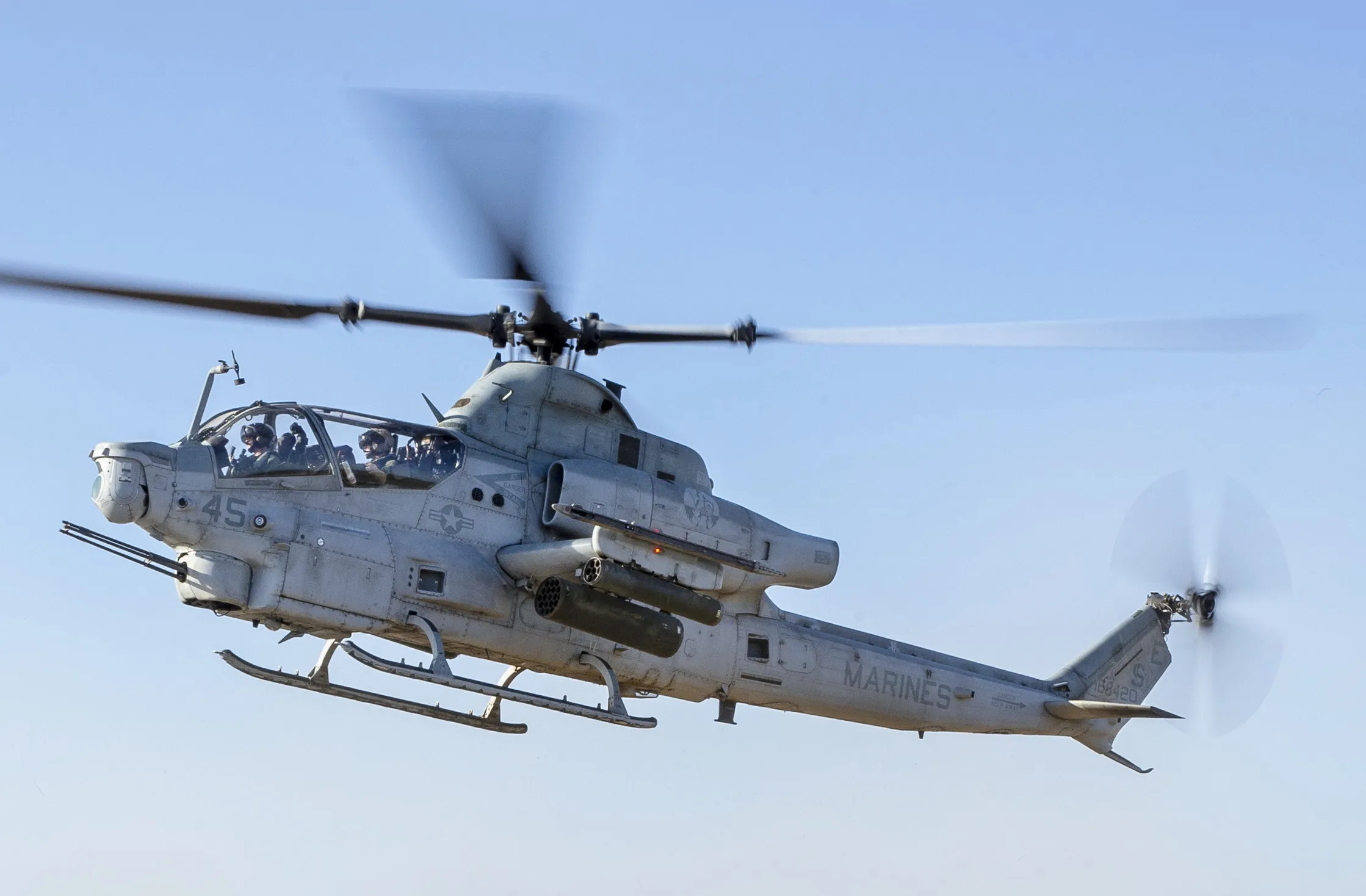
Bell began production of Nigeria’s first AH-1Z Viper attack helicopter on 16 September, with Nigerian Air Force representatives touring the company’s Amarillo, Texas plant and signing the aircraft’s airframe in a ceremony marking the start of assembly. The milestone advances a $997 million Foreign Military Sale covering 12 Vipers, first approved by the US State Department, toward its first hardware.
The package, as detailed by Army Recognition and confirmed by DefenceWeb, includes 28 T700-GE-401C engines — 24 for installation across the fleet plus four spares — and 2,000 APKWS laser-guidance sections for 70mm rockets. Each helicopter will carry the M197 20mm cannon, an electro-optical/infrared Target Sight System and night-vision cueing displays, backed by an electronic warfare suite. Bell expects to complete deliveries by early 2029.
A third rotor-wing logistics chain
Nigeria’s air force currently flies Russian-built Mi-24/Mi-35 gunships alongside six Turkish-made T129 ATAKs, while the army is separately bringing in 12 MD 530F Cayuse Warriors. Adding the AH-1Z means a third distinct maintenance and spare-parts pipeline for Nigerian rotary-wing attack aviation, on top of the two already in service. That is not a small commitment for an air force whose readiness rates on its existing fleets have been an open question for years — keeping three unrelated helicopter types flying simultaneously will test Nigeria’s technical training pipeline as much as its budget.
What the AH-1Z brings that the Mi-24s and T129s do not is a mature, US-standard precision-strike package: APKWS-guided rockets turn unguided 70mm rounds into semi-precision munitions, a capability suited to strikes against dispersed, moving targets rather than fixed positions. For an air force running sustained counterterrorism and counter-banditry operations across the north, that precision matters as much as raw airframe numbers — fewer stray rounds near populated areas, and a longer stand-off distance than older gunship types allow.
The deal also signals continued US willingness to sell top-tier attack helicopters into West Africa despite the scale of Nigeria’s security burden, at a moment when Washington has been more selective about major arms sales to the region. Whether the 2029 delivery timeline holds, and how quickly Nigerian crews convert onto a type neither the air force nor its regional neighbours currently operate, will be the next things worth watching.
Why it matters for Africa
Nigeria’s security burden is concentrated in the north and northeast, where the air force flies close-support and strike missions against Boko Haram and Islamic State West Africa Province remnants, and increasingly against armed banditry in the northwest. A precision-capable gunship matters in that environment because most strikes happen near villages and farmland rather than open desert, and APKWS-guided rockets cut the risk of the kind of stray-round incidents that have drawn criticism of Nigerian air operations in the past. The purchase also keeps Nigeria’s air force diversified across US, Russian and Turkish suppliers at a time when several West African neighbours — including Mali, Niger and Burkina Faso — have shifted toward Russian and Turkish equipment amid strained Western relations. Lagos betting on a US-standard platform, on top of its existing Turkish T129 fleet, signals it intends to keep multiple procurement channels open rather than consolidate around one supplier.