South African Army Weapons and Equipment List (2026): Who Built Africa’s Most Indigenous Arsenal

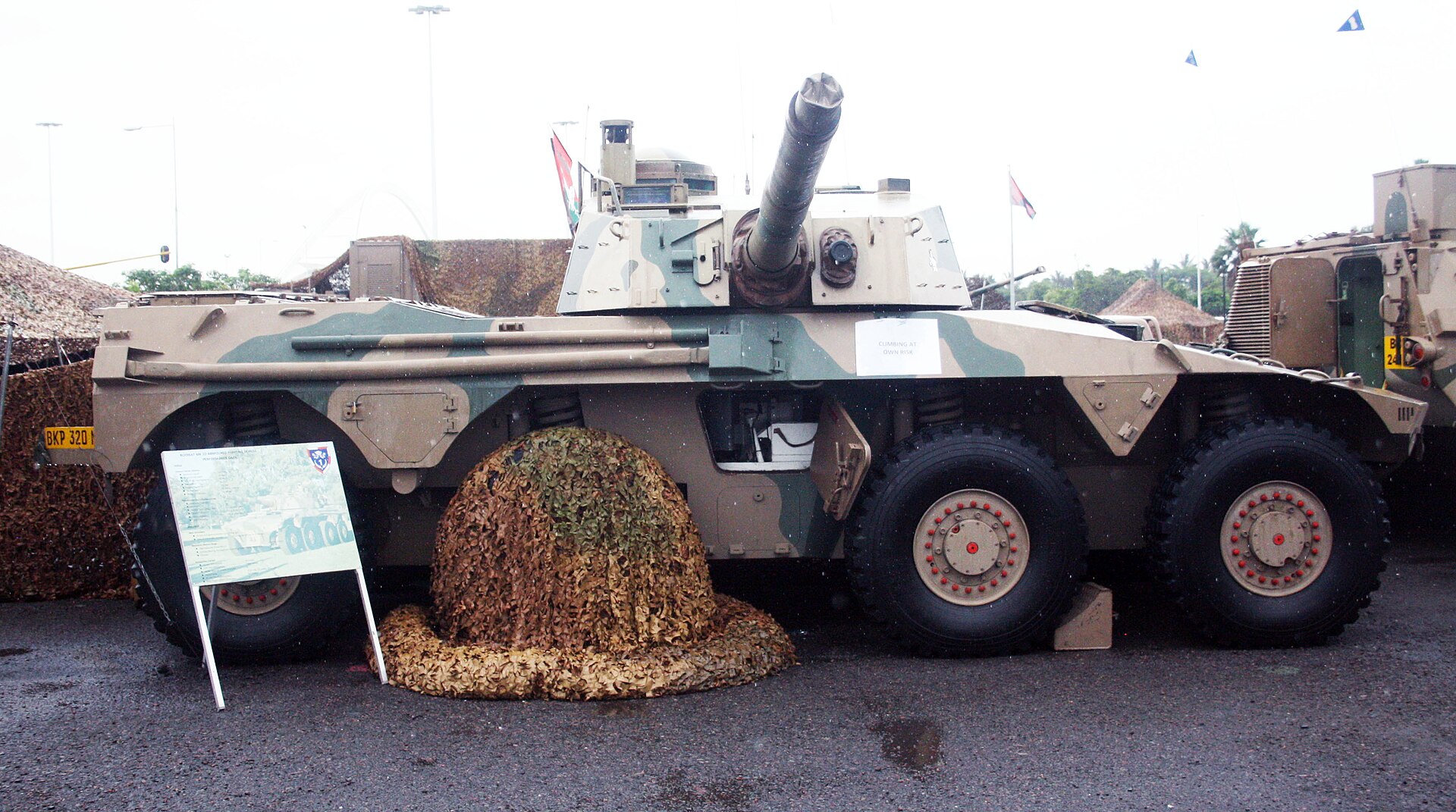


The South African Army is Africa’s most self-armed force — almost every tank, howitzer and armoured car it fields was designed and built at home by Armscor and Denel, a legacy of the apartheid-era arms embargo. But the same industry that once produced the G5 howitzer and the Olifant tank has spent 18 years and R7.7 billion trying to deliver its replacement infantry fighting vehicle, the Badger, without handing over a single one. This is the 2026 order of battle: what the Army actually holds, who built it, and why so little of it is new.
In short: South Africa is the rare African army that mostly arms itself. Its main battle tanks (Olifant), infantry fighting vehicles (Ratel), armoured cars (Rooikat) and artillery (G5 towed and G6 self-propelled howitzers) were all designed and built domestically by Armscor’s state-owned lineage, chiefly Denel, because the 1977 United Nations arms embargo cut South Africa off from foreign suppliers. That indigenous base has not delivered a genuinely new armoured vehicle to the Army in years: the Badger infantry fighting vehicle meant to replace the 1970s-era Ratel has consumed R7.7 billion since 2007 without a single production vehicle reaching a unit, and most of the Army’s heavy equipment is Cold War- or embargo-era stock kept running through refurbishment rather than replacement. South Africa does not appear in SIPRI’s list of major arms importers — it barely imports heavy armour at all — while ranking as Sub-Saharan Africa’s largest defence spender and an established arms exporter in its own right.
| Origin | Main systems | Share of listed inventory | Era |
|---|---|---|---|
| South Africa (Denel / Armscor lineage) | Olifant MBT, Ratel IFV, Rooikat armoured car, G5/G6 howitzers, Valkiri/Bateleur MLRS, ZT3 Ingwe ATGM | Large majority of the Army’s tracked and wheeled combat fleet | 1970s–1990s embargo-era development, sustained by refurbishment since |
| United Kingdom (legacy) | Centurion hull lineage underlying the Olifant programme | Indirect — the base platform for South Africa’s own tank rebuild | 1950s-origin hulls, rebuilt domestically from the 1970s onward |
| Cuba (Project Thusano, technicians only) | Refurbishment labour for Olifant Mk1/Mk2 tanks | Service work, not equipment supply | 2018–2021 |
| South Africa (Paramount Group, private) | Mbombe and Mbada armoured vehicle families | Mostly export product, not confirmed SANDF holdings | 2010–present |
Main battle tanks
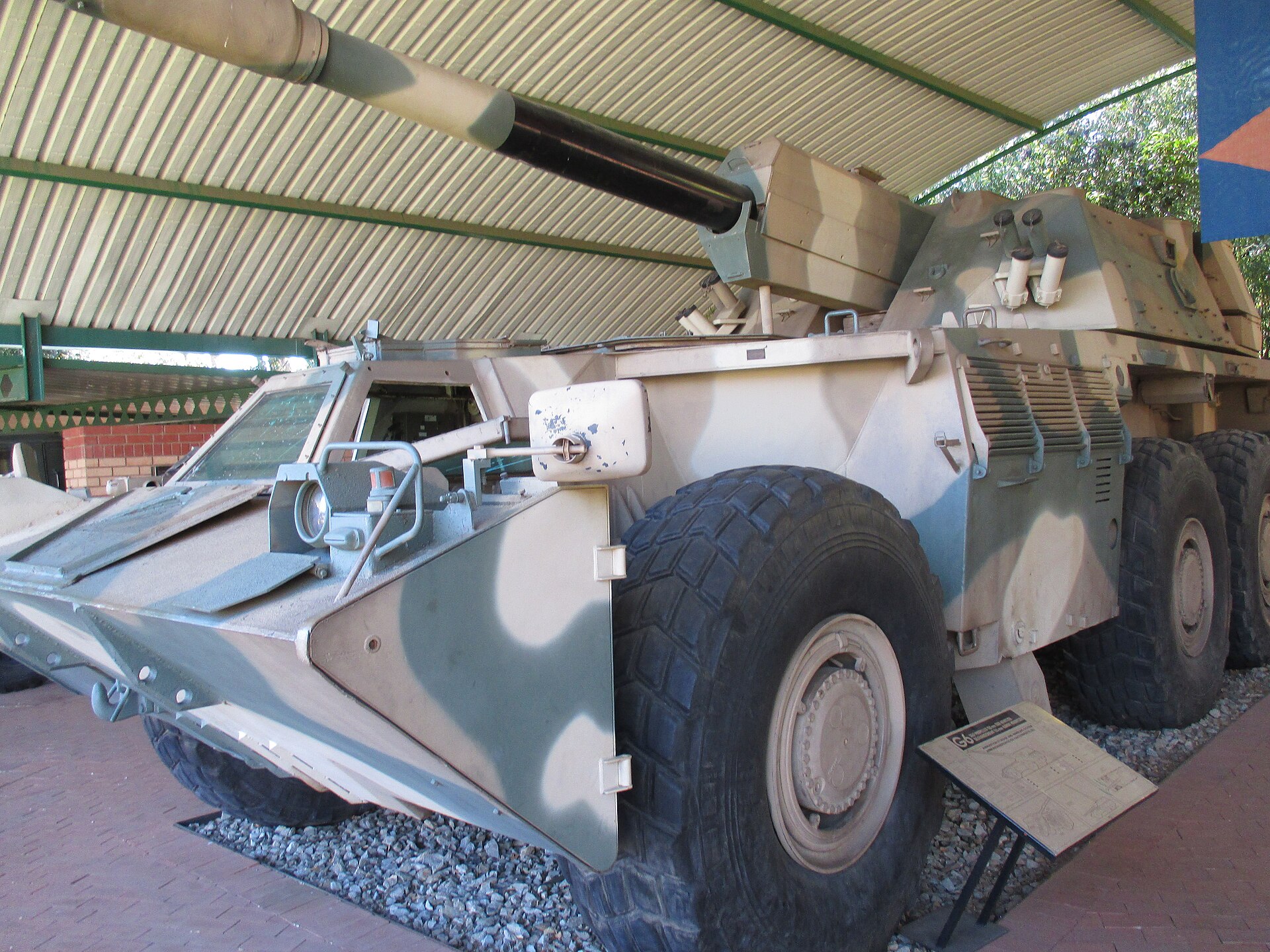
South Africa’s entire tank fleet is a single family: the Olifant, a deep indigenous rebuild of the British-designed Centurion hull that Armscor and its state-owned predecessors kept modernising through the embargo years because no foreign supplier would sell Pretoria a new tank. The Army has not operated any other tank type since. Most of the fleet has not seen active service in years and sits in long-term storage.
| System | Origin (country + manufacturer) | Quantity | Status | Source |
|---|---|---|---|---|
| Olifant Mk1A/Mk1B | South Africa, Armscor/Denel Land Systems (Centurion-hull rebuild) | Estimated ~133 in reserve/storage (2021 reporting), part of a nominal fleet of around 227 Olifants of all marks | Reserve, partially refurbished 2018–2021 | DefenceWeb (Cuban mechanics reporting) |
| Olifant Mk2 | South Africa, Denel Land Systems, upgrade work with BAE Systems in 2003 and 2005 | Estimated ~24–26 active hulls; 7 further examples refurbished under Project Thusano 2018–2021 | Operational | DefenceWeb; Army Recognition |
Infantry fighting vehicles and the stalled Badger
The Ratel, in service since the late 1970s, remains the backbone of South Africa’s mechanised infantry despite being one of the oldest IFV designs still on any African army’s books. Its intended replacement, the Badger, is the starkest illustration of how far the country’s once-formidable defence industry has fallen behind its own ambitions.
| System | Origin (country + manufacturer) | Quantity | Status | Source |
|---|---|---|---|---|
| Ratel-90 / 60 / 20 / 81 family | South Africa, Sandock Austral (now within the OTT Group/DCD industrial lineage) | Estimated 434 active plus 666 in reserve, though trackers vary; several sources put the combined fleet above 500 | Operational, undergoing a Service Life Extension Programme (SLEP) by OTT Group | Shephard Media; aggregated open-source trackers |
| Badger (Project Hoefyster) | South Africa, Denel Land Systems, based on the Finnish Patria AMV hull | 0 delivered to units; planned production cut from an original 264 vehicles to 88 | Under modernization — still in development, no vehicles handed over as of the December 2025 parliamentary briefing | DefenceWeb, “R7.7 billion and 18 years later” |
Project Hoefyster was signed with Denel in 2007 with an original budget of roughly R16 billion for 264 vehicles across five variants. By December 2025, Denel and Armscor told Parliament’s defence committee that R7.7 billion had been spent, a further R6.6 billion was still required, only 14 hull shells had reached the integration line, and Defence Minister Angie Motshekga confirmed no vehicle would be delivered before the end of 2025. The Section Variant’s product baseline — the design-freeze milestone that precedes production — was only completed in July 2025, with the Fire Support and Command variants not expected until April and June 2026, and the Missile and Mortar variants pushed out to 2027.
Armoured cars, MRAPs and reconnaissance vehicles
Below the tank and IFV layer sits a wheeled fleet built for reconnaissance, border patrol and the peacekeeping deployments that occupy much of the Army’s operational tempo, from the AU/SADC mission in Mozambique through 2024 to 27 years inside the UN’s MONUSCO mission in the Democratic Republic of Congo, which ended on 2 July 2026 after 14 South African soldiers were killed by M23/Rwanda-backed forces in January 2025.
| System | Origin (country + manufacturer) | Quantity | Status | Source |
|---|---|---|---|---|
| Rooikat 76mm armoured car | South Africa, Sandock Austral / Reumech OMC | 240 built 1990–1996; active fleet size not officially disclosed | Operational (partial fleet), remainder in reserve | Aggregated open-source trackers, not independently verified |
| RG-31 Nyala / RG-32 Scout | South Africa, Land Systems OMC (BAE Systems industrial lineage) | Fleet size not publicly disclosed | Operational, mainly peacekeeping and reconnaissance roles | Aggregated open-source trackers; defenceWeb |
| Casspir Mk3 / Mamba Mk2 | South Africa, OMC / TFM | Legacy fleet, size not disclosed | Operational, mainly Operation Corona border safeguarding | Aggregated open-source trackers, not independently verified |
Paramount Group’s Mbombe and, as of September 2026, the jointly developed Mbada 4×4 (with India’s Kalyani Strategic Systems, unveiled at AAD 2026 in Pretoria) belong in this category by design lineage, but neither has a confirmed South African Army order — both are export-first products from South Africa’s private defence industry rather than confirmed SANDF equipment, and are not counted in the table above.
Artillery, rocket launchers and anti-tank weapons
This is the area where South Africa’s indigenous industry has been most respected internationally: the G5 towed howitzer and its self-propelled derivative, the G6, set the long-range artillery benchmark that other countries’ 155mm systems were later measured against, and both remain export successes even as the Army’s own fleet has not grown in decades.
| System | Origin (country + manufacturer) | Quantity | Status | Source |
|---|---|---|---|---|
| G5 155mm towed howitzer | South Africa, Denel Land Systems (formerly LIW) | Estimated ~75 | Operational | Aggregated open-source trackers, not independently verified |
| G6 Rhino 155mm self-propelled howitzer | South Africa, Denel Land Systems | Estimated ~43 | Operational | Aggregated open-source trackers, not independently verified |
| T5-52 155mm/52-calibre wheeled SP howitzer (Tatra 8×8) | South Africa, Denel Land Systems | 0 in confirmed SANDF service; a proposed 6-unit order to replace G5s sold to the UAE has not been finalised since it was first reported in 2020 | Reported (unconfirmed order); export demonstrator shown again at AAD 2026 | DefenceWeb |
| Valkiri Mk1/1.8 127mm MLRS (24-tube, Unimog chassis) | South Africa, Denel/Armscor | Estimated ~76, mostly held in reserve | Estimated, largely reserve stock | Aggregated open-source trackers, not independently verified |
| Bateleur 127mm MLRS (40-tube, Kwevoel chassis) | South Africa, Denel/Armscor | Estimated ~25 | Operational, State Artillery Regiment | Aggregated open-source trackers, not independently verified |
| ZT3 Ingwe ATGM (Ratel ZT3 carrier) | South Africa, Denel Dynamics | Not disclosed | Reported (unconfirmed current fleet size) | Aggregated open-source trackers, not independently verified |
Air defence and small arms
The Army’s own organic ground-based air defence is thin: the Guardian/Protector/Outcome-phase GBADS programme, built around Starstreak missiles and the Thutlwa acquisition radar, has moved slowly, and South Africa’s more capable air-defence asset, the Denel Dynamics Umkhonto surface-to-air missile, is fitted to Navy frigates rather than fielded as an Army ground system today. Small arms are standardised around the Vektor R4 and R5 rifles, both licensed Galil derivatives produced domestically by Denel’s Vektor subsidiary, summarised here as a single line rather than broken out system by system.
How the arsenal was built
South Africa’s land force followed a different path from almost every other army covered in this series, because it had no choice. The 1977 United Nations mandatory arms embargo cut the apartheid government off from foreign arms markets just as it fought an escalating border war in Namibia and Angola, forcing Armscor and its state-owned manufacturing arms — the lineage that became Denel — to design and build tanks, artillery and armoured vehicles domestically rather than buy them. That first wave produced the Olifant (a rebuilt Centurion hull), the Ratel IFV (1976–1987, one of the world’s first purpose-built wheeled IFVs), the Rooikat armoured car, and the G5/G6 howitzer family, whose long-range 155mm performance was internationally regarded as class-leading by the late 1980s.
The second wave, after 1994, was drawdown rather than expansion. Post-apartheid South Africa cut defence spending sharply, and the one major re-equipment programme of the era — the controversial 1999 Strategic Defence Package — bought Gripen fighters, Hawk trainers, corvettes and submarines for the Air Force and Navy, leaving the Army’s Cold War/embargo-era vehicle fleets to be sustained through refurbishment rather than replacement, a pattern that has held for three decades.
The third wave is Project Hoefyster’s long failure to deliver the Badger. Signed with Denel in 2007 for 264 vehicles at roughly R16 billion, the programme has consumed R7.7 billion and 18 years without handing a single production vehicle to a unit; Armscor has publicly attributed the delays to Denel’s underperformance, and the planned fleet has been cut to 88 vehicles for a single battalion. In parallel, from 2018 to 2021, Cuban military technicians were brought in under Project Thusano to refurbish 7 Olifant Mk2s and 84 Mk1s — a striking reversal for an industry that once built its own tanks specifically because no one else would sell it any, and a sign of how far domestic maintenance capacity had eroded. Turkish firms such as ASELSAN, TAI and STM were the third-largest exhibitor group at AAD 2026, but that reflects commercial interest only: DefenceMENA has found no evidence of any Turkish system in South African Army service or on order.
The fourth and most recent wave is a tentative industrial reset. The Department of Defence became Denel’s direct shareholder, and the company — now a leaner state entity with around 1,600 employees, down from more than 5,000 at its peak — used AAD 2026 in September, its first show under DoD ownership, to publicly relaunch two land programmes: the T5-52, a 155mm/52-calibre self-propelled howitzer on a Tatra 8×8 chassis originally unveiled back in 2018, and a Badger demonstrator, positioned as evidence the programme is finally converging on a deliverable design. Neither has a confirmed SANDF production order. The same show saw Paramount Group and India’s Kalyani Strategic Systems unveil the Mbada 4×4 light armoured vehicle, underscoring that South Africa’s private defence industry remains far more active in export markets than in re-equipping its own Army.
| Date | Event | Value | Status |
|---|---|---|---|
| July 2025 | Denel completes the Badger Section Variant product baseline under Project Hoefyster | Part of R7.7bn spent to date; R6.6bn more required | Under modernization, 0 vehicles delivered |
| December 2025 | Denel and Armscor brief Parliament’s defence committee: Badger fleet cut to 88 vehicles, only 14 hull shells built, no delivery before the end of 2025 confirmed by the Defence Minister | R7.7bn spent / R6.6bn additional needed | Reported (delayed) |
| September 2026 | Denel publicly displays the T5-52 155mm self-propelled howitzer and a Badger demonstrator at AAD 2026, its first exhibition under Department of Defence ownership | Not disclosed | Reported (export/demonstrator, no confirmed SANDF order) |
| September 2026 | Paramount Group and Kalyani Strategic Systems (India) unveil the Mbada 4×4 light armoured vehicle at AAD 2026 | Not disclosed | Reported (industrial/export announcement, not a SANDF acquisition) |
How many tanks does South Africa have?
How many tanks does South Africa have in total?
Counting all Olifant hulls of every mark, South Africa’s nominal tank fleet is around 227: roughly 133 Olifant Mk1A/1B tanks in long-term reserve and around 24–26 active Olifant Mk2s. Only a fraction is genuinely combat-ready; most of the reserve fleet has not been used operationally in years.
How many Olifant tanks does South Africa have?
The Olifant is South Africa’s only tank type, so the Olifant total and the national tank total are the same figure: an estimated 227 hulls across the Mk1A, Mk1B and Mk2 standards, concentrated at Tempe military base and refreshed only in small batches, such as the 7 Mk2s and 84 Mk1s refurbished by Cuban technicians under Project Thusano between 2018 and 2021.
What are the South African Army’s main weapons?
Its core order of battle is the Olifant main battle tank, the Ratel infantry fighting vehicle, the Rooikat armoured car, and the G5/G6 155mm howitzer family, backed by Valkiri and Bateleur multiple rocket launchers and the ZT3 Ingwe anti-tank missile — almost all designed and built inside South Africa.
Does South Africa still build its own tanks and artillery?
It still designs them — Denel unveiled the T5-52 self-propelled howitzer and a new Badger IFV demonstrator as recently as AAD 2026 — but it has struggled to build them at scale for its own Army for years; the T5-52 has no confirmed SANDF order, and the Badger has delivered zero vehicles despite 18 years and R7.7 billion spent.
What is the Badger and why hasn’t the Army received it yet?
The Badger is Denel’s Patria AMV-based infantry fighting vehicle meant to replace the ageing Ratel under Project Hoefyster, signed in 2007. As of the December 2025 parliamentary briefing, R7.7 billion had been spent, only 14 hull shells had been built, the planned fleet had been cut from 264 to 88 vehicles, and no unit had received a production vehicle — a delay Armscor has attributed to Denel’s performance rather than to funding alone.
How South Africa compares
DefenceMENA’s Nigeria vs South Africa military comparison sets this Army inventory against Nigeria’s larger but less indigenous force, including budgets, personnel and air and naval capability side by side. DefenceMENA’s South African Air Force aircraft inventory covers the Gripen, Rooivalk and the rest of the SAAF fleet. A full South Africa military strength profile is planned separately on DefenceMENA as this series continues.
A note on the numbers
South Africa’s Badger/Hoefyster figures are unusually well documented because they come from Denel and Armscor’s own briefings to Parliament’s Portfolio Committee on Defence and Military Veterans, published via the Parliamentary Monitoring Group — these are treated here as official-grade sourcing. By contrast, unit-level holdings for the Ratel, Rooikat, G5, G6, Valkiri, Bateleur and ZT3 Ingwe fleets rest on aggregated open-source equipment trackers that the SANDF has not itself confirmed; these are marked Estimated throughout, and DefenceMENA will update this page if the Department of Defence or IISS’s Military Balance publishes more precise figures. Global Firepower is not cited on this page as a numeric source, only referenced elsewhere on DefenceMENA as an unofficial index. This page was published on 25 September 2026 and will be updated as deliveries, orders or parliamentary briefings are confirmed.
Sources
- DefenceWeb, R7.7 billion and 18 years later: Badger project has delivered zero vehicles
- DefenceWeb, Denel concluding Hoefyster development but fewer vehicles to be manufactured
- DefenceWeb, Under-performing Denel is the reason for Hoefyster problems – Armscor
- DefenceWeb, Cuban mechanics refurbishing Olifant tanks
- DefenceWeb, Denel sees strong potential for its T5-52 self-propelled howitzer
- DefenceWeb, Denel ready to stand up and be counted at AAD 2026
- Defence Blog, New light armored vehicle debuts at Africa’s top defense show (Mbada, AAD 2026)
- Shephard Media, Ratel IFV benefits from upgrade while Badger remains delayed
- Parliamentary Monitoring Group, Denel & Armscor on Defence Projects Hoefyster, Biro, Hotel
- SIPRI, Trends in International Arms Transfers 2025 (March 2026)