South Africa’s Defence Chief Tells Industry: Government Won’t Carry You, But Won’t Abandon You Either



South Africa’s top defence civil servant told the country’s arms industry that government will not write it a blank cheque, even as he promised clearer direction on future SANDF procurement and a bigger push for exports.
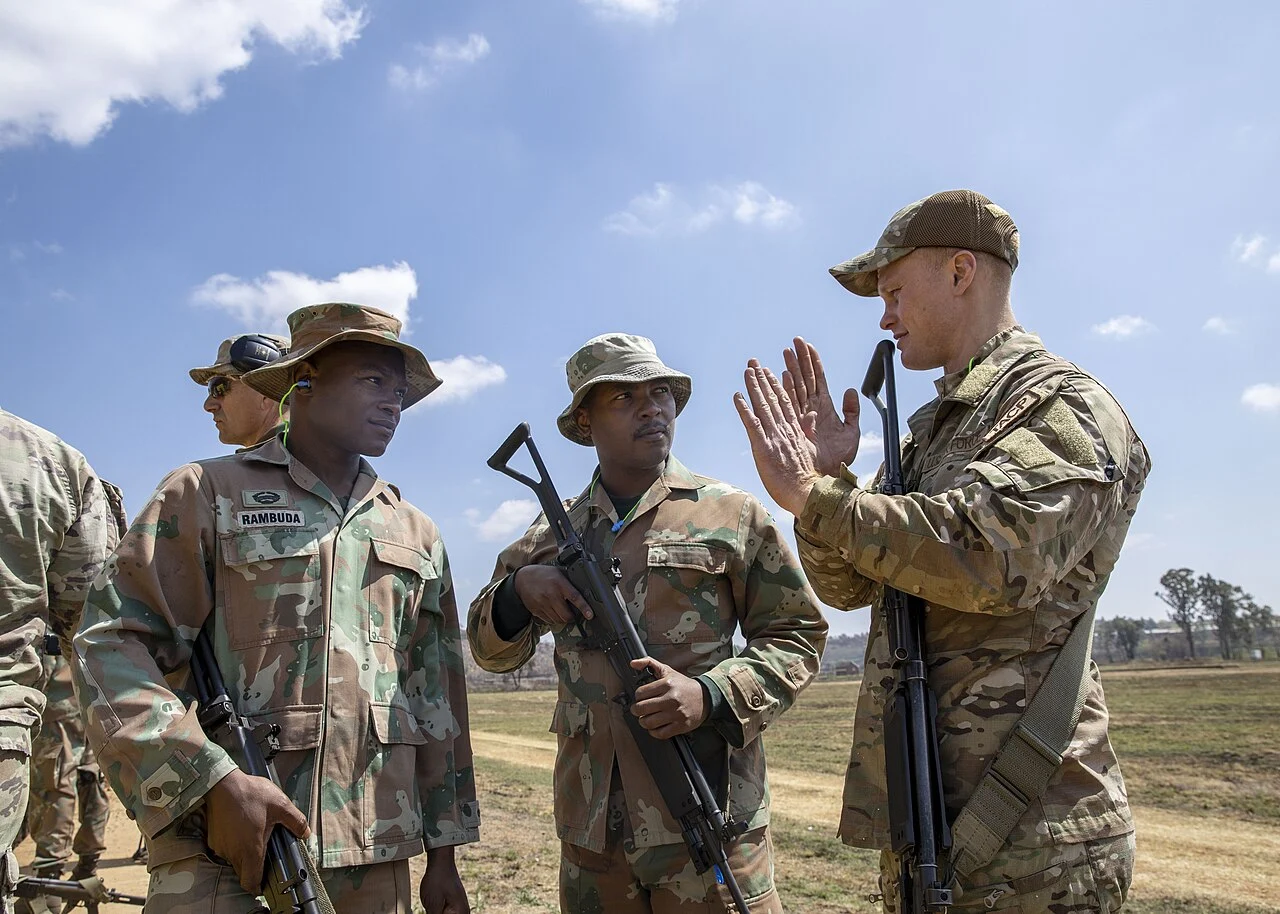
Photo: South African soldiers take part in the SANDF Military Skills Competition in Potchefstroom. Credit: U.S. Army National Guard photo by Staff Sgt. Jonathan Pietrantoni, Public domain, via Wikimedia Commons
Secretary for Defence Bereng Mthimkulu used the keynote address at the joint annual general meeting of the Aerospace Maritime and Defence Industries Association (AMD) and the South African Aerospace Maritime and Defence Export Council (SAAMDEC) on 22 October to lay out where the Department of Defence (DoD) stands on the industry’s long list of complaints: delayed procurement, thin domestic demand and years of underinvestment in research and development, defenceWeb reported.
“The Department of Defence stands ready to play its part. We expect industry to do the same,” Mthimkulu told the AGM, in comments later published by defenceWeb. His core argument was that industry and government’s interests are “aligned, not opposed” — but that alignment does not mean government will shield companies from the consequences of mismanagement or let export control become a rubber stamp.
A policy turning point, an implementation gap
Mthimkulu, whose tenure as Secretary for Defence is still relatively new, pointed to the Defence Industry Lekgotla held in July 2026 as the moment the relationship between the state and South Africa’s arms makers started to shift. He described the gathering’s resolutions as a mandate the DoD intends to act on, not shelve.
But he was blunt about where the system breaks down. Government, he said, is competent at writing policy and weak at implementing it — and he wants the department’s own follow-through monitored and officials held to account for delivery, rather than for producing another strategy document. On the department’s finances, he pushed back gently on the idea that South Africa’s defence budget crisis is purely a Treasury problem: the National Treasury’s concern, he said, is how the DoD spends the money it already has, not an absolute shortage, and the department has to own some of the blame for the state of its own books.
That tension has been building for months. DefenceMENA reported in October that South Africa’s defence budget grew on paper at the mid-term budget, while Treasury left the SANDF to absorb its own wage bill — exactly the kind of squeeze Mthimkulu’s speech was addressing.
What the DoD is promising industry
Mthimkulu set out specific commitments rather than general goodwill. The department, he said, will give industry clearer strategic direction on the SANDF’s future capability needs — information companies have long said they lack when deciding where to invest. The DoD also committed to advocating across government for sovereign defence capabilities, for streamlined export administration, and for financing support and international market access for South African firms trying to sell abroad.
He was careful to temper expectations: not every company and not every proposal pitched to government will succeed, he said, and firms should not treat state backing as guaranteed.
Exports featured heavily in the address. Mthimkulu called them fundamental to the industry’s long-term survival and argued they should be managed as part of economic and industrial policy, not treated as an afterthought to domestic SANDF orders. That framing lines up with where the numbers already are: DefenceMENA reported in October that South African defence exports passed R10 billion, with AMD using the milestone to lobby for a bigger domestic presence at AAD 2028. Armscor’s own outreach has moved in a similar direction — the state procurement agency signed a cyber-defence skills MoU with Unisa in October, and is separately understood to be gathering technical data on AK-pattern rifles as it weighs options to replace the SANDF’s ageing R4/R5 service rifle family.
On the trade side, Mthimkulu was equally direct: ethical, responsible and transparent arms trade is “non-negotiable”, and South Africa’s arms control framework is currently under review. For an industry still carrying the reputational weight of past controversial end-user cases, that line was as much a warning as a reassurance.
An industry that is still fragile
The backdrop to the AGM is an industry defenceWeb describes as cautiously optimistic after roughly three decades of decline, helped along by strong global demand for munitions and renewed political attention since Angie Motshekga’s appointment as Defence Minister. That optimism remains fragile. State-owned Denel’s Pretoria Metal Pressings division is locked in a fresh dispute with the Solidarity trade union over pay and governance, one of several signs that South Africa’s largest defence manufacturer has not fully stabilised even as export orders pick up elsewhere in the sector.
Mthimkulu’s closing ask to industry mirrored his opening pitch to government: uphold integrity, governance and regulatory compliance, collaborate more across the sector, and make room for small, medium and women-owned enterprises rather than concentrating contracts among the same handful of established primes.
Why it matters for Africa
South Africa remains the continent’s most diversified defence manufacturing base, spanning armoured vehicles, artillery, munitions, avionics and naval systems — much of it, through Denel, Paramount Group, Rheinmetall Denel Munition and smaller specialist firms, already exported to African and Gulf customers. Whether Pretoria can turn Mthimkulu’s promises into faster procurement cycles and clearer export support will shape how competitive South African firms are against Turkish, Chinese and Gulf suppliers who are courting the same African air forces and armies that once relied on apartheid-era and post-1994 South African kit. A credible export push also matters regionally: SANDF-adjacent firms supply components and platforms used well beyond South Africa’s borders, from Rooivalk-derived systems to armoured vehicles in service across Southern and East Africa, so a healthier domestic industrial base has knock-on effects for the partners and militaries that depend on it.
Sources