Loitering Munitions for African Armies: What Is Actually in Service?



Sudan’s Military Industry Corporation builds its own Kamin-25 and Safaroog strike drones for a civil war with no reliable air cover on either side. In Mali, Russia’s Africa Corps has brought ZALA Lancet and a longer-range Geran-2-family drone into the Sahel fight, with wreckage recovered near Sévaré. In Nigeria, DICON and UNICCON have demonstrated the multi-rotor UNIKAM series against Boko Haram and ISWAP. None of this is the same weapon, and no single one of them is in wide, confirmed service across the continent.
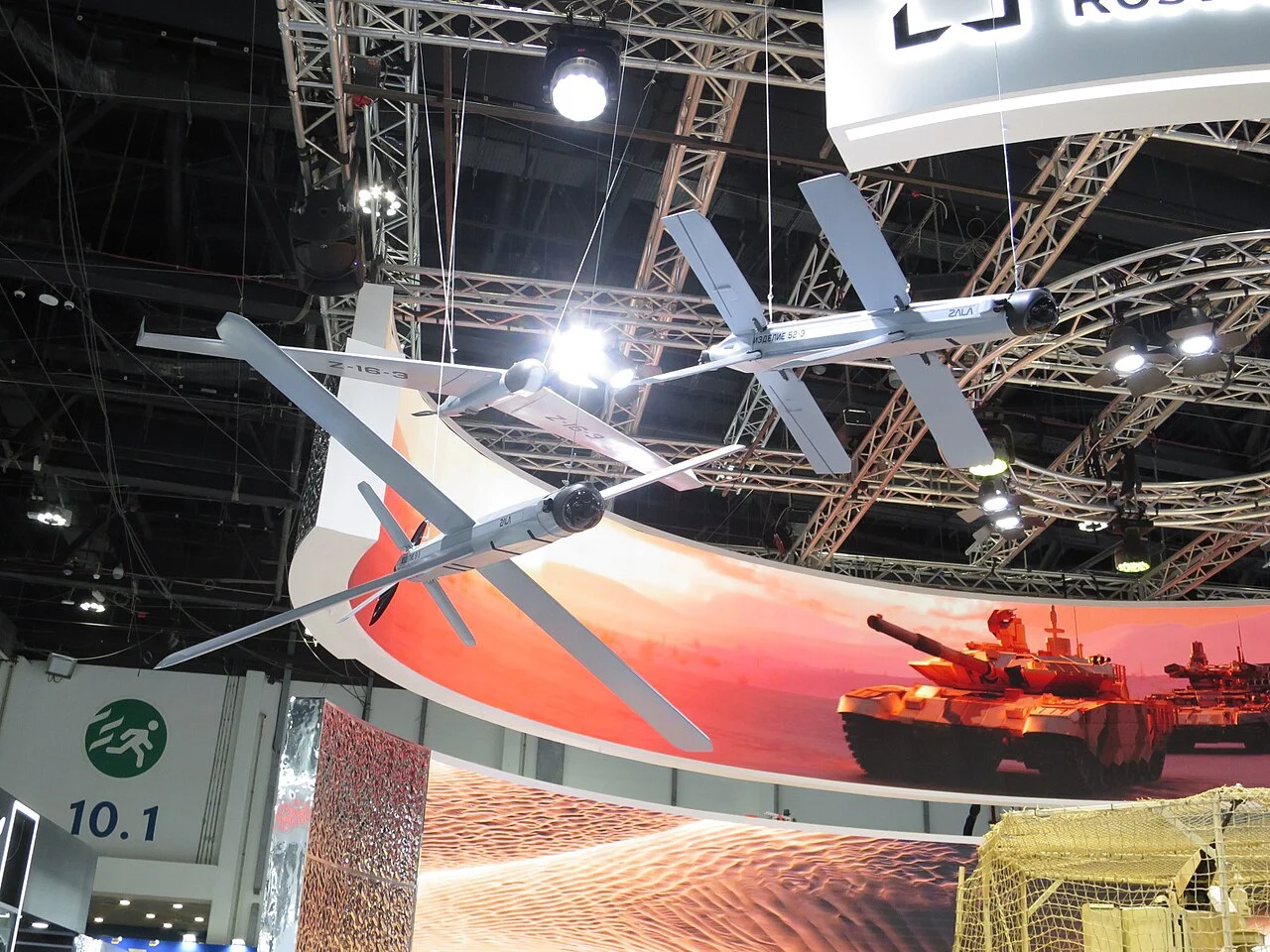
Photo: ZALA Aero loitering munitions on display at IDEX 2025. Credit: Mztourist, CC BY 4.0, via Wikimedia Commons.
Direct answer
For African forces that need to hit a point target without a strike aircraft, five systems have documented or credibly reported use in or around the continent: Sudan’s domestically built Kamin-25 and Safaroog (Military Industry Corporation), Russia’s ZALA Lancet and the longer-range Garpiya-A1 (identified in Mali through footage and wreckage analysis, not an announced contract), and Nigeria’s UNIKAM series from DICON and UNICCON. They are not interchangeable: Kamin-25, Lancet and UNIKAM are short-range munitions for close support, while Safaroog and Garpiya-A1 are heavier one-way attack drones built for targets hundreds of kilometres away. No Turkish loitering munition has a confirmed African contract; the one reported case, Sudan’s alleged use of the Baykar/NASTP YIHA-III, rests on photo identification neither Ankara nor Khartoum has confirmed.
| Requirement | Loitering munitions / one-way attack drones for point-target strike by African armies and allied forces |
| Confirmed or credibly reported users | Sudan (Kamin-25, Safaroog); Mali theatre via Russia’s Africa Corps (Lancet, Garpiya-A1); Nigeria (UNIKAM, demonstrated, not yet confirmed fielded) |
| Weight classes covered | Tactical/short-range (12–25 kg class) and long-range one-way attack (300 kg class) |
| Turkish option | No confirmed African contract or delivery; one reported, unconfirmed Sudanese case (YIHA-III) |
| Price data | No comparable unit prices published for any of the five systems compared here |
The African requirement
The requirement here is not air power in the fixed-wing sense. It is the ability to put a small, guided warhead on a vehicle, a command post or a troop concentration without risking a crewed aircraft or spending a cruise missile. Sudan’s army and the Rapid Support Forces have fought largely without mutual air superiority since 2023, which has pushed both sides toward cheap strike drones. In the Sahel, Malian government forces and Russia’s Africa Corps face JNIM and Azawad fighters dispersed across terrain too vast to patrol by road, where a loitering munition can reach a target that artillery or a helicopter cannot get to in time. In Nigeria the driver is different: budget and sanctions exposure have pushed DICON and its private partner UNICCON toward building the capability at home rather than buying it abroad.
Operating environment
- Contested, low-density airspace. Sudan’s war has produced air-to-air drone engagements and accusations of foreign-supplied UAVs on both sides, the opposite of a permissive environment for a manned strike aircraft.
- Long distances, thin logistics. Mali’s conflict spans a country roughly twice the size of France with a small road network; a drone that can loiter for hours and strike from tens or hundreds of kilometres away substitutes for aircraft and artillery the government and its partners do not have in enough numbers.
- Import exposure. Nigeria’s push to build UNIKAM domestically mirrors a wider effort, covered in DefenceMENA’s report on DICON’s local defence production drive, to cut dependence on imports that sanctions, licensing or cost can delay.
- Heat, dust and improvised fields. No source reviewed publishes comparable hot-weather or sand-ingestion test data for any of the five systems. That gap is stated here, not filled.
What capabilities matter?
The same criteria apply to every system: weight class, warhead, stated range and endurance, guidance, launch platform, confirmed or reported African use, and status. Where a figure is a manufacturer claim rather than an independent measurement, the table says so. A short-range tactical munition and a long-range one-way attack drone answer different parts of the requirement, so they are grouped separately rather than ranked against each other.
Comparison table
| System | Origin | Class | Weight / warhead | Range / endurance (reported) | Guidance | Reported African use | Status |
|---|---|---|---|---|---|---|---|
| MIC Kamin-25 | Sudan | Tactical, UAV-launched | 25 kg total; 5 kg AT or 7 kg AP warhead | ~50 km (manufacturer); 45–60 min loiter | Lock-on tracking via operator, autonomous loiter return, self-destruct on low power | Sudanese Air Force, carried on Z3-M UAVs | Reported in acceptance testing as of early 2023; later operational status not confirmed in sources reviewed |
| ZALA Lancet (3 / M) | Russia | Tactical | ~12 kg MTOW; ~3–5 kg warhead depending on variant | ~40–70 km depending on variant (sources vary) | Operator-guided strike via Z-16 reconnaissance drone; shaped-charge option on Lancet-3M | Identified in Mali via camera-footage comparison from a Russia’s Africa Corps video, June 2026 | Reported operational use (not an announced contract) |
| UNICCON/DICON UNIKAM series | Nigeria | Tactical, multi-rotor | Not stated in sources reviewed | Not stated in sources reviewed; reported speeds over 200 km/h | Standard remote control; fibre-optic-guided UNIKAM-FO1 variant reported jam-resistant | Demonstrated for Nigerian security services at Jaji, December 2025 and again mid-2026 | Demonstrated; fielding/operational status not confirmed in sources reviewed |
| MIC Safaroog | Sudan | Long-range one-way attack | ~40 kg warhead (reported) | 300–600 km depending on source; 2.5–4.5 hr endurance | Inertial + satellite navigation with an AI-assisted autopilot (manufacturer claim); anti-jamming claimed by one source only | Reported in Sudanese service by trade press; not independently confirmed here | Debuted IDEF 2025; reported in service, unconfirmed by a primary source |
| Garpiya-A1 (Geran-2 family) | Russia | Long-range one-way attack | Reported ~50 kg class warhead; figures vary between sources | Reported ~1,000–1,500 km (unconfirmed, varies by source) | Inertial/satellite navigation (reported; not independently confirmed) | Wreckage recovered near Sévaré, Mali, 18 May 2026, after clashes between Malian forces and Azawad rebels | Reported use via wreckage recovery; no official Russian or Malian confirmation |
Range and warhead figures for Safaroog and Garpiya-A1 mix manufacturer statements, trade press and open-source wreckage analysis, and sources disagree by hundreds of kilometres. The Garpiya-A1 identification is itself contested: some outlets call the Mali wreckage a Garpiya-A1, others a related Geran-2 variant. Neither Kamin-25 nor UNIKAM has a published, independently verified performance record.
MIC Kamin-25 (Sudan)
Sudan’s Military Industry Corporation (MIC) unveiled the Kamin-25 at IDEX 2023 in Abu Dhabi as a UAV-launched loitering munition carrying either a 5 kg anti-tank or 7 kg anti-personnel warhead at a 25 kg total weight. MIC’s Abu Dhabi manager told Janes that the Sudanese Air Force was testing it on Z3-M UAVs, which carry two rounds per aircraft, with acceptance tests scheduled for May 2023. The quoted figures are a 50 km range and 45–60 minutes of loiter; the operator locks onto a target for automatic tracking, and the munition returns to loiter if it loses sight, self-destructing over a pre-set area if power runs low. No source reviewed confirms what happened after the 2023 acceptance tests or gives a current fielded quantity. Status: reported in testing; current operational status not confirmed.
ZALA Lancet (Russia, via Mali)
The Lancet is a Russian loitering munition from ZALA Aero (Kalashnikov/Rostec) with an extensive combat record in Ukraine since 2022, built in variants from the 1 kg reconnaissance-oriented Lancet-1 up to the Lancet-3M with a shaped-charge warhead for caged targets. Published ranges run from about 40 km for the base model to 70–80 km for export versions; maximum take-off weight is around 12 kg. Its presence in Mali was not announced by Moscow or Bamako. Open-source analysts matched camera footage in a Russia’s Africa Corps video posted 19 June 2026 to known Lancet onboard-camera footage circulated by the manufacturer, with the companion Z-16 reconnaissance drone also visible. Status: reported operational use, not an announced contract.
UNICCON/DICON UNIKAM series (Nigeria)
Nigeria’s state-owned DICON and its private partner UNICCON Group demonstrated the UNIKAM family of multi-rotor loitering munitions at the Jaji Shooting Range in Kaduna on 23 December 2025, and again in mid-2026 when BabaSky Technologies, part of the UNICCON group, showed a fibre-optic-guided UNIKAM-FO1 variant it describes as jam-resistant, per defenceWeb. The only reported figure is a claimed top speed above 200 km/h; no source gives range, endurance or warhead weight. The demonstrations paired UNIKAM with a separate DICON/UNICCON counter-UAS system. Status: demonstrated; fielding not confirmed.
MIC Safaroog (Sudan)
MIC’s Safaroog is a larger step up: a one-way attack drone that debuted at IDEF 2025 in Istanbul with a reported range of 300–600 km, 2.5–4.5 hours of endurance and a warhead of up to 40 kg, powered by a 342 cc piston engine driving a pusher propeller. Militarnyi reports Janes as saying the type is already in Sudanese service and drawing Middle Eastern interest, a claim this article cannot independently confirm beyond that trade-press reporting. Guidance reportedly combines inertial and satellite navigation with an AI-assisted autopilot; anti-jamming resistance appears in only one source and is not corroborated elsewhere. Status: debuted 2025; reported in service, not independently confirmed.
Garpiya-A1 / Geran-2 family (Russia, via Mali)
Wreckage of what multiple outlets called a Garpiya-A1 kamikaze drone, part of the same family as Russia’s Geran-2 (a licensed derivative of Iran’s Shahed-136), was recovered near Sévaré in central Mali on 18 May 2026 after clashes between Malian forces and Azawad rebels, according to Defence Blog. One detail stands out: a laser rangefinder made by South African firm LightWare Optoelectronics was reportedly found inside the airframe, a reminder that COTS components move into these systems regardless of the platform’s origin. Bellingcat later verified footage of Shahed-type drones attacking Malian villages, citing an analyst who called the capability an “expendable, cost-effective” long-range option for Russia’s Africa Corps and Malian forces. No Russian or Malian authority has confirmed the drone’s identity or numbers deployed; this remains analyst attribution from imagery, not an official disclosure.
Turkish option: what is verified, what is not
No Turkish loitering munition has a confirmed, officially acknowledged contract, delivery or operational record in African service in the sources reviewed. The one reported case concerns Sudan: military.africa reported that photographic evidence surfacing on 13 June 2026 showed what it described as a Baykar/NASTP (Pakistan) YIHA-III loitering munition, apparently used by Sudanese government forces against the Rapid Support Forces. Neither Ankara nor Khartoum has confirmed this, and the identification rests on photo analysis rather than a primary or official source. Separately, STM’s Kargu and Roketsan’s Alpagu/Alpagut are marketed internationally — Alpagut with a reported 60+ km range and swarming capability — but no source documents a confirmed African buyer for either. Readers seeking a general explainer can see Envanter Medya’s guide to loitering munitions and its explainer on the ALPAGUT, again with no confirmed African use to date. Verified: Turkish industry builds and exports loitering munitions in this class. Not verified: any African government contract, delivery, price or technology-transfer arrangement; the Sudan case is a reported sighting, not a confirmed transfer.
African operators at a glance
- Sudan: Kamin-25 (Sudanese Air Force, reported in testing from 2023) and Safaroog (reported in service from 2025), both built domestically by MIC. See DefenceMENA’s wider account in Sudan War Drones: What the Evidence Shows.
- Mali: ZALA Lancet and a Garpiya-A1/Geran-2-family drone, both associated with Russia’s Africa Corps presence rather than a Malian army contract documented in the sources reviewed. DefenceMENA covers a related case of Russian military cooperation in Russia’s military repair depot in Uganda.
- Nigeria: UNIKAM demonstrated by DICON and UNICCON/BabaSky in December 2025 and mid-2026; not confirmed as fielded. See DefenceMENA’s report on Nigeria’s local defence production drive.
- South Africa: Paramount’s N-Raven precision-strike loitering munition, first shown at IDEX 2021, was reported moving into production from April 2023 with technology transfer in mind, per Aviation Week, but no source reviewed confirms a named operator; a 2026 Military Africa item notes a Greek partner now building a licensed variant, Irix.
Procurement and price evidence
No comparable public unit prices exist for any of the five systems compared here. None of the Sudanese, Russian or Nigerian cases involves a disclosed contract value, and the Mali cases are not even confirmed as formal contracts rather than military-cooperation transfers. For reference only, India’s Ministry of Defence signed two contracts worth a combined roughly ₹1,577 crore (about $190 million) with Tata Advanced Systems and NIBE in August 2026 for 840 Indian Army loitering munitions — an Indian domestic contract, not an African one, and no price should be inferred from it for any system above.
Delivery speed and local production
The reported timelines are too different in kind to rank. Sudan’s Kamin-25 moved from a 2023 debut to acceptance testing within months, but later fielding is undocumented; Safaroog moved from its 2025 debut to reported service within roughly a year, consistent with wartime urgency but unconfirmed beyond trade press. The Lancet and Garpiya-A1 appeared in Mali with no published contract date, consistent with a military-cooperation transfer rather than a standard sale. Nigeria’s UNIKAM has been demonstrated twice without a reported fielding date. No supplier here can be shown faster than another. On local production: Kamin-25, Safaroog and UNIKAM are each built domestically (MIC in Sudan; DICON/UNICCON in Nigeria), removing the import-dependency question that applies to most equipment covered elsewhere on this site, though it also means their performance claims are largely self-reported. The Lancet and Garpiya-A1 in Mali show no evidence of Malian technology transfer or independent Malian ownership; they are tied to the Africa Corps presence, not a conventional Malian procurement programme.
Which requirement fits which option?
| If the priority is | Options with reported use | Evidence gap |
|---|---|---|
| Fully domestic production, no import dependency | Kamin-25, Safaroog (Sudan); UNIKAM (Nigeria) | Independent performance data; current fielded numbers |
| Long-range strike beyond 300 km | Safaroog; Garpiya-A1 (reported) | Confirmed range, warhead and unit numbers from a primary source |
| Documented combat identification in an African theatre | ZALA Lancet (Mali, camera-matched June 2026) | Whether the Malian army, as opposed to Russia’s Africa Corps, operates it directly |
| Jamming-resistant guidance | UNIKAM-FO1 (fibre-optic, demonstrated) | Fielding status; range and warhead figures |
| Mature, large-scale combat record before African use | ZALA Lancet (extensive Ukraine use since 2022) | Formal Malian or Russian confirmation of the transfer |
See DefenceMENA’s military equipment database for country-by-country files, and our comparison of counter-drone systems for African armies for the defensive side of the same drone war.
FAQ
What is a loitering munition and how does it differ from a MALE drone?
A loitering munition is an expendable, one-way weapon that flies to a target area, searches or loiters, and destroys itself on impact; a MALE (medium-altitude, long-endurance) drone like the TB2 or Wing Loong is a reusable aircraft that releases separate munitions and returns to base. The two are often discussed together but are not the same acquisition.
Which African countries are confirmed or credibly reported to use loitering munitions?
Sudan’s armed forces field domestically built Kamin-25 and Safaroog systems. In Mali, Russia’s Africa Corps has used the ZALA Lancet and, reportedly, a Garpiya-A1/Geran-2-family drone, identified through footage and wreckage analysis rather than an announced contract. Nigeria has twice demonstrated its UNIKAM series without confirming it is fielded.
Are Turkish loitering munitions used in Africa?
No African contract or delivery is confirmed in the sources reviewed. One reported, unconfirmed case concerns Sudan’s alleged use of the Baykar/NASTP YIHA-III against the Rapid Support Forces, based on photographic identification that neither Ankara nor Khartoum has confirmed.
How much do loitering munitions cost?
No comparable public unit prices exist for the systems discussed here. India’s August 2026 contracts for domestic loitering munitions, worth a combined roughly ₹1,577 crore, are the only disclosed contract figures found during this research, and they are an Indian domestic purchase, not an African one.
Sources
- Janes: IDEX 2023 — Sudan displays UAV-launched loitering munition
- Militarnyi: Sudan presents Safaroog loitering munition, range up to 600 km
- Defence Blog: Russia brings Shahed-type drones to Mali conflict
- Bellingcat: Shahed-type drones filmed during attack on Mali villages
- defenceWeb: Nigeria’s BabaSky Technologies demonstrates UNIKAM-FO1
- ThisDay: UNICCON, DICON launch AI-powered drones to curb insurgency
- Aviation Week: IDEX — Paramount’s N-Raven loitering munition goes into production
- military.africa: reporting on YIHA-III sighting in Sudan, June 2026
- Janes: Baykar displays previously little-known one-way attack UAV
- The Week: Indian Army’s indigenous loitering munitions contracts, August 2026
Specifications and delivery figures are as reported by the sources named and vary between sources, particularly for the Garpiya-A1/Geran-2 identification in Mali. SIPRI’s Arms Transfers Database and manufacturer data sheets should be checked for any procurement decision.
Related: DefenceMENA compares the counter-drone systems African armies are fielding against the same drone threat in Counter-Drone Systems for African Armies.
Related: DefenceMENA examines what Sudan’s civil war has shown about drone warfare in Sudan War Drones: What the Evidence Shows.